



 In the late 1980s, it seemed that Teenage Mutant Ninja Turtles (or Teenage Mutant Hero Turtles as they were known here in the UK for a time as ninja was considered to be too violent a word) were everywhere.
A 1987 cartoon was a huge success leading to a wave of merchandise. Action figures and other toys were so popular they became difficult to get for a while, a classic arcade game machine was based on the cartoon, and merchandise included everything from bedspreads and t-shirts to Turtles themed pizzas (including one with apple cubes as a topping).
It was a far cry from its beginnings as an underground black-and-white comic book in 1984. Created by Kevin Eastman and Peter Laird, it was thought the comic would be a one-off, and the huge craze for all things Turtles must have been far from the creators’ minds. But it was hugely successful, led to an ongoing comic, the aforementioned cartoon and merchandise, and the rest is history.
So, it was inevitable that the Teenage Mutant Ninja Turtles would find their way to the big screen, and in 1990 they would with their first live screen outing. Two further films would initially follow, and over time further films and TV incarnations would be made. But, for me, the original Turtles film remains the best, and I was thrilled to get the chance to review the trilogy after the new Arrow boxset was announced.
 Teenage Mutant Ninja Turtles
Director: Steve Barron
Screenplay: Todd W. Langen and Bobby Herbeck
Based on: Characters created by Kevin Eastman and Peter Laird
Starring: Judith Hoag, Elias Koteas, Josh Pais, Michelan Sisti, Leif Tilden, David Forman, Michael Turney, Jay Patterson, Raymond Serra, James Saito, Toshishiro Obata, Sam Rockwell, Kitty Fitzgibbon. With the voices of Robbie Rist, Brian Tochi, Corey Feldman, Josh Pais, Kevin Clash, David McCharen, Michael McConnohie
Country: United States
Running Time: 93 min
Year: 1990
BBFC Certificate: PG
The first live action Teenage Mutant Ninja Turtles film is, to me, the last 1980s family film, it just happened to come out in 1990. In the 1980s the family movies I grew up with were much darker than in other decades, infused with adult humour or more scary moments. The original trilogy of Indiana Jones films, moments of the second Back to the Future film (1989), Ghostbusters (1984), The Empire Strikes Back (1980), Labyrinth (1986), The Dark Crystal (1982) and many more were all darker U or PG-rated fare.
Teenage Mutant Ninja Turtles took this trend into a new decade with a darker and edgier tone and violence that would be cut in the UK (mostly the use of nunchaku), despite ostensibly being a film marketed to children or family-friendly audiences.

The film follows April O’Neil (Judith Hoag), a television news reporter investigating a wave of crime in New York City that is being carried out by the Foot Clan, a group of ninja soldiers led by the evil Shredder (James Saito, and voiced by David McCharen). April befriends the Teenage Mutant Ninja Turtles – Leonardo (voiced by Brian Tochi), Donatello (voiced by Corey Feldman), Michelangelo (voiced by Robbie Rist) and Raphael (voiced by Josh Pais) after they save her twice and befriends them and their mentor Splinter (voiced by Kevin Clash). The Turtles also have regular runs ins with vigilante Casey Jones (Elias Koteas) who will join forces with them over time too.
Along the way Danny (Michael Turney), the son of April’s boss at Channel 3 News Charles Pennington (Jay Patterson), is one of the teenagers who is recruited to the Foot Clan. What plays out is a tale of good versus evil as the Turtles, April and Casey join forces to try to bring down Shredder and the Foot Clan, and save the teens like Danny who have been brainwashed into joining the clan in their crime wave.

The tone of the film is quite dark at times, though much of the time that the Turtles are on screen, it’s much lighter and jovial. The opening that shows the crime spree is particularly dark and some of the violence, particularly moments when Raphael is beaten up, is strong for a family film.
But this is juxtaposed with the comedic moments involving the Turtles, as well as some really fun fight sequences when the gang are fighting the Foot Clan; the tone is much less dark and comic book-like. There’s a fun fight involving Casey Jones and Raphael, when they first encounter one another early on, and a very funny scene when April meets the Turtles and Splinter for the first time.

There’s also a wonderful flashback sequence showing the creation of the Turtles and Splinter, and a great fight two thirds of the way through pitting Raphael against the Foot Clan. He gets thrown through a skylight leading to the first real time the rest of the Turtles fight against the clan.
The finale on a rooftop is perhaps a bit of a letdown, though. Shredder doesn’t do too much, though Splinter comes into his own. Shredder fares better early on, shown in glimpses before his first full appearance sees the tension built up with ominous music and a long shadow as he enters the shot.
The two main human characters in the film are brought to life well by Judith Hoag, as April O’Neill, and Elias Koteas, as Casey Jones. But it’s the Turtles that most people will be watching the film for and they’re brought to life beautifully through actors in suits and animatronics for their heads.

The voice work is excellent and really brings the characters to life. Corey Feldman, an actor synonymous with 1980s movie classics like Gremlins (1984), The Goonies (1985), Stand By Me (1986), and The Lost Boys (1987), voices Donatello, while others include Brian Tocchi as Leonardo, Josh Pais as Raphael, Robbie Rist as Michelangelo, Kevin Clash as Splinter, Michael McConnohie as Tatsu and David McCharen as Oruku Saki, otherwise known as Shredder.
Also look out for an early role for future Hollywood star Sam Rockwell as ‘Head Thug’, an unmasked gang member. Actors Skeet Ulrich and Scott Wolf also appear as unnamed members of the Foot Clan, in uncredited roles, and Turtles co-creator Kevin Eastman also pops up in a small cameo.

For the Turtles’ facial movements and Splinter there are some great animatronics by Jim Henson’s famed Creature Shop and this is supported by some fabulous suits and make-up for the heroes. Sesame Street fans may know that Kevin Clash, the voice artist and puppeteer for Splinter, created Elmo, and another fact is that the late great Sally Menke, who edited all of director Quentin Tarantino’s films until she passed away in 2010, worked on the editing for the film.
It’s all lensed well too by John Fenner with plenty of camera movement and beautiful shots of New York, including Central Park and the city’s iconic skyline. There are also some fabulous camera flourishes, for example the camera spinning round and slowly speeding up and entering Raphael’s mouth when the Turtle shouts out in anger after discovering Splinter has been kidnapped.

No review of the film would be complete without referencing the soundtrack. John Du Prez’s score has some neat moments, particularly the opening cue that scores the crime spree and which is used for the Foot Clan and Shredder throughout. Then there’s some memorable hip-hop tracks by the likes of M.C. Hammer and Partners in Kryme.
In closing, perhaps it’s rose-tinted glasses, but I always have a great time with the 1990 Teenage Mutant Ninja Turtles film. It’s a very fun comic book movie with plenty of dark and light moments, entertaining fight sequences and an infectious soundtrack. I enjoyed my first watch in 4K as much as the first time I saw it at the cinema 35 years ago.
Film: 

 Teenage Mutant Ninja Turtles II: The Secret of the Ooze
Director: Michael Pressman
Screenplay: Todd W. Langen
Based on: Characters created by Kevin Eastman and Peter Laird
Starring: Paige Turco, David Warner, Ernie Reyes Jr., François Chau, Kevin Nash, Toshishiro Obata, Mark Doerr. Voice cast Brian Tocchi, Robbie Rist, Adam Carl, Laurie Faso, Kevin Clash, David McCharen, Michael McConnohie, Frank Welker
Country: United States
Running Time: 88 min
Year: 1991
BBFC Certificate: PG
Picking up immediately after the events of the first film, Teenage Mutant Ninja Turtles II: The Secret of the Ooze is a very entertaining flick, but isn’t a patch on the first movie. It features plenty of entertaining sequences but there’s no real threat – even with the ‘Super’ Shredder (more on him later) that appears in the finale.
The film sees the Turtles and Splinter in hiding at April O’Neil’s (Paige Turco, taking over the role of the news reader) as the Foot Clan know where their sewer lair is. The Turtles are still battling crime and save a pizza delivery boy called Keno (Ernie Reyes Jr), who will join forces with them – there’s no Casey Jones this time out so an alternative companion was required.

Meanwhile, April is investigating a possible toxic waste leak and interviews Techno Global Research Industries (TGRI) Professor Jordan Perry (David Warner) about this. A spy for the Foot Clan discovers dandelions have been mutated by the leak and reports it to a disfigured but very much alive Shredder (this time portrayed by François Chau but still voiced by David McCharen).
Shredder has Professor Perry kidnapped to use ooze on a snapping turtle and wolf who mutate into Tokka and Rahzar, who are super strong but childlike. Along the way, Splinter reveals that the ooze was what led to the creation of him and the Turtles as talking anthropomorphic animals. The Turtles must battle Tokka and Rahzar and ultimately a mutated Super version of Shredder.

First things first, this is a much tamer and child-friendly film than the darker first entry in the trilogy. That’s not necessarily a bad thing, as the Turtles by this time were very family-friendly thanks to the cartoon, comic book series and toys, but does make for a different and, in my view, much weaker film.
The violence is much more toned down with less use of weapons, but there are some fun and well-choreographed action sequences, particularly an opening sequence that reintroduces us to the Turtles as they save Keno from a gang of burglars. Whereas the first film had a number of serious fights, this one plays these action scenes mostly – even a Turtles battle against Tokka and Rahzar – for laughs.

Shredder is meaner though and has his trademark purple outfit, rather than the red one seen in the first movie. The human actors are decent, particularly the late great David Warner, who for me is always good value for money

Rapper Vanilla Ice performs as himself in a nightclub sequence and behind the mask and make-up of Super Shredder is professional wrestler Kevin Nash, known by that name to fans of the old WCW and WWE, and as Diesel back in the WWE’s WWF days.

Director Michael Pressman plays a News Manager, and Michael Jai White who would be known for his lead role in the 1997 comic book film Spawn amongst others, makes an uncredited cameo as an audience member who joins the Foot Clan. A note on the voices of the Turtles, Adam Carl replaces Corey Feldman to voice Donatello and Laurie Faso voices Raphael instead of Josh Pais.
In conclusion, Teenage Mutant Ninja Turtles II is an entertaining romp that plays more like a comedy, most of the lines from the Turtles being quips, even more so than in the first film. I have a particular soft spot for it as I watched my VHS copy a lot as a child. It’s a significant step down overall from the first movie, though, but is an easy watch, and for fans of the franchise, definitely well worth a viewing.
Film:
 Teenage Mutant Ninja Turtles III
Director: Stuart Gillard
Screenplay: Stuart Gillard
Based on: Characters created by Kevin Eastman and Peter Laird
Starring: Paige Turco, Elias Koteas, Vivian Wu, Sab Shimono, Stuart Wilson, John Alyward, Mak Takano, Henry Hayashi, Travis A. Moon
Country: United States and Hong Kong
Running Time: 96 min
Year: 1993
BBFC Certificate: PG
The quality of the trilogy sadly falls again for the third and final film in the original series, which sees our heroes travel back in time to samurai Japan. Whilst the era is undoubtedly very interesting and has led to many great films, taking the Turtles from modern day New York to 17th Century Japan doesn’t work for me.
The film opens with a beautiful shot of samurai against a sunrise in Japan in 1603 which teases the setting of the film before the opening credits showcase the Turtles in training, back in the sewer and still led by Splinter. A mystery sceptre, which April is holding after buying it for the Turtles from a flea market, soon sends her back to 1603 Japan, replacing her in the modern day with Kenshin (Henry Hayashi), who had discovered the sceptre in the past and read its inscription “Open wide the gates of time” which led to the switch.

The Turtles soon discover what’s happened and Donatello calculates they have 60 hours to rescue April and discovers how to send the Turtles back in time to save her, replacing them with four Japanese warriors from the past. In Japan, the Turtles encounter Mitsu (Vivian Wu), who is the leader of a rebellion against Lord Norinaga (Sab Shimono) and English trader Walker (Stuart Wilson), who is working for the Lord. The Turtles get involved in the rebellion whilst trying to save April, with Casey Jones (Elias Koteas) keeping an eye on Kenshin, the four warriors who replaced the Turtles, and our heroes’ sewer lair.
On the acting front Paige Turco returns from the second film as April O’Neil and Elias Koteas is back as Casey Jones, after missing out on the second movie. They are joined by Stuart Wilson, as mercenary Walker, Sab Shimono as Lord Norinaga, who hires Walker, and Mitsu, as a rebel leader. All are decent and do wonders with what they’re given to work with.

Corey Feldman returns to voice Donatello, while Brian Tocchi and Robbie Rist return as Leonardo and Michelangelo respectively, with Tim Kelleher this time voicing Raphael. James Murray voices Splinter this time out, to lesser effect than Kevin Clash. It’s a real step down in the voicework front.
One of the main problems with the film is the plot – it’s not that interesting or inspired and feels quite tired. We waste no time in getting the Turtles back in time for the thrust of the plot but it all happens rather too conveniently with little peril. The Turtles have lost April, gone back in time and found her all within half an hour. We’re then caught up in the rebellion, which in other films may have been interesting but not here, and the Turtles’ attempts to get back home.

On the plus front though, the film does look good, with some interesting sets and memorable costumes, particularly the samurai look of the heroes, there are one or two entertaining set pieces and the soundtrack is nice and playful.
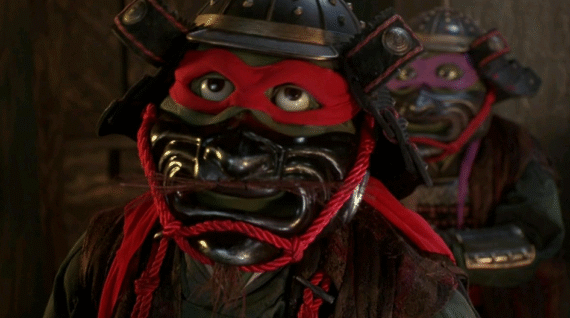
In conclusion, I’m sorry to say I’m not a fan of Teenage Mutant Ninja Turtles III. The filmmakers seemed to have gone all in for a child-friendly plot that just isn’t very interesting and feels very contrived and, worst of all, takes the Turtles out of their natural modern day setting. It’s not all bad, but what we’re ultimately left with is a much less polished and entertaining film than the others in the series and another significant step down from the first movie.
Film:
Overall film rating: 
The Teenage Mutant Ninja Turtles trilogy is available in Limited Edition 4K UHD and Blu-ray sets, as well as streaming exclusively on the Arrow Video Channel, from 15th December. The picture and sound quality on all three films is excellent. All retain a very filmic and natural feel, with just the right amount of grain, but there’s plenty of fine detail, good colour contrast and just a generally great look for the movies. Audio – dialogue, sound effects and music – are all crystal clear.
3-disc limited edition 4K UHD or Blu-ray contents (contents the same for both editions except for whether the discs are 4K UHD or Blu-ray)
- Brand new 4K restorations of all three films by Arrow Films
- High Definition (1080p) Blu-ray presentations of all three films
- Perfect bound collector’s booklet in the style of a Roy’s Pizza menu, featuring new writing on the films by Simon Ward, John Torrani and John Walsh
- Reversible sleeves featuring original and newly commissioned artwork by Florey
- Double-sided foldout poster featuring original artwork from Teenage Mutant Ninja Turtles and the “Map of the Kappa Realm”, a stylised re-creation of the ancient scroll that appears in Teenage Mutant Ninja Turtles III
- Two additional double-sided foldout posters featuring original and newly commissioned artwork by Florey
- Eight character trading cards
- Roy’s Pizza loyalty card
- Four character stickers
Disc 1 – Teenage Mutant Ninja Turtles
- 4K restoration of the film from the original camera negative by Arrow Films approved by director Steve Barron
- Two lossless stereo mixes (original theatrical mix and alternate “warrior” mix) plus newly remixed Dolby Atmos audio
- Optional English subtitles for the deaf and hard of hearing
- Brand new commentary with director Steve Barron
- Brand new commentary with comic book expert and podcast host Dave Baxter
- Rising When We Fall, a newly filmed interview with director Steve Barron
- Turtle Talk, a newly filmed interview with actors Robbie Rist, Brian Tochi, Ernie Reyes Jr and Kenn Scott
- O’Neil on the Beat, a newly filmed interview with actor Judith Hoag
- Wet Behind the Shells, a newly filmed interview with producer Simon Fields
- Beneath the Shell, a newly filmed interview with puppet coordinator and second unit director Brian Henson, and Rob Tygner, puppeteer for both Splinter and Leonardo
- Teenage Mutant Ninja Turf, a newly filmed featurette exploring the film’s locations in New York City and North Carolina
- Alternate UK version with unique footage prepared for censorship reasons, presented in 4K via seamless branching
- Alternate ending from VHS workprint
- Alternate Korean footage
- Theatrical trailers
- Image gallery
Disc 2 – Teenage Mutant Ninja Turtles II: The Secret of the Ooze
- 4K restoration of the film from the 35mm interpositive by Arrow Films
- Original lossless stereo audio and optional DTS-HD MA 5.1 surround audio
- Optional English subtitles for the deaf and hard of hearing
- Brand new commentary with director Michael Pressman moderated by filmmaker Gillian Wallace Horvat
- John Du Prez to the Rescue, a newly filmed interview with composer of the trilogy John Du Prez
- Hard Cores, a newly filmed interview with Kenny Wilson, mould shop supervisor at Jim Henson’s Creature Shop
- The Secret of the Edit, a newly filmed interview with editor Steve Mirkovich
- Behind the Shells, an archive featurette from 1991
- Theatrical trailer
- Image gallery
Disc 3 – Teenage Mutant Ninja Turtles III
- 4K restoration of the film from the 35mm interpositive by Arrow Films
- Original lossless stereo audio and optional DTS-HD MA 5.1 surround audio
- Optional English subtitles for the deaf and hard of hearing
- Brand new commentary with director Stuart Gillard
- Daimyos & Demons, a newly filmed interview with actor Sab Shimono
- Rebel Rebel, a newly filmed interview with actor Vivian Wu
- Alternate UK opening
- Theatrical trailer
- Image gallery
Disc 1:

Steve Barron is on good form in his new commentary, giving plenty of background to the genesis of the film and its story, the making of the movie, some of the key sequences, those who worked in front of and behind the camera, and much more in between.
Comic book expert Dave Baxter’s new commentary is equally strong, covering the unlikely path the comic book took to reach the big screen. It was only ever intended to be a one issue deal, but proved so popular that the rest is history. Baxter gives good background to Golden Harvest, the studio that made the film, the period in which the film was made, background to the comic book’s creators, differences between the characters in the comic and the film and plenty more. It’s a real highlight of the disc.
British director Steve Barron gives a really good 15-minute interview about his early career (his mother was a script supervisor), working on music videos, the transition to Hollywood and the challenges of working on the first Turtles film. I could have listened to this for longer, Barron is a great interviewee.
The 19-minite interview with actors Robbie Rist, Brian Tochi, Ernie Reyes Jr and Kenn Scott is also good fun. It’s a really easy, breezy, fun interview with some nice factoids.
Judith Hoag, who played April O’Neill, gives a fun 21-minute interview. She shares some informative background on the challenges of making the film and how she doesn’t think anybody has seen the director’s original vision of the film.
Producer Simon Fields provides some background to his career and producing the film in an 11-minute interview. It’s quite brief, as you can see from the running time, but plenty is packed in.
One of the highlights of the disc for me is the new featurette with Brian Henson and Rob Tygner looking at the Henson Creature Shop’s work on all three films. It’s a really good 16-minute piece. Both cover how they got into the creature work, and talk about some of the challenges of making the film. The conversation about the Turtles’ head animatronics was particularly enlightening and there’s some great behind the scenes images.
Another highlight is a featurette looking at the filming locations in New York City and North Carolina, which runs for 13-minutes. Plenty of locations are covered and it’s neat to see how the locations look today, compared to how they looked when the film was made.
Next we have the choice to watch the original UK release of the film – which is how I first encountered it as a child. It’s missing the nunchaku scenes due to censorship issues. This means some of Michelangelo’s scenes are a little bit different. This is a nice inclusion, with some unique, and less high quality, footage.
An alternate ending sourced from a VHS workprint is included. It sees April pitching a comic book idea about the Turtles that is seen as “too far-fetched” with the Turtles hanging outside a window to look in on her pitch. I prefer the ending we got but it’s still a nice scene.
The English language version of the film’s release in South Korea, was significantly redubbed to remove all references to Japan and Japanese culture to comply with South Korean law, and this audio track is included; as is one shot replaced from Splinter’s flashback, which is featured in the extras menu. The South Korean version of the film was also called “Hero” rather than “Ninja” Turtles and we see a couple of seconds of the title sequence in this section too.
Four trailers are included – the US theatrical trailer plus the UK teaser, theatrical and re-release trailers.
An image gallery concludes disc one with behind-the-scenes shots, posters and stills.
Disc 2:

The new commentary with director Michael Pressman and moderated by filmmaker Gillian Wallace Horvat is very good. Horvat is a great moderator getting the best out of Pressman, who is on fine form giving decent insight into the actors, story and plenty more about the making of the film.
In his new 14-minute interview composer John Du Prez talks us through his beginnings in music in Bath, his work on films like A Fish Called Wanda (1988) and of course the Turtles movies. He’s a really good talker who shares plenty. It’s one of my favourite interviews on the set.
A new eight-minute interview Kenny Wilson, mould shop supervisor at Jim Henson’s Creature Shop, talks for eight minutes about his work on the second film in casing the mould for snapping turtle Tokka. Short but interesting.
Editor Steve Mirkovich talks for 15 minutes about his work in editing, not just on the film, but other films like some of the works of John Carpenter (for example, Big Trouble in Little China and Prince of Darkness) and other movies. He co-edited the second Turtles film with John Wright and talks about how that came about, and working on the movie. It’s another really solid interview.
Teenage Mutant Ninja Turtles: Behind the Mania is a fun 29-minute archival look behind the scenes, with some fresh footage with the Turtles, a look at the toys, why audiences were so enamoured by the characters and a glimpse behind the scenes. We’re told about the comic book beginnings, with interviews with the creators, a look at the films and cartoon and more. I was pleasantly surprised at the quality of this, as I thought it would just be a brief electronic press kit to sell the films. It does go into that territory a little bit but is also far more informative than I expected, with a particular highlight being the look at the animatronics.
Rounding out the second disc is a theatrical trailer and around 20 stills.
Disc 3:

Director Stuart Gillard provides an enthusiastic new audio commentary looking at the striking opening image, the gestation of the film, how he got involved, a look at the real Japanese history, some of the sequences and more. The commentary is far, far better than the film itself.
Actor Vivian Wu, who plays Mitsu, gives a good new 14-minute interview in which she looks back fondly on the making of the movie, whilst also giving some good background to her early work on The Last Emperor (1987), Shadow of China (1989), and beyond, as well as what she knew about the Turtles when she was signed up to appear in the third film. She’s still very active on screen today, in both feature films and TV.
Actor Sab Shimono, who appears as Lord Norinaga also speaks very enthusiastically about the film, but reveals he was initially hesitant about appearing in a Turtles movie, but did so for his nephews and nieces and seemingly has no regrets given the ongoing popularity of the Turtles characters. It’s an entertaining 10-minute interview, which also provides some insightful background to Shimono the person and the actor.
Like the first film, nunchaku proved problematic to UK censors, meaning alternative footage needed to be used during the opening credits. A two-minute sequence which looks like it was sourced from VHS shows the alternative nunchaku-free opening.
Rounding out the final disc are a trailer and just over 20 stills and poster images.
I wasn’t provided with the wealth of physical extras like the booklet, but it sounds like a fantastic edition for fans of the series.
In conclusion, Arrow Films have provided an excellent package of the original Teenage Mutant Ninja Turtles trilogy of films from the early 1990s. The new 4K restorations are excellent and there’s a wealth of mostly new extras, including some great commentaries and interviews, well supported by alternative footage and archival special features. The first film, for me remains a classic, the second very entertaining, and the third a missed opportunity, but the chance to have all three on 4K as part of such a wonderful release, is gratefully appreciated.
Disc/Package: