



In previous articles, I’ve ranked and reviewed all the Disney, Pixar, Ghibli and Don Bluth films, so it seemed inevitable that I would eventually get round to the other big animation studio, DreamWorks. It’s taken so long partially because this is a big filmography to take on, but also because there’s always been that critical attitude towards DreamWorks as a second tier studio, at least when compared to its major contenders. While making my way through these 50 films, I’ve come to feel very warmly towards DreamWorks, a studio that I came to realise has always been there for me as I was growing up, even if I went through a stage of rejecting their wares more offhandedly than I did with Disney or Pixar’s offerings. Though this first part of my DreamWorks list does focus on the weaker films, by number 25 we’re already in fairly solid territory and the films to come in part 2 are well worth sticking around for.
ALL ENTRIES MAY CONTAIN SPOILERS
50.Madagascar
Despite the fact that it ended up spawning DreamWorks second big franchise, Madagascar has eluded me until now. I’d seen the odd episode of its TV spinoff The Penguins of Madagascar, which I remember quite enjoying, but apart from that I’d somehow let the whole franchise pass me by… or perhaps it wasn’t that unconscious. The moment Sacha Baron Cohen’s lemur King Julien arrived and started singing a heavily trailed version of Reel 2 Real’s I Like to Move It, I suddenly had a recollection of studiously avoiding Madagascar and all of its sequels. I hate to sound like a curmudgeon here but for me an anthropomorphic animal with an incongruous Indian accent supplied by a white, British comedian, singing a novelty version of a retro Ragga track just about encapsulates everything I dislike in the crasser brand of mainstream animation. I’m not crying out for every animated feature to be a masterpiece. Too many reviews at the time of Madagascar’s release claimed this sort of thing wasn’t good enough in the face of contemporary classics from Pixar, but for my money there’s always room for a film whose primary function is to make us laugh. King Julien’s instantly Gifable dance was always guaranteed to appeal to a whole generation of kids, even if its horribly inevitable influence ultimately meant we would eventually have to sit through CG squirrels doing Gangnam Style.
Sacha Baron Cohen’s entire career is riddled with potentially problematic creations, the relative offensiveness of which are endlessly debatable. King Julien slips into the lineup with Borat and Brüno surprisingly easily, although given that the Indian accent Baron Cohen adopted for the character is clearly treated as a punchline in itself, this is probably one of the easier characters to convincingly condemn. It’s basically the animated equivalent of what Fisher Stevens did in Short Circuit or what Peter Sellers did in The Party, although the hostile pushback against comparatively recent criticisms of The Simpsons’ Apu are evidence of how immovable people can be if something makes them laugh enough. King Julien, like the penguins, was given his own TV spinoff but these are all supporting characters. Perhaps the level of their popularity is an indication of just how bland the main foursome in Madagascar are, although they would go on to star in two more films. Voiced by an all-star cast of Ben Stiller, Chris Rock, David Schwimmer and Jada Pinkett Smith, the menagerie of zoo animals who inadvertently find themselves shipped back to the wild are a peculiarly unappealing bunch. Perhaps this is partially down to their stylised appearances, which are a bold choice but can be hard to look at for 80 minutes, especially when they are so often involved in a frantic blur of wild slapstick. This was a relatively new area for DreamWorks, with even the determinedly lowbrow Shrek films largely avoiding the lure of breakneck cartoon violence. Madagascar, for better or worse (ok, for worse), throws itself bodily into the slapstick arena. There are long stretches of the film in which barely 30 seconds go by without one of the cast walking into, falling off or being hit by something. It becomes exhausting, especially with characters who look like they’ve already been put through a jagged mangle in some deleted scenes that probably lasted eight and a half minutes.

If I sound extremely averse to the alleged charms of Madagascar, that’s because I absolutely am. The amusing spy-style antics of the penguin commando unit notwithstanding, there was very little I liked here at all. Some scenes, such as the one where we see the four main characters boxed up in crates next to each other, are inventively staged but the back-and-forth blather is rarely anything approaching witty and the popular supporting characters take up enough time that the plot itself never really has a chance to get going. While I frequently argue against the notion that animation is a children’s medium, Madagascar does seem to be an example of a film made with simple tastes and short attention spans in mind, and there are certainly enough big kids out there who loved it and took that love with them into adulthood. For those like me who missed it first time round though, you may not find much worth going back for. The litmus test is the King Julien I Like to Move It video. If you’re on the floor laughing at the end of it, I might be wrong. Just don’t look up the voice actor.
49.Shark Tale
The list of films submitted for consideration for the Best Animated Feature in 2004 was hardly auspicious. Some of those that missed out on a nomination were Clifford’s Really Big Movie, Home on the Range, The Polar Express and The SpongeBob SquarePants Movie (I do have a soft-spot for that last one). This goes some way to explaining the oft-puzzled mystery of how Shark Tale became an Oscar nominated film. Despite its terrible reputation in subsequent years, Shark Tale was another hit for DreamWorks and, while the inevitable comparison with Pixar’s infinitely better Finding Nemo has become an ongoing thorn in Shark Tale’s side, that film’s Oscar win the previous year briefly boosted the pulling power of fish films. But the success of DreamWorks own Shrek franchise had a greater influence on the cockeyed tone of Shark Tale. Despite nearly a century of evidence to the contrary, by the early 00s, and even before that, critical appraisals of animated films almost invariably stated that the medium was for kids and judged an animation’s worth based on its appeal to that demographic. Aside from trivialising a whole medium, this attitude meant that when the Shrek films slipped a few more prominent adult-aimed gags in there, suddenly critics were reacting as if this was a revolutionary thing: An animated film that appeals to adults too. In response, many mainstream animations started to sneak in unsubtle, ill-fitting and occasionally inappropriate gags that winked and waved at adults, rather than spending the time finding a well-defined tone that appealed across the board. Into this unbalanced fray swam Shark Tale, a film so heavily based around gangster film references but so weighted down by crass gags that it was unclear how it managed to appeal to anyone. There’s such a clear divide between the parts aimed at children and those aimed at their parents that the whole thing quickly and irreversibly curdles.
There are more than just tonal problems with Shark Tale though. Everything, from character to storyline to visual design feels wildly off. The story about a fish teaming up with a vegetarian shark to maintain the illusion that he killed a mob boss’s son is tiresomely convoluted and the film is far too distracted by its compulsion to make Godfather and Scarface references to give the storytelling the focus it requires. The characters are scuppered by their subservience to this tangled plot, becoming broad stereotypes rather than well-defined creations. Perhaps the worst offender in this respect is Renée Zellweger’s Angie, a complete non-entity entirely defined by her infatuation with Will Smith’s Oscar. This becomes even more problematic when placed in the context of Angelina Jolie’s gold-digging fin fatale Lola, creating the classic Madonna-whore complex which demonises female sexuality. This retrograde trope went comparatively unnoticed in comparison with Shark Tale’s depiction of Italian Americans, an issue picked up by several groups including the Italian American One Voice Coalition of New Jersey whose protest was met by DreamWorks tiny concessionary act of changing Peter Falk’s character’s name from Don Brizzi to Don Feinberg. In fairness to DreamWorks, the Coalition’s demand that all the names, mannerisms and forms of speech that identified the characters as Italian be dropped would have entirely undermined the intended genre parody which, for better or worse, is the very core of the film. The problem in this case was that, despite my irritation at animation being mischaracterised as a children’s medium, Shark Tale is very much aimed at a young audience and their lack of familiarity with the cultural touchstones of Goodfellas and The Godfather could result in problematic associations removed from the world of Hollywood. There was a further controversy when the film’s message about being yourself in the face of pressure to conform, delivered through the analogy of Jack Black’s shark character Lenny being a vegetarian, was taken as a specific allusion to homosexuality, which the pro-homophobia American Family Association characterised as an attempt to “brainwash” children into supporting gay rights. At this point I start to feel a bit sorry for Shark Tale, which seemed to be catching flack even for the small amount of things it was getting right.

Although it epitomises the film’s oddly chosen reference points, the casting of Martin Scorsese as the pufferfish loan shark (that’s right, in Shark Tale’s one moment of restraint, the loan shark isn’t a shark) results in the best piece of voice acting in the film. Everyone else, from Smith, Jolie and Zellweger to a pre-Po Black and a coasting Robert De Niro, is hamstrung by the feeble material but Scorsese is quite funny in his role. Yet Scorsese’s good work is undone by the decision to make his character look like its voice actor. The grotesque humanoid face plastered on this pufferfish is disturbing to say the least and Shark Tale runs with that concept, giving most of its characters this hideous half-human appearance. The garish colour scheme doesn’t help these already alarming designs, resulting in a film that is as ugly on the surface as it is messy underneath. Throw in the obligatory handful of dated pop culture references (yes, that fish did just sing U Can’t Touch This) and Shark Tale becomes one of the standard bearers for the worst excesses of early 21st century animation. Of course, DreamWorks were still finding their groove at this point and, while they weren’t averse to some of these missteps in future productions, they did get much better quite quickly. But Shark Tale must shoulder a fair amount of the blame for the ongoing misapprehension that DreamWorks is a lesser studio.
48.Flushed Away
In retrospect, the DreamWorks/Aardman partnership of the early 21st century feels like a distinctly odd coupling. While DreamWorks were still trying to find their identity at the time they signed up Aardman as collaborators, Aardman had very much established an identity of their own. They were known for smart, whimsical stop motion animations filled with gorgeous detail and a uniquely British charm. Although some members of the Aardman team complained of a high level of interference from DreamWorks during the making of their first two features together, both Chicken Run and Wallace & Gromit: The Curse of the Were-Rabbit managed to retain that crucial Aardman personality. The third and final DreamWorks/Aardman film, Flushed Away, is another matter entirely. Its box office underperformance led to the severing of ties between the two studios and, on this evidence, that was a good thing because Flushed Away is the only Aardman film that feels corrupted by outside influences, to the point where it barely feels like an Aardman film at all.
The first thing most Aardman fans will notice about Flushed Away is that it is computer animated rather than stop motion, the medium for which Aardman had become famous. Although this does immediately feel like the DreamWorks influence bleeding into the Aardman product, the real reason was that plasticine models were not compatible with water. I’m not averse to stylistic experimentation but I can’t deny I was disappointed when I heard of this change, given that a big part of the joy of watching Aardman films comes from the intricacy of those models and the painstaking animation process. In respect to this, the characters of Flushed Away are designed to have the look of classic Aardman characters but early on in the film, when the camera pans back to reveal an elaborate city inside a sewer, I couldn’t help but imagine how much more breathtaking that would’ve looked in clay.
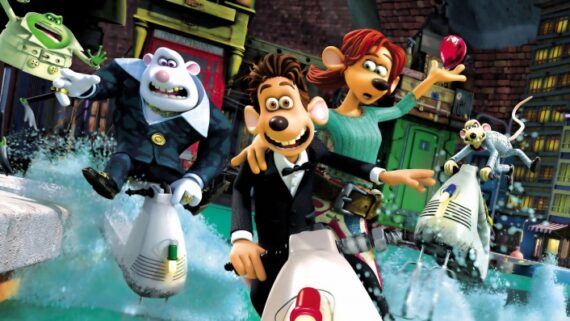
The main problem with Flushed Away is not how it looks though. Too often people talk about computer animation as if it can be produced instantly just by pushing a few buttons. The animators have done a good job of replicating the Aardman look, even if they can’t capture its elaborate prestige or reproduce the distinctive comedic timing of a stop motion film. That last point gets closer to the heart of what is wrong here. Unshackled from the arduous task of stop motion, the makers of Flushed Away seem to have gone bananas with pacing. The film moves forward at a dizzying lick, scarcely stopping to allow its jokes to register or its characters to be properly introduced. The story of a pet rat who is flushed down a toilet by an interloper and must try and make his way home through the sewers has a classically simple journey narrative but the film fails to take advantage of that, opting instead to hurl endless streams of obnoxious characters at the screen. There’s a lot of shouting, flailing and yammering here, not to mention a ton of needle drops, but nowhere is the charm and wit of Aardman. This feels very much like immediately-post-Shrek DreamWorks films like Shark Tale or Madagascar put through an Aardman filter.
A too-many-cooks situation seems to have been at play with Flushed Away’s screenplay, or perhaps just the wrong sort of cooks. The reins were first handed to legendary British sitcom writers Dick Clements and Ian La Frenais, whose TV masterpieces include Porridge, Auf Weidersehen Pet and Whatever Happened to the Likely Lads. American sitcom writers Christopher Lloyd (Modern Family) and Joe Keenan (Frasier) then added their contribution, with additional material by Will “Stop! Or My Mom Will Shoot” Davies. The result is a curdled melange of incompatible styles, with tired jokes about French frogs, characters being repeatedly hit in the balls, singing slugs and a full-on “me so solly” Chinese restaurant routine that has absolutely no reason to be there. A potentially great voice cast is wasted on material than massively ups the quota of in-your-face gags at the expense of character development of any kind.
While DreamWorks and Aardman had done wonderful things together in the early part of their relationship, by this stage it was clear that their union had run its course and they could achieve better things independently of each other. Flushed Away is the cinematic equivalent of the messy final row that finally brought both parties to this realisation.
47.The Boss Baby: Family Business
If you place every one of the fifty films on this list in order of runtime, The Boss Baby: Family Business comes out as the longest at an eye-watering 107 minutes. While the first Boss Baby film was hardly well-regarded critically, it came so close to being a decent film that I had some degree of hope that maybe they could nail it the second time out. Unfortunately, instead of ironing out the problems that dogged the first film, The Boss Baby: Family Business doubles down hard on plot convolution, frantic pacing and obnoxiously obvious jokes, making for a sequel that is borderline unwatchable for those who weren’t remotely charmed by the original.
For the first twenty minutes or so, The Boss Baby: Family Business feels like it might just work. It follows the first film’s child protagonist Tim as a grown up father himself, troubled by the fact that his own daughter is pushing him away and idolises her uncle Ted, the first film’s titular Boss Baby who has inevitably grown into a highly-paid CEO. Unfortunately, this promising and well-paced introduction falls apart in the face of Tim discovering his other daughter, the baby Tina, is an undercover exec from Baby Corp., which triggers a jumbled series of events designed to unconvincingly reinstate Tim and Ted’s former youthful states in order to satisfy audiences who just want more of a small Alec Baldwin in a suit, a one-joke premise that was always more suited to a ten minute short.
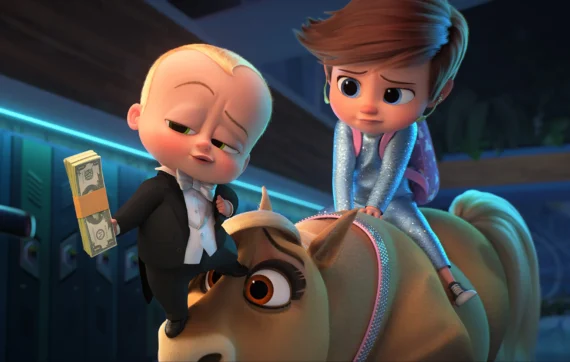
As with the first film, I found it hard to actively dislike The Boss Baby: Family Business, for the simple reason that it is trying so desperately to please. There are a lot of ideas rattling around in here but you can feel the strain of the filmmakers struggling to tell a coherent story that also brings back all the viewers’ favourite parts of the first film. As with its predecessor, the film was commercially successful but you can already feel the franchise struggling to hold itself together. A third film, should such a thing ever be attempted, could easily push it over the edge.
46.Madagascar 3: Europe’s Most Wanted
For viewers with a dedication to animal rights, something has probably always seemed cockeyed about Madagascar’s multi-film arc about a group of wild animals who want nothing more than to return to their former life in the zoo. If that is the case, then Madagascar 3: Europe’s Most Wanted will only add insult to injury with its eventual revelation that the animals feel their true place in life is in the circus. This, of course, is an overly earnest reading of the Madagascar franchise, in which pretty much everything is wilfully cockeyed and almost nothing is to be taken seriously. The problem with the Madagascar franchise is less ideological than it is merely a question of personal taste. For me, the best instalment of the series is the second, in which the wacky pacing is toned down just enough to incorporate a greater degree of emotional connection and plot coherence. This third outing consciously takes things in the opposite direction, leaning into frantic action, lazily self-conscious storytelling (how did they get to Monte Carlo exactly?), loud, obnoxious characterisations and a frustratingly wandering plot. And, of course, Sacha Baron Cohen is back as King Julien, which is a problem in itself.
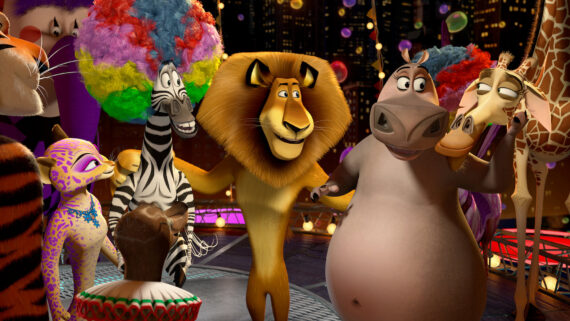
The notion of a European set Madagascar film evokes a little of the desperation of those 70s British sitcom movies that couldn’t think of any way to open out the plot other than sending the characters to a new location. Oddly, the screenplay was co-written by multi-Oscar nominated filmmaker Noah Baumbach, whose dryly witty indie films hardly made him seem like the ideal candidate for punching up a Madagascar script. His contribution is not particularly detectable amidst this messily constructed film, which still continued to rake in the dough. Although it is not likely to win many new converts, Madagascar 3 will probably please those who do enjoy the sound and fury of this franchise. Given the popularity of its two predecessors, it must have seemed like an equally viable route to lean into either the goofball anarchy of the first film or the more emotionally nuanced approach of the second. I can’t blame them for opting to go bigger, louder and crazier the third time out and, while I was disappointed that they moved away from the style of storytelling I prefer, Madagascar 3 does at least try and push its franchise’s wilder inclinations to a new extreme. If you don’t find the first film borderline intolerable, you might even like this one.
45.Monsters vs. Aliens
Monsters vs. Aliens is one of those half-forgotten curios from the tail-end of the period when DreamWorks was discovering its identity. By this stage they had two extremely successful franchises underway with Shrek and Madagascar, another one that had just kicked off the previous year in Kung Fu Panda, and the following year they would score another mega-hit with How to Train Your Dragon. In response to this refinement, Jeffrey Katzenberg would state that primarily parodic genre films like Monsters vs. Aliens and the upcoming Megamind were now off the slate for the foreseeable future. While this left Monsters vs. Aliens as a bit of a stylistic orphan in the filmography, it was still a moderate hit and spawned its own small franchise which included a short-lived television series. I really wish I could say I liked this peculiar little underdog more than I actually do. I love it when poking around in obscure corners turns up gems but after Monsters vs. Aliens I came away mainly with dust bunnies and disappointment.
A spoof on Sci-Fi, B-Movies and Creature Features, Monsters vs. Aliens doesn’t really lean into any of these inspirations with enough assurance, resulting in a haphazard grab-bag of quirky bits and pieces that never quite coalesce. The film’s visual design, especially that of its human characters, is conspicuously ugly. They look like newspaper caricatures come to life, an impression that is further exacerbated by the fact that some of them are clearly based on real people. Kiefer Sutherland’s General W.R. Monger looks and sounds like George C. Scott in Dr. Strangelove, while Stephen Colbert’s President Hathaway looks like Colbert himself (allegedly a coincidence, but a distracting one nonetheless). While Reese Witherspoon’s main character Susan Murphy, a woman who is turned into a giant by a radioactive meteorite, is made to look slightly more palatable, character’s like Paul Rudd’s narcissistic weatherman Derek Dietl are imbued with the exaggeration of satirical sketches that aim to capture the essence of the person through the overstatement of their flaws. The uncomfortable grotesquerie of this design choice significantly lessens the impact of the monster characters, who are far more attractive to look at despite being a blob, a humanoid cockroach and a fish/ape hybrid.

Monsters vs. Aliens has a wacky spirit that could have worked with better material. The opening sequence of Susan’s disastrous wedding day is quite amusing but as the main plot kicks in, the screenplay is too jittery in its impatience to get from one beat to the next. It doesn’t help that so few of the jokes land. Remember that George C. Scott-looking character I mentioned: General W.R. Monger. You’ve probably noticed that that’s a joke name but you’d be forgiven for having missed it because the joke only really works on paper and, honestly, it barely works there. This is the sort of vaguely desperate aspiring satire Monsters vs. Aliens has to offer. The notion of the President communicating with aliens by first playing that famous sequence of notes from Close Encounters on a keyboard and then switching to an over-enthusiastic rendition of Axel F is initially amusing but it’s the sort of joke you start to laugh at and then stop, as you realise you’re just being manipulated by the recognition of two big film references rammed into each other with the scarcest indication of a gag to hold them together. And then you realise that in the time it’s taken you have this realisation, reconsider the expression of mirth that almost escaped your lips and wonder how much of the film is left, that same joke has been going on the whole time.
With its goofball antics and noisy gags, Monsters vs. Aliens isn’t a film for the overthinkers. You have to be willing to go with it in order to get anything out of it but even then, there’s no guarantee. The jokes, characters and plot all feel under-worked and fans of the genres being homaged/parodied will likely be disappointed by just how little the film seems to draw on their associated iconography. Ultimately, a good cast which also includes Hugh Laurie, Will Arnett, Seth Rogen and Rainn Wilson, feels wasted on a film that can’t quite figure out its own identity. DreamWorks, meanwhile, had better figured out its own identity by this point and films like Monsters vs. Aliens were no longer a fit.
44.Turbo
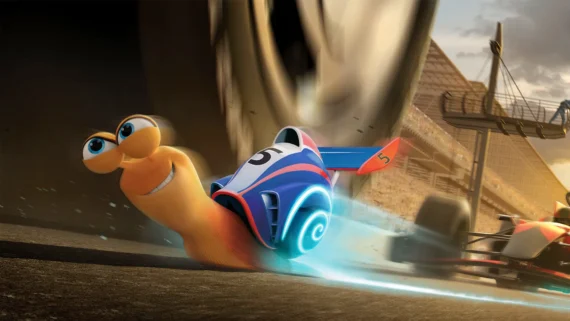
Amongst the vast DreamWorks filmography, Turbo is not held in especially high regard. Although at the time of writing we’ve reached a moment when the target audience of its era should be reaching the nostalgic age, online averages for the film are still comparatively low. It may take a little longer for the Proustian rush that apparently transformed The Goonies and Hook from bad films into classics to work the same magic on Turbo, but the greater likelihood is that Turbo is just too strange and misjudged a story to even be saved by the passage of time. The premise, when boiled down to the absolute basics, is incredibly simple: a snail, a creature famous for moving slowly, suddenly acquires the ability to go really fast. It’s not much of a concept but Turbo attempts to apply it to the tropes of the underdog sports movie, making the central snail into an Indy 500 fanatic who dreams of racing alongside his heroes. The fact that he is granted this opportunity by way of a freak accident requires a big leap in suspension of disbelief. Sure, when the film is already about a super-fast racing snail you might suggest that suspension of disbelief is not exactly a big ask but it’s just lazy storytelling to use an anything-goes approach. Just as the hair-pulling in Ratatouille felt like a first draft workaround that never got replaced, so Turbo might have considered placing the development of the snail’s racing aspirations after the freak accident, making them part of a logical progression rather than a half-arsed coincidence.
I think I would have forgiven Turbo its clunky plotting if only much else about it had been any good. Sadly, a weak premise predictably translates to a weak film, the plot of which seems to be marking time until the disappointing final race. The character comedy relies heavily on stereotypes which, while affectionately rendered, never get beyond the one-note gimmicks of their individual cultural transgressions. Despite a voice cast that includes the likes of Maya Rudolph, Bill Hader, Paul Giamatti and Samuel L. Jackson, no-one really gets a chance to flex their comic chops, least of all lead actor Ryan Reynolds as Turbo himself. One of the film’s vaguely amusing running gags is the repetition of the phrase “The snail is fast” but alas it serves as a partial admission that there is very little else to distinguish the main character. Despite a big build-up, the racing sequences just don’t work, with Turbo’s size in relation to the cars against which he is competing proving to be a major problem in terms of perspective. The animators’ attempts to negotiate the size difference without losing momentum or causing confusion ultimately fails badly.
If Turbo simultaneously and somewhat conveniently fulfils the demands of the easily forgettable and best forgotten, it is still bright and amiable enough to please a preschool audience. While it should not be critically penalised for setting its sights on a younger, more easily pleased demographic, there are much better films out there to assuage the paternal guilt of utilising the occasional necessity of the electronic babysitter. Four years later, Pixar’s Cars 3 did the underdog sports film incredibly well, not only becoming the best film of the franchise but further propelling Turbo into the oblivion of obsolescence.
43.Trolls
Although I hate it when reviews of animation, no matter what the style or target audience, get bogged down in how well it will play to children, there are certainly films out there where the intended demographic is little ones. There’s nothing wrong with that and, when it comes to judging the quality of such films, there’s a special skill involved in predicting how well something might play to its generation of preteens. In the case of Trolls, I could see that it was aimed squarely at a younger crowd even from early promotional images. The sparkly, colourful design and the infectiously relentless energy that became apparent in the trailers made it even clearer and my initial impression was Fair enough, probably not for me, and I moved on with my life and forgot about Trolls’ existence. Now that my DreamWorks marathon has brought Trolls back into my orbit, I’m somewhat dismayed to find that there are three of these films with which I’m going to have to contend because, as I’d correctly predicted, Trolls wasn’t for me. While the nostalgia for the popular toy line that inspired it and a hint of self-aware snark about its own candy-coloured excesses feel like small concessions to adults, Trolls is very much a film for kids who love to sing and dance and laugh along. I’d probably have enjoyed it more had I been accompanied by a child whose joyous inspiration I could watch come alive. As it was, I watched this alone at 10pm while my son was in bed and, while the voice credits for James Corden and Russell Brand were further fuel for my dread, there was a phrase I found amongst the keywords for this release that made my heart sink even more: Jukebox Musical.

I’m not a complete stick-in-the-mud. I love musicals. I love jukeboxes. But put the two together, you invariably end up with these scrubbed-clean, saccharine renditions of popular songs that squeeze out all the charm by trying too hard to make them as universally accessible as possible. Trolls never gets far through its plot without dropping another one of these karaoke intervals, the sort of thing the Shrek films had the good grace to leave until the epilogue where I could safely change the channel prematurely. Given its enormous popularity, Trolls obviously did its job of winning over the kids and it’s hard to hate its positive messages and sincere exuberance. The cynic in me sees product but my more charitable side sees well-made, considered product, not a humongous leap I grant you, but an important one. Trolls knows exactly what it’s doing and good luck to it in building that fanbase. I just prefer to wear my hair down.
42.Home
Despite churning out an incredible amount of acclaimed and popular films, DreamWorks has often had the reputation of being a second-rate studio. When critics who fawn over Pixar want to decry a slip in quality from their favourite studio, it is usually DreamWorks that gets evoked as a comparison. While I do think that Pixar has the greater filmography, it is only through unnecessary comparison that DreamWorks gets degraded. At least, that is true most of the time. With such a huge slate of releases, it is inevitable that some DreamWorks films feel less ambitious and less satisfying, failing to work even on their own modest terms. Home, for me, is the epitome of this kind of DreamWorks film, so unremarkable that few critics even reached for the standard Pixar comparison.
Based on Adam Rex’s children’s book The True Meaning of Smekday (an interesting title for a story whose adaptation got lumbered with such a blandly nondescript one), Home seems utterly content to coast by on well-worn dynamics, cute but empty characters and showy celebrity voice work that seems too eager to please but less willing to engage with characterisation. I was very excited to see my comedy hero Steve Martin among the cast and it was fun to hear him for a scene or two but it quickly became clear that his recognisable voice was all Home could be bothered to offer. Jim Parsons’ lead performance as the alien Oh also seems pitched in a way meant to evoke a more lovable take on his The Big Bang Theory character. As someone who has never been a fan of that show, I didn’t really even enjoy Parsons’ presence for a scene or two. One of Oh’s major character traits is that he is annoying. For viewers who remain unmoved by the proposed counterweight of his cuteness, that becomes wearing from the moment we meet him. Rihanna at least provides the younger target audience with an icon they will appreciate, although she is lumbered with the dull cliche of the lost girl trying to find her mother, the mild sassification of which is not sufficient to compensate for the hackneyed tropes.

As is often the case with unambitious animations like Home, I didn’t hate the experience of watching it but I did find myself drifting off on several occasions. A sprinkling of decent gags and suitably brisk pacing keep the thing moving but there’s not enough here to fill a 95 minute runtime. Looking at Oh as he dashed about annoying people on both sides of the screen, I kept visualising him as a cheap, plastic fast food tie-in toy, the sort you root out from the bottom of a charity shop box of miscellany. You stare at it for a second as a small glimmer of recognition struggles to ignite in the back of your mind, and then you respond with a non-committal “oh yeah, Home”, before dropping the toy back into the dust bunny from whence it came, simultaneously consigning the memory it triggered to the equivalent area of your brain.
41.Abominable
You have to have a lot of confidence in your film to give it a title like Abominable. It sets up such an easy ride for critics in the event of the film being terrible. Abominable avoided this trap not by being excellent but by being completely average. While few would watch this film and claim it was a masterpiece, it is so thoroughly mediocre that to suggest it was an abomination would come across as borderline histrionic. Well played, Abominable, well played.
How much you enjoy Abominable will probably depend on how many of these kind of films you’ve seen before. Growing up in the post-E.T. era, I had seen many and while there is a lingering affection for these stories of kids and their fantastical friends, my overall assessment is affected by how well the story is told and if it brings anything different to the table. Abominable brings nothing new at all, happy instead to reap the rewards of a story that kids may love but that most adults could probably write beat-for-beat after watching the trailer. Abominable also had the misfortune of coming out the year after Warner Animation’s Smallfoot, another yeti film. The combination of the two films didn’t exactly kickstart a yeti-craze but I do vaguely recall feeling a mild sting of fur-fatigue at around this time, even though I watched neither film on release. Admittedly, I’ve still never seen Smallfoot but I have seen Pixar’s Up, from which Abominable’s journey through an exotic landscape seems to borrow liberally.
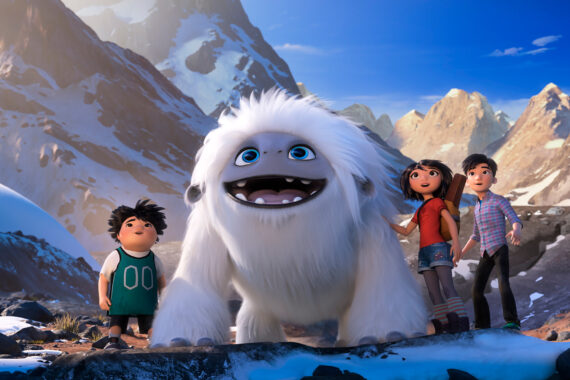
I quite enjoyed the opening stretch of Abominable in which the yeti, Everest (beautifully animated, if a bit awkwardly designed) is on the loose in urban Shanghai but once the film trades the city for provincial Sichuan, the story becomes overly familiar and leans awkwardly on magical powers that don’t quite fit with the concept. While it was an inoffensive enough viewing experience, I did have to focus quite hard to prevent myself drifting off. At a time when Disney and Pixar were largely mired in sequels and remakes, DreamWorks could have seized the spotlight with something original but sadly the original property they came up was so familiar that it felt like both a sequel and a remake without, in fact, being either.
40.Trolls World Tour
Having not been especially taken with the first Trolls movie, I approached Trolls World Tour with extreme caution. This second instalment in the candy-coloured franchise is often considered the weakest so I was mildly relieved, if not exactly ecstatic, to find that it was a slight improvement by my estimation. Anyone who read my review of the first Trolls will realise this is somewhat faint praise (if the phrasing itself didn’t give that away) but after the candy floss swirly to which its predecessor subjected me, I was pleased to find a little more structure and some semblance of a worthy message in Trolls World Tour. Using different genres of music as a metaphor for societal divides is nothing new but the film manages to put across a multi-layered lesson that eschews the formerly fashionable preserve of simplified children’s fodder that saw us as all the same underneath, in favour of a better message that celebrates individual differences. However laudable the message though, a film automatically loses points if it makes you wade through performances of Gangnam Style and Who Let the Dogs Out? to get there.

Of course, the Trolls franchise is making shrewd choices when it selects songs that were enormous international hits, frequently in spite of their terrible quality. I’m all for celebrating the diversity of our individual tastes but that doesn’t make sitting through souped up reiterations of songs that have been run into the ground any less insufferable for those of us who would rather give the karaoke bars a miss. I guess what I’m trying to say through this thick cloud of middle-aged curmudgeonry is that I don’t begrudge Trolls World Tour its existence, I just have to concede, as I did with the first film, that it’s not for me. I did, however, enjoy reading some of the angry online posts from rock music fans who took the film seriously enough to proclaim its depiction of their favoured genre as offensive. Who would have ever thought DreamWorks would make a film that could trigger Iron Maiden fans?!
39.Rise of the Guardians
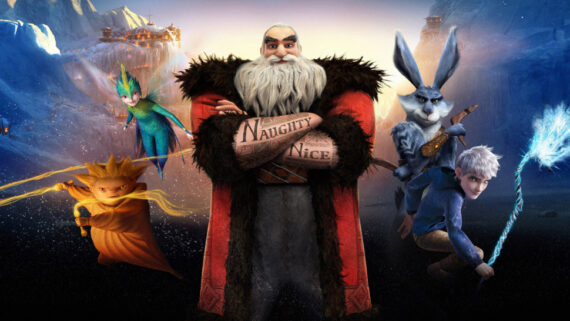
With Rise of the Guardians, DreamWorks seemed to be attempting a slight stylistic change. Although the studio had made plenty of Action Adventure films, they had generally settled into a groove of humorous scripts and rounded, cartoonish character designs. Based on a series of Fantasy books by William Joyce, Rise of the Guardians aims for a sleeker, more realistic look, akin to a CG version the human characters from early traditionally animated DreamWorks films like The Prince of Egypt and Sinbad: Legend of the Seven Seas. The tone, with its chunks of mythology and slick action intervals, is more self-consciously hip and complex, although fortunately the notion of a team of action heroes made up of children’s fantasy figures like Santa, Jack Frost and the Tooth Fairy is not presented entirely without the humour it so clearly requires. The TV spots used to advertise the film heavily played up the extremely minor characters of Santa’s elves, probably because their goofball slapstick asides resembled that of Despicable Me’s already wildly popular Minions. Unfortunately, this approach to marketing tended to play down Rise of the Guardians’ real strengths, which lay in its Avengers Assemble-esque action sequences. Consequently, audiences weren’t quite sure what to expect and Rise of the Guardians was met with tentative confusion, not helped by the release only two years earlier of the similarly titled Legend of the Guardians, Zack Snyder’s weird animated owl film.
Rise of the Guardians has its fans and it’s far from a terrible film, but the sprawling Fantasy franchise it seems to have in mind makes its ultimate cult status feel like a failure on its own terms. The film takes too long explaining itself which feels distinctly unsatisfactory when you’ve got a roomful of pretty much every legendary childhood fantasy figure and all that they want to do is discuss logistics. Then again, in adapting these characters to fit Rise of the Guardians’ chosen tone, the film has pretty much sucked the magic out of most of them. The fleet-footed Jack Frost and the cute Sandman notwithstanding, the former occupants of our most blissful childhood delusions have been made into weird, ugly creatures. Alec Baldwin’s burly Russian Santa, Isla Fisher’s peculiar hummingbird/Tooth Fairy hybrid and Hugh Jackman’s earthy Australian Easter Bunny are all so strange that they manage to kill the appeal of these time-honoured bearers of our preschool dreams. By contrast, Jude Law’s Boogeyman does not have a hard enough edge for a plot in which a truly scary villain is really required.
By keeping one eye on the possibility of an extended franchise, Rise of the Guardians manages to be a disappointment to most audiences. While those who are hoping for a self-contained adventure will doubtless be bored by the film’s fussy dedication to setting up its lore, those who love these intricate worlds will likely be let down by the fact that it never got the chance to expand beyond its first chapter. Rise of the Guardians also proved to be a disappointment for DreamWorks, for though it grossed more than double its budget, this was not enough to cover the high costs of marketing and distribution, leading to their first loss on an animated film since Sinbad: Legend of the Seven Seas. Rise of the Guardians’ losses ultimately became a major factor in a company-wide restructuring that resulted in 350 layoffs and the cancellation of several upcoming projects including the ambitious Me and My Shadow. While it still delights a certain demographic then, Rise of the Guardians does not hold a particularly auspicious place in the DreamWorks canon.
38.The Boss Baby
I remember when it was announced that The Boss Baby had been nominated for the Best Animated Feature Oscar and for a couple of days people lost their minds over it. How could The Boss Baby be an Oscar nominated film?, they crowed again and again on social media, apparently forgetting worse films had been nominated for the same award in the past (Shark Tale springs to, and then thankfully immediately fades from, mind). Hell, there was even a worse film nominated that same year, Blue Sky’s utterly forgettable Ferdinand. You could blame it on a slow year for the category but even a cursory glimpse at the submissions for that year reveal many more worthy contenders: The Big Bad Fox and Other Tales…, Cars 3, Ethel & Ernest, In This Corner of the World, The Lego Batman Movie, Mary and the Witch’s Flower, My Entire High School Sinking into the Sea and DreamWorks own Captain Underpants: The First Epic Movie. So how did The Boss Baby end up getting nominated? Well, it’d be naïve to suggest that quality was always the driving force behind Oscar campaigns and let’s not forget that The Boss Baby was a sizeable hit. I remember standing outside a cinema in Nottingham with a towering image of Alec Baldwin’s titular infant looming over me. For a while there, this film really was everywhere and no-one seemed to mind until it had the audacity to finagle itself onto the Oscars podium.
My defensiveness over The Boss Baby probably betrays the fact that I have a slight soft spot for it. I’m not going to go as far as saying it’s a good movie but the fact that it never quite manages to find the consistent tone or coherent storyline it requires is sad given that for a while there in its opening stretch The Boss Baby looks like it might even be a GREAT movie! Director Tom McGrath’s reverence for vintage animation led him to incorporate a visual style inspired by the limited, stylised look of 50s and 60s cartoons. In the numerous surreal asides and dream sequences, these dead-on recreations are bliss for animation enthusiasts to experience. Unfortunately, Michael McCullers screenplay just cannot figure out how to make this daft premise work for a whole 90 minutes. There could have been a very nice short made from this material but instead we have to watch it tie itself in knots across a feature runtime. DreamWorks Captain Underpants film from the same year managed to pull off a ludicrous feature length storyline thanks to a smartly consistent tone. The Boss Baby, however, aims too high in its quest to combine real sentiment with a management-speak spewing infant. Of course, there’s another layer here. The representation we see of the new baby is merely the projection of an unreliable narrator, his seven year old brother, whose attempts to process the experience of having a new sibling are presented in this way. This brings up another inconsistency, however, in that it seems a little unbelievable that a seven year old would have such intricate experience of the office culture and management jargon that is used here.
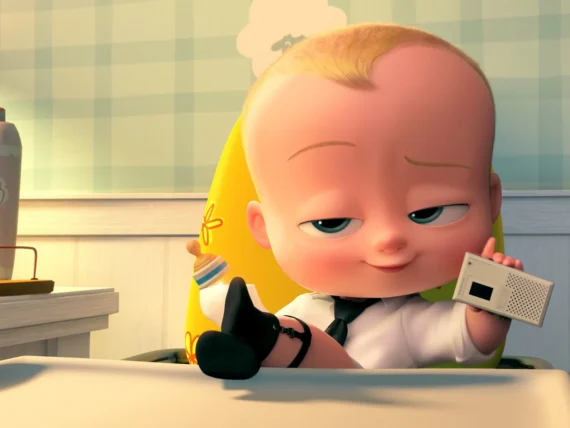
It’s at this point in a review that some bright spark usually starts creating a reply that says “Chill out, it’s just a cartoon.” That’s the sort of attitude that consistently devalues the art of animation, implying it is a medium exclusively meant for children and that there really doesn’t have to be any level of quality or coherence to the writing. It’s a shame that this attitude occasionally seems to seep into the product with which we end up. The Boss Baby feels like it might have worked with just a few more passes at a storyline and screenplay. There’s a vibrancy to the animation and a commitment in the performances that just need something more solid at the film’s heart to support them. What we actually get are fleeting moments of inspiration hung on a saggy line. The balance shifts too wildly from preposterous to maudlin and back again and, as an easy mark for sentimentality (especially stuff to do with children and families), I was disappointed to find myself dry-eyed throughout.
37.Ruby Gillman, Teenage Kraken
I had fairly high hopes for Ruby Gillman, Teenage Kraken, one of DreamWorks lowest grossing films. It emerged in the wake of a long run of DreamWorks sequels and one film, The Bad Guys, based on a series of books. Ruby Gillman, Teenage Kraken was the first original DreamWorks film since Abominable and its failure led several commentators to put forward the tedious and damaging notion that only films based on an existing IP have a chance at the box office. Several other suggestions were made as to the reason behind Ruby Gillman, Teenage Kraken’s failure, including its unwieldy title and unclear demographic, although the fact that the film is just not that good probably hurt its word of mouth potential too. It’s a shame because there’s a lot of charm here. I love the design of Ruby and Lana Condor does a great job of voicing her, and the prospect of an action adventure crossed with a high school film certainly has potential. In interviews, director Kirk DeMicco talked about the influence of John Hughes and later high school films like Ladybird and Booksmart, but in practice Ruby Gillman, Teenage Kraken has very little of any of those films’ DNA. The high school angle is quickly pushed to one side after a bit of introductory dithering about prom, and as the film becomes more about a girl who turns into a giant kraken if she goes in the ocean, the story loses its grip on the obvious parallel with teenage quests for identity and settles harder into the undersea mythology, which is unfortunately delivered through cumbersome exposition dumps.

The plagiarism controversy of Antz vs. A Bug’s Life was over a quarter of a century ago and DreamWorks had clearly found its own groove by this stage, but Ruby Gillman, Teenage Kraken does seem to owe a very large debt to two Pixar films, Luca and Turning Red, which is especially distracting given that it is not as good as either. Whether these films were influences or not, however, Ruby Gillman, Teenage Kraken just isn’t good enough on its own terms. Pam Brady, Brian C. Brown and Elliott DiGuiseppi’s screenplay is the main problem. It gives us the teenage bit, it gives us the kraken bit but it never comfortably combines them or make the audience care much about either. There are also a couple of reveals concerning Annie Murphy’s new girl Chelsea Van Der Zee that are far too easy to see coming. The film’s chief strength is its visuals, such as the bold colours of the characters when they are underwater recalling striking predecessors like Mune: Guardian of the Moon or even Marcell Jankovics’ 1981 masterpiece Son of the White Mare, but these hallucinatory passages are never tied to the sitcom-like land sequences enough to make either work in the context of the whole picture.
I really wanted to like Ruby Gillman, Teenage Kraken, a film which already seems to have begun its journey towards cult acceptance following its failure in the mainstream. I wish it well in that respect but as long as I’m making wishes, I just wish it was better.
36.Bee Movie
There’s an episode of The Simpsons, Angry Dad: The Movie, that includes a parody of Pixar films called Condiments. It features various jars and bottles in a kitchen making puns and jokes about sauces and spreads. Bee Movie feels like the result of the writers of Condiments being tasked with stretching a similar concept to feature length. A film that has gradually gone from reviled critical flop to notorious cult classic, Bee Movie’s current reputation rests heavily on just how weird and unwieldy it is. If you’re willing to go with its haphazard construction then you might have some mild, albeit incredulous, fun but if you’re looking for strong characters or engaging plotting then you’ve come to the wrong place.
As with DreamWorks previous insect film Antz, Bee Movie casts a well-known adult comedian in the role of its lead character and then leans heavily on his established persona. In this case, DreamWorks went a step further by also turning over writing duties to their star. Jerry Seinfeld and a group of his writer buddies from the Seinfeld years wrote Bee Movie and it’s immediately apparent that they were all too busy trying to come up with the best bee pun or gag about being a bee to give any serious consideration to the story. In the early stages of the film it is almost interminable, with joke after joke after joke about honey, stripiness, hives, buzzing, pretty much anything related to bees gets its own zinger…or should that be “stinger?” No wait, I can make this better… Should that bee “stinger?” Does that work? Is that anything? Wait, what? The plot? Yeah, we’ll get to that later. Something about a protracted courtroom battle. Oh, and throw in Ray Liotta somewhere.
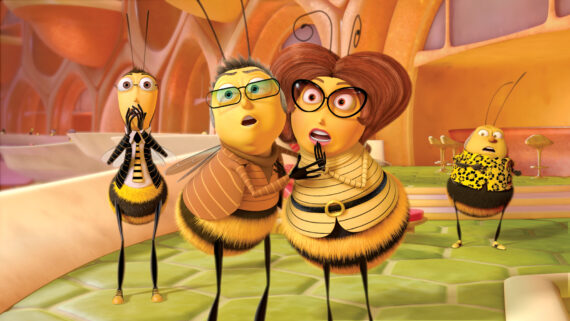
I was tempted to end that last bit with the phrase “Kids love Ray Liotta” but I realised I was about to fall into a trap that is one of my pet peeves when it comes to animation reviews: the assumption that all animation is for children. In the case of Bee Movie, I guess it’s not unreasonable to suggest that kids would’ve been the primary demographic but I’m not entirely sure that Seinfeld and his team were ever told that. Bee Movie seems to be aiming for a more adult vibe, with quite a lot of jokes about death, cynical jabs at the legal system and an environmentalist slant that feels like a finger wag at older audience members as much as a learning opportunity for the younger ones. For all his questionable abilities as a screenwriter, Seinfeld is adept enough with a gag to occasionally hit the mark, with a runner about a man losing his whole life to a bee being particularly hilarious. As a lead voice actor, he is less successful, and his screenplay clearly favours his character Barry B. Benson far too heavily, to the detriment of the ensemble. Seinfeld worked so well because Jerry had a generous attitude to his co-stars and was happy to let them shine as brightly or even brighter than him. In writing Bee Movie, he seems to have largely forgotten his co-stars exist. Maybe the film should’ve just been Barry delivering a standup routine to a bunch of bemused drones.
Amongst the lower tier DreamWorks movies, I’ve placed Bee Movie quite high because it at least seems to be aiming for something really unusual and ambitious, even if the working team aren’t quite up to delivering on that promise. Still, I do like a corny pun and if Bee Movie overdelivers on that front, the sheer volume of bee gags becomes a hysterical joke in and of itself. While it’s ultimately something of a bizarre experience, Bee Movie’s reputation amongst smirking internet memers does prove to be somewhat irresistible. The tagline for the film was “Honey Just Got Funny.” That’s both funny ha-ha and funny peculiar.
35.Shrek
Although it came several films into the DreamWorks story, Shrek has become like the studio’s Toy Story equivalent, a cornerstone of their fame that is seen as a pivotal initiator. Based on the picture book by William Steig, Shrek’s tale of a curmudgeonly ogre in a fairytale kingdom was an instant critical and commercial success, beating Pixar’s Monsters, Inc. to win the first ever Oscar for Best Animated Feature, an achievement that competitive CEO Jeffrey Katzenberg must’ve relished after all the bad blood between the two studios. Shrek was hailed as a landmark classic, a film that both adults and children could enjoy, spawning a lucrative franchise starring an increasingly popular set of beloved characters. Shrek’s far-reaching appeal has made it an important film in the childhoods of many, so I’m sorry to have to sound as grumpy as the green Scottish ogre himself but, in all honesty, I don’t like it and have never much liked it. This is where I break the tension with a fart gag, right?!
With its relentless barrage of bodily function jokes, Shrek is decidedly lowbrow. It was by no means the first animated feature to include gross out gags. Fart and poop jokes had been on the rise in mainstream animation throughout the 90s, Shrek just takes it a step further by not so much delivering its naughtiness with a sly wink as grabbing the audience by the neck and ramming their faces into its fetid armpit. The fact that the film relishes its own wanton scrunginess is actually one of the things I like about it, even if the jokes themselves become wearing after a while. Neither should it be held against Shrek that its trailblazing scatology caused an avalanche of imitators that blasted our popcorn out of its buckets with their increasingly uninspired anuses well into the next decade. What baffled me more about Shrek was how everyone seemed to think it was so damn clever. It was as if the filmmakers themselves had somehow accessed one of the film’s own enchantments, a spell to make critics think mildly subversive fairy tale jokes were worthy of a Best Adapted Screenplay Oscar nomination (yes, really!).

I think one of the things that so captivated critics was the notion that someone was sticking it to Disney. Shrek’s many undercutting allusions to Disney films probably seemed refreshing after a decade of Disney domination, and especially after they’d inflicted the deathly dull Dinosaur on the public the previous year. Shrek’s impish japery could hardly be a farther cry from that insipid, prehistoric yawnfest, which also briefly made Shrek seem like a saviour of sorts. If parodic Disney deconstructions were hardly a new thing in animation (see Tex Avery’s Screwball Squirrel, Bob Clampett’s A Corny Concerto and Bruno Bozzetto’s Allegro Non Troppo for just three earlier examples), Shrek’s was especially well timed, arriving at the end of the Disney Renaissance era in a way that made it almost seem responsible for the downturn in fortune Disney experienced in the 00s. But another thing that was widely admired by critics was how Shrek supposedly appealed to both adults and children equally. What this claim so frequently equates to is a couple of slightly awkward dirty jokes (in this case, Lord Farquuad’s sweary name and a couple of innuendos about his alleged small penis) and then a lot of goofy gross-out that more likely appeals to the child inside the adult than the adult themselves. This is fine but so many reviews gave the erroneous impression that Shrek was Oscar Wilde meets the Brothers Grimm by way of the Farrelly Brothers that I couldn’t help but be disappointed by the tepid, toothless parody that it actually turned out to be.
I’m not trying to rain on anyone’s parade here. There was a 2021 article in The Guardian that celebrated Shrek’s 20th anniversary by essentially saying “You’re all wrong, Shrek has always been rubbish.” The viral reaction to this piece swiftly showed that Shrek very much works for many, many people. As for me… I’m embarrassed to say that I was once a vocal naysayer who would fight tooth and nail to decry the film, so much so that I once ruined a New Year’s party by adding alcohol to that already toxic equation. Since then I’ve given up both drinking and weird anti-Shrek diatribes, and while the film still doesn’t work for me, I can at least acknowledge the things it does get right. Though the look of the film has inevitably dated, with the human characters especially looking a little waxy nowadays, the animation historian in me can still recognise and appreciate the advancements that Shrek brought to the table. In terms of character design, Shrek himself is a triumph of a creation who manages to be simultaneously grotesque and appealing, an assignment that could have easily gone badly wrong (for proof, check out the infamous test footage known as Shrek – I Feel Good Animation Test). Donkey is similarly well rendered and animated with a deft physicality that captures the energy of Eddie Murphy’s spirited performance. As for the celebrated satirical humour, it only really works for me when Shrek is prepared to be really nasty. For instance, the Gingerbread Man torture sequence still surprises with how dark it goes, with the grim punchline of the Gingerbread Man now walking with a candy cane and speaking Tiny Tim’s famous “God bless us everyone” line actually pushing the boundaries of taste about as far as they’ll go in a family film.

In terms of the voice actors, for me John Lithgow is the standout as Lord Farquaad. I’ve never been overly fond of Mike Myers penchant for accents so his rather one-note turn as Shrek didn’t really convince me, despite several alterations being made during production to accommodate Myers desire to play the part as Scottish. Cameron Diaz is fair but unremarkable as Princess Fiona, which leaves the most popular voice performance of the film, Eddie Murphy as Donkey. Earlier in this review I referred to this performance as “spirited” and it is certainly that. It is also bloody annoying. This is partially the point, of course, given that a large part of Donkey’s comedic function is to get on Shrek’s big green pecs. Murphy does a good job of making Donkey endearing and likeable even as he grates, but after 90 minutes of his incessant, cheery ramblings I was really ready for it to be over.
But I think my main problem with Shrek is its weak storytelling, which ultimately leads to an inconsistent tone and muddled moral outlook. The screenplay is by Joe Stillman, Roger S.H. Schulman, Ted Elliott and Terry Rossio, the latter two also having been responsible for DreamWorks previous underrated The Road to El Dorado. It sets up a series of quest narratives and then fails to deliver on the excitement upon which such a premise usually thrives. As a film that seeks to subvert fairy tale conventions, some degree of unorthodoxy is to be expected but of the three short quests of which the film consists, only the rescuing of the Princess from a dragon really comes alive. It is peppered with nice little ideas, like the Fiona’s dedication to storybook convention even when the situation in which she finds herself is completely unconventional, and a few that don’t really work (I’ve never liked the strange Donkey/Dragon romance, which was ultimately sustained into the sequels) but it at least has a bit of forward drive. Elsewhere, the quest to find Lord Farquaad is over in a couple of scenes and the quest to take the Princess to him is where the film’s tone begins to get messy. Although the little moments of subversive comedy keep coming, their quality varies and clashes with the emerging romance between Shrek and Princess Fiona which gradually elbows its way into the spotlight, bringing with it a maudlin melodramatic atmosphere that feels like too violent a gear shift.

This sudden earnest sincerity is further exacerbated by a message that feels jarringly contradictory. Shrek is often described as a film with a “Be Yourself” message, with Fiona’s slovenly inclinations aligning with Shrek’s personality far more than that of the preening fairy tale Prince’s that convention has led her to covet. However, Fiona turns into a big green ogre like Shrek every night, a result of a witch’s curse. She has been told that true love’s kiss will allow her to take on love’s true form. So when she eventually kisses Shrek, the form she takes on is that of the ogre, with Shrek telling her she is beautiful. Awwwww, right? Hang on a minute though, if the message is to be yourself, surely love’s true form should be what Fiona actually looks like, not the form that most closely aligns with and most pleases her new lover. Against the odds, the comedic pairing of Donkey and the Dragon actually does a better job of selling the message, even if the eventual half-dragon Donklets we see further down the road have caused some to question the logistic plausibility of the relationship.
Shrek’s dedication to its moral is so half-baked that it can’t support the sincerity it tries to introduce, effectively tanking its third act. Let’s not forget that a lot of jokes are derived from the diminutive stature of Lord Farquaad, which is portrayed as inherently preposterous and undesirable. So what’s the message? It’s OK to be ugly but not short? Be yourself but maybe buy some lifts? Love’s true form is whatever colour and build your partner happens to be (unless you’re a donkey, in which case you can get adventurous)? I’m sure we could finagle this into some kind of positive message if we worked hard enough but Shrek itself seems to have spent so little time trying to do so, instead hoping that a sudden u-turn into wistful and a sad Pop song on the soundtrack will do the job for it. Sorry, but that won’t do, Donkey, that won’t do!
34.Shrek 2
There are some successful films that really don’t feel like they need sequels, the sort of film where the story feels completely told already and to add more would be to take something away. Despite not having liked the first Shrek, however, I did not feel that way about Shrek 2. For me, the story that Shrek told was so gossamer thin that it didn’t do justice to the potential of the subversive fairy tale kingdom it set up. A sequel, I thought, might at least capitalise on some of those missed opportunities. In some ways I was right. There’s a lot more going on in Shrek 2 than there is in its predecessor, with more characters put to better use. Ironically, Shrek 2 does more by trying to say less. While the first film spent lengthy longueurs unsuccessfully attempting to untangle its message about beauty, the sequel takes similar themes but uses them as the basis of a more traditional fairy tale which makes its moral asides subservient to its swifter storytelling and gags. That’s not to say that a lot of what bothered me about Shrek doesn’t still hang heavy in the green ogre’s second outing. I still don’t really like the main characters, which is an obvious problem. Shrek is still an odd combination of assertively curmudgeonly and tiresomely wishy-washy, Donkey is still annoying as hell (which is not any more fun just because they keep acknowledging that fact) and Princess Fiona is unfortunately marginalised by the conventions the story is following. In the first film, Fiona’s learned dedication to storybook tropes was one of the stronger beats, particularly as it was undermined by her actual inclinations. But the meet-the-family sitcom story that Shrek 2 sets up can only result in Fiona becoming the eyeball-rolling sidelined female and then the classic damsel-in-distress whose obliviousness to the truth robs her of the chance to do much of her own ass-kicking.
One of Shrek 2’s main strengths is in the new characters it introduces. Rather than find some contrived way to bring back Lord Farquaad from his dragon-digested fate, the sequel introduces Jennifer Saunders’ Fairy Godmother as a new and rather brilliant villain. A manipulative mother who is trying to secure the future of her dim, narcissistic son Prince Charming (an amusingly tetchy Rupert Everett), Saunders has a ball with the role and the character design is appropriately innocuous to first conceal her true malevolence and then make it incongruously hilarious. Julia Andrews and John Cleese are effective as Fiona’s royal parents, playing their roles with restraint. I sometimes brace myself when Cleese turns up as his latter day performances sometimes tend towards screen-hogging and legend-coasting but here he turns in an appropriate characterisation. The standout, of course, is Antonio Banderas as Puss in Boots, a wildly popular character who eventually got his own spin-off franchise. With all these strong new creations, Shrek 2 easily surpasses its predecessor but it also falls foul of some classic sequel pitfalls. There’s a notion that people come back to see a sequel hoping for the same but bigger. They want to see both something new and the greatest hits. This unfortunately leads to an overstuffed final act in which a bunch of ancillary characters from Shrek are hauled out at the last minute to become part of the main plot. I didn’t mind seeing Pinocchio and the Big Bad Wolf again in throwaway callbacks at the beginning of the film, but by the time the finale has somehow inserted a gigantic version of the Gingerbread Man into the plot, Shrek 2 feels like it is overplaying its fan service.
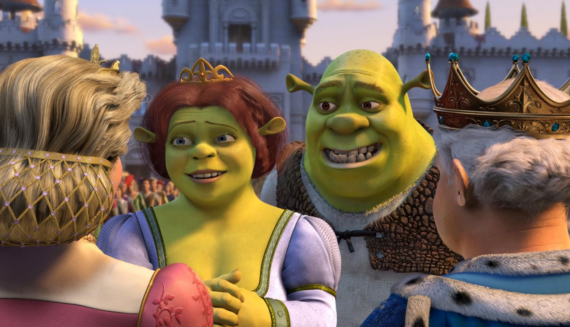
In terms of its brashness of tone, frequency of pop culture references, well-chosen but overabundant needle drops and gross-out gags, Shrek 2 is bound to please fans of the first film. The bodily function jokes are actually far fewer and further between this time round, although there is still a hint of that 00s tastelessness that makes the setting of Far, Far Away feel like a reference to the era. It’s hard not to squirm a little in your seat when an oversized, unintelligent creation is given the dubious name Mongo and the villainous Prince Charming’s comeuppance involves being sexually assaulted by a masculine barmaid. Still, Shrek 2 did its job by delivering another wildly popular entry into the franchise and covering some of the losses that DreamWorks recent flops had caused. Shrek would obviously come back for more instalments of his lacklustre saga in future, with those later films proving to be less popular even with fans of the franchise. For the moment though, DreamWorks had pulled off a sequel that delighted fans of the original Shrek, even if it was unlikely to win over those who weren’t so keen the first time round.
33.Dog Man
Dog Man is a spinoff from the excellent Captain Underpants: The First Epic Movie, the link being that this part-man/part-dog hero is another creation of the fourth-graders George and Harold from that earlier film. There are a few allusions to these two budding comic artists in snippets of self-aware dialogue but there is no framing device that explains the concept for viewers unfamiliar with the franchise. While this is all the better for those who are already up to speed, Dog Man does rather live and die by its conceit. Those going into it cold will likely see little more than juvenile plotting and a loose pile of jokes. That is not to say that being armed with the necessary context will make Dog Man a great film. I had already watched Captain Underpants and all I really saw in Dog Man was justifiably juvenile plotting and a pile of jokes.
There’s nothing wrong with films that are little more than gag after gag threaded on a deliberately hackneyed plot. That approach certainly didn’t do Airplane any harm. But Dog Man doesn’t quite have the gall to lean into its absurdities with the force of Zucker-Abrahams-Zucker. Instead, it attempts to combine its daft characters with a plot that skirts the perimeters of sentiment with one eye on crossing over. It’s fair to say that George and Harold probably would have sought to include in their Dog Man comic a plot pieced together from their influences, but without the extra experimentation of the more ambitious Captain Underpants, Dog Man feels like it only has that one string to its bow. The jokes are often good and the bold, deliberately primitive animation style fits the concept but with such a ploddingly familiar plot, Dog Man’s 89 minutes seem like at least a twenty minute overshoot.

Amidst the extensive DreamWorks canon, Dog Man is a squarely midtable creation, joining such likeable but inessential films as Penguins of Madagascar, Shrek the Third and Trolls Band Together. Like those films, it’s an adequately entertaining experience with flashes of inspiration but there’s little to inspire a rewatch or kindle hope for future instalments.
32.Shrek the Third
Despite their enormous popularity, I’ve never been a fan of the Shrek films so it stands to reason that Shrek the Third, a film which even fans of the franchise regularly vote as the worst of the lot, was probably not going to be for me either. I hate to sound like a contrarian then but while watching this widely lambasted threequel, I slowly realised that I was having a better time than I had with the much-lauded Shrek and Shrek 2. Now I’m not about to claim that Shrek the Third has converted me to the alleged charms of the big green ogre or even that it is an especially good film, but I did find this instalment to be funnier than the previous two, its themes of the anxiety of imminent parenthood resonated with me more strongly and its story seemed more carefully plotted than the pile of gags, cameos and half-chewed morals into which its predecessors ultimately collapsed.
Shrek the Third begins with the death of Fiona’s father, King Harold, a plot point that could have been maudlin were it not for a genuinely funny deathbed scene which combines black comedy with just enough real sentiment to have the best of both worlds. Harold’s death leaves Shrek and Fiona as next in line to the throne of Far Far Away but Shrek wants nothing more than to return to his swamp and a simpler life. So he sets off on a quest to find Fiona’s cousin Artie Pendragon, the only other living heir. Shrek’s quest is complicated by the fact that Artie is a sixteen year old outcast, and by Fiona telling him at the outset of the quest that she is pregnant. Terrified by the idea of fatherhood and royal responsibility, Shrek has greater problems to deal with this time than just the motormouthed Donkey.
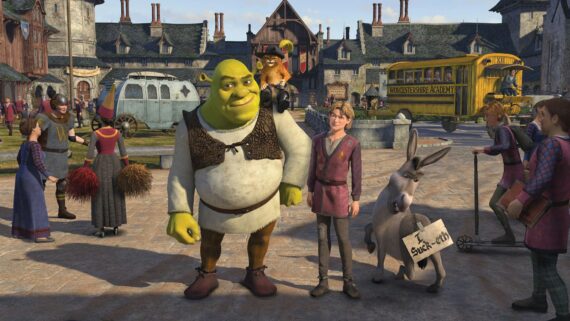
Although you can probably map out the rest of the plot without even trying, Shrek the Third does offer more than just its predictable take on facing responsibilities and coping with change. Having been sidelined a little in Shrek 2, Rupert Everett’s preening Prince Charming gets the chance to be the main villain here and continues the Shrek series’ tradition of great baddies. He recruits an army of famous fairy tale meanies to assist in his quest, which is a lot of fun but the film is stolen by a troupe of princesses who assist Fiona in defending the kingdom from Charming’s designs. Snow White, Rapunzel, Cinderella and Sleeping Beauty are voiced by Amy Poehler, Maya Rudolph, Amy Sedaris and Cheri Oteri respectively and, as you might expect from such a stellar comedy lineup, they turn out to be the highlight of the film. The screenplay was co-written by Who Framed Roger Rabbit scribes Jeffrey Price and Peter S. Seaman and there are several standout bits of business that demonstrate similar levels of wit, in particular a scene in which Pinocchio is pressed for information on Shrek’s whereabouts and uses evermore creative language to avoid telling a discernible lie.
Unfortunately, the Shrek the Third script is also riddled with moments that remind us that Price and Seaman also wrote Wild, Wild West. Terrible additions include a completely unfunny version of Merlin voiced by Eric Idle, an overly cloying final speech from Justin Timberlake’s Artie and a superfluous body-swap plot with Puss and Donkey which seems to only be there to give those two marginalised characters something to do. Fiona, too, is once again left behind on the quest, although she does end up being in most of the best scenes with the princesses. There’s a clunkiness to a lot of the writing which seems in such a rush to get to the jokes that it pushes aside every other consideration. In particular, one scene involves Donkey sincerely asking Puss how a woman gets pregnant. Given that we’ve seen Donkey’s half-dragon offspring throughout the film, I think it’s fair to assume that Donkey would not only have an understanding of the process of impregnation but also the key to one of the most baffling zoological sex mysteries ever to appear in a family film. A greater problem for me is that which hung over the first two films and which seems to be getting worse here: Mike Myers utterly bland performance in the title role. Fine, he can do a Scottish accent, but there is a pivotal scene in which Shrek finds out Fiona is pregnant where Myers reading of Shrek’s reaction is so unclear that I genuinely wondered whether he was supposed to have heard her. It was only through the reactions of other characters and Donkey’s subsequent dialogue that I realised what emotions Myers was meant to be portraying. Given that Shrek’s parental anxieties are the heart of the film, this emotional disconnect was a major problem.
There was a time when I thought I hated the Shrek franchise but that’s not the case. On this rewatch I’ve actually warmed to it to a certain extent, although that only makes its consistent failure to live up to its full potential all the more disappointing. Shrek the Third was another mildly diverting trip to Far Far Away that didn’t exactly thrill me but neither did it make a return visit seem like an entirely disagreeable prospect.
31.Spirit Untamed
Although it got mostly average reviews from critics, Spirit Untamed has become one of DreamWorks’ most vitriolicly despised theatrical releases amongst keyboard warriors the world over. The reasons for this are numerous. Chief among them is the film’s connection with the 2002 film Spirit: Stallion of the Cimarron, a very early DreamWorks production from the days when they were producing beautiful, intricate, hand-drawn animated features. Although the original film wasn’t a massive hit, enough time has passed that the generation to whom it meant something have now reached the toxically nostalgic age at which any plundering of properties from their youth will trigger an over-the-top reaction. The fact that Spirit Untamed was released to cinemas also proved to be problematic for these fans. Given that a Netflix series, Spirit Riding Free, had already been produced with little backlash, it seems that theatrical release is part of the criteria to overstate how damaging a new entry in a franchise actually is.

Although it has a higher budget than the TV show, Spirit Untamed was still produced comparatively cheaply and the animation does have a straight-to-streaming look to it, albeit still often striking and beautiful. But unleashing this variant on the character of Spirit onto the big screen caused untold indignation, as if the very different earlier film could somehow be retrospectively soiled. It’s fair to say that the original Spirit film and its subsequent series and belated sequel, can easily be taken as two different beasts, with the latter trading on the small amount of traction created by the existing IP’s name. Talk about whether Spirit Untamed is classed as canonical is batted backwards and forwards but ultimately, the more important point is that once you’re old enough and mature enough you can make those kind of calls for yourself. For me, the Spirit of Untamed is a similar character based on the one from Stallion of the Cimarron. Others might look at it another way but it’s that easy to decide for yourself, except, apparently, for those who wail “You don’t get it, man. Untamed is an insult to everything that original drawing of a horse went through!”
There’s one other regularly denied but plainly evident reason that the backlash against Spirit Untamed was so strong. With its young female protagonists, this is clearly a film made with the demographic of girls in mind (my DVD copy is called the “sleepover edition”) and there are a lot of fanboys out there who simply cannot tolerate that. That’s not to say Spirit Untamed isn’t perfectly enjoyable for all genders. I, a 43 year old man at the time of writing, quite enjoyed it myself. But from a marketing perspective it is definitely tooled to appeal to girls, and there are plenty of man-boys out there, some even older than 43, who feel that that’s unfair because there’s not enough content made with them in mind to even up the score!
Of course, there are plenty of people who completely legitimately disliked Spirit Untamed too. It’s a very modest film with a simple plot, well-worn character dynamics and a vaguely televisual feel. That said, all that familiarity made for easy engagement and I enjoyed the film while it was playing, even if it has already started to fade from my memory a bit (like I said, I’m 43!).
30.Trolls Band Together
And so we come to what is, at the time of writing, the final big screen outing for Poppy and Branch, and while I wouldn’t call myself a fan of the Trolls franchise, I will say this for it: the films get better with every instalment, to the point where Trolls Band Together is right on the borderline of actually being good. Everything you’d expect is here, from the rainbow aesthetic to the barrage of popular songs, but the formula has been pared down into something more focused and less headache inducing. The songs feel more carefully chosen than the selections from the world’s most popular but most annoying hits that cropped up throughout previous Trolls films. This is because unlike Trolls World Tour, which tried to examine as many genres of music as possible, Trolls Band Together picks a lane and sticks to it. It might immediately put some people off to hear that the lane it picks is boybands but the music fits the film’s aesthetic perfectly. The large number of writers responsible for Trolls World Tour is also pared down to just one, the clearly very talented Elizabeth Tippet, whose tone is a perfect mix of satirical and celebratory. The film understands that you can make jokes about the formulaic nature of boybands without shaming fans of them. In fact, I’d hazard a guess that Tippet herself is something of a fan, given the clear understanding she exhibits of both the mechanics of being in a boyband and the unhinged ecstasy of following one.

While the key to Trolls Band Together’s improvements is its simplification of the serotonin bombardment of previous entries in the series, that doesn’t mean the film is any less inventive. In fact, this third instalment is a bit more experimental, with a couple of 2D animated sequences inspired by Yellow Submarine and a pair of villains who look like they stepped out of a 1930s rubber hose animation by the Fleischer brothers. These disruptions to the dominant aesthetic are refreshing and effective, and Tippet’s screenplay keeps the good gags coming to provide the sturdy base that such diversions require. All in all then, while the Trolls world still isn’t exactly for me, the experience of watching this trilogy hasn’t been as painful as I first expected and I’m even quite impressed by this third film. I do hope they quit while they’re ahead but hey, if a fourth Trolls film does emerge I’m not going to begrudge the fanbase another delirious headrush. Who knows, if the uptick in quality continues I might be a fully fledged fan by the time of Trolls 7.
29.Penguins of Madagascar
Although Penguins of Madagascar was released about half a year before Minions, the Madagascar spinoff is rarely discussed now without the Despicable Me spinoff also being mentioned. While there is a key difference in that Minions was a billion dollar box office smash and Penguins of Madagascar contributed to DreamWorks taking a $57.1 million write-down, in terms of quality the lukewarm critical reception received by both films seems to stem from the same problem. Like the Minions, the penguins captured audience’s hearts as supporting characters, used sparingly to punctuate their respective narratives. The reductive assumption that a surefire route to riches is plucking the most popular characters from a franchise and giving them their own feature resulted, in the case of the penguins, in an underperforming and quickly forgotten film. That said, the same reductive thinking paid off handsomely from a commercial standpoint for the Minions. Perhaps this model for success isn’t as reductive as I’ve attempted to characterise it as being. After all, the toddler-friendly antics of the Minions feel tailor made to score big across multiple demographics, while the penguins have a flipper in two camps, attempting to constantly wink at the adult audience amidst the bursts of slapstick action. This approach is a trickier balance to maintain and, while it arguably results in a better film in this case, it also creates stretches where the attention wanes.
In all honesty, I love the penguins. I find them extremely funny and the clear highlight of the Madagascar films. I even used to occasionally watch their TV spinoff which preceded this film and featured adventures of about eleven minutes apiece, which felt like the perfect length. The film maintains the frantic wit and astute satire of the espionage genre that made these former outings so memorable, but the absolute avalanche of gags that is so thrilling at first becomes overwhelming very quickly. Early on, as I realised I was thoroughly enjoying myself, I paused the film in order to refresh my drink, and was shocked to see that barely twenty minutes had elapsed. Those minutes were so densely packed that I assumed I was much further into the film. Keeping up such a demand on the audience is akin to force feeding them too much fudge. Though it remains delicious, the cumulative effect quickly becomes nauseating. As I began to flag and become aware I was missing some of the jokes, I initially thought that this was a film I needed to watch again. But as the plot got sillier and thinner, I realised there was little else other than a few more potential chuckles to inspire a repeat visit.
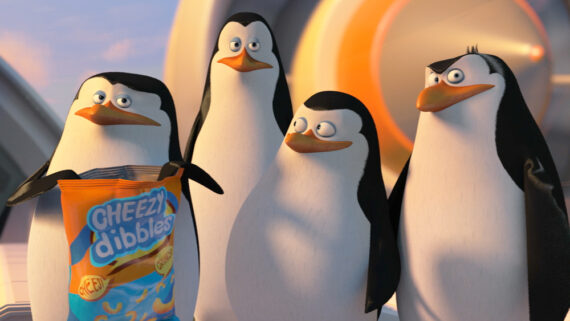
Parts of Penguins of Madagascar are inspired, particularly John Malkovich’s turn as a villainous octopus who communicates in accidental celebrity puns (“Nicolas, cage them.” “Drew, Barry, more power!”), the animation is reliably high quality and the penguins are as entertaining as ever. But at best a film this fast-paced and wilfully trivial could sustain a 70 minute runtime. Ultimately, though I have a lot of goodwill towards Penguins of Madagascar, and though it is better than two thirds of the films in the franchise that spawned it, these penguins are best consumed in smaller portions. This humongous dollop just ended up giving me brain freeze.
28.The Bad Guys 2
Before The Bad Guys 2 began, there was a DreamWorks ident in which the iconic boy in the moon floats past and waves to various characters from the company’s franchises. It brought home just how many huge properties DreamWorks owns now and, while it’s easy to be cynical about the diminishing returns associated with franchising and sequelising, I must admit it made me a bit teary-eyed. Here were characters who had entertained me through the years, ever since my teens, all in one place in one brief piece of film. While critics have generally considered DreamWorks a secondary studio , this ident illustrated just how effectively their creations have slid into the culture, making their mark despite systematically being decried as not as good as Pixar. While there are several DreamWorks characters who achieved cult status off the back of one-off movies, the characters presented here were those who have proved popular enough to spawn more than one film. Among them were The Bad Guys, whose latest venture has proven that they too deserve a place alongside the infinitely franchisable.
The Bad Guys 2 has ended up mid-table in my DreamWorks ranking but that is just testament to how many great DreamWorks films there are, far more than I expected at the start of this rewatch. I loved the first Bad Guys film but I was on the fence about whether a sequel was a good idea. There are many ways a sequel can go. You can get drastically diminishing returns or you can get something that improves upon the original. Often, you get a fine, enjoyable film that builds on the franchise without necessarily adding much in the way of anything new. DreamWorks have produced sequels in all of these categories and, while a part of me hoped that The Bad Guys 2 might be an improvement, a bigger part of me was just relieved it was a strong, entertaining continuation. I acknowledged when reviewing The Bad Guys that it was just a really good time and little more. The Bad Guys 2 very much retains that vibe and it’s probably safe to say that if you liked the first one, you’ll like this one. On the one hand, it understandably doesn’t feel as fresh as the original and it takes a bit of clunky finagling to get the characters from where they were at the end of the first film to a position where they’re ready for a new adventure. But once they’re up and running, and with the time-honoured sequel technique of a handful of new characters in the mix, the old momentum returns.

It’s a good sign that almost everyone is back for The Bad Guys 2, from the full original voice cast to the writer and director. While that means we have to suffer through more overdone fart gags (and hey, I know I would’ve loved these as a kid so why not?), it also means we get the chance to build on the groundwork laid in the previous film. In particular, this benefits Richard Ayoade’s Professor Marmalade, who spent much of the original in a toned-down form before the surprise reveal of his evil plot. With that out of the way, he is free to become a full-blooded, scenery-munching Hannibal Lecter-esque villain and Ayoade, as well as the animators who have given this diminutive tyrant life, absolutely steal the film. The final moments seem to suggest that we haven’t seen the last of The Bad Guys and I’m fine with that. This is a franchise with the potential to churn out any number of high octane action/adventure stories and, while they may not rise above the simple pleasures of the series’ initiator, it’s comforting to know that they don’t really have to.
27.Antz
It’s a rare thing to find a review of DreamWorks debut feature Antz that doesn’t also mention Pixar’s A Bug’s Life and, while I often think it’s unfair and unnecessary to review a film by comparing it to another, in the case of this unofficial insectoid double feature, it’s virtually impossible to consider them separately. Given that DreamWorks founder Jeffrey Katzenberg’s desire to start an animation studio seems to have been heavily influenced by the bad blood resulting from the feud that caused him to leave Disney, the sudden appearance of a DreamWorks film about creepy crawlies after Pixar’s John Lasseter had shared details of the in-production A Bug’s Life with Katzenberg can’t have been coincidental. Whoever’s story you believe in the subsequent Pixar/DreamWorks clash, Katzenberg’s decision to rush Antz to completion and release it six months earlier than originally planned was obviously motivated by spiteful escalation. In the event, Antz made it into cinemas first while A Bug’s Life grossed more. That said, Antz was still a major critical and commercial success and Katzenberg’s main aim was not necessarily to immediately outgross his rivals but to prove his studio could be a genuine competitor. And from what sounds like a very ugly feud, we the public ultimately got two very good bug films.
Although I tend to believe the accusations of plagiarism against Katzenberg, I concede that an adventure starring insects is hardly a new concept. One of the earliest animated features, 1941’s Hoppity Goes to Town, is just one example of a precedent, and Katzenberg’s claim that the idea for Antz originated from a 1988 Disney pitch for a film called Army Ants seems plausible, even if his timing for reviving the project seems suspect. While Pixar had made an indelible mark on the industry, it’s important to remember that computer animation was still second to traditional animation in the 90s, and the plan for DreamWorks has always been to wow the world with the hand-drawn epic The Prince of Egypt as the studio’s triumphant debut. When Antz went into production, it was seen as very much the runty little brother, with many of the artists working on The Prince of Egypt laughing derisively at this strange little bug film. It was no small decision then to reshuffle the release schedule and make the more modest Antz DreamWorks’ debut. Still, when the other DreamWorks artists saw the completed film they were reportedly surprised by how impressive and different it was. Audiences followed suit, sending Antz to the top of the box office chart, and for a period of about a month the film was free to be discussed on its own terms. Then A Bug’s Life was released and soon no-one was allowed to talk about one film without mentioning the other and were legally required to pick a favourite. Not wanting to risk a hundred hours of worker-ant-like community services, I will adhere to those unrevoked laws here today (A Bug’s Life is better).

Antz and A Bug’s Life certainly have their similarities: an awkward outsider protagonist who romances a princess, a tyrannical villain with unspeakable power over the entire colony, a quasi-Marxist subtext undone by the failure to address the presence of a monarchical structure, about half a million ant characters. But beneath those superficial similarities lie two very different films. While A Bug’s Life has a brighter, more appealingly kid-friendly style, Antz is dingy, bleak and explicitly courts an adult audience. I was once under the impression that the dreary look of Antz was the result of a lower budget but from an adult viewpoint it seems clear that it is a stylistic choice that reflects the harder-edged material. Death and despair hang over Antz like a giant fake bird (we’ve talked enough about A Bug’s Life for me to casually mix my movie metaphors at this stage). We see characters obliterated by magnifying glasses, their bodies crumbling to blackened ash. We see a whole army of Antz literally torn apart by termites. A good-hearted sidekick is brutalised by a villain who himself will eventually fall to a bone-shattering death (and, unlike all those Disney villains who fell to their deaths, this time we see the impact). A comedic wasp voiced by Jane Curtin is swatted to death in the same scene in which she is introduced, leaving her Dan Aykroyd-voiced husband to become a grieving alcoholic. This is not ordinary kid’s stuff, a fact highlighted by the fact that so many of its cast members come from the New Hollywood 70s, where happy endings were so often subservient to pessimistic realism.
Antz own brand of gritty realism works both for and against it. It’s undoubtedly refreshing to see a mainstream animated film with such chillingly brutal stakes and the screenplay by Todd Alcott and Chris and Paul Weitz often does a fine job of mixing horrific moments with effective off-colour humour, such as when protagonist Z tries to reassure the disembodied head of a soldier ant that he’s going to be just fine. On the other hand, the grim tone sometimes sucks some of the fun out of Antz. Compare Kevin Spacey’s relishable performance as the villain in A Bug’s Life with Gene Hackman’s blandly dictatorial ant-bastard. The partially realistic design of the ant characters is a tad grotesque, although the film does a good job of differentiating between them while also making them identical enough to underline its satirical point. Perhaps the strangest choice of the film is the casting of Woody Allen in the lead role. I’m not sure if Allen was always who the writers had in mind but some of the material has clearly been tailored towards his particular style. Though Allen apparently rewrote parts of his dialogue for that very reason, the character of Z never quite comes to life because the writing leans too hard on Allen’s persona for an original creation to fully emerge. Still, if you’re a longtime fan of Allen as I am (for better or worse), there’s enough in this slightly watered down version to enjoy, though non-fans may just find Z a bit irritating. The real standout here though is Sharon Stone as Princess Bala, a witty, funny and relatable performance which shapes the female lead in a way Julia Louis-Dreyfus was unable to do with her flatly underwritten princess role in A Bug’s Life.

Antz spends a lot of time delineating and critiquing the society at its centre, which helps a great deal in its satirical ambitions, but this also comes at the expense of some underdevelopment of character and story. I’ve always thought Z and Bala’s quest to find Insectopia is over much too quickly, while the eleventh hour redemption of Christopher Walken’s villainous henchman Cutter is undersold. Secondary characters like Aykroyd and Curtin’s upper class wasps are barely given time to register and their function in the plot is so minor that they could have easily been deleted. Still, the plot generally chugs along at a pleasing place and ends on a nice note, with a cleverly executed pan out that highlights just how little ground the film’s story actually covered and a sweet voiceover from Allen which is not cynically undercut in that way that would soon become de rigueur in more obnoxious animations. While Antz may retrospectively feel like an underwhelming first film for DreamWorks, it proved that they could pull off a largely satisfactory computer animated feature when such things were still a rarity, something that would ultimately prove essential to the studio’s longevity.
26.Shrek Forever After
The Shrek franchise has never been my favourite DreamWorks property but I must admit that over the course of revisiting it, I have warmed to it a little more. It is generally agreed that the first two Shrek films are the best, with the following two often considered much weaker by the fanbase. I am of the unpopular opinion that the Shrek films get better as they go along, with Shrek Forever After coming at the story from a very different angle but in a way that allows it to pay loving tribute to its predecessors and deploy its popular cast of characters in a new and interesting way. Originally intended to be the penultimate chapter of the Shrek saga, Shrek Forever After was promoted to being the finale when Jeffrey Katzenberg became convinced the story that Josh Klausner and Darren Lemke came up with was the perfect ending. At the time of writing, there is a belated fifth Shrek film set to be released and whether that proves to be a further improvement or a flaccid, nostalgia-fuelled retread is something only time will tell. But when you consider Shrek Forever After in the context of its intended place as the last act, it does the job very nicely.
One thing I’ve always said about the Shrek films is that they do villains very well. Lord Farquaad, the Fairy Godmother and Prince Charming were all highlights of their respective films but Shrek Forever After outdoes them all with the introduction of the brilliant baddie Rumpelstiltskin. I love the way he is designed, as if a Troll doll mated with a bobblehead, and the jittery animation does a fantastic job of accentuating his malevolence. Walt Dohrn steals the show with his volatile performance. Just watch the scene in which he dupes a drunken Shrek into literally signing his life away. He can barely suppress his bottled-up rage at Shrek having thwarted his designs on the kingdom and it becomes clear that, far from being a mastermind, Rumpelstiltskin is merely a hot-headed, opportunistic berk. That his lies and manipulations land him in a seat of enormous power is a political metaphor that is all too relevant in the current climate.
The plot of Shrek Forever After is set in motion when Rumpelstiltskin, a conman who uses magical contracts to dupe his victims out of their possessions, meets up with Shrek. Shrek has just had a heated argument with Fiona after the pressures of his newfound family life and ongoing celebrity have pushed him to breaking point. Missing his old, solitary life in the swamp, Shrek signs a contract in order to obtain 24 hours as “a real ogre” again. All he has to do is exchange that day for a day from his childhood, which Rumpelstiltskin will take away. Unfortunately for Shrek, Rumpel picks the day he was born, catapulting him into an alternate reality in which he never rescued Fiona, never met Donkey and never became a father. With only 24 hours to play with, Shrek must nullify the contract through its one and only exit clause: that old chestnut, true love’s kiss.

There are bits of It’s a Wonderful Life and Back to the Future 2 baked into Shrek Forever After’s storyline but the film wisely eschews direct parody, opting instead to present its own take on this story. By wiping the slate clean, it allows Shrek to visit important destinations from the previous films but find them quite different from before. This results in a sort of melancholic twist on the straight hit of nostalgia for which a lesser film might’ve opted. This do-over also allows the film to use its characters in a better way than ever before. Shrek’s isolation and desperation bring out a more interesting side of his well-established neuroses, while Donkey, who had become a bit of a sidelined liability by Shrek the Third, is now a crucial sidekick with a purpose. Fiona, so often marginalised by fairy tale convention, has by far her coolest role yet as the fugitive leader of an underground resistance. I liked this version of Fiona so much that I was almost rooting against Shrek winning her over. Fortunately, the climactic reconciliation is a very movingly realised scene. Sentimental finales are often one of the areas where Shrek films drop the ball but this one works beautifully, its emotion heightened by the fact that it was originally intended as the characters’ final bow. The only character who gets a raw deal in Shrek Forever After is Puss in Boots, whose alternate reality equivalent is an obese pet who has forgotten how to be an adventurer. While Kung Fu Panda had artfully navigated similar waters, Shrek Forever After belly flops onto them in a way that is more reminiscent of those horrendous fat-suit episodes of Friends or the questionable treatment of Thor in Avengers: Endgame, which sacrificed an opportunity to engage with some interesting issues of depression in its cringeworthy hurry to make jokes about salad dodging and Cheese Whiz. Honestly, I think they would have done better to leave Puss out of this adventure altogether, although maybe he used this indignity to leverage his own successful spin-off franchise.
While Katzenberg’s observation that Shrek Forever After’s story would be a good one on which to go out was shrewd, the cynic in me does wonder whether it was more motivated by wondering how much longer these characters would be profitable. Shrek Forever After was another big hit but the critical tide has been turning since the third instalment and the reaction to this one was very lukewarm. Shrek Forever After spends some time ruminating on whether Shrek saved Fiona or Fiona saved Shrek. Whichever way round it was, it’s indisputable that Shrek saved DreamWorks so, whether you like the franchise or not, we have a lot to thank it for. I’m glad it got to go out on a comparative high, although its imminent return confirms what the tagline of this film says: “It Ain’t Ogre… Til It’s Ogre!”