



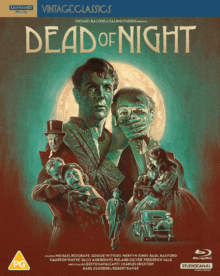
 Director: Alberto Cavalcanti, Charles Crichton, Robert Hamer, Basil Dearden
Screenplay: John Baines, Angus MacPhail
Based on stories by: H. G. Wells, John Baines, E. F. Benson, Angus MacPhail
Starring: Mervyn Johns, Michael Redgrave, Roland Culver, Mary Merrall, Googie Withers, Frederick Valk, Anthony Baird, Sally Ann Howes, Robert Wyndham, Judy Kelly, Miles Malleson
Country: UK
Running Time: 103 min
Year: 1945
BBFC Certificate: PG
By the mid-1940s, when Ealing’s Dead of Night was released, Germany had led the way in creepy portmanteau stories, and British horror films had been on hiatus for a number of years.
The silent era in Germany had brought us the likes of Eerie Tales (1919), Fritz Lang’s Destiny (1921) and Waxworks (1924), which were suitably atmospheric, spooky and entertaining anthology movies.
The British horror film had been put on hold in the 1940s for very good reason; horrific movies were effectively banned because of the real-life horrors and atrocities of the Second World War.
But as the war came to an end, not only would British horror films be back on the cards again, but with Dead of Night Ealing would effectively perfect the formula and lay out the template that all future horror anthology films, including great ones by the likes of Amicus, would follow and imitate. Ealing’s Dead of Night was hugely influential and today, 80 years after it was first screened in cinemas, it remains an incredibly effective, creepy and astonishingly good piece of cinema.
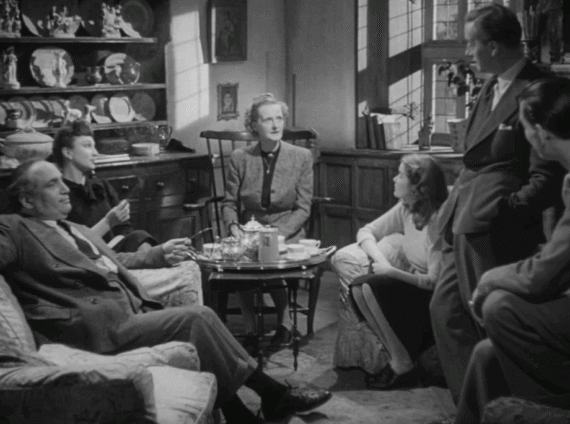
Dead of Night is framed by a story set in a farmhouse, where architect Walter Craig (Mervyn Johns) arrives, after being invited by Elliot Foley (Roland Culver) to provide his expertise on some planned renovations in the house. Craig is greeted by a group of guests, all of whom he recognises from a recurring dream despite never having met them before.
Craig has a sense of impending dread and doom that something bad will happen and the other guests tell stories to test Craig’s foresight, as well as to have a bit of fun. This story frames the tales that are told, whilst psychologist Dr. van Straaten (Frederick Valk) tries to keep Craig grounded and attempts to explain each tale.
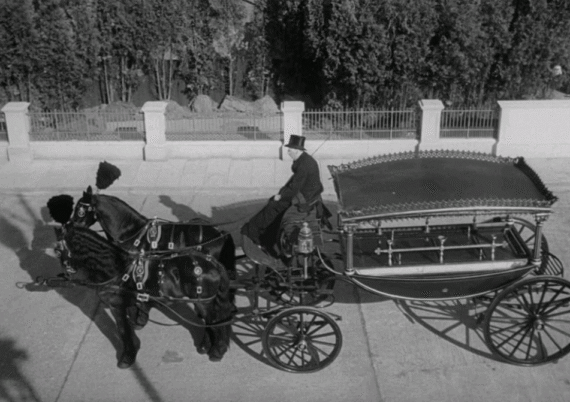
The Hearse Driver follows racing car driver Hugh Grainger (Anthony Baird) who is in hospital following an accident. One night, time seemingly stops, and he looks out of a window to see a horse-drawn hearse outside before hearing the driver say, “just room for one inside, sir”. The story uses foreshadowing to suggest Grainger may die.
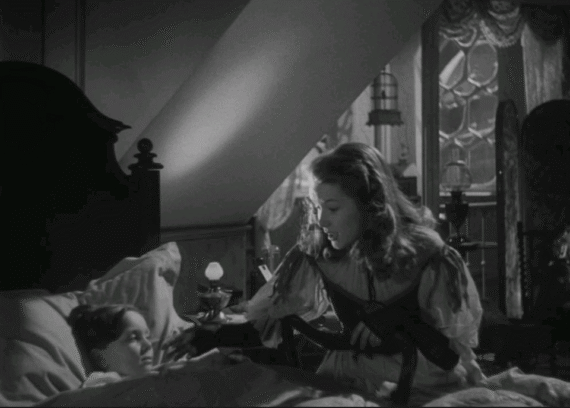
The Christmas Party sees Sally O’Hara (Sally Ann Howes) who attends a Christmas party where, during a game of hide-and-seek, she meets Jimmy (Michael Allen), who recounts how a murder once took place in the very same mansion as the party. She then meets a boy called Francis, who holds the key to the tale.
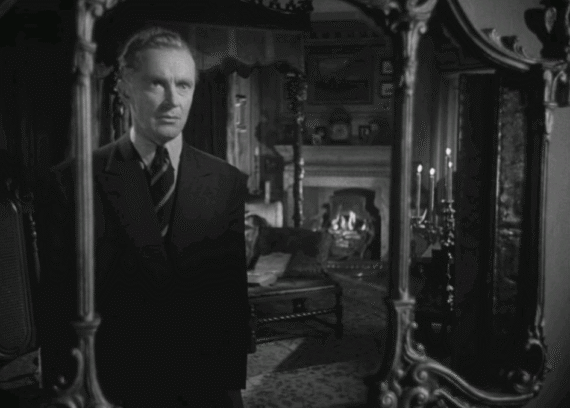
The Haunted Mirror is one of the most effective stories. Joan Cortland (Googie Withers) describes giving her husband Peter (Ralph Michael) a mirror and when he looks into it he sees himself in a completely different room to his own. Joan discovers that the previous owner of the mirror, Francis Etherington, suspected his wife was having an affair and so murdered her. The mirror seemingly has a hold over Peter which may lead to devastating consequences.
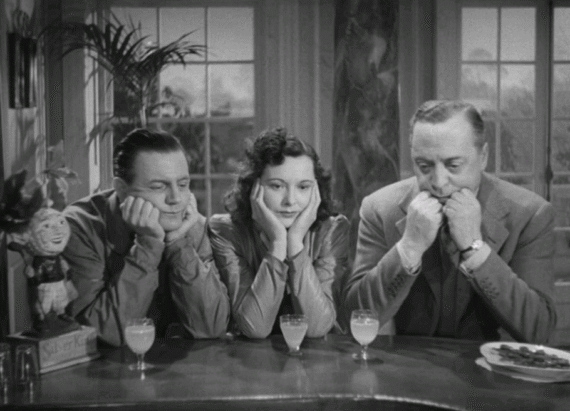
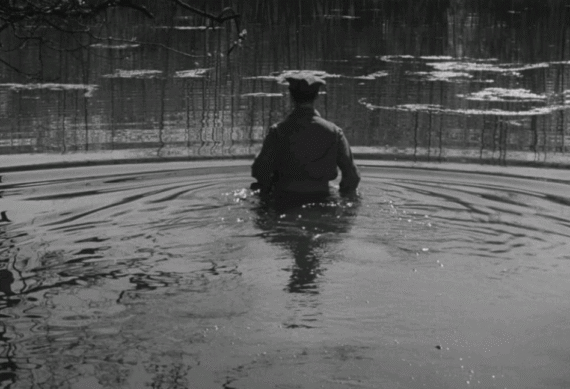
Levity is provided by the jovial tale The Golfer’s Story which follows two golfers, George Parratt (Basil Radford) and Larry Potter (Naunton Wayne), who play a round of golf to win the hand of Mary (Peggy Bryan), with whom they are both smitten. Parratt cheats to win the game, while Potter walks into a lake to drown himself, before returning as a ghost. The two stars of this one play very similar roles to those they played in a number of films, having first appeared together in Alfred Hitchcock’s 1938 classic thriller The Lady Vanishes.

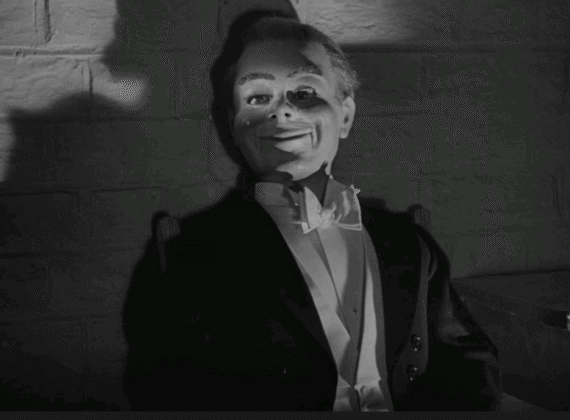
The Ventriloquist’s Dummy is the most iconic, creepy and oft-imitated tale of the lot. Recounted by Dr. van Straaten, we hear about how the doctor interviewed ventriloquist Maxwell Frere (Michael Redgrave) after he is implicated in the attempted murder of a rival ventriloquist, Sylvester Kee (Hartley Power). Frere’s dummy, Hugo, seemingly has a life of his own and talks of leaving Frere for Kee before the fateful attempted murder. The dummy is seemingly implicated in some of the bizarre happenings.
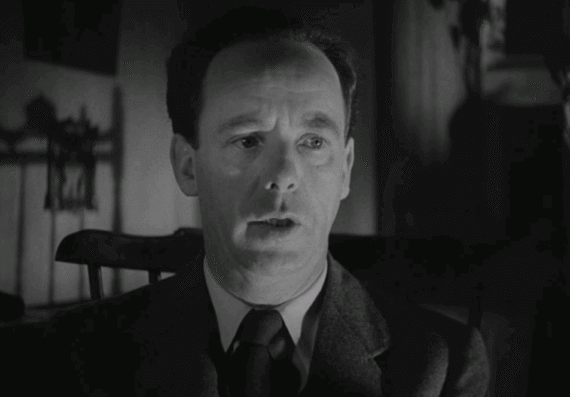
Everything then comes full circle with the framing story in a marvellous ending, which I shall not spoil, but suffice to say it’s very off kilter, bringing all the stories together in a pretty scary way and culminating in a sense of déjà vu that’s pervaded throughout the course of the film.
That framing story is economically told, introducing us to all the key players and some of the central themes before thrusting us into the anthology stories, then explaining them briefly before moving on to the next tale.
There’s a wealth of effectively spooky moments, beginning with time and sound stopping in the first story as Hugh lies in bed. He gets up, night turns to day, he looks out the window and sees a hearse driver who creepily turns to the camera and says “just room for one inside, sir”, before we hear the clock ticking again and the music kicks back in, and day becomes night once again. It’s a bravura sequence.
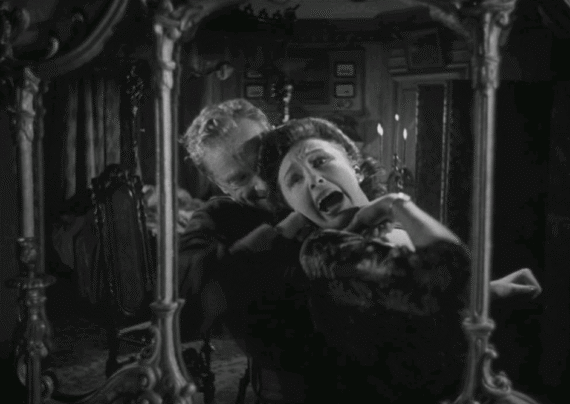
Then there’s the finale of the mirror story, as Peter becomes overtaken by the mirror and is seemingly possessed by the previous owner. It’s ominous and culminates in Peter attempting to strangle Joan in front the mirror, where she finally also sees the different room in the reflection, realises what’s happening and smashes it to bring her husband back to his senses.
Pretty much all of the sequences involving Hugo, the ventriloquist’s dummy in the final story, up the ante on creepiness. It’s a beautifully filmed, scripted and acted story, with some great lighting, particularly in the Hugo sequences, by Stan Lacey and Douglas Slocombe. Lighting is also used to great effect in the finale of the movie, as are some interesting camera angles and flourishes.
The way the stories are told makes them feel like a single narrative. It never feels episodic, aside from perhaps the golfing story, due to its different tone.
The quality of the stories is strong throughout, but the best, for me, are the mirror and ventriloquist’s dummy tales; both are also by far the longest, outside of the golfing and wraparound stories. Outside of these, the hearse driver scene and quite shocking finale to that story are very memorable and fear-inducing, as is the brilliant finale of the movie.
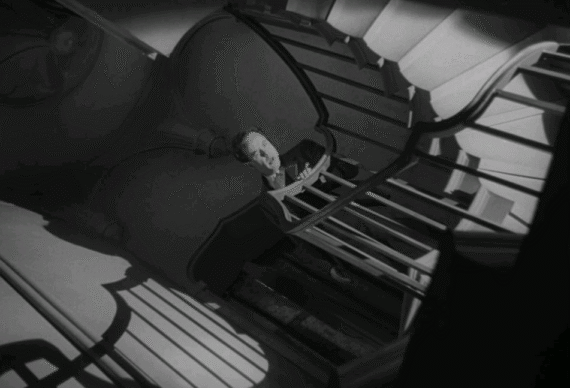
The golfing story is often maligned, yet it works for me. It gives some much-needed levity between the two darkest stories involving the mirror and ventriloquist’s dummy. It’s good fun, and also not without its own dark moment, with the suicide of the golfer.
Direction is first class, thanks to the best of the best of Ealing directors, Alberto Cavalcanti, Charles Crichton, Basil Dearden, and Robert Hamer, and there are some marvellous performances, headlined by Redgrave. The score by Georges Auric is fabulous. It is really ominous throughout and very dramatic. It underscores the creepy moments perfectly.
Each story essentially mirrors the main story. The whole film may be playing out in Craig’s mind, and, in each story, this is also the case for the lead character who apparently sees things others don’t. Frequent symbolism and themes include mirrors, duality and that ventriloquist dummy being key to unlocking the whole tale, as Alice Lowe eloquently points out in one of the extras.
In closing, Dead of Night is a masterpiece of horror and still arguably the best anthology film ever made. It certainly set the template for those that would follow, especially the oft-imitated creepy ventriloquist’s dummy tale, and is a true landmark of British horror and one of the high points in the legacy of the great Ealing Studios.
Film: 
Dead of Night is released on limited edition dual format 4K UHD and Blu-ray by StudioCanal on 20th October 2025. The image and sound quality throughout in the new 4K restoration is phenomenal with lots of rich detail, no blemishes, the black and white cinematography looking fabulous, and the movie retaining a very filmic quality.
Extras:
Brand new 4K restoration
64-page booklet with brand new essays
Two posters
On-disc extras:
Dead of Night: Dreams and Duality with Alice Lowe
Marketing Galore! The Art of Ealing with Nathalie Morris
Audio commentary by critic and film historian Pamela Hutchinson
Short Sharp Screams: Dead of Night and the British Horror Anthology – Interview with author John Llewelyn Probert
Scoring the Night: On Georges Auric and Dead of Night – Interview with author Dr. David Huckvale
Remembering Dead of Night featurette
Behind the Scenes stills gallery
The two new extras are great and open with a piece by filmmaker and actor Alice Lowe, who gives a warm appreciation of the film. The 36-minute interview looks at the duality of the feature, covers her love of Ealing and why the film resonates with her, plus her theory that the film happens in one man’s head. She talks through each story and what she likes about it and provides some great analysis and background to the film, which all resonated with my take on the movie. It is a fantastic piece. Lowe has appeared on a couple of recent boutique Blu-rays now, and each interview has been great, so it would be fantastic to see her on future releases.
Nathalie Morris provides a very insightful overview of the posters Ealing used to market their films, which includes the evocative and atmospheric poster for Dead of Night. The 22-minute piece covers the thought process behind the posters and their British feel, which is thought to be why the films had become so popular. Morris touches on some of the films, their posters and the artists behind them. It’s a really informative piece.
The archival extras are equally strong, beginning with a fabulous commentary by Pamela Hutchinson, who talks through the film’s production from the meaning of the name and opening painting to the context in which it was made. She gives her own analysis of the story, why it works and what its meaning is, as well as the themes, plus details on those both in front of and behind the camera. It’s a simply wonderful listen that is carried over from Imprint’s release of the movie.
The 42-minute interview with author John Llewellyn Probert is also from the Imprint release of the film and is fascinating. It covers anthology books, including showing the covers of some of them, and runs through some facts about them. Probert then moves on to Dead of Night and its style of including a framing story. He covers the stories, providing background to their origins, context and how the film takes elements from ghost story books. Probert looks at the Amicus anthology films and the origins to their stories too, and gives some personal views on these films and Dead of Night and what he admires in them. It’s another brilliant extra.
Also carried over from the Imprint release is a magnificent 48-minute interview with author Dr David Huckvale on Dead of Night and its composer Georges Auric. If you’ve seen interviews with Huckvale before, you’ll know how knowledgeable he is about film scores and music in general, and this is no different. We get loads of historical background to Auric, his compositions and style and approach to music. There’s plenty on the score for Dead of Night including some of the individual compositions, as well as discussion about Auric’s other film scores. Another first-class special feature.
The final two extras appeared on the previous StudioCanal Blu-ray release of the film and begin with the 75-minute Remembering Dead of Night, which is marvellous. It features a range of experts talking about the background to the film, its importance in British horror and as an anthology film, and why it is so successful. There are some interesting insights into the interlinking narrative story and on those in front of and behind the camera. Lots of ground is covered in a really entertaining and well-produced way.
The behind-the-scenes gallery autoplays for one minute with a poster and around 12 behind the scenes images.
In summary, StudioCanal’s new 4K release of Dead of Night is an outstanding release of a landmark British horror anthology film. It continues the label’s marvellous treatment and 4K upgrades for Ealing’s classics. The audio-visual presentation is fabulous and there’s a wealth of new and archival extras totalling almost four hours, not including the commentary, which together provide a rich, entertaining and insightful look at the filming and legacy of a masterpiece. A perfect release to settle down to by the fire this Halloween.
Disc/Package: