


 Director: Mike Figgis
Screenplay: Mike Figgis
Based on the novel: Leaving Las Vegas by John O’Brien
Starring: Nicolas Cage, Elizabeth Shue, Julian Sands, Richard Lewis, Steven Weber, Emily Procter, Valeria Golino, Thomas Kopache, Laurie Metcalf, French Stewart, R. Lee Ermey, Mariska Hargitay, Julian Lennon
Country: USA
Running Time: 112 min
Year: 1995
BBFC Certificate: 18
Nicolas Cage is an enigma, a charismatic performer who always throws everything into a role. His performances range from critically acclaimed to chin-scratching, yet he’s never anything less than incredibly watchable.
From early works like Fast Times at Ridgemont High (1982), Valley Girl (1983), and his uncle Francis Ford Coppola’s Rumble Fish (1983) to critical success in the likes of Moonstruck (1987) and the Coen Brothers’ Raising Arizona (1987) to becoming an action star in the likes of The Rock (1996), Con Air (1997) and Face/Off (1997), Cage was in some incredibly memorable and quotable films in the 1980s and 1990s.
Arguably, Cage’s best performance came in 1995’s Leaving Las Vegas, written and directed by Mike Figgis and based on a 1990 semi-autobiographical novel of the same name by John O’Brien. Cage’s performance would lead to him winning the Golden Globe Award and Academy Award for Best Actor, and his co-star Elizabeth Shue would also receive widespread acclaim, being nominated as Best Actress at the same two award ceremonies.
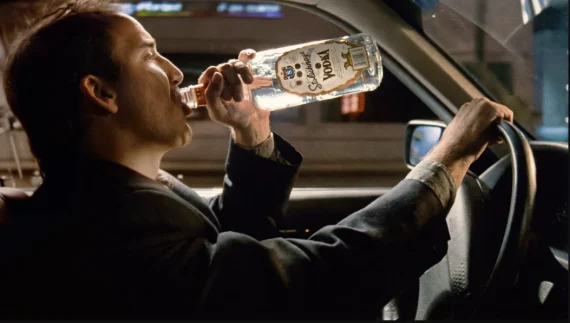
Leaving Las Vegas follows Ben (Nicolas Cage), who is an alcoholic so consumed by his vice that he has lost his job as a Hollywood screenwriter as well as his family and friends. He feels he has nothing left to live for and decides to go to Las Vegas to drink himself to death, fuelled by a large severance cheque he has received from his boss.
Shortly after arriving in the city, Ben nearly runs over sex worker Sera (Elizabeth Shue) on his way down the famed Vegas Strip. The following day Ben contacts Sera and offers her $500 to spend an hour in his hotel room with him. Sera agrees and, instead of having sex, the pair bond and make a promise to each other: Ben will never criticise Sera’s profession as long as she never tries to stop him from drinking alcohol.
The pair are initially happy, but soon grow irritated by the other’s behaviour, and what plays out is a kind of romance but much more a drama as the dangers of Ben’s alcoholism and Sera’s profession threaten devastating consequences for them both.
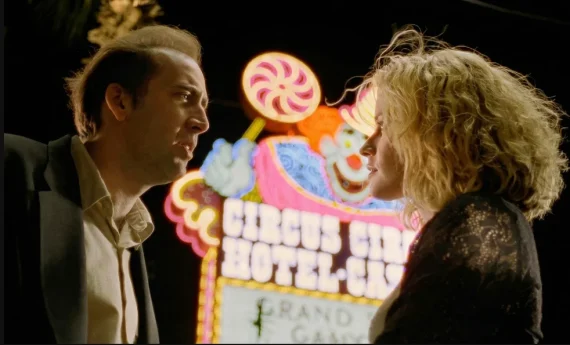
First and foremost, this is an actor’s showcase for Cage and Shue. Cage can be described as overacting in some films and his performances can be divisive but that’s not the case here. He gives his all to the performance and it’s simply astonishing. He is phenomenal, playing each facet of his character, both sober and inebriated sides, caring for Sera and being a ticking time bomb as well. It’s a masterclass.

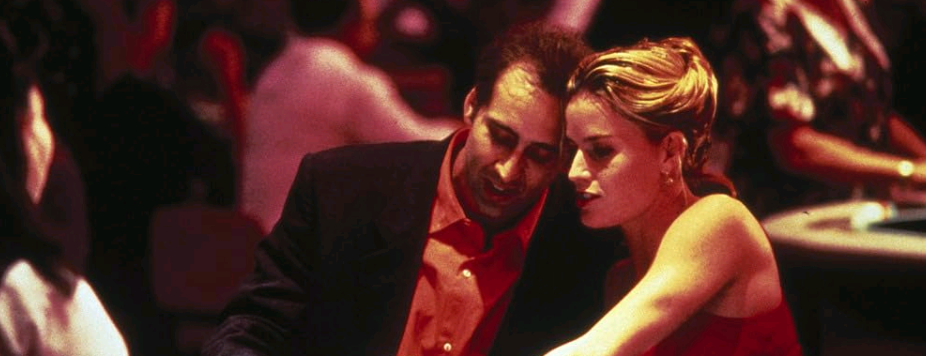
Equally encapsulating is Shue as Sera. Her performance is perhaps my favourite of the two – though that’s a tough one – she has several monologues as she talks to her therapist, which give her a chance to shine, but also has some incredibly difficult sequences to act, like a gang rape and other uncomfortable conflicts with her abusive Latvian pimp, Yuri (Julian Sands). Her first meetings with Ben are very memorable and Cage and Shue have an excellent chemistry together. One of the best sequences sees Sera holding Ben after he’s had a mini breakdown fuelled by alcohol. It’s a beautiful and tender moment, which throughout its dialogue and visual clues gives us a strong insight into the characters and how they truly feel about each other.

In other films their characters may be cliches – the drunk and the sex worker with a heart of gold – but that never feels the case here. They both feel like real characters with whom the audience spend a small amount of time with, seeing a glimpse into their all too brief lives together.
Elsewhere, Figgis has a cameo as a mobster and also look out for blink-and-you’ll-miss-it parts for the likes of Danny Huston, Shawnee Smith, Bob Rafelson, singer Julian Lennon and another member of the Coppola family, Marc Coppola.
The film is wonderfully scripted and sensitively directed by director Figgis. It’s mostly observing the two lead characters, their interactions and ultimately their lives, but there are some flourishes throughout that fit with the Las Vegas location, from the way we’re first introduced to the Strip, all neon lights at night, to Bob imagining conversations he’d like to have the guts to have with some of those he encounters.
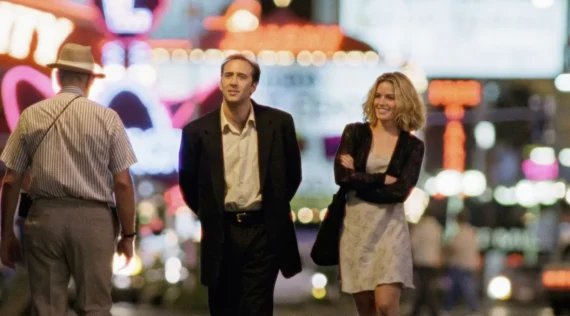
It’s lensed beautifully on super 16mm, generally used for art house or lower budget films, by Declan Quinn, with some great tracking shots and more of those flourishes mentioned above, like hyperkinetic movement at some of the times Ben is at his most inebriated, whilst Vegas is shot like a character in its own right.
Multi-talented director Figgis also composed much of the score, which helps us to get underneath the skin of the characters, particularly Ben, and the different sides that Vegas brings out in him – joyous and fun when he arrives and more melancholy as the story develops. The soundtrack is also infused with three jazz standards by Sting and a version of Lonely Teardrops performed by Michael McDonald, which opens the film.
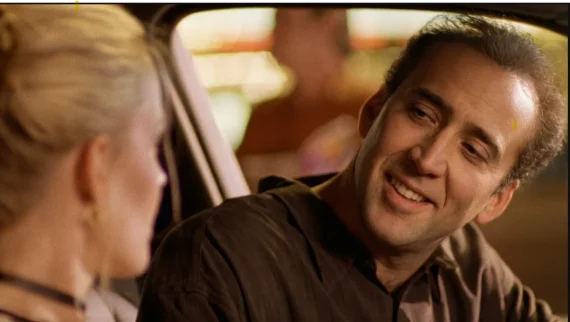
Leaving Las Vegas is a very dark and downbeat film that puts the audience through the wringer and does not cop out and leave us with a happy ending. From the first moments we meet Ben and Sera, we’re not given any indication this will have a positive outcome. We’re given some semblance of hope as their relationship plays out, but ultimately we know it will be doomed. Yet, without spoiling it too much, this does not make its gut punch of an ending any less easy to take.
Ultimately, it’s a film of one character’s self-destruction and another’s incredibly tough life, and the unlikely, yet ultimately doomed, relationship that develops between them, both toxic and loving as they accept the darker side of each other’s personalities and lives.
In conclusion, Leaving Las Vegas is an utterly devastating film, which shows some really dark sides of humanity and does not shy away from challenging themes and materials. It is unrelenting, powerful and devastating in equal measure. The film is anchored by an acting masterclass by Nicolas Cage and Elizabeth Shue, who are ably supported by the rest of the cast, particularly Julian Sands. Sensitively scripted, directed and scored by Mike Figgis, it is rightly acclaimed, particularly for the outstanding performances of Cage and Shue.
Film: 

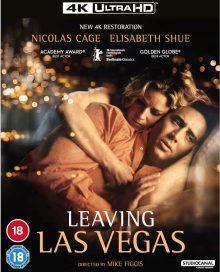
Leaving Las Vegas is released in a 30th anniversary 4K UHD edition by StudioCanal on 18th May 2026. The image looks stunning with plenty of fine detail and a natural colour scheme which belies the lower budget 16mm stock used as opposed to 35mm. It’s a very visual film thanks to the cinematography and flourishes of the camera, as well as some of the editing techniques, and all of this is given a chance to shine. It also sounds very good too; dialogue is crisp and clear, sound effects and music pop. The trailer for the new 4K restoration is available to watch on YouTube.
Special features:
New audio commentary by Mike Figgis
Mike Figgis documentary – The Shoot
Deleted scene
Making of
Interviews
B-Roll
The commentary is good, though there are some pauses. Figgis shares some scene-specific comments, some of the difficult moments, the commitment of the actors, background knowledge on the production and plenty more. It’s a really strong commentary. Bizarrely, once the commentary track finished on my review disc, the German version of the film started playing. This may have just been an issue with the check disc and didn’t happen when watching the film without a commentary.
Next is a six-minute ‘making of’ which is essentially an EPK (Electronic Press Kit) featurette to sell the film opening with a trailer and featuring some brief interviews with Figgis, Cage and Shue.
Around 10 minutes of B-roll is provided which provides a brief but welcome behind the scenes glimpse from the making of the film.
The Shoot is a really good archival documentary from the time of the film’s production; it runs for 61-minutes and gives a real insight into Figgis as a director and the production. Figgis shares why he likes filming on 16mm and the piece features interviews with a range of crew members which goes deeper than some documentaries. It’s a very good watch.
A small selection of interviews taken from the EPK are included, each around three minutes in length and featuring actors Nicolas Cage, Elizabeth Shue, Julian Sands and Figgis. They’re brief but welcome inclusions.
The deleted scene provides a chance to glimpse Jessica Alba before her breakthrough role in James Cameron’s sci-fi TV series Dark Angel (2000) and subsequent Hollywood roles in the likes of Sin City (2005) and Fantastic Four (2005). She had been an actress since the age of 13, including a small part in The Secret World of Alex Mack (1994), and a recurring role in another TV series Flipper (1994). The deleted scene runs for just under two minutes and sees Cage following Alba’s character as she walks a dog and narrating what he says like a film script. The pair then have a brief interaction.
In closing, StudioCanal have provided a strong 4K UHD edition of the acclaimed Leaving Las Vegas to celebrate its 30th anniversary. The all-important audio-visual presentation is great and the film is supplemented by an excellent hour-long documentary, equally strong new audio commentary by director Mike Figgis and other archival features, including a chance to see a pre-Hollywood fame Jessica Alba in a deleted scene.
Disc/package: 