


 Directors: Frank Beyer
Screenplay: Frank Beyer, Karl-Georg Egel
Starring: Manfred Krug, Krystyna Stypułkowska, Eberhard Esche
Country: East Germany
Running Time: 139 minutes
Year: 1966
Where Trace of Stones (1966) triumphs is in the fact it shows the human flawed side of those living in the communist state of East Germany. This was the very reason it was banned by the Socialist Unity Party (SED) – it portrays an incompetent party, adultery and characters with non-conformist views.
The SED would’ve had foreknowledge of the film and its contents. It was based on a well-known book, of the same name, produced by state-owned film studio DEFA and and was its most expensive production to date, at the time.

So, the fact it was made in the first place is quite surprising – or at least, it’s baffling the film made it as far as release, until it was pulled from the schedules after a short three-day run at a festival, to collect dust for 22 years.
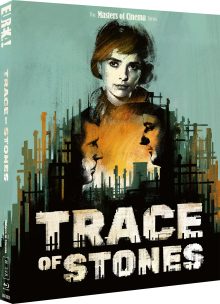
Eureka is releasing the movie on Bluray in 1080 HD, as part of its Masters of Cinema series. The restoration work was carried out by the DEFA Foundation.
The near two-hour and twenty-minute drama was directed by Frank Beyer, who also made Jakob the Liar, released by Eureka earlier this year. The story takes place at a construction site, run by the state party, and involves a love-triangle which causes a bureaucratic upheaval at the site.

The triangle includes bullish work crew leader Hannes Balla, played by Manfred Krug, who has a mischievous streak – yet as the story unfolds, we see him to be decent and well-meaning with a sentimental air. Krug has a magnetic quality.
Then, there’s engineer Kati Klee, portrayed by Krystyna Stypułkowska, who is also engaging to watch as she establishes herself in the male dominated environment, full of bravado. And finally, Eberhard Esche as Werner Horrath, a party secretary who helps manage the project. It’s compelling to watch Horrath’s story unfold as his actions play at odds with the behaviour expected of a high-ranking party official.

The film is a slow-burn but a thought provoking picture that draws the viewer in with a host of well-defined and authentic seeming characters. Plus, there are some charming moments, especially in scenes between Balla and Kati. There are also some very funny moments, particularly those shining a light on the incompetency of some of the party members.
The black-and-white picture is shot stylishly in a sweeping wide-screen format with a clear vivid imagery on display. There really isn’t much to look at on the construction site, but the way the meetings and interactions are shot is involving.
Film:


Special Features:
- Limited edition O-card slipcase featuring new artwork by Carly A-F [2000 copies]
- Limited edition booklet featuring a new essay on the response of East German audiences to the banning of Trace of Stones by DEFA expert Michael Wedel [2000 copies]
- 1080p HD presentation from a restoration by the DEFA Foundation
- Original German audio
- Optional English subtitles, newly revised for this release
- The 11th Plenum: A Cultural Devastation – substantial archival documentary on the 11th Plenum, which resulted in the banning of several DEFA productions including Trace of Stones
- Trace of Time: Director Frank Beyer – feature-length archival documentary on Trace of Stones director Frank Beyer, widely recognised as one of the most important East German filmmakers
- Children’s Home (Angelika Andrees & Petra Tschörtner, 1978) – DEFA documentary on the residents of an East German children’s home, banned until after the fall of the Berlin Wall

The film is packaged with three archival documentaries. The hour-long feature on Frank Beyer’s life is fascinating, showing interviews with the director and sequences of his other movie. The 46-minute documentary on the 11th Plenum, the party committee which banned the movie, along with 11 others, is fairly dry with long interviews, yet shows the madness of party system. The 25-minute documentary Children’s Home shows fascinating footage in crisp quality, if generally quite mundane.
The booklet contained a fascinating article all about the reactions to the film being banned. It features unearthed letter to an East German newspaper from readers complaining about the film’s ban and the fact the paper was going along with the party messaging.
I really wish Eureka had produced some sort of contemporary feature, be it an interview or a video essay, about the film. I think it really needed some explicit commentary on the exact reasons the film was banned, along with analysis of the film’s themes. However, for those with a particular interest in that era of German history – these bonus features will be a treat.
Disc/package:

Eureka is releasing Trace of Stones in Bluray on 18th May, 2026.