



In Part 9, the final part of my journey through the Best Picture winners, I’m looking at the films I’ve chosen as the top ten Best Picture winners. All entries contain spoilers.
You can find the earlier parts of the list here:
Part 1
Part 2
Part 3
Part 4
Part 5
Part 6
Part 7
Part 8
10. THE FRENCH CONNECTION
Watched 7 December 2022
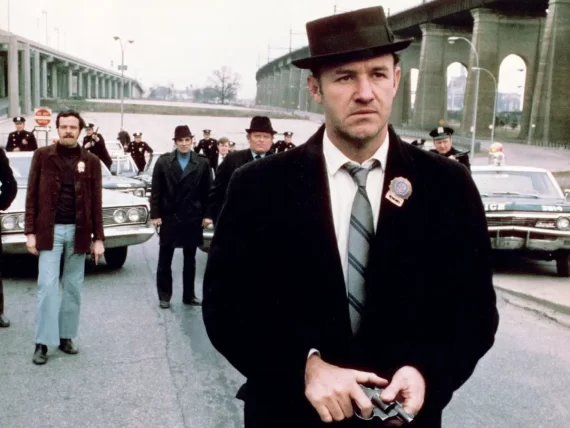
For those who watch William Friedkin’s The French Connection without context, it may be possible to miss just how important and influential a film it is. So many subsequent crime thrillers have imitated it, often badly, that it could get lost in the shuffle of its hit-and-miss successors. But look at films of the same genre leading up to The French Connection and you’ll find little else like it. Friedkin cited Costa-Gavras’s excellent Z as an influence on his film’s gritty, documentary-like realism but The French Connection pushes things even further in that respect. With its superb location work around the insalubrious streets of New York, it feels like you could wipe your finger across the screen and come up with a layer of grime several inches thick. This impression is heightened by the moral muddiness of the film’s characters, which eschews the then-accepted trope of the hero cop in favour of Gene Hackman’s dogged, brutal, racist Jimmy “Popeye” Doyle, an instantly iconic figure in American cinema who challenges the very notion of a traditional icon. These innovations, along with several action sequences that set a new bar for the genre, make The French Connection one of those rare productions that genuinely changed the language of film in one fell swoop.
Even if we disregard The French Connection’s importance to the Action/Thriller/Crime genres, you’d have to be watching with one eye closed (like the original Popeye himself) to miss just what a taut, unsurpassed marvel it is. Clocking in at a blissfully concise 104 minutes (before the popular misconception that longer-equals-bigger-and-better firmly took hold), there isn’t an ounce of flab on the film. Ernest Tidyman’s expertly crafted screenplay introduces its characters in pacy vignettes, laying out the information we need without getting bogged down in exposition. Friedkin’s direction ensures that even if you miss certain details of the plot first time round, it’s still easy to figure out what role everyone plays, who is chasing who and why. The early scenes of Popeye and his partner Cloudy (the latter based on NYPD detective Sonny Grosso. Sonny/Cloudy. Geddit?!) going about their jobs establishes a sense of their camaraderie but with a refreshingly unpleasant realism that clashes with the usual light jocularity of buddy pictures. Roy Scheider’s Oscar-nominated, subtly restrained performance as Cloudy provides a perfect balance for Hackman’s viciously entertaining lead turn and as the film reaches boiling point Scheider temporarily recedes into the background, allowing Popeye and his bludgeoning techniques to take centre stage and kick the film up another notch.
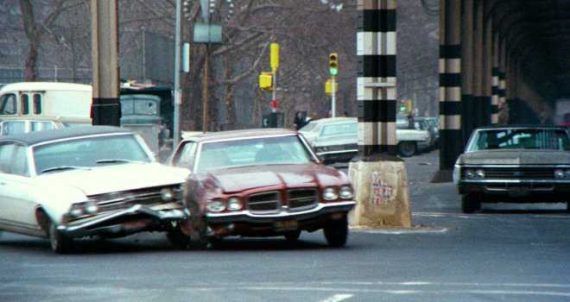
Of course, there’s that car chase, and it is as great as you’ve heard. Unusual in the fact that it is a chase between a car and an elevated train rather than two cars, the scene distinguished itself in many other ways. Owen Roizman’s Oscar-winning cinematography puts us right in the car with Popeye, giving us a frenzied POV as the commandeered vehicle races through the streets to keep up with the train above it. This is intercut with shots of the car both narrowly avoiding obstacles and smashing into them, including some moments that were actually errors on the part of stunt drivers which ended up making the sequence even more effective. Friedkin also cuts between the action in the car and the action on the train, showing how both pursuer and pursued are rapidly losing control of the situation. It’s frenzied, it’s scrappy, it’s exciting as hell. But it’s not the only brilliant sequence in The French Connection. Though rightly lauded, the car chase has a tendency to overshadow some of the other exceptional moments, notably a scene in which Popeye tries to surreptitiously pursue his mark on a subway train. Tense and suspenseful, it’s also timed with the precision of a classic silent comedy routine, with a final beat that evokes the same sort of laughter as Buster Keaton’s nimble slapstick. I’m also a big fan of a scene in which a car is dismantled completely in search of hidden contraband, and a scene in which Popeye harasses barroom patrons while staging a convincing altercation with an informant. These moments occur naturally, never seeming like self-conscious flourishes, and it’s not until quite late in the film that you notice how all these superb moments have mounted up into a relentless whole that barrels forward with the same insistence as that elevated train.
In common with many films of its era, The French Connection ends on a downbeat note of failure and deflation. In decades to come, this would be a guaranteed way to set up a sequel but in the 70s these deliberate anticlimaxes briefly became a paradoxically satisfying way to end on a note of realism. Of course, when a practice becomes de facto it often leads to forced examples and there are plenty of films from the era that tack on unnecessary down notes in a way that frustrates as badly as the upbeat alternative. This is not the case with The French Connection. Though it did spawn a fairly well-regarded sequel, there’s never a sense that its ending is trying to be anything less than final. I’ve so far avoided seeing The French Connection II because, to me, this story ends perfectly with the image of Popeye running off into that dank warehouse, desperately firing off his gun in the darkness. It may provoke an “Is that it?” reaction from those more used to the neatly wrapped-up films that tried to emulate The French Connection but didn’t have the gumption to completely reject the clichés it avoids. But anyone on the film’s wavelength will likely think it an apt and satisfying finale.
9. WEST SIDE STORY
Watched 28 May 2023
The first of four Musicals to win the Best Picture Oscar in the 60s, West Side Story is also, for my money, the best, and one of the finest Musicals ever made. That’s not necessarily a fashionable opinion to have these days, given that the publicity around the recent (also very good) Spielberg remake shone a light on the fact that a considerable amount of brownface makeup was used in the original. Rita Moreno was the only Latino performer in the whole cast and even she was made to have her skin artificially darkened. When she questioned the practice and protested that Puerto Ricans could be many different colours, she was accused of racism by a makeup artist.
Like so many classics then, West Side Story has its problematic side. But it is also a striking, mesmerising and energising piece of filmmaking that I can’t help but adore. Based on the 1957 Broadway Musical of the same name, West Side Story is a loose retelling of Romeo and Juliet but with contemporary rival New York gangs taking the place of the Montagues and Capulets: the white American Jets and the Puerto Rican Sharks. When two of their number, Maria and Tony, fall for each other at a local dance, their secret love makes them long to heal the rift between the gangs, starting by trying to quash an upcoming rumble. If this all sounds tediously grim and didactic, there are a lot more layers to West Side Story’s approach that prevent it from becoming either familiar or on-the-nose, even with a Shakespeare play serving as its basis. For one thing, the choreography is absolutely stunning. You may think that gang members facing off against each other by way of balletic leaps and rhythmic finger clicks would be inherently ludicrous but West Side Story establishes this as its norm with a sensational ten minute opening number that is mostly devoid of dialogue and depicts the Sharks/Jets rivalry through silent gestures and riveting dance moves. Director Robert Wise agreed to share a co-director credit with Jerome Robbins, who choreographed and directed the bulk of the musical sequences. Though this was magnanimous of Wise in an industry known for its disruptive egotism, the dancing in West Side Story is so pivotal that it would’ve seemed ludicrous for a director not involved with those sequences to take sole credit for the film. Wise’s contribution, however, is far more than just filler between musical numbers. He strikes the perfect tone for the material and there’s a rhythm to the dialogue and movement in his scenes that feels intricately choreographed itself. It speaks clearly of Wise and Robbins’ effective collaboration that their respective strengths build on the other’s and the scenes consequently flow into each other with the same fluidity displayed by the performers.

While Roger Ebert acknowledged West Side Story as a great film, he yearned for a stronger sense of danger, with the gang members being “less like bad-boy Archies and Jugheads.” But I’ve always thought that the goofball personalities of the Jets in particular is crucial in underlining how they could be normal, happy kids without the prejudices that have been projected onto them. This impression would be lost if their violent tendencies seemed inherent rather than learned. There’s a key line which highlights how West Side Story is sympathetic to, rather than judgmental of, its gangs. Despairing of a violent attack the Jets have perpetrated, elderly drugstore owner Doc cries “You make this world lousy”, to which one of the kids responds “We didn’t make it, Doc.” Up until this point, Doc has seemed like a weak narrative concession to adult finger-wagging but this exchange acknowledges his blindness to the part his own generation and those before it have played in instilling the prejudices that drive the current divides. It’s easy to blame the kids and West Side Story knows this, even if Doc remains unwilling to experience that same realisation. Likewise, the police officers are corrupt, sadistic and racist, rather than the pillars of society favoured by the simplified moralising of less nuanced productions.
Another more common complaint that Ebert had about West Side Story was that the central romance and the actors portraying it are bland in comparison to the supporting performance by Rita Moreno. While I think Natalie Wood and Richard Beymer do fine as the lovers, with Wood especially rising to the occasion in her final scene, I’ve never had an issue with the comparative blandness of the romance because it is so blatantly just a small part of a film that is far more interested in the simmering tensions and ominous sense of hovering tragedy, not to mention an oft-unacknowledged but very prominent streak of comic relief. The fact that neither Wood nor Beymer were Oscar-nominated, while Rita Moreno and George Chakiris both won Oscars for their supporting roles, is testament to the fact that West Side Story is primarily an ensemble piece. Although the Romeo and Juliet origins suggest Maria and Tony should be the focus, writer Ernest Lehman and lyricist Stephen Sondheim seem noticeably more interested in characters like Anita, Bernardo and Riff. The fantastic soundtrack, which is one element of the film that is rarely disparaged, does provide Maria and Tony with some great songs, including I Feel Pretty, Maria and the iconic duet Somewhere (a song for which the character allocation changed with each adaptation, from Consuelo in the Broadway version to Maria and Tony here and Rita Moreno’s Doc-substitute Valentina in Spielberg’s version). But the more memorable numbers are given to the rest of the cast, with the Jets being blessed with the slinky Cool and the full-on goof of Gee, Officer Krupke, and Anita, Bernardo and the Sharks bagging the plum cut with America, one of the greatest musical numbers ever written. The satire on the Puerto Rican experience in America is still biting today and the way the song builds to its genuinely funny punchlines is magnificent, with Sondheim’s ingenious lyrics allied to Leonard Bernstein’s catchiest melody. The delivery of Moreno and Chakiris marries their musical talents with their excellent comic timing, not to mention their combustive dancing. In the case of Chakiris, this one number probably played a huge part in his Oscar win, while Moreno shines throughout the film and emerges as its real star in the eyes of most.
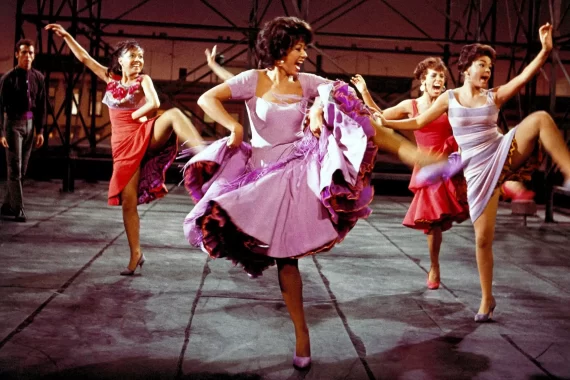
Another winning element of West Side Story is Boris Leven and Victor A. Gangelin’s art direction, enhanced further by Daniel L. Fapp’s cinematography and Irene Sharaff’s costumes. The whole look of the film is scrumptiously stylised, creating an artificial but immersive world which, for me, works better than actual location shooting. The opening sequence shows an overhead view of various New York locations before zeroing in on one in particular. It is as if each one is a stage offering a different drama, and the film chooses this particular one to present to us. The material’s stage origins feel honoured by this approach without merely being replicated, with the sets being evocative enough to suggest exterior locations while also channeling the interior magic of the theatre. With its fluid tone, eye-popping visuals, rousing soundtrack, leavening comedy and vibrant range of performances, West Side Story has fought off very strong competition to pirouette its way into my top 10.
8. THE STING
Watched 2 June 2023
Sometimes, an innovative, boundary pushing single is released in the same week as a flashy, guaranteed Pop hit. When the charts are announced at the end of the week and the Pop song inevitably charts higher, the disgruntled, self-serious fans of the other song bemoan this fact with a ferocity akin to that inspired by a personal injustice. And yet the Pop hit endures, resounding down the decades and delighting fans new and old for generations. The Sting, combining a light tone, snappy storytelling, vivid performances and socko plot twists, is the film equivalent of that Pop hit and, no matter how much fans of The Exorcist opine its Academy Awards victory, its hefty appeal refuses to dim. Sometimes the Pop song is just better.
For my part, I adore The Sting. I turn to it whenever I fancy an evening of guaranteed pure entertainment and in recent years it has inadvertently become a film I often treat myself to on my birthday (as I just did with this rewatch). There is a broad, performative edge to The Sting’s presentation that almost replicates the thrill of a good evening at the theatre. In a decade during which major Hollywood films were often characterised by a sense of realism, The Sting is a living cartoon with an air of pastiche in its Scott Joplin-quoting score, its tinted cinematography and its vivid period costumes. But the actors, though clearly having fun with their roles, never feel merely like performers playing dress-up, as in, say, Woody Allen’s The Curse of the Jade Scorpion, to cite a particularly egregious example. Instead, the high-spirited ensemble works hard to evoke a sort of unreal approximation of Depression era Chicago, like the Saturday Evening Post style illustrations that introduce each chapter come-to-life. The Sting keeps its stakes high, and when violence occurs the blood we see is a vibrant crimson, but that tinkling piano keeps reassuring us that we’re not heading for one of those trademark 1970s downbeat endings, and for a film that makes such a fantastic matinee that is an important tonal decision.
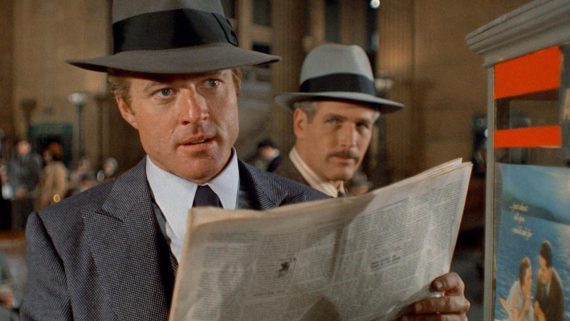
The Sting reunited Paul Newman and Robert Redford with their Butch Cassidy and the Sundance Kid director George Roy Hill and the abundant charisma and deftly balanced Comedy/Drama split of that film reignites immediately. Alongside its two stars, who are both very good (Redford received his only Oscar nomination for acting in this role), Robert Shaw is memorably menacing as the stony-faced villain Doyle Lonnegan, and there is a gallery of game supporting talent, with standouts including Ray Waldron, Harold Gould, Eileen Brennan and Charles Durning, the latter playing a wonderfully hateful secondary villain, the vicious, dirty cop Snyder.
In a film all about con artists, it is crucial to distinguish different levels of morality in order that we have someone for whom to root. Though there is a moral ambiguity to almost every character here, The Sting ensures that its heroes are charming and follow some kind of moral code, albeit a skewed one, while its villains are cold, calculating or obnoxious. Such clearly delineated audience affiliations are key in not distracting from the slippery plot which is always either depicting a con or else perpetrating cons of its own. If you enjoy a good con trick, card game, false identity or frantic chase, you’re never far away from one in The Sting. It’s fair to say that the influence of David S. Ward’s tricked up screenplay has ensured that many latter day viewers come to the film somewhat more prepared for the games it plays, but the misdirection it employs is still sufficient to wrongfoot anyone who is not looking too hard to work out what’s coming. The Sting is a better experience if you don’t try and second guess it and while the proliferation of twist-filled media that followed in its wake may make it impossible not to arrive primed to do so, the easy charm of the film is hopefully enough to draw most viewers in to the point where they relax and just enjoy watching the thing unfold. Certainly, the climactic scenes in particular wowed 70s audiences. My Dad told me that when he originally went to see the film, the audience burst into spontaneous applause at the final twist. But even if you’re ahead of where the film is going, there are plenty of smaller reveals and bumps in the road along the way to enjoy.
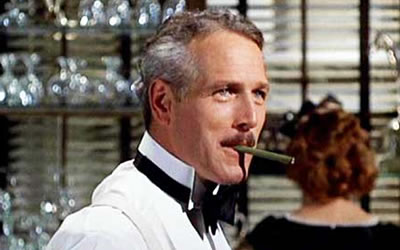
For a film whose winding plot could be called complex, the pleasures offered by The Sting are comparatively simple. It’s just a great time at the movies and that is not to be devalued. The fact that it has entered my top 10 above such films as Lawrence of Arabia or The Godfather Parts 1 and 2 may be vexing for some who measure the value of films entirely in innovation, influence and perceived importance. I wouldn’t want to suggest that The Sting doesn’t also have a stake in all those factors but, above all, the main reason The Sting has ranked so highly for me is that… well, sometimes the Pop song is just better.
7. IN THE HEAT OF THE NIGHT
Watched 3 April 2023
There are certain films that mean something to us, about which it is hard to be objective. For me, In the Heat of the Night is one such film. This was a favourite of my Dad’s from the era in which he grew up and we watched it together so many times that I can’t view it now without hearing the things he said and the moments he laughed, like some kind of commentary track from beyond the grave. At the time, I loved In the Heat of the Night just for being a great film to share with my Dad, but in retrospect I can see that he was pointing me in the direction of films he knew would shape my character and stimulate my liberal inclinations (which I’d picked up at an even younger age from listening to my Dad complain about Tories as he watched the news). When I think of other films to which he introduced me – 12 Angry Men, All the President’s Men – I can definitely see a pattern, but this wasn’t some kind of covert liberal indoctrination either. Dad was sharing films that he loved, that had an effect on him as a young man, and because I took after my Dad so significantly, they had the same effect on me. So before I even get to the content of In the Heat of the Night, there’s that emotional context that needs to be declared upfront. That’s the sort of honest and open disclaimer of which my Dad would’ve approved.
Even without my personal history with In the Heat of the Night, I’m certain I would’ve loved the film anyway. A satisfying Murder Mystery enhanced by its astute take on 60s race relations, In the Heat of the Night is the instantly gripping, thrillingly atmospheric and wildly entertaining tale of Virgil Tibbs, a black Philadelphia detective who inadvertently gets drawn into a murder investigation in the small Mississippi town of Sparta. Starting out as the racist police force’s main suspect, Tibbs is soon enlisted by the bigoted but tentatively receptive Chief Gillespie in an attempt to get to the bottom of who killed wealthy industrialist Phillip Colbert, who had come to Sparta with the intention of building a factory. As Tibbs attempts to focus on the case while keeping Gillespie’s kneejerk hunches in check, he also has to deal with the volatile townsfolk, the rising threat of racially-motivated violence and emerging evidence of his own prejudices.
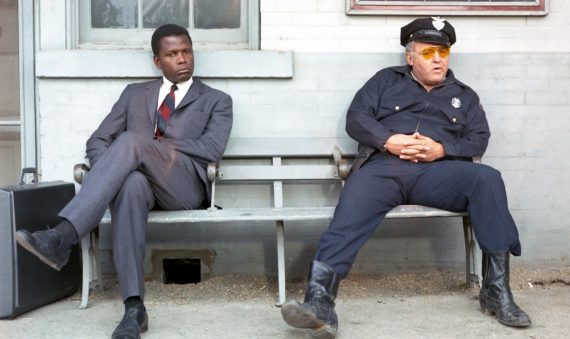
If In the Heat of the Night sounds like the sort of film that could drift into heavy-handed messages and pompous speechifying, it is actually a balanced, restrained examination of racism in which the themes and story work in the service of each other. The film never feels like it stops the action to deliver an ideological diatribe. The issues arise in relation to the plot and while the crime itself is proven to not be racially motivated, the investigation’s focus on that very real possibility acknowledges the systemic criminality of prejudice and how it exacerbates other forms of violence. The reaction of the townsfolk to the presence of a black detective ultimately results in another body in a case that could’ve otherwise been brought to a conclusion without further bloodshed. It doesn’t take long to find one of those smug online reviews of In the Heat of the Night that claims it tries to “solve racism” but the film’s approach is far more restrained than that particularly dunderheaded and depressingly prevalent assessment would suggest. In the Heat of the Night concludes with a note of hope and growth but it is not the Christmas dinner at the end of Green Book. There is no suggestion that Chief Gillespie will suddenly join the Civil Rights movement or even stop using racist epithets, a point that a late-on scene of male-bonding gone awry is at pains to make, but a progression has taken place. To end on any other note in a film of this kind would be to betray its intentions, leaving the audience with the counterproductive impression that certain lost causes render progression impossible.
There’s an expectation that films about race will be forbiddingly bleak at the expense of entertainment but In the Heat of the Night is a ferociously entertaining film. It is a surprisingly funny film too, with the pairing of Sidney Poitier and Rod Steiger providing an inspired odd-couple heart. The character beats are exceptional, with Steiger making Gillespie’s struggle between embedded ignorance and a deeply suppressed inclination to do better into an amusingly wearied journey. Steiger’s writ-large turn finds its perfect foil in Poitier’s Tibbs, a dignified performance of poise and restraint which occasionally allows the simmering rage that so clearly underscores it to bubble over the top. Stirling Silliphant’s superb screenplay rejects the potentially repetitive and condescending structure of Tibbs repeatedly embarrassing Gillespie and his staff in favour of a more nuanced approach in which Gillespie occasionally gets the upper hand in a way that makes Tibbs examine his own flaws and subtly implies Gillespie’s deliberately buried intelligence which justifies that hopeful climax. Steiger won the Best Actor Oscar for his brilliant performance but there is a sense of injustice in his solo victory. The partnership here feels so symbiotic that a rare joint Oscar would’ve felt more appropriate. As it was, the phenomenally popular Poitier may have been a victim of his own success when his three major roles in In the Heat of the Night, To Sir, With Love and Guess Who’s Coming to Dinner all coincided and likely split the vote. Tibbs is the role for which he really should’ve been nominated and when he delivers THAT iconic line, it’s hard to imagine that he wasn’t.
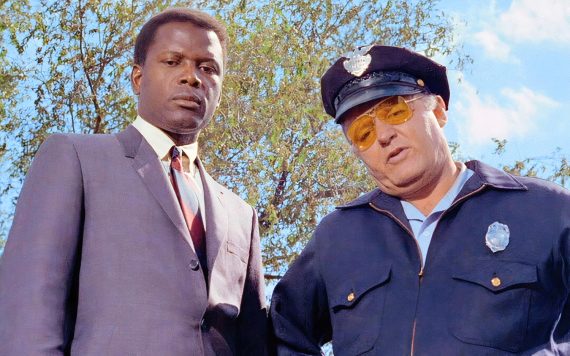
In the Heat of the Night is often characterised as a safe liberal picture by those disgruntled that it beat Bonnie and Clyde and The Graduate to Best Picture. But attempts to file it away with the far more reticent liberalism of Guess Who’s Coming to Dinner reveal In the Heat of the Night to be a more daring film than it is sometimes given credit for being. Notably, the scene in which Tibbs slaps the wealthy and influential white man Endicott was a bold moment for its era. Poitier has claimed this was his idea while others have noted it appeared in an early draft of the screenplay, but whatever its source, this satisfying, tense moment must’ve felt liberating to Poitier who’s superstardom had sometimes been purchased on the unfortunately necessary basis of compromise. Reportedly, Poitier and Steiger would sometimes attend screenings of In the Heat of the Night to listen to the mixed reactions to the slap, with rapturous whoops from black audiences and astonished gasps from white ones. The scene leads to one of the key moments of the film, in which an enraged Tibbs rallies against Endicott and promises to destroy him with the murder investigation, at which point Gillespie observes “You’re just like the rest of us, ain’t ya?” Though it is a bit of a false equivalency, given that prejudicial treatment based on skin colour is less understandable than vengeance against an oppressor, it’s an accurate representation of the flawed logical trajectory a man like Gillespie might follow and the fact that it gives Tibbs food for thought is a nice touch, as is the fact that he doesn’t altogether drop his pursuit of Endicott once he has cooled down. In the Heat of the Night shows its admirable nuance by refusing to deal in Road to Damascus moments.
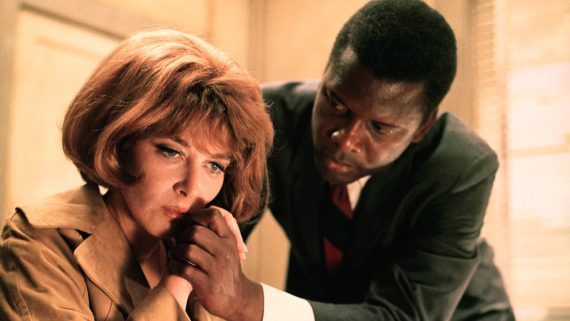
The supporting players in In the Heat of the Night fill out the world memorably. Warren Oates is good as the none-too-bright Officer Sam Wood, Anthony James is effective as diner cook Ralph, Peter Whitney is fun as the devious Deputy Courtney, and James Patterson is terrifyingly seething as Mr. Purdy. Most memorable of all is Lee Grant as the murdered man’s widow, with the scene in which she finds out about his death being one of the most realistic portrayals of someone suddenly hit by grief that I’ve seen on screen. But In the Heat of the Night mainly hinges on that central relationship. Tibbs and Gillespie wouldn’t be half as interesting in isolation from one another, as the lukewarm reception to the two Tibbs-focused sequels attests. Still, if those films suffered from the lack of Steiger, it would’ve been even worse had they attempted to reunite them as fishing buddies or something. The relationship between Tibbs and Gillespie is perfect as we leave it, an ode to incremental change in which neither man will pine for the other’s company or even think about them much, yet both have inspired positive change in the other. Just like my Dad did in me on those movie nights I miss so much.
6. ON THE WATERFRONT
Watched 19 June 2022
When the random generator threw out On the Waterfront as the first film I’d be watching in the Best Picture Project, I couldn’t have been happier. As starting points go, I could scarcely have hoped for a better one and I was not surprised to discover I still love On the Waterfront every bit as much as I did when it blew me away for the first time decades ago. In fact, I think I love it even more. The story of one man’s fight to bring down the corrupt union boss who holds sway over the longshoremen on a New Jersey dock, On the Waterfront is widely considered to be Elia Kazan’s allegorical response to those who criticised him for willingly naming names before the House Committee of Un-American Activities. Fortunately, this queasy context can be easily ignored since Kazan’s allegory simply doesn’t work and there are far more deserving tyrannical targets whom audiences can project onto the despicable gang of corrupt union thugs.
If Kazan failed in making On the Waterfront a convincing defence of his own political actions, that’s the only way in which he failed here. On the Waterfront is simply a magnificent film in every respect. Kazan’s direction is taut and gritty, making fantastic use of the Hoboken locations, and Budd Schulberg’s immaculate screenplay is intelligent without resorting to wedging unconvincingly eloquent dialogue into the mouths of characters who would never speak that way. Every character has their own distinct voice, allowing for Schulberg to present soapbox moments without it ever feeling forced, by placing this dialogue in the mouth of Karl Malden’s Father Barry, the moral guardian of the waterfront. These rousing speeches differ significantly from, say, Marlon Brando’s famous “I coulda been a contender” monologue, which is plainspoken as hell but finds the poetry of desperation in the character of Terry Malloy’s limited vocabulary and specific worldview.
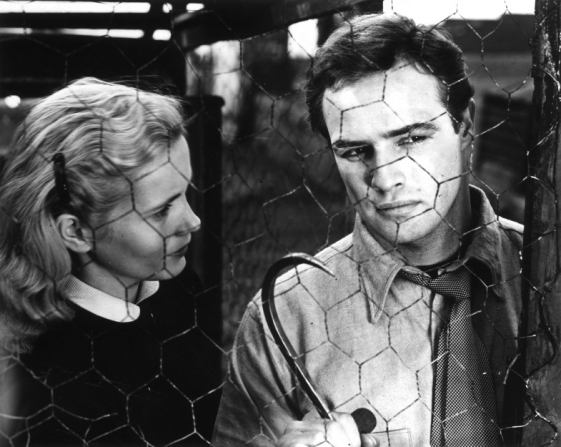
The casting of On the Waterfront is utter perfection, with no less than five cast members being Oscar nominated for their performances. Only Rod Steiger’s nomination feels like a slight overreaction. This is no sleight on Steiger, who delivers one of his most effectively low-key performances, but he doesn’t get the screentime to develop his admittedly pivotal character quite as vividly as his co-stars. Still, Steiger does at least get to be the other actor in the famous “contender” scene, giving Brando a strong presence to play off as he delivers that iconic and devastating speech. The aforementioned Malden is a very shrewd piece of casting, as he has the requisite gravitas to sell those moralistic monologues, while Lee J. Cobb proves yet again that he can play a bastard like no-one else. His terrifying Johnny Friendly is imposing but charismatic, threatening yet laced with a clearly visible vulnerability that will never let him fully enjoy the rewards of his corruption. He has an early speech in which he proudly and passionately espouses his own bravery at having pulled himself out of poverty. The origin of his constant anger is clear but this is a man who has very much forgotten his roots and Cobb gets it all across in a performance that I’m still convinced should’ve claimed that year’s Supporting Actor Oscar.
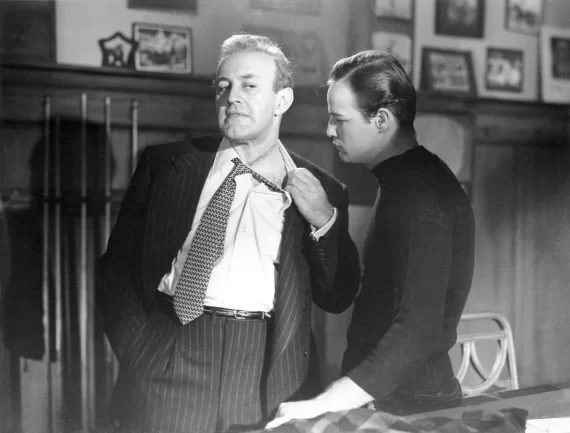
Two members of the cast did walk away with Oscars. One, of course, was Brando, an up-and-coming legend who has been working his way towards an Oscar win with three previous nominations. But this win was not simply because it was “his turn.” Brando’s performance in On the Waterfront is one of his most delicately judged, combining a rough and ready affability with a tortured humanism, a strained sense of self-worth with a bruised romanticism. There’s no showboating or overacting here. Terry Malloy becomes a real person before our eyes. Doubtless you’ll have heard of Brando’s brilliance in the role but you may not have heard that Eva Marie Saint, in her big-screen debut no less, is even better. As Edie Doyle, the formidable, grieving sister of a murdered docker, Saint is electrifying from her first scene onwards, as she cries and bellows furiously over her slain sibling. Those who know Saint from later roles, specifically her train-board temptress in Hitchcock’s North by Northwest, probably think of her as a glamorous actress but her Edie Doyle is convincingly ordinary, plainly pretty but as rough-edged as her guilt-ridden suitor. I almost think it’s a shame that Saint wasn’t given Best Actress rather than Supporting, as that would’ve meant On the Waterfront would’ve joined those other three films to have won the big five Oscars: It Happened One Night, One Flew Over the Cuckoo’s Nest, The Silence of the Lambs. On the Waterfront more than deserves to be among this illustrious group and if Anthony Hopkins can get a Best Actor award for 24 minutes of screen time, I see no reason not to consider Edie as a pivotal enough character to excuse her offscreen stretches.
5. ALL ABOUT EVE
Watched 10 October 2022
Joseph L. Mankiewicz’s All About Eve is a film I’ve been looking forward to getting to since starting this project. A stunningly fine piece of filmmaking, this classic was a sensation in its time and its exquisite, though not necessarily timeless, screenplay by Mankiewicz does a marvellous job at providing us with both a sense of the values of its era while also subverting them in several ways. If the story can ultimately be seen as championing marriage and domesticity as a preferable path for women than a career, it also implicitly challenges this notion by providing four excellent central female roles in an era when you were lucky to get one decent one. Mankiewicz’s writing here adores women without planting them on pedestals. He creates a diverse set of fascinating, flawed female characters, each with their own unique voice, something he subsequently failed to do in his later film The Barefoot Contessa, in which similarly verbose, witty dialogue was rammed willy-nilly into the mouths of every character.
One complaint often levelled at All About Eve is that it is a film that lacks visual style, coming across more like a filmed play. While I’ve never had a problem with filmed plays if they’re done well, I’d say All About Eve is far more than that. While Mankiewicz isn’t necessarily a noteworthy visual stylist, there’s more to direction than that. I’d say his direction of actors here is almost unrivalled, with the dialogue-heavy screenplay never once feeling artificial. There’s a real sense of camaraderie between the leads that makes their long-term associations utterly convincing and their impeccable witticisms feel like the practiced rapport of old pals. Check out the early scene in which Eve first comes into the characters’ lives in the dressing room of celebrated Broadway star Margo Channing. Mankiewicz brilliantly differentiates between how the established friends interact and how they respond to the new interloper. It is this sort of exceptional humanism that makes All About Eve so wonderful. Mankiewicz’s screenplay is rightly celebrated as one of the greatest ever written but it could’ve gone badly awry if mishandled by the wrong director or cast. By directing himself, Mankiewicz is able to keep hold of the reins and the perfect casting helps enormously in this regard.
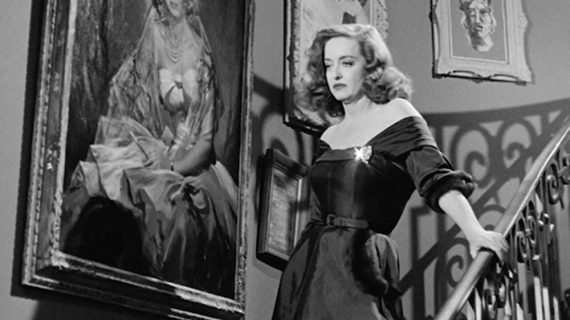
So let’s take a look at that cast. If you were going to criticise anything here, it would probably be the casting of the characters Bill and Lloyd. While Gary Merrill and Hugh Marlowe do fine in the parts, they do not come close to the level of the female cast. But Bill and Lloyd are very much supporting roles here, with the one notable male part being George Sanders’ vitriolic critic Addison DeWitt. A terrific, pot-stirring villain, DeWitt gets some absolutely plum speeches and Sanders’ gleefully sardonic performance won him a Supporting Actor Oscar. The four main women in All About Eve were also Oscar-nominated but their domination of the two female acting categories split the vote and they all walked away empty handed. This feels particularly criminal in the case of Bette Davis, whose performance as Margo Channing is one for the ages. Davis had always been a phenomenal actress but the material she had previously worked with had often tended towards the melodramatic. Margo, by contrast, is a far more real creation and the credit for this arguably lies more with Davis’s performance than Mankiewicz’s writing. Though Margo is a fantastically-written creation, her impressive quips, barbs, rants and monologues could’ve resulted in a character who stretched credibility. Instead, Davis’s juggling of poise and vulnerability, her inflections and mannerisms, make Margo leap off the screen. Ingenious little gestures and expressions are thrown away with a casual naturalism that underlines their impact. In an exceptionally strong year for the Best Actress category, I’d argue for Davis over either Gloria Swanson in Sunset Boulevard or the eventual winner, Judy Holliday in Born Yesterday. While both easy victors in most other years, Swanson and Holliday’s superb performances both rely on some level of exaggeration, which is something Davis’s performance plays down and it still manages to emerge as bigger and more satisfying.
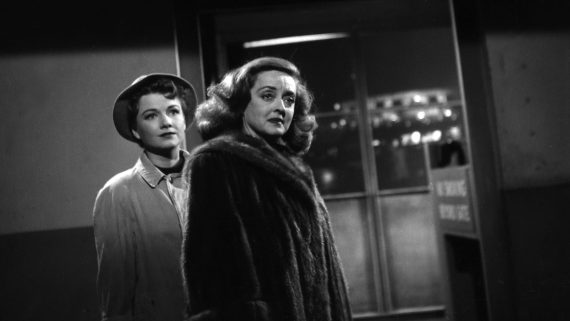
One of the other performances Davis was up against was Anne Baxter as Eve and her presence on the ballot is often blamed for Davis not winning. But Baxter absolutely deserves to be there for a complex turn in a far more thankless role. Unlike Margo, Eve doesn’t get any witty quips or lengthy drunk scenes. In order to retain the character’s disturbing mystique, Baxter plays Eve with a sustained balance that only allows the occasional malevolent twinkle to be glimpsed for the longest time. Her cloying modesty and self-effacement has a practiced artificiality but, with so many performances like this that were meant to be taken in earnest in contemporary films of the time, Baxter’s take on Eve emerges as a satirical swipe at Hollywood’s more unsubtle portrayals of squeaky clean innocents. Baxter’s performance is one that gets better the more you see the film. The first time round I thought it too overdone but it becomes apparent that this is the point, with Eve’s aspirations to stardom seeping into her everyday life. She simpers when being phoney and sneers beautifully when she is herself and, in a fantastic scene with Celeste Holm that fills in the grey between the two extremes, she moves fluidly from one to the other as manipulation turns to blackmail.
Like Baxter, Celeste Holm doesn’t get a lot of witty lines to fall back on. Instead, she makes Karen into a sincere, convincingly good person whose best efforts sometimes lead to the wrong choices but whose intentions are always noble. She is a necessary anchor in a tempestuous emotional sea, a great source of relief when the waters get especially choppy. Finally, there’s Thelma Ritter, the inveterate scene-stealer who once again grabs hold of every moment she is given with both hands. Ritter is given plenty of great lines and she delivers them with the perfect timing and exquisite body language for which she became known. For me, the major flaw in All About Eve is her character’s abrupt and complete disappearance before the film is even halfway over. Birdie is the sort of character best used sparingly but her unceremonious banishment from the narrative having sewn the seeds of doubt about Eve too blatantly highlights her narrative function in a way that is a disservice to the character. There’s enormous potential in the idea of an old vaudevillian who is now Margo’s maid and I really wish Mankiewicz had written Ritter just one more scene to properly close out her character’s arc. Instead, it feels like when an actor dies halfway through a sitcom season and their absence is painfully apparent for the remaining episodes. But in that event there is usually some inserted dialogue alluding to a holiday or illness or some such excuse, that may be unconvincing but at least acknowledges the situation. Birdie just flies the nest completely and is never mentioned again.

As a final point, I’d contest the notion that All About Eve comes across like a filmed play. Though it mainly consists of characters in rooms, Mankiewicz uses these spaces in a way that often emphasises their size, bringing a sense of the cinematic to a potentially claustrophobic script. Look at the famous sequence in which Margo stands on a stage and stamps out a cigarette. The space feels cavernous, mirroring both the monumental scope and lonely isolation of megastardom. When watching All About Eve, I never once feel wanting for Hollywood glamour. It’s all there on the screen to be revelled in even as it is deconstructed in front of our starry eyes.
4. IT HAPPENED ONE NIGHT
Watched 11 October 2022
Comedy is one of the most underestimated genres when it comes to critical plaudits, and Romantic Comedy especially tends to bring out a misogynistic tendency towards trivialisation from those who have patronisingly designated it a “woman’s genre.” In terms of Best Picture winners, there have been very few outright Comedies that have won the top award but curiously, the first film of only three that have won all five Oscars in the main categories (Picture, Actor, Actress, Screenplay, Director) was a Comedy (to add to the curiosity, one of the others was a Horror, another of the most spurned genres). Not only was It Happened One Night the first Comedy to win Best Picture, it was also a film of a great deal more sophistication than the majority of its predecessors on the victory podium. Frank Capra’s gem of a film still plays brilliantly with audiences today and creaks a great deal less than most of its contemporaries. With its plot about an unlikely pair of travelling companions thrown together by circumstance, first clashing and then gradually falling for one another despite the class borders that separate them, It Happened One Night not only seems like the prototype for the modern Rom-Com but also still the quintessential example, displaying just how intelligent, funny, heartwarming and compelling this much-maligned subgenre can be at its very best.
I’ve always been an advocate for Comedy as one of our greatest and most powerful genres but I can’t help but wonder if a little of that anti-Comedy snobbery has somehow seeped into my perception because for some reason, though I knew I loved it, I didn’t go into It Happened One Night imagining it as a film with a shot at my top 5. I’d started this Best Picture project with an idea in the back of my head that All About Eve would probably emerge as my overall victor and that It Happened One Night would probably end up with a place just outside the top 10. But as I sat rewatching It Happened One Night something became clearer and clearer, something which I had neither the ability nor the inclination to contest. This is absolutely one of the best films I’ve watched so far. There was no real reason to doubt this, other than the film’s lightheartedness which really shouldn’t be a factor in whether a film is great or not. Our assumption that the best film of the year has to have a worthy cause or deadly serious subject matter has repeatedly seen “important” films push aside better ones on their way towards the winner’s circle. But It Happened One Night is a hugely important film in the way it shaped the Rom-Com genre and set a precedent for how romantic relationships could be explored with wit and real insight into human foibles, without the necessity to resort to Vaseline-lensed sentimentality.
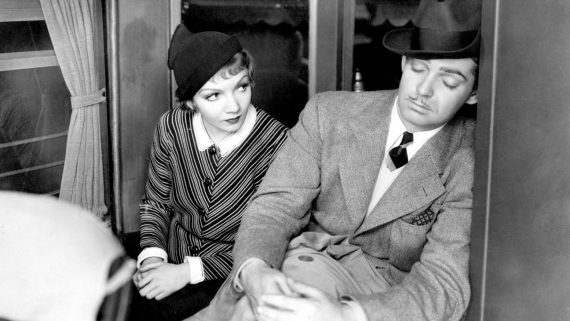
Though Frank Capra is a director frequently associated with moist-eyed corniness and didacticism, It Happened One Night is one of his harder-edged pictures. On the way to their inevitable happy ending, runaway heiress Ellie and unemployed newspaperman Peter do plenty of sparring and very little simpering. But the immaculate screenplay by Capra’s regular collaborator, the underrated Robert Riskin, does not reduce their journey to endless, tedious arguing either. The love-hate staple of Rom-Coms is too often oversimplified in later iterations, with 50 minutes of two people at each others throats instantly reversed by one moment in which the woman sees the man surreptitiously being kind to a puppy or something. It Happened One Night allows the romance to blossom more naturally, with Peter and Ellie’s frustrations with each other being realistically couched in an obvious attraction and their resistance being more down to their attempts to maintain their personal facades and predetermined assumptions rather than surrender to the horizon-broadening coupling that will ultimately make both of them better people. Though there is plenty of incident throughout It Happened One Night, Riskin and Capra both understand that the key to its success is to get the characters right first.
As important as the writing and direction in It Happened One Night is the casting. Though it is a film peppered with colourful supporting roles, it is Peter and Ellie who really need to be absolutely right in order for the film to work and boy, did they get them right! It’s easy to see how both the top acting awards went to It Happened One Night. Clark Gable is hilarious as the reckless, whiskey-soaked reporter whose fragile masculinity and opportunism mask an essentially good-nature. His soft heart can be clearly glimpsed in the scene in which he gives his last few dollars to a poor child with a sick mother, but Gable plays it with a nuanced sense of conflict. Soon afterwards, there is an absolutely jaw-dropping scene in which Peter scares away a nosy man trying to turn Ellie in for a reward, by posing as a hard-as-nails mobster and threatening the man’s children. This moment epitomises It Happened One Night’s oft-overlooked dark side and anyone less charming and convincing than Gable would likely have struggled to sell such a risky shift in comedic tone. But if Gable is terrific, Claudette Colbert’s scrumptious turn as Ellie is the real heart of It Happened One Night. The spoiled heiress type was to become a Rom-Com staple but was usually played very broadly as a stereotype who needs teaching a lesson by a more down-to-earth man. Riskin, though, has written the romance with more balance, portraying Ellie as out-of-touch with the real world but basically good-hearted and every bit as shrewd as her companion in many respects. Colbert’s performance is measured and human, her desire to assert her independence portrayed as sympathetic and her inability to understand those outside of her social class shown to be a product of that enforced dependency, something from which she is willing to break free in order to learn more. If the fact that her millionaire father and de facto jailer (wonderfully played by Walter Connolly, who deftly pulls off a surprise third-act turnaround) turns out to be correct about her mismatched marriage seems to push a retrograde, conservative father-knows-best attitude, this is balanced by his same approval of her union with the working-class Peter, which favours a liberal denunciation of perceived class barriers.
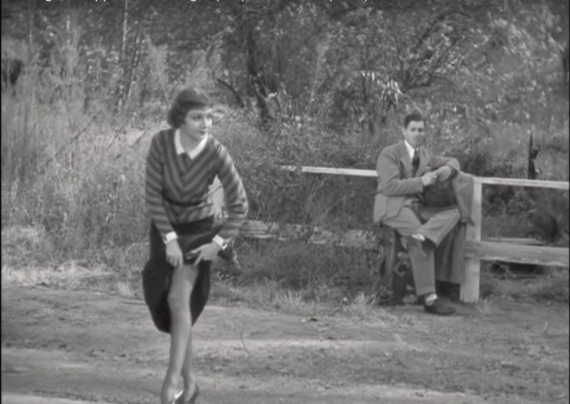
Just about falling in the Pre-Code era, It Happened One Night was seen as pretty racy in its day, with scenes of the leads in various states of undress as they get ready for bed (prepare yourself for some red-hot undershirtless action!) and Riskin’s ongoing metaphor about the “walls of Jericho” becoming a central motif, with those walls eventually crashing down along with the constructs of the class system. Perhaps most famously, a hitchhiking scene in which Colbert exposes her legs is, despite the comparatively quaint expectations of the era, still very sexy today. Colbert was apparently reluctant to film the scene but it doesn’t show in her performance of it, which is as committed as her numerous and subtly devastating crying scenes. Before my obvious infatuation for Claudette Colbert gets the better of this review once again, I should take a moment to praise Capra’s direction. He pulls together all the threads perfectly, coaxing stars who were reportedly unimpressed by the material to reach extraordinary comedic and dramatic heights.
An absolute peach of a picture, It Happened One Night surprised me by how easily it sailed to the top end of my ranking, elbowing favourite All About Eve out the way in the process.
3. THE APARTMENT
Watched 31 January 2023
In David Lean’s classic 1945 romantic drama Brief Encounter, Celia Johnson and Trevor Howard meet in the apartment of Howard’s friend for an ultimately thwarted extramarital affair. Sitting in the audience and regarding Brief Encounter with his typical eye for unusual angles, Billy Wilder found himself more interested in the unexplored story of the friend who had to vacate his apartment than he was in the romantic leads. Wilder’s desire to explore this idea further was temporarily thwarted by the rigid Hays Code of the 40s and its rules on the depiction of adultery, but he kept it in his back pocket and when rules inevitably began to slacken a little with changing times, he leapt on the opportunity to make the masterpiece that is The Apartment. Though it is now often to be found in TV schedules in the middle of the day, The Apartment was once regarded as a very controversial film: “a dirty fairy tale”, as critic Hollis Alpert put it at the time. Although he meant it pejoratively, Alpert pretty much hit the nail on the head with his description, with The Apartment also being based on a salacious Hollywood scandal involving agent Jennings Lang, actress Joan Bennett and producer Walter Wanger, and a tragic personal story from co-writer I.A.L. Diamond’s friend, who returned home after breaking up with a woman to find she had committed suicide in his bed. If you’re thinking none of this sounds like the ideal inspiration for your typical comedy, you’d be right. Though The Apartment is often classed as a comedy, its abundant humour is mixed with a bleak streak which pushes its way to the forefront as the film progresses. After the cross-dressing hijinks of Some Like It Hot, this may not have been the sort of film audiences were expecting from Wilder but the precedents are clearly there in his other work. I’ve always thought the fact that the broad antics of Some Like It Hot have somehow become enshrined as Wilder’s best film do the director a huge disservice. There are so many better, funnier and more interesting films amongst his body of work. But with its St. Valentine’s Day Massacre plot, even Some Like It Hot had its dark side.
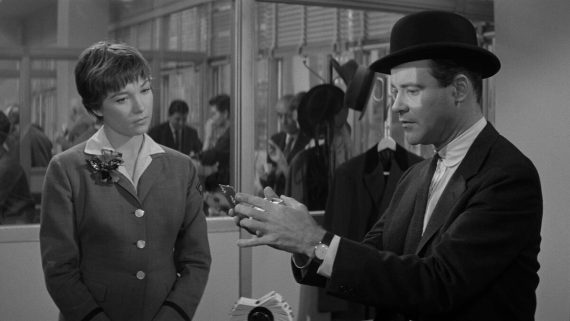
Wilder has been both celebrated and criticised for his penchant for combining deadly serious themes with a comedic approach but it is one of the things that really makes him stand out as a writer/director and with The Apartment he reached the apex of that approach. The tonal balancing act of The Apartment is incredibly deft. The first hour, which explores low-level office worker C.C. Baxter’s attempts to climb the corporate ladder by lending out his apartment to his managers for their extramarital affairs, is largely comedic but it has a darker tone than some of Wilder’s more screwball takes on downbeat subjects, like A Foreign Affair or the subsequent One, Two, Three. Though there is a farcical element to Baxter being hauled out of his apartment in the middle of the night by horny, entitled executives, there’s also a chilly cynicism to Wilder’s exploration of widespread adultery amongst highflying businessmen and Baxter’s willingness to essentially prostitute himself to reach that same level. But the cynicism of which Wilder is so often accused is almost always undercut by an opposing idealism that ties his films together rather than let them drift into nihilistic despair. It is this that makes Hollis Alpert’s “dirty fairy tale” comment so apt. We have our heroes to root for, our villains to despise, lessons are learned and happy endings, albeit sometimes unconventional ones, are reached.
Like any good fairy tale, to get to its happy ending The Apartment must first send its heroes into the deepest, darkest forest. The second half of the film quickly becomes extremely bleak, with an attempted suicide and the subsequent fallout. But the bleakness is balanced by a disarming tenderness as Baxter’s best side is brought out by his attempts to care for the heartbroken elevator operator he adores. The tonal switch is somewhat unexpected the first time you see The Apartment, to the extent that I found it quite unnerving the first time I saw it. But the balancing act between comedy and drama has rarely been more skilfully executed than it is here, with the trademark Wilder wit never disappearing even as the full pathos of human frailty is examined. The deft screenplay appreciates that in life the deadly serious often coincides with the ridiculous, so when a comedic subplot involving Baxter’s own run-in with a married woman suddenly smashes into the suicide attempt, Hope Holiday’s comedically self-pitying Margie MacDougall doesn’t just stop being funny. As Baxter emerges in a panic from finding the unconscious Fran overdosed on his bed, Margie tells him “I broke a nail trying to get the ice-tray out. You ought to buy yourself a new refrigerator.” The frantic Baxter races out the front door to get help, to which she responds “I didn’t mean right now!”
As well as an exceptional, Oscar-winning screenplay, The Apartment benefits from a wonderful, small core cast supplemented by colourful supporting turns. It’s hard to imagine The Apartment having worked at all without the innately lovable Jack Lemmon in the central role of Baxter. A typically morally-compromised Wilder hero, Baxter’s willing implication in his bosses’ reprehensible carryings-on could’ve made him unlikeable but Lemmon makes clear that this seems like Baxter’s only option to achieve his dreams, and that one impulsive decision has trapped him in an endless cycle of immoral and inconvenient actions. Though he allows himself to be seduced by a romanticised image of professional success, this corrupting influence is balanced by the purity of his love for Fran, who is also trapped by her more literal seduction at the hands of corporate entitlement. Shirley MacLaine has rarely been better than in her heartbreaking turn as the jilted elevator operator and her chemistry with Lemmon, which is largely platonic for the majority of the runtime, is never sullied by the lascivious tendencies of the era, a deliberate decision in order to differentiate Baxter from his licentious superiors. Completing the central trio of leads is Fred MacMurray, who boldly takes on the thankless role of heartless adulterer Sheldrake and underplays to perfection. It is often noted that MacMurray was better known for playing more likeable characters, although his previous association with Wilder had seen him cast as the murderous Walter Neff in Double Indemnity. It is testament to the skill of both writer/director and performer that they somehow made the murderer the more likeable character of the two.
The Apartment’s supporting cast is also superb, including the aforementioned Hope Holiday, Edie Adams as a vindictive secretary and Ray Walston and David Lewis as frequent users of Baxter’s apartment. But best of all is Jack Kruschen as Dr. Dreyfuss, Baxter’s neighbour. The relationship between Baxter and Dreyfuss is based around a farcical misunderstanding in which Dreyfuss believes every tryst happening in the apartment involves Baxter himself. At first this plot strand is played for broad laughs but when Dreyfuss’s medical skills are urgently required, the misunderstanding is exploited in a dramatic and moving manner which I never saw coming. It is perhaps the best illustration of The Apartment’s exquisite ability to switch tones abruptly but convincingly. Dreyfuss goes from comedy sitcom neighbour to the moral core of the film.
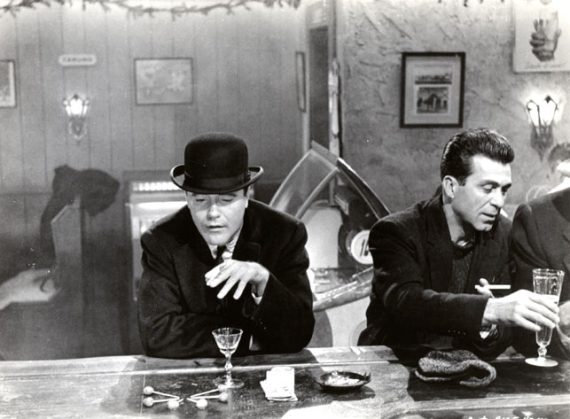
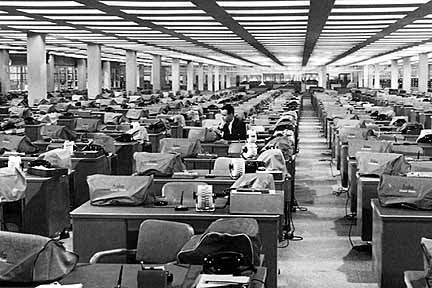
There’s an incredible sense of place to The Apartment, which brings an evocative claustrophobia to its seamy world. Joseph LaShelle’s cinematography and Alexandre Trauner and Edward G. Boyle’s Oscar-winning art direction help to make the titular space into a realistic, insalubrious little flat rather than the cavernous spaces that stood in for TV apartments. The insurance company office, meanwhile, is a triumph of forced perspective, using progressively smaller furniture and actors to create the illusion of a very long room. In another example of The Apartment’s impeccable inspirations, the office scenes were based on King Vidor’s silent classic The Crowd in order to make a similar point about one worker lost amongst a dehumanising environment.
In placing The Apartment in my ranking, I was forced to weigh it up against another great comedy, Frank Capra’s It Happened One Night, a film that brings me immense joy. But The Apartment is just such a layered, beautiful, moving, funny and perfectly crafted masterpiece that, even with its more downbeat feel, it brings me at least an equal amount of joy, from its opening shot to that perfectly understated ending.
2. CASABLANCA
Watched 8 February 2023
It’s hard to believe in retrospect but when the production team began work on a little film called Casablanca, none of them expected it to really stand out among the roster of releases that year, let alone end up a timeless classic that has become emblematic of the magic of Golden Age Hollywood. The modest intentions of the filmmakers play a big part in making Casablanca the iconic masterpiece that it is. This is not Gone With the Wind, a film designed to be an award-gobbling juggernaut, self-consciously creaking under the weight of its own length and ambition. Casablanca is a snappy 100 minutes that aims primarily to entertain but hits all its targets so incredibly squarely that it is elevated beyond its intentions without ever feeling like it is showing off. It’s a rarity that all elements of a picture come together so completely but Casablanca is the complete package, which explains why it continues to dazzle to this day and why Warner Bros. choose to evoke its memory with a burst of As Time Goes By at the top end of every one of their new releases. That’s essentially a banner that says “Warner Bros.: we made goddamn Casablanca, y’all!”
I have a three year old son so when I watch TV in the evenings I tend to keep the volume low and have the subtitles on to assist my 40 year old ears in their quest for aural satisfaction. But sometimes the captions alter the dialogue slightly for the sake of convenience and it became quickly apparent while watching Casablanca that the subtitles had to go because to alter the dialogue of Casablanca whatsoever is detrimental to its magnificence. These were particularly clipped captions, so I found myself hearing sparkling witticisms coming from the characters’ mouths and reading bland summaries underneath them. Good though the storyline of Casablanca is, the magic is in the telling rather than merely moving from plot point to plot point. A large part of this magic is derived from the absolutely exquisite screenplay by Julius and Philip Epstein & Howard Koch. Julius himself later said that the Casablanca screenplay contained “more corn than in the states of Kansas and Iowa combined. But when corn works, there’s nothing better”. I’d be a little kinder than this to Casablanca’s script. It’s style is what I’d call Hollywood-poetic. The language is beautiful without being florid, eloquent without being unrealistic, funny without being showy and deeply romantic without once hinting at nausea. The quotability is ludicrously high: “Here’s looking at you, Kid”, “Round up the usual suspects”, “We’ll always have Paris”, “Of all the gin joints in all the towns, she had to play it again in my crazy hill of beans, Sam.” You know the drill.
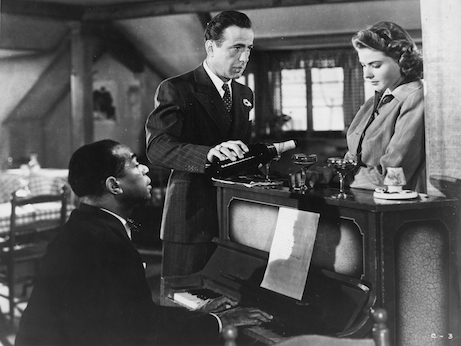
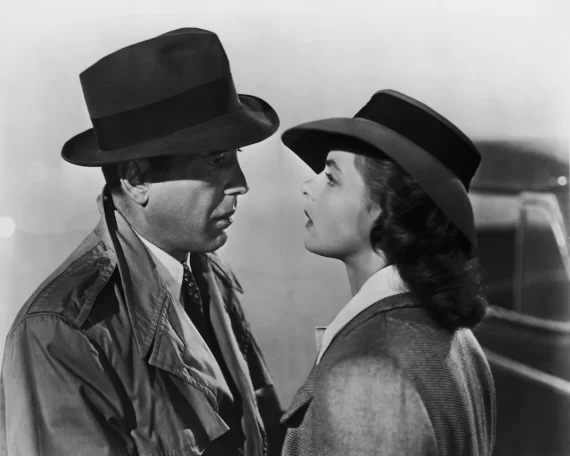
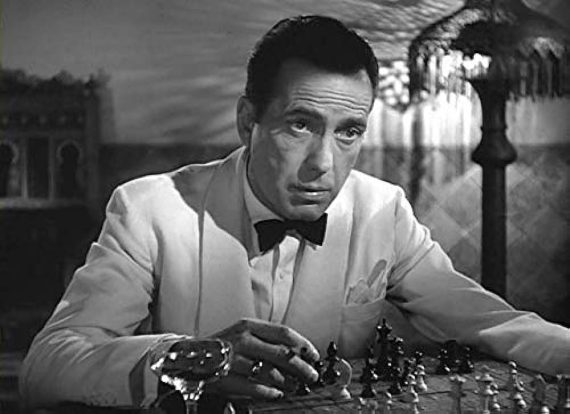
I suppose I can imagine how the Epsteins could’ve seen their screenplay as corny, having gone through the process of setting it down on paper and crafting it into a thing of hardbitten, heartbroken poetry. But once it reached the mouths of this particular cast of actors, its legend was cemented forever. Of the 22 speaking parts, only Paul Henreid as the blandly heroic Victor Laszlo fails to impress. As the lesser third point in the central love triangle, Laszlo is a weaker role in terms of witty lines or romantic moments so Henreid’s stiffness isn’t too distracting but you can’t help but wonder if an actor with more charisma might’ve upped the stakes even more. Henreid, described by Ingrid Bergman as a “prima donna”, did not get along with his co-stars and reportedly called Humphrey Bogart a “mediocre actor”. He only took his role when he was promised top billing alongside Bogart and Bergman but that ain’t fooling anyone. Casablanca knows who its real stars are. Witness the build up the screenplay gives to Bogart‘s Rick, setting him up as an unseen, legendary figure in the course of a few concisely effective opening scenes, before introducing him by focusing on his hand as it writes a signature, only then slowly panning up his arm to reveal Bogart in all his iconic glory. Bergman, meanwhile, isn’t so much shot by the camera as consumed by it. It relishes her every moment of screentime and though her simple glamour is never overstated, there is not a moment when we question how this woman could’ve penetrated the tough exterior of someone like Rick and irreparably shattered his insides. Their chemistry in the scenes they play together is palpable. Playful and merry in the Paris flashbacks, simmering and desperate in the heartbreaking aftermath.
If the strong central performances give Casablanca its foundation, the film is made special by its gallery of colourful supporting players and their beautifully drawn smaller moments. I recently watched Grand Hotel, a film that was sold on the star power of its ensemble. Casablanca boasts an even more impressive cast, featuring an array of Hollywood’s greatest character actors. They may not have had the same box office draw as Greta Garbo, John Barrymore and Joan Crawford, but retrospectively it’s a cineaste’s dream to find Claude Rains, Dooley Wilson, Peter Lorre, Sydney Greenstreet, Conrad Veidt and S.Z. Sakall all in the same film. Of these legends, several get mere minutes of screen time but all of them contribute something. I couldn’t imagine Casablanca without Lorre’s weaselly cameo as the shady Ugarte or Veidt’s overbearingly intimidating performance as Major Strasser. As club pianist Sam, Wilson feels like the beating heart of the film, his unforgettable musical interludes including the evergreen As Time Goes By, guaranteed to slay any fan of classic cinema within its first few bars. I was very impressed by Sakall’s sympathetically avuncular performance as Carl the Waiter this time round too, a role I had pretty much forgotten about in the too-long interval between my last viewing and this one. It’s testament to the deluge of excellent characters and performances in Casablanca that a creation like this could fall through my memory cracks.
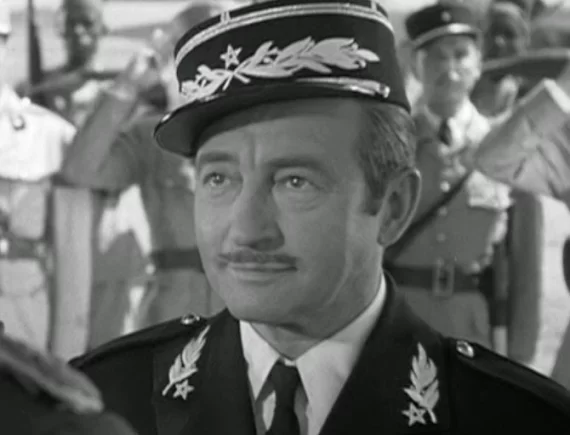
But above all the supporting performances and, for me, even the leading ones, stands Claude Rains as Captain Renault. Amongst all Casablanca’s dream roles, this one is the absolute plum and they went to the finest supporting actor in Hollywood to fill it. Renault is an an audacious creation for a 40s film. He begins as a Nazi collaborator and proudly corrupt official, who we then learn extorts sex from female refugees in exchange for transit papers and is involved in implied acts of murderous police brutality. I can only assume that the prudish censors having both eyes squarely trained on ensuring Casablanca didn’t allow a female character to leave her husband for another man is the only thing that allowed the monstrous Renault to walk off into the sunset with Bogart at the film’s conclusion. But the writing and Rains’ extraordinary performance are the things that ensure that, perhaps more troublingly, we are happy that he does. The elliptical manner in which Renault’s worst crimes are portrayed may have been imposed on the writer’s by the production code but it ends up lending the film a smart ambiguity that creates the illusion that the character is not beyond redemption. It doesn’t hurt that Rains gets all the funniest lines or that he is so naturally charismatic that we can’t wait for him to be on screen. Rains has rarely had the chance to display his excellent comic timing as prominently as he does here. Witness the moment when, in the midst of shutting down Rick’s club on charges of illegal gambling, he coolly and graciously accepts his own winnings without missing a beat. For me, Rains is the thing that keeps me coming back to Casablanca more than anything else and Louis Renault is one of cinema’s greatest, most compellingly amoral characters.
I can’t consider the brilliance of Casablanca without mentioning its director, Michael Curtiz. Despite having directed one of the defining films of the Golden Age, Curtiz is regularly devalued by those who see his status as a journeyman director as confirmation of a lack of talent comparable with that of their preferred auteurs. Though I undoubtedly enjoy the convenience auteur theory brings to the easy categorisation of films under their director’s headline, I also think it tends to minimise the work of the thousands of contributors in what is undoubtedly a collaborative medium. But Curtiz is one of those rare directors who is often excluded from the conversation when his films are discussed, or else minimised with that idiotic assertion that if you direct enough films you’ll eventually hit gold. Curtiz was incredibly prolific but even at the rate of five or six films a year I still don’t think just anyone would eventually make Casablanca, less still also direct Angels with Dirty Faces, Mildred Pierce, The Adventures of Robin Hood, Yankee Doodle Dandy and Captain Blood to name just a handful of his other works. I doubt the average novice director could bumble their way into directing even a film as good as Curtiz’s Elvis Presley vehicle King Creole. At some point we have to give the man some credit! The main issue with considering Curtiz in conjunction with auteur theory seems to be a perceived lack of a personal style, but watch enough of his films back to back and you’ll notice the consistency of his classical professionalism. He has a good eye for aesthetically pleasing compositions but he never once feels like he’s putting the audience’s opinion of his expertise above the audience’s desire for entertainment. Curtiz can keep a steady hand on proceedings while also getting out of the way, so while you might not have necessarily guessed that he directed Casablanca, when you find out it makes complete sense. Given the large cast and throngs of extras Curtiz had to deal with, while also ensuring that the mechanics of a potentially complex plot remained easy to follow and entertaining to watch, I think he deserves our applause, as well as the Best Director Oscar he won.
It’s fitting that we should end our discussion of Casablanca with that final scene, perhaps the most iconic in cinema history. It’s tempting to see it purely in romantic terms but it is so much more than a sentimental flourish. In fact, it acknowledges that, however strong the love of two people is, there are some things that are more important, which is not a sentiment you’re likely to find in cheaper films that fetishise romance at the expense of a deeper understanding of the complexity of love. Still, anyone who has had their heart broken or had to say a painful goodbye should feel more than a small stirring during this finale. If some may have an issue with the way Rick makes the decision for Ilsa, it’s worth remembering that she specifically asks him to do the thinking for both of them in an earlier scene which, while it could be seen as problematic in itself, I’ve always seen as an acknowledgement that Ilsa has made the same decision already but just needs that extra push to go through with it. If there’s a patronising air to the line “Someday you’ll understand that” from Rick, it’s lost amongst such beautiful surrounding dialogue that it’s easy to chalk up to its era without too much disruption. The rest of the dialogue is quotable line after quotable line and Curtiz, Bogart and Bergman all capture this intimate moment to perfection. Ingeniously, Renault is also a crucial part of the scene, at first on the sidelines and then foregrounded with his own famous quote and an act of sacrifice that rounds off the film with a glorious moment of tender jocularity. It’s unthinkable that there was once an intended coda to Casablanca and fortunately David O. Selznick recognised what a terrible mistake it would’ve been to change the ending one iota. As it is, Casablanca sticks the landing like no other film before or since. Even in the face of inevitable parodies, it has retained its power to move, thrill and amuse in equal measure. Hearing that final line and swell of music is one of the most rousing cinematic experiences, every single time.
1. ANNIE HALL
Watched 28 April 2023
Throughout this lengthy rewatch of all the Best Picture winners, I’ve had to reckon with some problematic figures. Lurking among the Oscar nominees are abusers of all kinds, both accused and convicted, and the question of what we do with the films they have helped create is not an easy one to answer. Getting round to Annie Hall should’ve been something to which I was looking forward. It’s always been one of my favourite films and for a long time from my late teens onwards, Woody Allen was one of my heroes. In fact, I’m on record as saying just that in a podcast that dates from as recently as 2016, something that no longer sits well with me. I used to think Allen was one of the greatest directors of all time but my taste began to change as his terrible twenty-first century films piled up and drove me to reassess the whole filmography. It’s still littered with films I love but they can’t help but be coloured by the increasingly problematic image of the man who made them, with Manhattan in particular feeling virtually unwatchable now. Why wasn’t this always the case for me? I mean, Manhattan is a film that is not just ambivalent towards statutory rape but positively romanticises it as some kind of emotionally restorative experience for men in their 40s. Yet its classic status was rarely questioned until recently. I even used to have a Manhattan poster on my bedroom wall. Allen’s work is replete with lascivious moments of this kind that inspire deep discomfort. There’s even one in Annie Hall, a reference to sex with sixteen year old twins. Although Allen gives the line to another character who is portrayed as being on a trajectory of self-imposed moral and intellectual decline, the ambivalence with which it is received is disturbing, as is the frequency with which such material would continue to appear in subsequent Allen scripts. And though it’s rarely mentioned, I’ve never been a fan of the moment he gets a very young girl to stare directly into the camera and say “I’m into leather” either. This is a joke that sickened me even when I was a teenage Allen-defender.
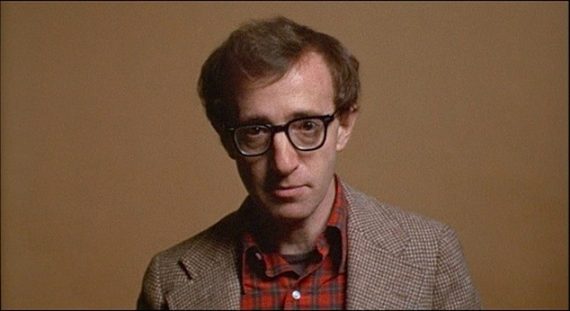
I don’t believe it’s always easy to separate the art from the artist, especially when the artist wrote, directed and starred in the film in question, but there are personal connections and cultural significances that reveal the notion of completely dropping anything related to problematic figures as a far harder decision than it is sometimes portrayed to be. Perhaps it is easy for those who have only a casual relationship with whatever medium with which their fallen idol is associated but for obsessives like myself, often the artists and creations are so tangled up with the people we became while devouring them that to simply tear away that part of ourselves would constitute an act of fairly serious psychological self-sabotage. Woody Allen had a massive influence on my sense of humour, an issue that is itself tied up with the fact that his work was passed down to me by my now-departed Dad, who found him as hilarious as I did. This genetic connection at the funny bone led to an impulsive trip by me and my Dad (neither of us impulsive people) to see Allen’s New Orleans jazz band in a rare performance on British soil. This came at a hard time in my life, when I was a lonely, unemployed twenty-something with mental health issues, and that overnight escape to Brighton with my Dad meant so much. The man I saw on stage that night may no longer be my hero but the man who sat next to me in the audience still is. I don’t know how to go about recategorising that memory as no longer applicable.
I’m not about to suggest that I have an answer to the complex question of what to do with the creations of problematic artists. But it would be hypocritical of me not to at least acknowledge the example that has affected me most personally, just as it would be dishonest of me to place Annie Hall any lower in my ranking than I have. The fact that I can still watch and enjoy the film as much as I do is a subject worthy of further analysis but for now I’m going to set it aside for the most part in order to discuss the film itself, while acknowledging that the fact I have the luxury to do so remains a sign of troubling privilege that I should and will continue to examine privately.
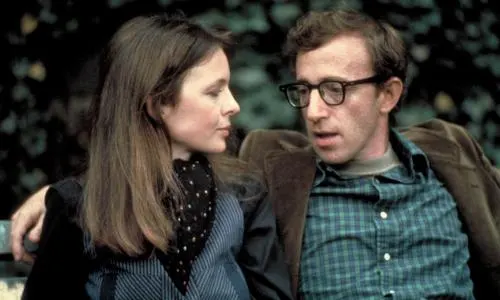
I’m of the firm belief that the Rom-Com has the potential to be cinema’s finest genre. At its best, it allows us to examine love, sex and adult relationships in an in-depth fashion without sucking all the fun out of the subject. Unfortunately, the Rom-Com has fallen victim to formula so often that many of its most popular set texts are air bubbles that have nothing to say about relationships at all and just barrel through the same routine of awkward misunderstandings, gross out set pieces, a big argument to end act two, a reconciliation to end act three and unearned kissing in place of actual closure. Like any formula that is repeated enough, we have ended up loving some of these tropes, and a light and frothy Rom-Com that works is a very impressive feat to pull off. But really smart, incisive comedies about love and sex seem few and far between, especially those that are as beloved as their shallower younger siblings. When Harry Met Sally may now be the most widely adored cornerstone but Annie Hall set the benchmark. Perhaps one of the main reasons that When Harry Met Sally, a film so clearly influenced by the Allen style, has overtaken Annie Hall in popularity is the fact that it focuses equally on both members of the relationship, as its title suggests. By contrast, though it is named exclusively for Annie, Allen’s film is far more focused on Alvy Singer, the male protagonist. The film Allen originally planned was even more deeply focused on Alvy, with the romance with Annie only being one of several strands which also included a murder plot (an idea later reworked in Manhattan Murder Mystery). It was only in the editing process that Annie Hall was shaped into a more focused Romantic Comedy. Some elements, like the famous closing narration, were only added literally minutes before test screenings. This rough-edged trial and error approach ended up paying dividends, with Annie Hall’s loose, stream-of-consciousness style emerging naturally and helping distinguish its unique, non-linear appeal.
Although the film’s title is fully justified, given that Annie is the central point around which the self-analysis revolves, this is very much Alvy’s story as he uses the romance to examine his past relationships and their influence on his life. Opening with a fourth-wall breaking piece to camera, Annie Hall then takes place in Alvy’s head, with scene transitions influenced by passing thoughts and throwaway comments that evoke related memories. Alvy retains the ability to occasionally address the audience directly, confirming the impression that he is in control of the narrative, at least to the extent to which he is in control of his own volatile mind. This allows Allen to introduce all sorts of narrative techniques, from split screens to flashbacks and even animation. It sounds showy but the more unusual scenes are as fleeting as any of the other scattered memories and so well incorporated into the narrative that they don’t draw attention to themselves. Occasionally an idea is better than its execution, such as a scene which contrasts Easter meals at the dinner tables of Alvy and Annie’s family’s which ends up being more chaotic than funny. But misfires are rare in this tight 90 minute masterpiece.
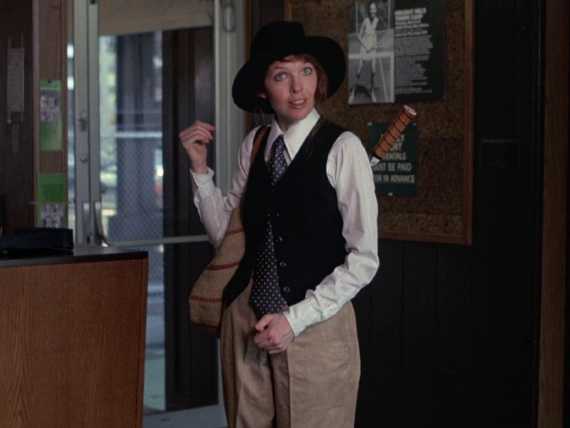
There’s a popular phrase often used to describe Allen’s work which emerged from his own film, Stardust Memories. It refers to Allen’s “early, funny films”, as opposed to his later, more mature narratives. The distinction being made here is between broader comedies like Sleeper and Bananas and comedies focused on the human condition, like Manhattan and Hannah and Her Sisters. Though he has made wholly dramatic films, Allen’s talent clearly lies more in comedy and Annie Hall is generally cited as the pivotal film in transitioning from broader high concept farces to more philosophical comedies about people and relationships. I’ve always found the latter not only more satisfying but also funnier, with jokes about emotional vulnerability and existential anguish being more relatable than gags about robot dogs and giant banana skins. Certainly, I think Annie Hall is Allen’s funniest film, with jokes vacillating between warm and cutting, satirical and personal, highbrow and goofy. With such a barrage of brilliant dialogue, Allen has here written the perfect role for his oft-used persona and it resulted in a well-deserved Best Actor nomination. Allen always acknowledged that he was not really an actor but Alvy is his greatest creation, allowing him to showcase his considerable comedic skills while also turning in his best dramatic performance. Diane Keaton’s charming turn as Annie, meanwhile, won her an Oscar. Not only does she capture a delightfully accurate nervous energy in the early scenes of the burgeoning relationship, she realistically charts a personal evolution as the couple become comfortable, and ultimately frustrated, with one another and Alvy’s coercive attempts to get her to embrace adult education turn to resentment as she begins to break free of his influence.
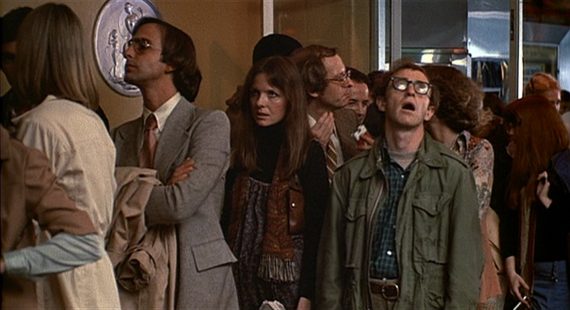
Many critics of Annie Hall have misconstrued the depiction of Alvy as sympathetic when really he is a man undone by his own insistent, neurotic contradictions, a point the film is at pains to highlight in scenes that cut between him saying one thing and then contradicting it completely at another time and location. If Alvy’s viewpoint were also the film’s, Annie Hall would indeed be a toxic relic, but it is rather an examination of male toxicity and the detrimental effects it has on functioning relationships. If Allen’s subsequent behaviour is applied as evidence of his sympathy for Alvy then it can seem to undermine the film’s intentions, but these intentions are made so clear in Allen and Marshall Brickman’s screenplay that it is far more accurate to say that Allen’s life is an example of a man failing to live up to the thesis he presented here. Alvy learns a tentative lesson and, though the audience isn’t led to expect a complete transformation, satisfying closure is provided by the sense that some growth has taken place.
But more than just a love story between people, Annie Hall is the first of Allen’s films that feels like a declaration of love to the city of New York: the people, the places, the fashions. While New York had featured in Allen’s earlier work, it was subverted through the context of a dystopian future or played second fiddle to scenes in a Latin American country. His best early, funny one, Love and Death, was set in Tolstoy’s Russia and shot entirely outside of the United States. Annie Hall, though, is a purely New York film, drinking in the beauty of the city in a better and less showy way than Manhattan would subsequently do. Even when the location shifts briefly to L.A., it is in service of illustrating by contrast how preferable Allen’s own cultural haven is. Annie Hall is also a film of its time in the best sense. It captures late 70s New York with an immersive vibrancy that transports, rather than seeking a dull timelessness. The bookshops, diners, nightclubs, cinemas and sidewalks are all deliciously evocative to the point where you feel submerged in them. It’s almost enough to make me fraudulently don an “I Heart N.Y.” t-shirt.
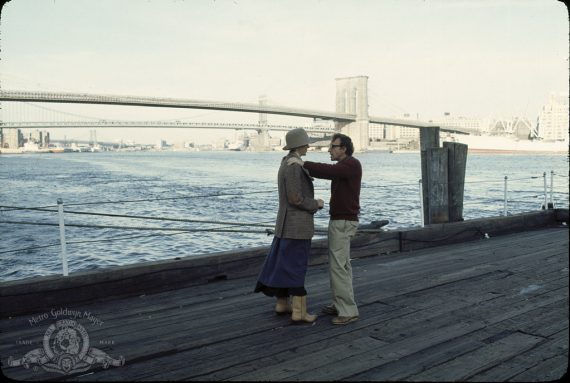
When people talk about Annie Hall, the same famous scenes tend to come up: the lobsters, Marshall McLuhan, the subtitled date, the cocaine. It’s all worthy of a mention and I’m not going to rehash those same highlights again, but I would like to add a mention for the less celebrated scene in which Alvy comes round to Annie’s apartment to kill a spider, which is at least as funny as any of them. In the acting stakes, Keaton and Allen are usually singled out, with Tony Roberts also doing fine work as Allen’s pal who wants to move to California. But there are a number of other great smaller roles that pop up throughout, with Carol Kane, Christopher Walken and John Glover all impressing. There are also fleeting cameos by a pre-fame Jeff Goldblum and Sigourney Weaver. But the standouts of the supporting cast are a hilarious Shelley Duvall as an intense Rolling Stone reporter, Johnny Haymer as a tragically unfunny comedian and Paul Simon as an oleaginous record producer, a role you can just tell he relishes playing.
For many years, I watched Annie Hall at least once a year and never loved it any less for knowing it back to front. I would not hesitate to call it one of my favourite films of all time. But as we got gradually better at holding public figures to account for their actions, I began to back away from Allen’s work in general, and this film that I loved, that I love, suddenly went unwatched for many years. It would be deeply hypocritical of me to ignore this context when I’ve focused on similar issues in reviews of American Beauty, Kramer vs. Kramer and Gone with the Wind. There’s no accounting for the fact that, in light of horrible events, we find some works easier to keep enjoying than others. More power to those who can completely cut out problematic art from their lives but I won’t (and, in good conscience, can’t) judge those who have certain films, albums, books or artists with whom their hearts and minds are too entangled to comfortably lop them off in one decisive move. I’ve wanted to rewatch and reassess all the Best Picture winners for a long time now but have always held off because I knew Annie Hall was waiting there, I suspected it would still rank very highly for me and I didn’t know how that would make me feel or look in other people’s eyes. I was right, Annie Hall has ended up ranking as my number one film. I was also right to not know how that would make me feel, because I honestly still don’t. While I was watching the film, I got nothing but enjoyment from it. It is after it ends, or in the moment I make the decision to put it on, that I begin to wrestle with the issues that are unavoidably associated with it. Ultimately, I’ve decided the best thing I can do for now is admit my feelings about Annie Hall but frame that recommendation with the details of the baggage that comes with it. In years to come, I may find this position untenable and I leave myself wide open to that possibility. But in the meantime, I’d rather be part of the conversation than cowering in the corner, guiltily clutching my copy of Annie Hall like a nervous, pale man coming out of the curtained-off area of a video rental store. All I know for sure, and I say this in the spirit of honesty rather than emotional manipulation, is that for the 90 minutes it’s playing, this film helps me miss my Dad less. For those negatively affected by the actions of Woody Allen though, that is surely scant comfort. I didn’t used to believe in guilty pleasures but I guess that is technically what Annie Hall has become for me.