



In Part 8 of my journey through the Best Picture winners, I’m looking at the films that make up the bottom half of my top 20, all of which I’ve rated 5 stars. All entries contain spoilers.
You can find the earlier parts of the list here:
Part 1
Part 2
Part 3
Part 4
Part 5
Part 6
Part 7
20. ALL QUIET ON THE WESTERN FRONT
Watched 9 November 2022
The appropriately-named Lewis Milestone’s film adaptation of German novelist Erich Maria Remarque’s All Quiet on the Western Front gave the Oscars its first solid gold classic Best Picture. At the time of writing, All Quiet on the Western Front is just under eight years away from its 100th birthday and yet it has retained its reputation as one of cinema’s great moments in a way that many of its contemporary Best Picture winners failed to do. You don’t have to watch for long to see why. From its masterful opening scene of troops marching to war drowning out the naively patriotic ramblings of a schoolteacher chastising his students for not signing up, All Quiet on the Western Front tells its story with a relentless visual ingenuity and a clear-eyed, unsentimental honesty that would soon become rare, as war came round once more. It’s quite a shock for those who have only seen flag-waving wartime Hollywood films to come across a film that not only offers a sympathetic perspective from the point of view of German soldiers but which also actively seeks to deglorify war and condemn romantic notions of heroism. Milestone’s powerful handling of the material worked its magic on the film’s star, Lew Ayres, who subsequently became a conscientious objector during World War II, a move which scandalised Hollywood and temporarily damaged his career. It is typical of Hollywood’s hypocrisy that they should garland a pacifist diatribe one moment and attack someone who exercises those same values the next. Clearly, pacifism is only to be praised during peacetime.
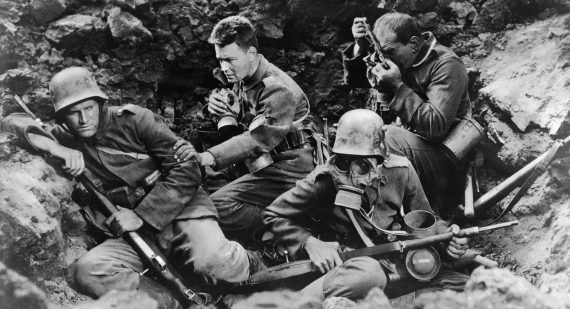
The War is Hell film tends to be a hard sell these days, with modern equivalents often causing viewers to roll their eyes at the obviousness, but All Quiet on the Western Front was the Grandaddy of them all, emphatically staking its claim as the most effective anti-war film out there and making many of its would-be successors seem redundant and hokey by comparison. There is certainly a thrill in seeing a very early example of such a forcefully subversive War film but All Quiet on the Western Front isn’t merely carried by its innovations. It is bolstered by strong storytelling which takes in all elements of a soldier’s experience, rather than just getting lost amongst muddy battle fields for two hours. Make no mistake, Milestone has plenty of astonishingly immersive scenes of trench warfare to offer, but they are punctuated by sequences of downtime, showing the struggle to merely survive between battles in poor conditions and with inadequate supplies. The grim fallout of the hostilities is explored in harrowing hospital scenes, there are moments of levity showing the camaraderie that keeps the desperate men going, and there are scenes of the homefront, depicted as a place of patriotic delusion which looks very different to an aspiring soldier and a returning one.
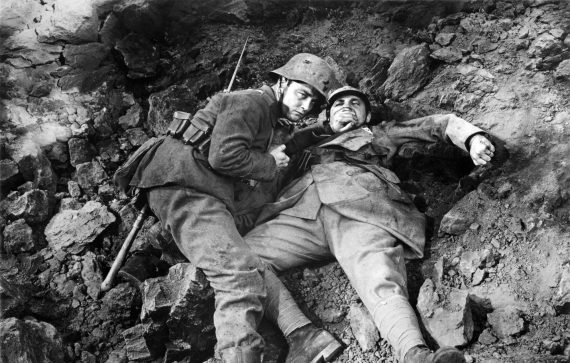
Perhaps All Quiet on the Western Front’s most famous scene is that in which Ayres’ protagonist Paul stabs a French soldier during battle and is then pinned down in a foxhole with the dying man. This ingenious sequence brilliantly highlights how the perceived difference between the abstraction of killing on a battlefield and one-on-one murder are in fact no different, as the former bleeds seamlessly into the latter and the attacking soldier desperately tries to revive his victim. Other standout moments include a desperate soldier trying to claim the boots of his amputee friend, two soldiers fantasising over the illustration of a woman on a poster, and Paul’s return visit to his unshakabley delusional teacher, who’s pupils are more than willing to reject the real experiences of a soldier in favour of the florid romanticism of their schoolmaster.
The critical success of Edward Berger’s excellent 2022 adaptation of All Quiet on the Western Front is testament to the power of Remarque’s source text, underlining the fact that Milestone’s film is not merely prized for its trailblazing but rather for its continued ability to move, inform and entertain. Those unfamiliar with early sound cinema may be initially put off by what seem to be over-the-top or stilted performances but these are typical of the era and, when you adjust your perspective accordingly, are actually quite good examples of early 30s screen acting. Though none of the performances were Oscar nominated, Ayres’ earnest air is fitting for Paul’s crumbling wide-eyed innocence and Louis Wolheim is memorably grizzled but humane as the more experienced mentor Katczinsky. George Abbott, the writer also known for his wildly different work on the musicals The Pajama Game and Damn Yankees, provides the actors with an eloquent and multi-faceted screenplay to get their teeth into. Unlike the badly-dated Cimarron, which won the next year’s Best Picture award, All Quiet on the Western Front has aged rather beautifully, its dated elements such as lack of a score and over-demonstrative acting quickly becoming unnoticeable as Milestone’s brilliant direction and storytelling grip the viewer, its deep humanism never once undermined by unpleasant contemporary attitudes.
19. THE GODFATHER
Watched 3 July 2022
The Godfather is a 5 star film. Revisiting it after many years, I knew I was going to enjoy it and I really did. Its enormous influence on subsequent film and TV is immediately apparent and Francis Ford Coppola’s tasteful, vital direction turned around his faltering career. Coppola, working with the author of the bestselling source novel Mario Puzo, also came up with an incredibly well-constructed screenplay in which the complexities of the Corleone crime family and its dealings are expertly delineated with minimal exposition. The plot spans ten years and the characters, particularly Al Pacino’s Michael, go through interesting and believable changes as their lives are altered, and in some cases ended, by the eruption of a mob war around them. The Godfather takes its time introducing and setting up these characters in an opening wedding sequence that brilliantly outlines everything you need to know for what’s coming next. There are a lot of characters here and they all get their own moments as the main throughline of Michael’s transformation from quietly disapproving outsider to cold, calculating Don snaps into focus.
The Godfather deserves a perfect score but I don’t think it’s quite a perfect film. The central performance of Marlon Brando, who won the Best Actor Oscar for the second time for his portrayal of Vito Corleone, is something that has been so widely parodied that most people will have seen a cotton-wool-cheeked imitator before they get to the original. This being the case, it’s impossible to give the performance a fair hearing but I’d suggest that the degree to which it lends itself to parody is probably at least as much of a problem as the effect those inevitable parodies have had on its credibility. Nevertheless, Brando’s work here is always at least enjoyable to watch. Vito is a larger than life character who needs to be differentiated from those around him in order to achieve his impact, and Brando certainly achieves that. There are also a couple of scenes in which Vito hears about his son’s death in which Brando is so moving that all those images of bad comedians mumbling about an offer you can’t refuse fall away completely. Was this performance deserving of the Best Actor Oscar? I’d argue that it should’ve gone instead to Pacino, who was nominated in the Supporting Actor category despite being the true protagonist. Category fudging like this is a regular Oscar issue, most notably in 1944 when Barry Fitzgerald ended up competing in both the Best Actor and Best Supporting Actor categories for the same role in Going my Way. His miscategorisation as a Supporting Actor led Pacino to boycott the Oscar ceremony but there is a case to be made for Brando’s Best Actor designation. Despite only being in about 40 minutes of a 3 hour film, Vito is the figurehead of the whole story. Like Anthony Hopkins’ Hannibal Lecter in The Silence of the Lambs, his iconic status trumps his reduced screentime in a way that would make considering him a supporting actor seem oddly inappropriate. While Michael emerges as the true lead and Pacino’s performance is arguably the highlight, it is Brando of whom most people think first when The Godfather is mentioned.

The blockbuster success of The Godfather caused the Academy to go into nomination overdrive, with four of its performances gaining recognition in the Best Actor and Supporting Actor categories (the women, who don’t play much of a role in the film beyond being the victims of the terrible things that men do, were overlooked). In particular, the Supporting Actor category was flooded with three nominees, splitting the vote and resulting in the award going to Joel Grey for his impish Emcee in Cabaret. Though he fulfils the demands of his role as the hotheaded Sonny, I’ve always thought James Caan’s nomination for a slightly overplayed performance was undeserved. This is perhaps unfairly influenced by a clumsy piece of editing which leaves in an infamously unconvincing air-punch during what should’ve been a horrific scene of a vicious beating meted out by Sonny to his brother-in-law. This goof completely undermines the scene, making a pivotal moment into a cinematic curio in which the whole brutal attack suddenly feels like kids play-fighting in the playground. Robert Duvall’s Tom Hagen, meanwhile, is at the other end of the scale, underplayed with an impressive restraint that makes his character a perfect oasis of calm amidst scenes that could otherwise reach the edge of melodrama. The scene in which he is confronted by Vito while preparing to break bad news is a highlight for me and I’ve always felt that Duvall’s delicate, sensitive playing brings Brando’s performance back from the edge of caricature to reveal something more human underneath. Duvall is The Godfather’s quiet secret weapon, its gun taped to the back of the cistern.
I’ve been a bit nitpicky with my criticisms of The Godfather so far but they perhaps help get to the bottom of why a film I recognise as a classic has never become a personal favourite of mine. In its stately magnificence, there’s a coldness that sometimes keeps me at arms length, though again this coldness is there by complete design and reflects the gradual transformation of Michael, whose early scenes with his girlfriend Kay are played with a convincing warmth by Pacino and Diane Keaton. Before The Godfather, gangster films generally portrayed the villainous protagonists as more two-dimensionally evil, encouraging audiences to root for law enforcement. The Godfather, freed from the old production code that left audiences in no doubt of the outcome, presents a muddier moral picture in which we are partially made to sympathise with the Corleone family and perceive the complexities of their characters and motivation behind their outlook. While some claimed this was reprehensible glamorisation, that completely misses the point of The Godfather. Coppola clearly wants us to feel horror at Michael’s slide into a life of crime and it is the early scenes of Michael which give us an entry point, which we then retain through the continued presence of Kay. That’s why that final shot of the door closing, seen from both Michael’s and Kay’s points of view, is so haunting. Audience members have, by this point, picked which side of the door they’re on and that says a lot about the way in which you watch The Godfather.

It’s understandable that some people find The Godfather rather slow paced but this has never been an issue for me. Not only are the long dialogue scenes necessary in order to understand the complexities of the relationship between the five families and the combustible atmosphere that hangs over the world of organised crime, but Coppola makes them riveting. There’s much to read into the dynamic between the men around those tables and plenty to read into the gaps between what is being said. When violence does explode, it seems both inevitable and somehow surprising, given the oddly calculated and sedate way the threat of such an explosion is discussed at length as a precursor. The portrayal of these details is so rich that The Godfather’s three hours fly by. Given the unpleasant people we are spending time with, there ought to be a sense of relief as the film ends but instead there’s an almost Stockholm Syndrome-like yearning to see where it will go next. Of course, Coppola would deliver on this demand a couple of years later and win another Best Picture Oscar in the process.
18. ONE FLEW OVER THE CUCKOO’S NEST
Watched 17 February 2023
I recently spent the duration of an overly lengthy review picking the problematic bones out of Gone with the Wind. It was a process with which I was fully aware I would have to engage before I’d even rewatched the movie. I mean, this was a 1939 film set in the nineteenth century American South. That’s a combination guaranteed to set preemptive liberal guilt a-jangling. By contrast, when my random generator threw up One Flew Over the Cuckoo’s Nest as my next film I was initially nothing but excited. This was an old favourite of mine from my youth and I associated it with a thrilling sense of antiestablishment subversion, the like of which had long made the 70s my favourite era for filmmaking. However, as I began to recall the content of One Flew Over the Cuckoo’s Nest from a 21st century perspective, I broke into that same cold sweat that Scarlett O’Hara and Rhett Butler had inspired a few nights earlier. As a child of the 90s, I was right in the sweet (or sour) spot for loving 70s cinema. It was just old enough to feel classic, just recent enough to feel relevant. Its antiauthoritarian bent chimed with the burgeoning rebellion of my teen years and sat comfortably alongside my then-current love of Bill Hicks. But, like Hicks’ blatant sexism and homophobia, its contradictory conservatism was hidden in plain sight by the woefully inadequate notion of progressiveness that pervaded the toxic decade in which I was watching.
The 70s is a decade that is often characterised as a liberal haven during which the free-thinking creatives briefly took over Hollywood and cinema became a more visceral, challenging and rewarding experience. While it’s certainly true to say an incredible amount of talent broke through to the mainstream at this time, the liberalism was relative. In retrospect, there’s certainly a sense that the sexual revolution of the 60s outran the women’s liberation movement, resulting in a culture that foregrounded a permissive attitude to sex without matching it with the necessary respect for women that would prevent its more dangerous inclinations from running wild. It wasn’t just leery sitcoms or British sex comedies that housed this rampant, predatory misconception of sex positivity. Celebrated films like MASH, National Lampoon’s Animal House and Manhattan displayed a misogyny that reduced harassment and sexual assault to a punchline and statutory rape to a triviality (or, in the case of Manhattan, some kind of bizarre redemptive opportunity). Their antiestablishment attitudes were tied in with a sexual entitlement in which only women who were unquestioningly submissive to sexual overtures were depicted with any level of sympathy.
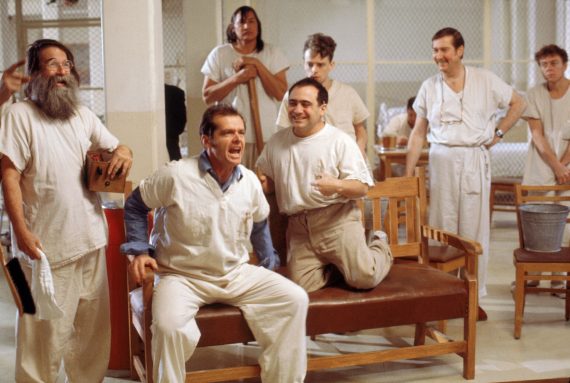
Of course, 70s attitudes cannot be entirely blamed for the problematic content in One Flew Over the Cuckoo’s Nest, since it was based on the 1962 novel by Ken Kesey. While the adaptation retains both Kesey’s invigorating dissension and his troubling misogyny, some elements such as the overt racist language used by protagonist Randle P. McMurphy have been ironed out. The film retains the cockeyed flipside of a societal microcosm in which male patients are oppressed by female nurses and black orderlies but in deleting the epithets used by Kesey’s McMurphy, it actively rejects the novel’s strange alignment with contemporary racism. What remains, and what must remain if McMurphy is not to be changed beyond recognition, is his attitude to women, including his casually self-justified conviction for statutory rape. Unrestrained sexuality is a crucial factor in making McMurphy the complex character he is, rather than the blandly perfect cipher he could be. Kesey’s determination to compare him to Christ in some frankly hamfisted moments complicates matters but this is thankfully a road down which the film doesn’t travel. How problematic you find the depiction of a statutory rapist may depend on how you interpret its intentions. Context clues and era-based presumptions may swing you towards a troubling conclusion but director Miloš Forman is smart enough to keep the fact of the matter blurry. Like Scarlett O’Hara and Rhett Butler, McMurphy was nominated for but missed out on a place in the AFI’s top 100 Heroes list. Given One Flew Over the Cuckoo’s Nest’s enduring popularity, this can only be attributed to the smart recognition that McMurphy, like the Gone with the Wind protagonists, is simply not clear-cut enough to be considered for the label ‘Hero.’
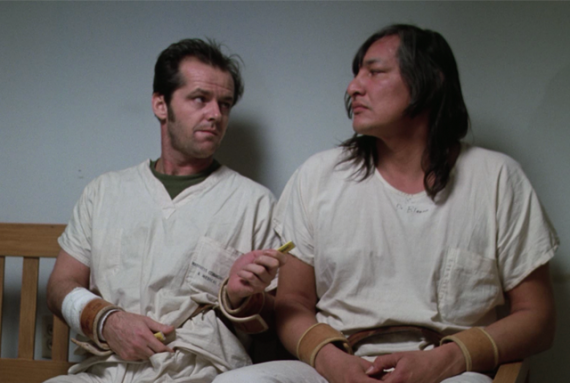
If Kesey’s questionable attitudes are something no adaptation can get out from under completely, I was relieved and delighted to discover that Forman’s film does about as good a job of neither supporting nor exacerbating them as a 70s film could’ve hoped to achieve. Although the story follows a fairly conventional model of a heroic arc, the ethical ambiguity of the characters renders it far more enduringly interesting, perhaps even more so for the shifting of eras and attitudes. McMurphy’s championing of individualism and proactivity is both inspiring and reductionist, a fact betrayed by a history of violence that culminates in the attempted murder of Nurse Ratched. While this moment has been taken by some to be meant as a cathartic moment in which the victim deserves what she gets, the disturbing manner in which it is presented and the subsequent outcome suggest otherwise, particularly in the light of the astute Christ-ectomy that has been performed on the narrative. Though McMurphy becomes a martyr in some ways, his sacrifice is clumsy and partially accidental, resulting in terrible outcomes for as many as it inspires. Though Kesey depicts the literal destruction of a woman’s voice as key in achieving a greater freedom, Forman’s version of this seems much more measured and temporary, if not wholly unproblematic.
One Flew Over the Cuckoo’s Nest is filled with female emasculators but it is significant that very few of them are seen. So while one might initially conclude that Harding’s wife and Billy’s mother are major contributors to them ending up in the psychiatric institution, it becomes clear that both men’s paranoia and Nurse Ratched’s willingness to exploit the same are the true culprits. In this reading, One Flew Over the Cuckoo’s Nest becomes not the story of how women oppress men but of how one woman, symbolic of something more than her sex, forces prolonged docility on a group of men who are also symbolic of something larger than their sex. It is crucial to note that, despite his less than progressive attitudes to women, McMurphy doesn’t hate Nurse Ratched because she is a woman in a position of power but because “she likes a rigged game.” Her ego hinges on the unerring rigidity of the system she upholds, the smooth running of which she has determined is reliant not on helping her patients but in keeping them in a state of perpetual placidity and dependence. She is not interested in small victories, which is why, in one of her characters’ key moments, she rejects the notion of sending McMurphy back to prison. Her need is not to get rid of him but to grind him down, crush his rebellion and assimilate him into the greater order that is useless in every respect other than keeping her employed and empowered. In all these respects, she represents the terrifyingly subtle malevolence of corrupt political systems. It is understandable that this subtlety leads many to miss just what an effective villain Nurse Ratched is.
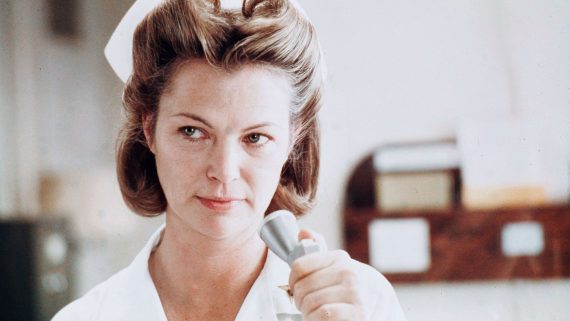
One Flew Over the Cuckoo’s Nest was the second film to win the top five awards at the Oscars (Picture, Director, Screenplay, Actor, Actress) and it’s easy to see how. Momentarily setting aside ideological considerations in favour of filmmaking alone, it is an excellent work all round. The performances are of particular note, bringing extra levels of wit to the strong screenplay. In particular, Jack Nicholson’s powerhouse turn as McMurphy is one for the ages. Elements of what was already being recognised as the Nicholson persona made him seem ideal for the role but even as those famous characteristics bolster the performance, not once do you feel you’re watching Jack Nicholson and not R.P. McMurphy. By contrast, Louise Fletcher brings an utterly chilling understatement to Nurse Ratched, her cold, calculating tone the complete antithesis of Nicholson’s effervescent roguishness. It’s a fiendishly effective juxtaposition that makes their scenes together utterly compelling. My favourite moment is the scene involving a vote over whether the patients get to watch a baseball game on television. Nurse Ratched attempts to break the unwritten rules of honour by sticking too rigidly to the arbitrary rules of conduct. McMurphy then scores a victory over her by breaking the rules of reality. The slowly escalating annoyance at something over which she cannot exert control is delicious to watch. Around these two central performances, we get a fantastic collection of supporting performances from soon to be familiar faces such as Danny DeVito and Christopher Lloyd, but the other standout is a young Brad Dourif who’s tender, funny and heartbreaking performance as the stuttering Billy Bibbit is one of the most memorable film debuts of all time.
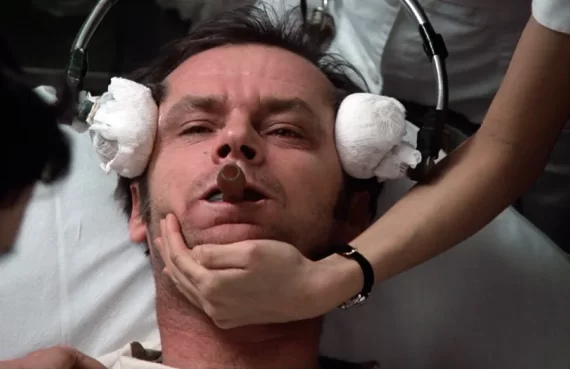
What of psychiatry? If taken at face value, One Flew Over the Cuckoo’s Nest’s depiction of mental health treatments as opposed to McMurphy’s plea for personal courage and individualism could be seen as simplistic at best, patronising or dangerous at worst. It’s been years since I read Kesey’s novel so I can’t comment with confidence on what his intentions were in this respect, but certainly I don’t see the film of One Flew Over the Cuckoo’s Nest as denouncing or devaluing psychiatric care. McMurphy’s personal philosophy is actually being pitted against what the institution symbolically represents rather than all hospitals of its kind. The depiction of electroshock treatment could be perceived as damaging and certainly it’s hard to hear the procedure mentioned without instantly thinking of Nicholson’s agonised thrashing during that scene. But it is the dishonesty of how the treatment is being used, rather than the treatment itself, that is being criticised here. Once again, the events of One Flew Over the Cuckoo’s Nest relate to this specific setting and if what you extrapolate from that is a criticism of mental health institutions then it’s possible you’re thinking too literally.
When examining films with potentially problematic content, especially films you love as much as I love One Flew Over the Cuckoo’s Nest, it’s easy to get caught up in mealy-mouthed apologia. This is not my intention here and I do recognise the problematic nature of some of this material’s core concepts. But I also feel that there is much that is still relevant about the satire of both Kesey’s novel and Forman’s film and, perhaps controversially, I prefer the latter. While both display a misogyny associated not only with their respective decades but which, as my teenage self would attest, also continued to play disturbingly comfortably a few decades down the line, Forman’s film leaves a lot more room for interpretation. Perhaps Kesey’s approach was more passionate but that also made it less pliable. You may think that’s a good thing but I found that extra level of ambiguity that characterises the film to be a welcome added layer of nuance. Certainly, I came away from this rewatch of One Flew Over the Cuckoo’s Nest delighted that, both despite and because of my shifting values, I still love it as much as I always did.
17. MIDNIGHT COWBOY
Watched 22 February 2023
It is an oft-cited fact that John Schlesinger’s Midnight Cowboy was the only X-rated film ever to win the Academy Award for Best Picture but the film’s 1969 victory in that major Oscar category feels like a moment of far greater significance that this bitesize piece of pub-quiz trivia suggests. As the oppressive production code began to relinquish its grip on cinema’s artists, films were able to explore more complex, adult themes without having to be coy or overly-cautious. A glorious age of American cinema was gearing up but Hollywood seemed initially resistant, packing 1968’s Oscar list with musicals, period dramas and reverent literary adaptations. With its unconventional structure, unrestrained exploration of sexual themes and dedication to trenchant realism, Midnight Cowboy feels like a vital stepping-stone towards the more satisfying, challenging and enduring American cinema that dominated Hollywood for several wonderful years before spaceships and spectacle took things in a different direction.
Midnight Cowboy follows the story of Joe Buck, a young Texan with a troubled past who heads to New York with dreams of becoming a male prostitute. Decked out in cowboy clothes he has chosen for himself, Joe envisages a glamorous lifestyle bedding attractive middle-aged women in fancy hotels but a couple of disastrous initial encounters quickly educate him in the realities of the city in which he has chosen to live and the profession he has picked out for himself. Destitute, Joe takes up with limping small-time conman Enrico Salvatore ‘Ratso’ Rizzo and moves into the squalid apartment in which he is squatting. Forming a tentative bond, the pair attempt to improve Joe’s chances as a hustler but as business begins to improve, Ratso’s health also begins to deteriorate, forcing Joe to re-evaluate his priorities.

If Midnight Cowboy’s story of prostitution and numerous plot-strands involving homosexuality made it immediately controversial, its excellence in just about every respect also made it a critical and commercial hit. Director Schlesinger had made a name for himself helming several classic British films including Billy Liar and Far From the Madding Crowd but his transition into American films is seamless and he handles the shifting tone and challenging structure of Waldo Salt’s extraordinary screenplay with supreme confidence. Salt, a blacklisted writer in the process of putting his career back together after a string of flops, turns in one of American cinema’s finest scripts. Incorporating haunting flashbacks and lopsided fantasy sequences, the tone switches from comedic to desperate to devastating without missing a beat. Key in achieving this effect are the two central performances by Jon Voight as Joe and Dustin Hoffman as Ratso. As superb a pair of performances as you could hope for, Voight and Hoffman make Joe and Ratso both heartbreakingly convincing and vividly larger-than-life. Between Joe’s goofy, beaming naivety and Ratso’s whiny, furtive world-weariness, this compelling odd-couple are almost like living cartoons in an environment that is all too real. They stick out like a couple of throbbing digits wherever they go and Salt and Schlesinger delight in throwing them into situations that only increase their conspicuousness. Ultimately, it is this shared lack of belonging that drives the pair together and their relationship works in much the same way as a central romance, even though no homosexual element is directly alluded to in this case.
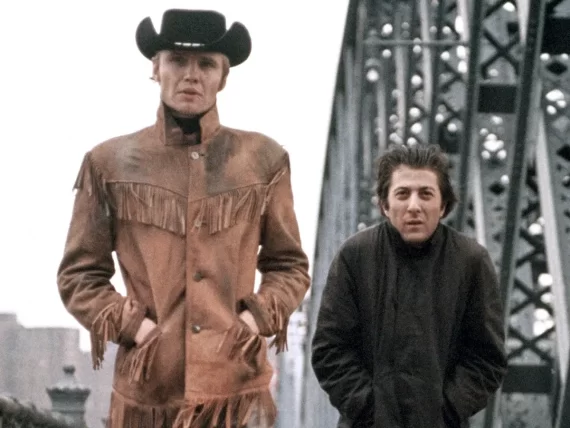
For much of its first half, Midnight Cowboy plays like a comedy as Joe encounters a self-proclaimed ‘gorgeous girl’ (Sylvia Miles in a fleeting but Oscar-nominated character sketch) who takes him up to her room only to end up asking for money from him instead of vice-versa. An initial meeting with Ratso leads to a humiliating encounter with a religious fanatic, while Ratso’s subsequent invitation for Joe to move in with him leads to a very funny scene in which he shows Joe round his miserable digs with a wavering sense of faux-pride which Hoffman plays to perfection. Even when things darken significantly in the second half (with the cumulative weight of the experience perhaps playing a part in this downturn in mood), the film still boasts an insistent sense of gallows humour, particularly in the scene in which Joe and Ratso end up at a Warhol-esque party which only exacerbates their uncomfortable prominence. These scenes are sometimes decried as too era-specific in a film that feels relatively timeless but Midnight Cowboy feels to me like a period piece which benefits from being situated in its proper context. The sexual politics it depicts are clearly of-their-time so era-specificity prevents the satirical edge from blunting. It also helps illustrate how Joe and Ratso are men who struggle to fit into their time as well as their place. They are characters who were born to stand out to their detriment, which makes Ratso’s dreams of moving to Miami even more tragically futile.
Schlesinger’s greatest achievement in Midnight Cowboy is in making New York seem both intimidatingly massive and oppressively small. Keeping his camera tightly focused on the insalubrious streets, he captures the depressing claustrophobia that haunts the characters’ lives. Both Joe and Ratso dream big but the realities they encounter squish their dreams into compacted cubic nightmares, eradicating any hope of escape. Success is elusive for this pair and their close association, though born of a need for companionship, is likely to result in worse for both of them. The film’s famously bleak ending, so often parodied but not diminished one iota in its power, is recast as something potentially more hopeful when viewed in this light but Joe’s final decisive act in New York is likely to haunt him just as the flashes of his youth in Texas still do and his connection to Ratso may prove considerably harder to sever than expected.

Despite its claustrophobia, Midnight Cowboy feels epically iconic from its opening moments onwards. Joe’s triumphant walk to his workplace to the strains of Nilsson’s gorgeous Everybody’s Talkin’ is a rousing opening and the song recurs throughout, forever linked to the images it accompanies. It’s an opening sequence that immediately instils a sense of history in the viewer and ensures them they are in safe directorial hands. On this rewatch I have also determined that Hoffman’s performance as Ratso is one of my favourite performances of all time. Nominated alongside Voight in the Best Leading Actor Oscar category, the pair lost out to John Wayne in True Grit. Whether this was because their dual nominations split the vote or whether this was the Academy’s reverent tip of the hat to old Hollywood, Wayne’s win feels unjustified in this company. Wayne is actually evoked in the dialogue of Midnight Cowboy as Joe’s ultimate symbol of manliness. In turn, Wayne went on a homophobic rant against Midnight Cowboy’s Best Picture win in a Playboy Article. “Disgusting” movies would kill Hollywood, he claimed. But Midnight Cowboy ultimately played a big part in revitalising a flagging Hollywood that was still nominating pictures like Hello Dolly! for its top award.
16. MOONLIGHT
Watched 20 February 2023
Barry Jenkins’ Moonlight is such a quietly subversive film that it is easy to miss its importance and boldness at first. The small handful of negative criticisms of this roundly hailed masterpiece noted that its story had been told many times before: a young black boy’s struggles with adolescence and identity as he grows up with a crack-addicted mother in a poor Miami neighbourhood. But focusing on the superficial ignores the way in which Moonlight deconstructs the roles that could otherwise have emerged as stereotypes. Its prominent LGBTQ+ themes were a rarity in both the Hood films with which it was hastily compared and in Best Picture winners. Based on Tarell Alvin McCraney’s unproduced 2003 play In Moonlight Black Boys Look Blue, Jenkins’ film simplifies the play by replacing its structure, in which three stages of the protagonist’s life are presented concurrently, with a linear narrative split into three successive chapters. Though McCraney’s showier approach, which apparently hides the connection between the three versions of its protagonist until halfway through the play, might have worked well on stage, Jenkins was wise to opt for a more straightforward method of storytelling which allowed him accentuate the main strengths of his take on Moonlight: the visual aesthetic, the sensuous atmosphere and the tender heart.
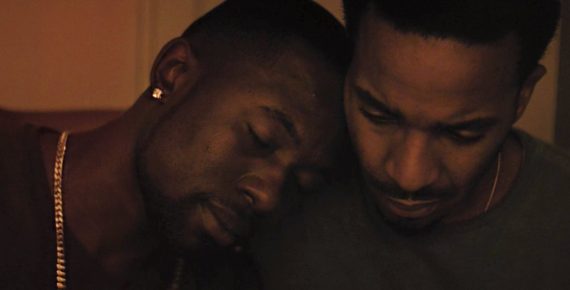
Although there is more to Moonlight than just its story, Jenkins also ensures that his film works well at a basic narrative level. If we’ve seen stories like this before, we’ve rarely seen them told in this way. For the most part, Jenkins focuses on character and dialogue, which is both authentic and subtly poetic, but the story also reaches a few dramatic peaks. Most notable amongst these peaks is the confrontation between Mahershala Ali’s drug-dealing father figure Juan and Naomie Harris’s Paula, the drug-addicted mother of protagonist Chiron. By initially playing up Juan’s genuine nurturing interest in Chiron and Paula’s neglect of him, Moonlight sets us up to feel a certain way before revealing that Paula gets her drugs through one of Juan’s employees, establishing him as a greater part of the problem than the solution. This kind of unexpected narrative pivot is typical of Moonlight’s fleet, delicate deconstructions and refusal to soft-pedal the complexities of the issues at its core. No doubt if we pulled back further we could examine the systemic problems that placed Juan in this position but this is sufficiently implied, and Moonlight seeks to inspire a larger empathy that can be applied beyond its handful of characters.
Aiding the quality of Moonlight’s intelligently sparing screenplay are its exemplary cast. Due to the lengthy time period over which the story unfolds, there is no distracting star turn to overwhelm the experience. Chiron is played by three different, equally effective actors, as is his longterm friend and lover Kevin. Ali and Harris were rightly lauded for their performances, both Oscar-nominated with Ali winning for about 20 minutes of screen time, but they remain on the sidelines of the story as keenly felt influences, their performances in turn enhanced by writing that evokes their presence even in their absence. Juan’s offscreen death, barely alluded to, is an example of an event that most filmmakers would’ve tried to make into an emotional centrepiece, but Jenkins acknowledges in his exclusion of the details that this is Chiron’s story, not Juan’s, and the emotional fallout is implied through small, oblique moments.
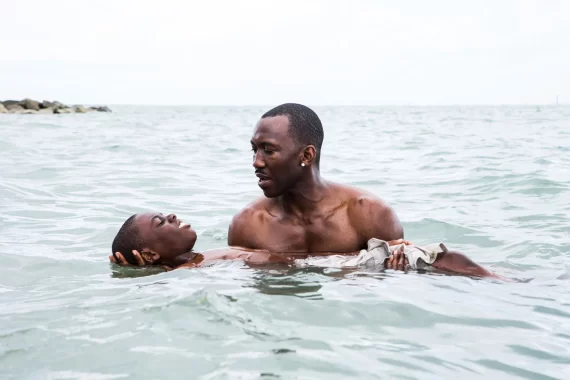
In a film that relies so heavily on its immersive atmosphere, a unique kind of dreamlike realism, the cinematography of James Laxton and the music of Nicholas Britell are key. Britell’s score applies Hip-Hop remix techniques to orchestral music to create something more fascinating and less on-the-nose than the straight Hip-Hop soundtracks of the average Hood film. Laxton, meanwhile, worked closely with longtime friend Jenkins to create the astonishingly beautiful style that is the first thing that comes to mind when I think of Moonlight. While the traditional approach to this kind of material is a rough-edged, documentary realism, Laxton’s work brings a sun-glaring, ethereal beauty to even the most insalubrious of settings. This lends the film a vibrant romanticism that never undermines the gravity of the material but acknowledges that poverty is more complex than more one-note, grainy misery-fests may suggest. The prominent motif of water allows this crystalline sumptuousness to shine, especially in a famously breathtaking scene in which Chiron and Juan swim in the ocean together.
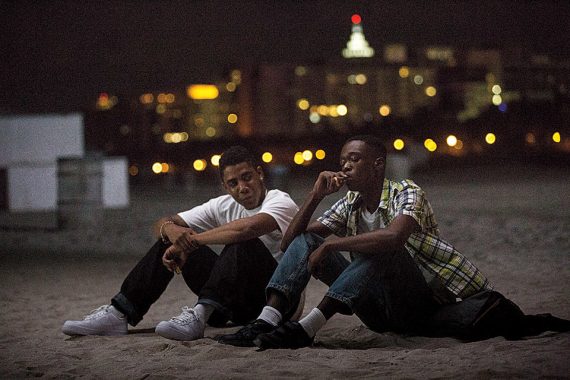
The theme of identity is compellingly explored throughout Moonlight, with each chapter named for a moniker adopted by or given to Chiron at some point. Emerging sexuality is explored without either desexualising or sensationalising the experience, and while oppression and prejudice are inevitably part of the story, they are matched by a sense of joy and redemption that is all too often missing from tragic LGBTQ+ representations to a detrimental level. This is especially noticeable in the deeply moving final chapter, which links love and sex with other sensual pleasures such as the emotional effect of music and the enjoyment of food. While some found this low key finale disappointing in comparison to the chapters that precede it, it provides the perfect ending to the unique film Jenkins has made. This becomes more apparent with each viewing when, relieved of erroneous narrative expectations, the viewer can savour the impeccably evoked intimacy with the same undisturbed relish with which Chiron enjoys his dinner.
It’s a shame that the surprise success of Moonlight in taking the Best Picture award was somewhat overshadowed by an Oscar night blunder in which the victory was briefly attributed to Damien Chazelle’s charmless La La Land instead. Although the error was corrected, what should’ve been a joyous moment was tainted by a feelbad edge that was only surpassed when Will Smith got slap-happy several years later. Still, Moonlight’s win was still encouraging and its association with that unfortunate incident has perhaps forced us to isolate it from an awards-ceremony context to see it as the triumphant stand-alone achievement it is. Maybe this is a hypocritical statement from someone who has spent the last few months writing so extensively about Best Picture Winners, but Moonlight is a timely reminder of how accolades should never be a major consideration for great filmmakers. This is so clearly a film that put quality, innovation and pleasure above any such considerations and it plays so naturally to the extent that it almost feels less like it was made than it just came into being.
15. REBECCA
Watched 3 May 2023
There was a ridiculous article in Empire in 2016 in which they included Rebecca in a list of the Top 100 British Films. The write-up acknowledged that Rebecca was an American production (Alfred Hitchcock’s first, in fact) but argued that it belonged on the list since it was largely set in England and starred a primarily English cast. This is nonsense, of course. It’s immediately apparent, especially after watching Rebecca back to back with Hitchcock’s British films, that it is a Hollywood production through and through. You can immediately feel the change in Rebecca’s sweeping grandeur, blustery romanticism and gothic heft. Not to mention that our point of entry in the story is outsider Joan Fontaine, who’s experience of returning to England with her new husband is one of anguish and alienation. Hitchcock gave audiences a haunting version of British life in Rebecca but it is most definitely very much a Hollywood film. The first fruits of Hitchcock’s move to Hollywood could scarcely have been more impressive. After the disappointment of his first Daphne du Maurier adaptation Jamaica Inn, Hitch more than made up for it with an epic gothic melodrama that enraptured critics and audiences alike. None of Hitchcock’s films up to that point had troubled the Oscar voters but Rebecca stormed onto the Best Picture winners podium right out of the gate. It remains a much treasured classic.

Though Hitchcock’s touch is still more than evident, the move from Britain to Hollywood requires a slight recalibration in the viewer’s mindset as the filmmaking becomes more opulent, the acting more stormily melodramatic and the story more grandly ambitious. After the scrappy naturalism or quirky playfulness of performances in The Lady Vanishes or The 39 Steps, the swooning performances of Laurence Olivier and Joan Fontaine can at first seem slightly overwrought. This effect doesn’t last long however, as the expansiveness of the film quickly chimes with the intensity of the performances. Fontaine in particular is excellent, her downtrodden timidity shifting seamlessly into overawed joy, overwhelmed anguish and terrified desperation, her teary eyes penetrating the viewer’s sympathetic heart. Olivier’s performance as the haunted widower Maxim de Winter takes a while longer to snap into focus but this is in keeping with the enigmatic character. By the time we reach the two-hander scene in which the film’s main revelations are revealed, Olivier and Fontaine are positively spellbinding and this dramatically mesmerising moment emerges as one of the best sequences Hitchcock had yet shot.
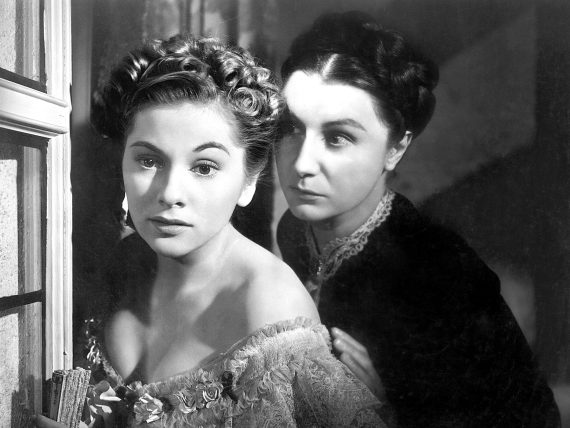
Olivier and Fontaine were both Oscar nominated and a third well-earned nomination went to Judith Anderson for her thoroughly chilling performance as Mrs. Danvers, housekeeper of the cavernous country pile Manderley, in which most of the film takes place. Danvers would be an easy role to completely overplay but Anderson’s performance has a pleasing dramatic rise and fall, maintaining the mystery that is so crucial to Rebecca’s narrative power. Though the film is also peppered with smaller turns by great British actors like George Sanders, C. Aubrey Smith and Nigel Bruce, as well as scene-stealing American Florence Bates, the other major presence in Rebecca is Manderley itself. When a suitable real location could not be found for exterior shots, Hitchcock again worked with models but they are of a higher quality than the toy-like distractions of his British films. Still, their artificiality is apparent and it feels like a bit of a shame when the interior scenes of Manderley are so effective.
The only other flaw that prevents Rebecca from placing higher than it has is its slightly hurried third act. The build up of the eerie mystery is superb and the pay-off does not disappoint, but after such an extraordinary scene the film struggles to maintain the drama for the 25 minutes or so that it takes to tie up the loose ends and the sudden dramatic final flourish feels a bit abrupt. It’s still engaging enough but it’s a shame to end with a slow wind-down rather than maintain that gripping atmosphere. Nevertheless, Rebecca is still a five star classic for me and the perfect way to kick off Hitchcock’s Hollywood career.
14. AMADEUS
Watched 1 July 2023
When I started my Best Picture Project way back in June 2022, I opened with a bang when the random generator picked out On the Waterfront. I was hoping for an equally big finish and I got it when Miloš Forman’s Amadeus was the final film left over. A big, beautiful, lively creation which hides a poisonous cerebral sting beneath its captivatingly bewigged pomp, Amadeus is a deliberately fanciful take on a portion of the life of Mozart and the apocryphal one-way rivalry with court composer Salieri. Though its historical inaccuracy has been criticised by some, this completely misses the point of this wonderful film. Its writer, Peter Shaffer, described it as a “fantasia”, and the wryly camp humour, maximalist thematic explorations and striking central caricature all back up this description. As a grand finale, it’s hard to imagine a film that feels more like the grandiose fall of a glorious velvet curtain.
At 161 minutes (or 3 hours if you watch the director’s cut), Amadeus is one of the shortest-seeming long films because of its sheer amount of energy and the constant stimulation it offers in a visual, aural and intellectual sense. Far from the sort of dryly reverential Biopic for which some of the film’s critics seemed to be pining, Amadeus imagines Mozart as an egotistical, impulsive, vulgar, volatile brat with a persistent high-pitched giggle that bursts forth like a nervous tic. By contrast, court composer Salieri is a dignified, restrained figure driven to madness by his inability to understand how God could’ve bestowed genius upon such a ludicrous creature as Mozart. This fascinating examination of egotism, jealousy and religious belief drives Amadeus’s narrative as we see Salieri driven to further distraction by each new masterpiece.

The film is blessed by two virtually perfect, exceedingly different central performances by Tom Hulce and F. Murray Abraham as Mozart and Salieri respectively. Abraham is exceptional. His ability to project, through facial expressions alone, the contradictory turmoil of a man who has just heard something beautiful, is stunning, but he also gets to play bigger as the elderly narrator who has succumbed to madness in a manner that feels almost like a reverie. Only from the confines of a broken mind can he find anything close to sense in his experiences or comfort in his mediocrity. By contrast, Hulce’s Mozart is a living cartoon, the classical composer as 80s rock star (the film did, indeed, inspire Falco’s subsequent hit Rock Me, Amadeus). It’s the sort of performance that can make or break a film but in this case it is very much the former. This is a bold, audacious turn in a role that demands nothing less and Hulce makes the film pop, providing the excessively rich cheese to Abraham’s dour chalk, which alternates between smooth strokes and tortured scrapes across the blackboard. In a wonderful irony, though both were nominated, it was ultimately Salieri and not Mozart who walked away with the Best Actor Oscar.
Shaffer’s screenplay, based on his play of the same name, is an absolute gem. Salieri’s musings on God are particularly fascinating, betraying an inflated sense of significance that offsets his inferiority complex. This is most evident in the scene after Salieri assists Mozart in transcribing his final masterpiece, after which Mozart dies. Salieri believes God destroyed Mozart rather than let Salieri even share in a small part of his glory. It’s an incisive glimpse into a man so insecure that he has convinced himself of a God that works to taunt him directly. This beautiful irony pays off in the perfect ending, as Salieri declares himself the patron saint of mediocrities, absolving the inadequate like a deficient Christ. This exquisite writing is bolstered by Forman’s subtly scathing direction, not to mention the art direction of Patrizia von Brandenstein and Karel Černy and the cinematography of Miroslav Ondriček, which creates an air of opulence tainted by toxicity.
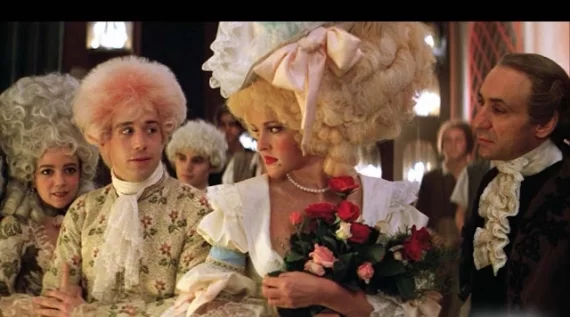
And, of course, there’s the music. I’m no fan of Opera or Classical particularly, but in the way the music of Mozart is framed here, Forman manages to highlight the genius even for those who are not inclined to go looking for it themselves. The clever scene in which Salieri plays snippets of his own work to an oblivious priest, only for the priest to perk up in immediate recognition at a snatch of Mozart’s work, places the audience in the shoes of the priest and reminds us how truly great music weaves its way into our subconsciouses even if we didn’t intend to grant it entry.
13. NO COUNTRY FOR OLD MEN
Watched 14 August 2022
I remember being slightly disappointed when I first heard about No Country for Old Men. Having been a massive Coen brothers fan for years, I had been completely thrown by their previous two films, Intolerable Cruelty and The Ladykillers, because they had been adaptations of other people’s ideas, rather than creations from the fertile wellspring of the Coens’ own imaginations. So hearing that No Country for Old Men was an adaptation of Cormac McCarthy’s 2005 novel of the same name, I initially doubted this would be the return to form I’d been waiting for since the overlooked masterpiece The Man Who Wasn’t There fell flat at the box office. But in subsequent weeks and months, I kept hearing more and more about how brilliant No Country for Old Men was, seeing enticing clips and rave reviews. Feeling my excitement for the Coens work rekindling, I made the trip to the cinema and was so captivated by the film I saw that I nearly fell down the stairs on my way out (true story).
Three years earlier when The Ladykillers was released, few would’ve expected the Coens to end up atop the Best Picture Oscar winners podium with their next film. Though they had always been adept at switching genres and tones from film to film, The Ladykillers was such a startlingly crass low point that it was hard to imagine a way back from it. There can be few director’s filmographies with back-to-back films as completely different as The Ladykillers and No Country for Old Men. While the latter did represent a return to form, watching it for the first time didn’t feel like a simple homecoming. Though the trademark Coen brothers’ dark sense of humour does emerge here and there, No Country for Old Men is a much bleaker, sparser film than any of its predecessors. By sticking closely to the source material, the Coen style feels filtered through McCarthy’s grim vision in a way that adds new atmospheric strings to the directors’ bow. The closest cousin in the Coen catalogue is their debut Blood Simple, which shares a chilly atmosphere and dialogue-light approach with No Country for Old Men. But Blood Simple had a farcical underpinning baked into its narrative, something which is entirely and deliberately absent from No Country for Old Men’s despairing meditation on violence.

Although it does feel like new ground for the Coens in several ways, No Country for Old Men does not feel remotely out of place in their catalogue. The detached open spaces and weirdly unsettling motel rooms are immediately familiar, while McCarthy’s characters fit beautifully into the Coen oeuvre. While less eccentric than their Coen-created predecessors, it’s not hard to draw a line from the psychotic killer Anton Chigurh to Raising Arizona’s Leonard Smalls or Fargo’s Gaear Grimsrud, even if they seem to inhabit slightly different worlds. While the violence in previous Coen films was usually delivered with a comic edge, it is absolutely crucial that this not be the case in No Country for Old Men, which must retain its alienating and sickened depiction of its world’s brutality. The character of Sheriff Bell, while far from the bland everyman type that often serves as a point of entry, provides a touchstone for the viewer that doesn’t so much offer respite as validation for a sense of nauseated fear. Bell’s arc is one of trauma and quiet defeat, resulting in an ending that many felt was anticlimactic but this complaint betrayed a fundamental misunderstanding of what No Country for Old Men is. While there is plenty of tension and bursts of action throughout, this isn’t a film that befits a neat resolution. McCarthy’s story, to which the Coen’s stick faithfully, takes unexpected turns that swerve further and further from audience expectations. Where we usually get confrontation, we instead get meditation, ambiguity where most film’s offer us closure. No Country for Old Men is the sort of film that can challenge and change the way a viewer thinks about film itself.
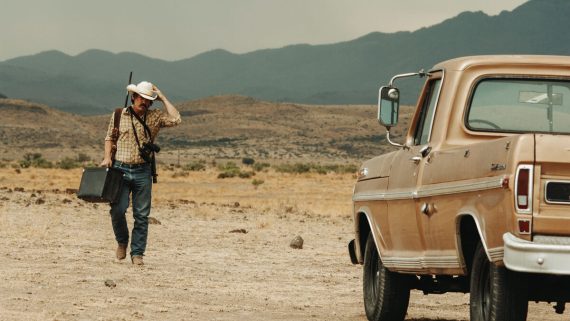
The cast of No Country for Old Men is terrific, with its three leads bringing a completely different energy to their strands. In accordance with these clashing personalities, the main characters rarely coincide with one another and when they do it sparks violence or the looming threat of such. Josh Brolin, as the unfortunate soul who stumbles on the aftermath of a drug deal gone wrong, brings a suitable stoicism to his dialogue-light role, while Javier Bardem completely embodies the terrifying Chigurh with an unsettlingly calm but ominously irritable eloquence that suggests a skewed moral code of sorts, reminiscent of Johnny Caspar’s unconventional idea of “ethics” in Miller’s Crossing. Bardem is absolutely perfect in the role, making Chigurh a borderline mythic villain who’s wearied determination, single-minded persistence and complete self-assurance make him seemingly indestructible. The famous coin toss scene is one of the greatest moments of 21st century cinema and a large percentage of the credit for that belongs to Bardem’s performance, which deservedly bagged him an Oscar. It was inevitable that Bardem would steal the headlines but I’ve always felt Tommy Lee Jones also deserves copious praise for his take on Sheriff Bell. Jones’s craggy, haunted face reflects the deepening mental scars that dog Bell on a daily basis and will follow him into retirement. Bell is a good man but he isn’t a traditional movie hero. The film isn’t interested in how he can bring down Chigurh so much as the effect his vain attempts have on Bell himself. The complexity of the effect prolonged exposure to violence can have on our psychological state ultimately becomes a greater focus for No Country for Old Men than its cat-and-mouse narrative, to the extent that the antihero we’ve been following for the majority of the film can be casually killed off in an offscreen incident. This event sends the viewer into free fall, pulling the rug out from under our every expectation and leaving us clueless as to where the narrative can go now or even how much longer there is left of the runtime.
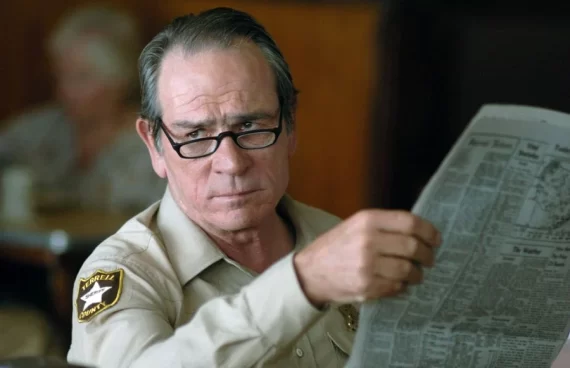
No Country for Old Men’s negative critics reacted to its boldest narrative decisions as if they were mistakes. Why was there no clear protagonist? What was with that anticlimactic ending? How come they didn’t get the bad guy? Questions like this fundamentally misunderstand the kind of film No Country for Old Men is and the desperation for it to fit into established tropes and forms feels like a cry for a dull uniformity across all of cinema, as if filmmakers have a contract with audiences to fulfil their expectations. While No Country for Old Men refuses to do so, it doesn’t feel like a self-conscious attempt to subvert anything, but rather a narrative unfolding in exactly the way its themes naturally dictate. This isn’t a brattish rejection of commerciality so much as a laudable dedication to honest storytelling. Many adapters would probably have tagged on scenes of Bell bringing Chigurh to justice, justifying this by differentiating the demands of cinema from those of literature, but that would not only have been a cop out, it would’ve brought the whole house of cards crashing down. Many a narrative has been betrayed by adherence to presupposed cinematic requirements. It’s a good thing Cormac McCarthy’s source text ended up in the hands of the perfect directors to sidestep such detrimental conventions.
12. THE BRIDGE ON THE RIVER KWAI
Watched 5 September 2022
The Bridge on the River Kwai marked David Lean’s shift into Epic cinema, which would come to define the latter stage of his directorial career. Based on the Pierre Boulle novel of the same name, The Bridge on the River Kwai is a fictional war film set against the real historical backdrop of the construction of the Burma railway, built by civilian labourers and prisoners of war in the early 1940s. As is the case with using any real atrocity as a setting for fiction, there were controversies over historical inaccuracy, depiction of soldiers of all nationalities and depiction of the conditions in which prisoners of war were kept (which were actually far worse than shown here). But taken as a straight piece of fiction, The Bridge on the River Kwai is exemplary in its storytelling, its characters, its dialogue, its direction and its cinematography. The latter is the work of Jack Hildyard, whose attractively restrained work perfectly captures the gritty atmosphere without making the film dowdy or depressing. This isn’t the romantic sweep of Lean’s subsequent Lawrence of Arabia and neither should it be. While Lawrence of Arabia is the more beautiful film, The Bridge on the River Kwai is, to me, a far better one. Its pacing is less ponderous, its psychological undercurrents more taut and its overall air less stuffy and self-impressed. Lawrence of Arabia may look more awesome on a big screen but The Bridge on the River Kwai is more impressive when you take the crasser concerns of acreage out of consideration.
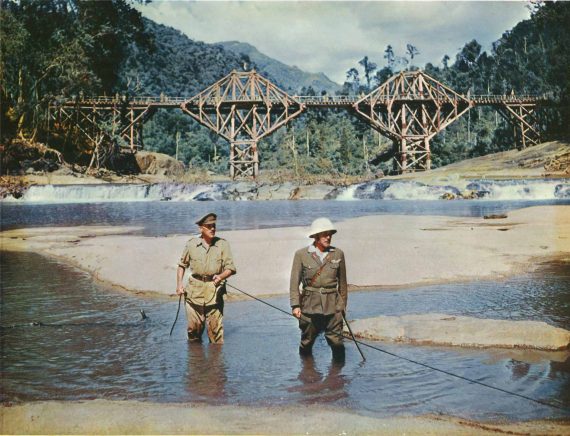
Right from the off, the first thing I noticed about The Bridge on the River Kwai was its terrific screenplay. Written by Carl Foreman and Michael Wilson, who’s impressive list of credits include classics like High Noon, Champion, A Place in the Sun, Planet of the Apes and Salt of the Earth, The Bridge on the River Kwai immediately distinguishes itself with a grimly witty scene of William Holden’s prisoner of war Shears burying a dead soldier. His cynical improvised eulogy establishes Shears anti-authoritarian, anti-war attitude which is crucial for the character. Straight after that we meet Alec Guinness’s Colonel Nicholson, leader of a contingent of British soldiers being brought to the prison camp. The polar opposite of Shears, Nicholson has the highest respect for the military, authority and the rules. This immediately puts him at odds with camp commander Colonel Saito (a brilliant turn from Sessue Hayakawa), who sees war as being beyond the reach of governing guidelines, including Nicholson’s beloved Geneva Convention. The first act of the film plays out as a duel between Nicholson and Saito over the point in the Geneva Convention that states that officers are exempt from manual labour. This kind of prolonged battle of wills is a dramatic staple but the one in The Bridge on the River Kwai is a good deal more interesting than most, in that it forsakes the simplicity of a standard good vs. evil setup for a much blurrier morality. Nicholson’s incredible resilience in the face of Saito’s torture is offset by the growing impression that it is driven more by a rigid dedication to the rulebook than a genuine concern for his men. Parallels are quickly drawn between Nicholson’s and Saito’s fanaticism, casting Guinness’s eventual victory in an unusual light. As he is celebrated by his soldiers, hoisted aloft and cheered, a sourness pervades the sort of scene usually played for moist-eyed sentimentalism. This is a precursor to Nicholson and Saito’s subsequent alliance, which may have seemed unlikely without the skilful groundwork laid in that first hour.
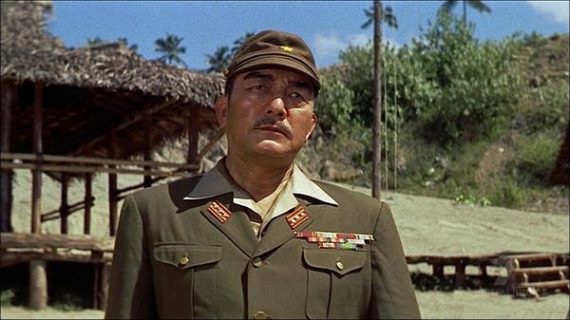
The Bridge on the River Kwai’s undermining of expectations regarding patriotic war films of its era continues with another plot strand involving William Holden’s Shears. Having managed to successfully escape the prison camp and presumed dead by the enemy, he is then pressed by the Special Operations Executive into returning to assist a commando mission in blowing up the bridge that Saito is having constructed. In the average war film of its era, there would be a moment where Shears realises his sense of patriotic duty and willingly volunteers for the mission. But instead he does everything he can think of to get out of it, even confessing that he has been impersonating an officer in order to get better treatment. This fact, already known by the SOE, is used against him in order to strongarm him into the mission. At no point is Shears a willing hero. Instead, he is an opportunistic, self-focused survivalist who sees the madness of war and determines to get himself out of it. This is not judged as cowardice by the film, as it doubtless would’ve been ten years earlier. Rather, Shears is another complex character in a film filled with them. He is flawed but his anti-war attitude is depicted as clearer-eyed than the compromised visions of Nicholson and Saito.
In its second half, The Bridge on the River Kwai becomes even more interesting, providing both a gripping wartime adventure plot and a densely psychological view of leadership. Saito, who initially seemed to be a two-dimensional sadist, is humanised as we get a glimpse of the pressures upon him and the emotional toll they take. Nicholson’s assumed heroism, meanwhile, is undercut by the realisation that his passion is not for his country or his battalion but for a rigid militaristic ideology that is all but meaningless when stripped of human implications. Even his prolonged battle with Saito in that first hour suddenly snaps into focus as a fight founded on classism, its implicit focus being the protection of the supremacy of officers over enlisted men. This varied collection of powder keg personalities collide in an iconic and absolutely brilliant final scene that does not hold back in depicting the horrors and folly of war or the detrimental effect that the personal ideology of a single officer can have on entire swathes of people.

The Bridge on the River Kwai shifts focus fluidly between protagonists but it emerges as Guinness’s film as far as the acting stakes are concerned. He makes Nicholson iconic, giving us occasional glimpses of his humanity beneath that severe facade as if genuinely by accident. Foreman and Wilson’s extraordinary screenplay shines throughout, even providing moments of much appreciated humour, something that Wilson would also bring to Lawrence of Arabia. Lean, meanwhile, seems to shift effortlessly into the demands of Epic cinema. With Lawrence of Arabia, his visual flourishes would really come into their own, as with that justly celebrated lit match moment. But on The Bridge on the River Kwai, Lean seems to be hidden in plain sight, keeping the story running with propulsive forward motion but without ever stepping out from behind the camera to go “Look. Look what I’m doing!” He fulfils all the requirements of a great action film and an intelligent psychological study without awkwardly switching between the two or short-changing one in favour of the other.
11. UNFORGIVEN
Watched 27 October 2022
The third, and so far final, Western to win Best Picture, Unforgiven became the most acclaimed film of Clint Eastwood’s directorial career, rejuvenating his critical standing after his previous Action dud The Rookie. Eastwood decided that Unforgiven would be his final Western so as to avoid repeating himself and it proved to be a hell of a way for one of the icons of the genre to bid farewell to it. Working from a fantastic screenplay by David Webb Peoples (of Blade Runner fame), Eastwood cannily combines a Revisionist core with classical set-ups. There are plenty of rolling valleys, craggy mountains, dusty towns and dank saloons to align Unforgiven with classic Western iconography and yet at heart this is a complex study of violence and accountability that eschews the simple morality of the foundational Westerns in favour of a much greyer outlook. This is a film of no heroes, and the natural inclination to root for Eastwood’s posse is one that compels audiences to ask serious questions of their own moral decisions.
Even if you take it on the most basic level, Unforgiven is a riveting couple of hours, with plenty of gunfights, journeys across vast plains, campfire conversations, tense standoffs and tragic backstories to keep anyone entertained. But the thorny themes, impossible to unravel with any moral certainty, are what make Unforgiven truly great. Beginning with the nasty initiating event of a cowboy disfiguring a prostitute who laughed at his penis, Unforgiven introduces us to Gene Hackman’s sheriff Little Bill, who lets the perpetrator and his friend off with a fine payable to the prostitute’s employer. Feeling this is far from enough, the other prostitutes club together to offer a reward for the slaying of the two men. But Little Bill, determined not to be undermined, will use any means to see off gunfighters who come to his town seeking the bounty. Already Unforgiven is ripe with fascinating talking points, as the majority of viewers side with the prostitutes who are treated like livestock by their employer and Little Bill’s verdict. In doing so, we’re essentially condoning capital punishment by way of vigilantism. Then we meet Eastwood’s Will Munny, a reformed outlaw who is now a struggling farmer. A widower dedicated to the moral code that his wife instilled in him, Will feels forced to seek the bounty when his financial struggles threaten his children’s future. But his quest will reopen old wounds and reawaken certain tendencies within him. Again, we have a very complex situation, with Will sacrificing his principles for his family’s safety. The knowledge that Will has done worse in his past than the men he is pursuing or the sadistic lawman he will come up against adds another layer. Can we, and should we, forgive Will’s past? And can we endorse his return to bounty hunting? Unforgiven hands us nothing on a plate and leaves us with no answers. Instead, it stokes the fires of moral ambiguity and leaves us with unsolvable puzzles, made more palatable during the runtime by familiar, impeccably realised genre conventions.

Peoples’ screenplay is phenomenal, avoiding easy answers and glib moralising. While some complain that Richard Harris’s English Bob is superfluous to the plot, anyone engaged with the themes of Unforgiven will recognise how crucial his superficially tangential story is, allowing Peoples’ to bat around his themes in a way that opens out the debates even more. Harris and Saul Rubinek, as English Bob’s out-of-his-depth biographer, bring a welcome strand of humour to the film while also introducing themes about how heroes are manufactured by inaccurate media and misplaced hero worship, with Rubinek’s character switching allegiances every time he meets someone more monstrous than his current subject. The rest of the cast is strong, with the film dominated by Eastwood and Hackman. Hackman‘s Oscar-winning turn as Little Bill is superbly measured, bringing out the terrifying sadism of the character through his deceptively calm approach. Eastwood has never been better than he is here. I’ve always thought of him, like John Wayne, as more of a forceful screen presence than a good actor. But, as is also the case with Wayne, there are notable exceptions and the richer potential of this character allows Eastwood to display a greater range.
Perhaps the most interesting piece of casting is Morgan Freeman as Will’s former partner Ned. Surprisingly, given Eastwood’s well-documented Conservatism, this appears to be an early example of colourblind casting, since no mention of Ned’s race is made and he is treated as an equal, allowed to drink at a table with Will in the saloon and partaking unquestioned of the services offered by the prostitutes. While some have seen this as a flaw, more and more it feels like a progressive move worthy of applause. There’s nothing in the dialogue to indicate that Ned was intended to be a black character and it seems that Freeman was just hired because he was the best man for the job, without Peoples or Eastwood feeling compelled to add in the racism that would surely have been present in this era and in a town like Big Whiskey, Wyoming. Even a loaded image like Ned, shirtless and chained, being whipped by Little Bill, is not pursued for its obvious implications. The first time I watched Unforgiven, I braced myself for the racist language I felt sure would come in scenes like Jaimz Woolvett’s Kid questioning Ned’s right to join the manhunt, or Little Bill’s taunting of the shackled Ned. That it never came was initially a relief which I then found perplexing, briefly considered an oversight on the filmmakers’ part, and ultimately came to see as a bold, refreshing and correct decision for the film Eastwood made.
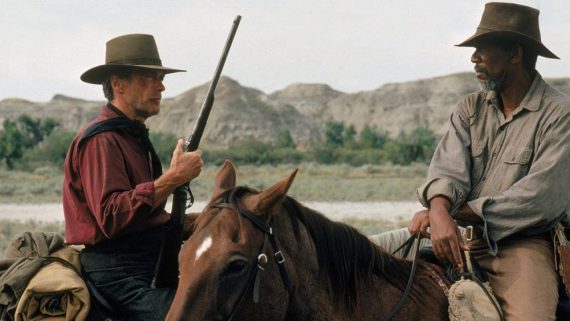
One of Unforgiven’s most gruelling themes is the psychological implications of murder. This is an underexplored theme in the Western genre, where men are frequently dispatched with a dispassionate gunshot and shipped off to Boot Hill with naught but celebration. In Unforgiven, the weight of killing hangs heavy, making several characters think twice about their chosen paths. A bullet doesn’t necessarily mean instant death and listening to your victim bleed out is not something to be enjoyed or experienced with ongoing causality. Peoples and Eastwood both do excellent work with this theme, with the eloquent dialogue of the former enhanced by the haunted performances Eastwood coaxes out of his cast, as well as contributing his own. With its reluctance to offer answers to the disturbing questions it poses, Unforgiven is often seen as a grim and, well, unforgiving experience. But in the very act of acknowledging that these are issues that demand debate and defy reductive solutions, Unforgiven is actually a film of great humanism. It’s resonant themes feel even more relevant now, with millions of keyboard warriors on all sides of the political spectrum surely due such a thoughtfully crafted lesson in moral ambiguity.