



In Part 3 of my journey through the Best Picture winners, I’m looking at films I rated 3 stars, which generally means there was something interesting or appealing in them but that they fell short in other ways. All entries contain spoilers.
You can find the earlier parts of the list here:
75. GANDHI
Watched 12 March 2023
Across the course of this project, I’ve discovered (in truth, ‘confirmed’ is probably a better word) a personal dislike for Biopics, particularly those delivered on an epic scale. Gandhi is another such film and, like Lawrence of Arabia and Patton before it, it’s a film whose continued acclaim is not matched by my own reaction. When I recently watched The Last Emperor, another Best Picture Winner from a decade in which gargantuan runtimes and visual beauty often seemed to trump all other considerations for the Academy, I was left rather cold by the depiction of the central character who’s actual life sounded much more interesting than the abridged version onscreen. Gandhi begins with a caption that openly acknowledges the impossibility of accurately capturing the essence of a person’s life in three hours. But in focusing on certain major incidents, Gandhi rather brazenly seeks to depict its titular hero as a saint, with some early tantalising glimpses of complexity quickly swept away by an avalanche of speechifying. This can feel inspiring at some points and, as a lifelong liberal, it’s satisfying to see a host of great British actors lining up to play stuffed-shirt imperialists having the wind knocked out of their sails, but ultimately the repetitious sermons grow wearisome and the version of Mahatma Gandhi we get is tediously one-dimensional.
Most reviews of Gandhi, even some of the negative ones, tend to agree that the performance of relative newcomer Ben Kingsley is the highlight of the film. Although there has been retrospective controversy about the artificial darkening of Kingsley’s skin, he did at least have Indian heritage on his father’s side and bore a striking resemblance to the real Gandhi, neither of which could’ve been claimed by Richard Burton, whom was reportedly an earlier suggestion for the role. When David Lean became briefly involved, he wanted Alec Guinness, presumably so he could continue to pursue his own personal fetish for putting that actor in the most offensive makeup he could imagine. It’s fair to say that Kingsley turned out to be a good choice for the very British type of film that director Richard Attenborough ended up making but I’ve never been as blown away by his performance as everyone else seems to be. He delivers his lines with dignity and a forcefulness which makes him convincing as a leader, but there is no depth or charisma to make Gandhi seem like anything more than the figurehead Attenborough and screenwriter John Briley have whittled him into. Had some of the more unsettling elements of Gandhi’s character been included, like his attitudes to women and sex or the racism of his early writings, then this would’ve been a very different film indeed. These omissions are partially covered by that opening caption, but that doesn’t allude to their negativity and, if anything, seems to suggest that what has been omitted would only enhance the hagiographic nature which the carefully cherry-picked material that has been included undoubtedly aims to create.

Gandhi was a long-time passion project for Attenborough and when he began his research back in 1962 he asked India’s first prime minister and Gandhi’s former colleague Jawaharlal Nehru how he should portray Gandhi. Nehru replied that Gandhi was “a great man, but he had his weaknesses, his moods and his failings” and advised Attenborough not to portray him as a saint as he was “much too human” for that. On the evidence of the film he made, Attenborough disregarded all of Nehru’s advice other than the words “great man.” Certainly, there is little that feels especially human in the Gandhi we see here. Rather, Attenborough has delivered a film that aims to draw out the humanity of the audience, which undoubtedly has value, but it does so at the expense of what could’ve been a more truthful and satisfying experience.
74. NOMADLAND
Watched 18 June 2023
Nomadland was a film that received a lot of buzz at a time when so many people were excited about the prospect of getting back into cinemas. As someone who rarely visits the cinema myself and is generally quite happy to watch films at home where the chairs are comfier, the snacks more elaborate and the trouserlessness less frowned upon, I watched Nomadland in much the same way I had been watching films for the preceding lockdown year. My experience was not enhanced by an escape into a carefully designated cinema seat and, as someone who tends towards introversion, the wide-open but frostbitten landscapes that many found so inspiring after months staring at the same fence panel just made me happy to be indoors. There were those who said Nomadland was “poverty porn”, either accusing it of romanticising a hard lifestyle foisted upon so many or else claiming it revelled in the tragedy of it all, but neither claim seems true to me. The nomadic lifestyle portrayed in the film is shown as neither lamentable nor enviable. If you see it as either, that’s very much on you, since director Chloe Zhao’s delicate touch does not seem to lead us in any direction except towards empathy. Having lost my Dad during that COVID year, I found my point of entry in the overwhelmingly sad stories of loss that affected so many of the characters here, many of them real nomads telling their actual stories.
But while I was moved by Nomadland’s humanism, I did feel rather removed from it in many other ways. The nomadic life holds little interest to me personally and I found that when the film wasn’t focusing on the personal stories of what lead each character towards this lifestyle, I became quickly bored. The film is shot beautifully, with Joshua James Richards’ Oscar-nominated cinematography proving immersive, but this is not a world in which I really wanted to immerse myself. I found the film becoming repetitive after 40 minutes and wished for a more concise runtime. But to deprive Nomadland of its languid, ponderous pacing would be to rob those who did love it of one of the things that made it unique. The approach clearly works, but not for a viewer who already feels a disconnect from the material.

One thing that really didn’t work for me was the combination of real nomads and professional actors, chiefly Frances McDormand and David Strathairn. Nomadland was based on a non-fiction book so I can see the wisdom in attempting to capture a level of authenticity by casting non-actors as themselves, but the result feels uncomfortably caught between two worlds. I think I would’ve found this infinitely more effective as a straight documentary, with the subjects able to tell their stories without having to worry about existing in a fictional story, and without the too-recognisable McDormand breaking the atmosphere with her presence. I adore McDormand and she is fine in this role, I just think it is beyond the capabilities of even the best actor to make this setup feel natural or even wholly comfortable. I believe Zhao and McDormand’s hearts were wholly invested in the project but I think it is, at its core, misjudged. I kept wanting to leave McDormand’s fictional story to see more of the real deal. In retrospect, Nomadland feels like a very modest Best Picture winner, redolent of a time when we were embracing the big screen again after a year away. I can’t separate it from that context in my mind, which perhaps makes it seem even smaller, although its landscapes are much wider than the implied claustrophobia of financial devastation and emotional agony allow me to fully accept. It’s an interesting film in theory but sadly a little less than interesting to watch. I tentatively admire it and celebrate its existence but, for me, it just doesn’t quite work as it should.
73. HAMLET
Watched 26 June 2023
Although I often say things like “I’m not the biggest fan of Action movies” or “I’m not really a Sci-fi guy”, I’m aware that I’m contributing to a reductive shorthand that underestimates the breadth and diversity of genre. But when it comes to screen adaptations of Shakespeare, specifically those which use the original text as dialogue, it’s fair to say that if you don’t like Shakespeare, it’s unlikely you’re going to love the big screen equivalent. It’s not a completely rigid rule, as growing up I witnessed how Baz Luhrmann turned a classroom full of female Bard-phobes into Shakespearean devotees, utilising only an MTV aesthetic and Leonardo DiCaprio’s hair. But generally, if you don’t like Shakespeare’s writing I’d be a lot less sceptical of your reluctance to watch a film like Laurence Olivier’s Hamlet than I would of someone who had only seen a few Westerns prefacing their movie night with “Don’t be showing me no horses now!”
Fortunately, I’m not averse to Shakespeare. I wouldn’t say I’m a huge fan either. It’s not like if I have a rare bit of me-time I’m checking the clock to see if I can squeeze in a few acts of The Two Gentlemen of Verona. I appreciate the language more than anything and I often enjoy a Shakespeare adaptation more if I’ve studied the text first. I’ve read Hamlet in the past but, as the father of a 3 year old boy who demands I play with construction vehicles all day long, I didn’t really have time to refresh my memory this time round. But Hamlet is one of the greatest hits, right? Everyone knows at least a line or two from this. Something about two bees and a tutu made of solid flesh? I thought I could probably fake my way through. One thing I did do was put on the subtitles, which made things a lot easier. Seeing the words on screen as they were spoken, I suddenly thought Hey, I understand what they’re saying! So that was a plus.

On the downside, with a hefty philosophical work like Hamlet in particular, Shakespeare screen adaptations can get a bit stuck in their stage origins. How do you visually enliven a man talking to himself against the backdrop of grey castle walls for two hours plus? I’m oversimplifying, of course. There are bits of Hamlet that lend themselves to the cinematic medium and Olivier does capitalise on them. In particular, his realisation of the ghost of Hamlet’s father is both visually inventive and aurally chilling. The spectre’s unforgettable voice was provided by Olivier himself, using techniques of amplification and speed manipulation to create what sounds like a voice from another realm. I would argue that it is Oliver’s most effective performance in the film, since his Oscar-winning turn in the title role feels both impressive and preposterous in equal measures. I’m not for one second going to suggest that Laurence Olivier doesn’t know how to deliver Shakespearean dialogue but he feels too old for the role, something compounded by the bizarre casting of Eileen Herlie, eleven years Olivier’s junior, as Gertrude, Hamlet’s mother. The emphasis Olivier places on the Oedipal tensions between the two was no doubt fashionably contemporary in an era when The Seventh Veil had recently won the Best Screenplay Oscar, but it feels a little silly now. It is, of course, very difficult to measure actors doing Shakespeare against actors performing modern material, and I know Olivier’s Hamlet is considered one of the definitive takes on the role but to me, while the performance wasn’t an absolute dog, neither was it a great Dane (oh come on, I’m trying to have fun with this one. I’ve just sat through 153 minutes of soliloquising).

Ultimately, as only a tentative advocate of Shakespeare, I’m probably not the best person to ask about the quality of this particular Hamlet. I did, however, enjoy Olivier’s previous Shakespeare film Henry V a great deal more. With its visual invention which blended the mediums of stage and screen with ingenious smoothness, its full-colour experimentation grabbed me far more than the sullen, black and white death march of Hamlet. Hamlet is undoubtedly an excellent play and, despite the controversial changes Olivier made (most notably Rosencrantz and Guildenstern, who aren’t so much dead here as non-existent), this version is likely to appeal to most people who agree with that assessment. Given how influential this film was on future screen adaptations of Shakespeare, it’s easy to see why Hamlet was fleetingly considered by some critics to be one of the greatest films ever made. But, while I enjoyed it to an extent, it does feel awfully cobwebby nowadays.
72. DANCES WITH WOLVES
Watched 31 January 2023
When Dances with Wolves arrived on the scene, there hadn’t been a really big American Epic for a long time, least of all a Western. Sure, there had been several Epics that won Best Picture in the previous decade: Gandhi, Amadeus, Out of Africa, The Last Emperor. But these had all been set in foreign climes and only one helmed by an American director. In recent years the spotlight had fallen on films with a smaller scope, like Rain Man and Driving Miss Daisy, but the craving for Epics never abated and when one with a distinctly American flavour arrived it was an instant sensation, setting the tone for the widescreen sensibilities that would dominate the 90s Best Picture podia.
Dances with Wolves tells the story of John Dunbar, a Union soldier whose inadvertent act of heroism is rewarded with a transfer to the western frontier, which Dunbar wants to see before it disappears. Sent to a distant outpost by a mentally ill Major whose suicide leaves behind no record of his assignment, Dunbar finds himself manning the fort alone. When he encounters his Sioux neighbours, suspicions on both sides keep them apart but as prejudices give way to reality, Dunbar and the Sioux grow closer and the barriers between cultures begin to fall. It’s easy to see why Dances with Wolves had such an impact. It has breathtaking scenery and a grand old Hollywood feel across its three hour runtime. But as the film went on I quickly began to doubt that there was enough of substance here to justify the runtime. The story is incredibly simple and the pacing is deliberately slow, which sometimes works in the film’s favour and sometimes against it. I can’t deny that I enjoyed the look of Dances with Wolves but vistas can only carry you so far. In truth, from the instant Dances with Wolves started, two syllables sprung instantly to mind: Uh-oh! This was triggered by an opening sequence in which Dunbar, laid up as he awaits the amputation of his leg, painfully forces on his boot and chooses to run off instead. It could’ve been a nice opening moment but it is immediately smothered to death by John Barry’s insistent score. It is often said of the singer Michael Bolton that he gives too much too early on in his songs, leaving nowhere to go from there. This scene was like the Michael Bolton of film scenes. It was scored as if it were a climactic battle and my emotions struggled to find their natural inclinations while also emphatically rejecting the ones the film was trying to strongarm them into.

Once Dances with Wolves reaches the rousing frontier setting, Barry’s score is no longer such a problem as the intensity matches the scope. Unfortunately, this is also the moment when Dunbar starts keeping a diary, which becomes an excuse for incessant, wistful voiceover narration. The astonishingly stiff delivery by Kevin Costner is impossible to take seriously and undermines his otherwise decent, if hardly Oscar-worthy performance. Following this, his only Oscar nominated performance, Costner became a slightly unfair target of the Razzies, with a seemingly endless string of nominations for Worst Actor and one for Worst Actor of the Century (which he lost to Sylvester Stallone). I’ve always quite liked Costner, and though I acknowledge that he’s not much of an actor, for a while he fit the profile of the classic matinee idol, a major draw who, of course, you plug into any big budget film you can get him into. That’s exactly the strength he brings to Dances with Wolves, with his good looks and good-natured, solemn presence matching the sometimes too self-serious tone appropriately.
While I didn’t love Dances with Wolves, it passed the time (perhaps slightly too much of it) adequately. Though there have been complaints that the film oversimplifies the culture it aims to celebrate, its lasting impact on the image of Native Americans in cinema was celebrated by members of the Lakota Sioux Nation in a ceremony honouring Costner, co-star Mary McDonnell and producer Jim Wilson. Though accusations of a white saviour narrative abound online, the story feels more like a call for cross-cultural acceptance than an example of a white outsider “teaching” others to be like them, and in the climactic scene it is Dunbar who is literally saved by the Sioux, rather than vice versa. The noble savage stereotype is also largely avoided by giving the Sioux characters more complexity than a lesser film might, although by making the opposing Pawnee tribe into vicious warmongers, Dances with Wolves does elevate the Sioux by comparison while still managing to slip the time-dishonoured bloodthirsty “injun” trope in as well. The problems of Dances with Wolves’ wearing, middle-of-the-road tone was captured amusingly in a contemporary review by legendary critic Pauline Kael, who said “This epic was made by a bland megalomaniac…You look at that untroubled face and know he can make everything lightweight.” While this cruel description does ring true to a certain extent, I deliberately removed one line. After calling Costner a bland megalomaniac, Kael suggests “The Indians should have named him “Plays with Camera.” She couldn’t resist the hoary old Native American name joke, which illustrates just as strongly why a film like Dances with Wolves still felt necessary in 1990, and why making it blandly accessible to the largest number of people may not have been such a terrible idea.
71. PLATOON
Watched 22 July 2022
Platoon was a film that was seen as important in its day. Part of a cluster of 70s & 80s Vietnam War films that included Apocalypse Now, Full Metal Jacket and previous Best Picture winner The Deer Hunter, Platoon offered a less sprawling experience than its contemporaries, instead opting for a tighter, more realistically visceral examination of what it felt like to be at ground level in the thick of morally blurry combat. Writer/director Oliver Stone was able to base the screenplay on his own experiences in Vietnam, something that the directors of the other aforementioned films couldn’t claim (well, Michael Cimino did claim he’d been in Vietnam but this was a lie). This gives Platoon a sense of authenticity that many Vietnam veterans have corroborated as effective over the years. It was this immersive experience to which I first responded, and to which I still respond, when watching Platoon.
But returning to the film after many years, it felt distinctly lacking in other areas. Though it is brutally and unflinchingly honest about atrocities committed by US soldiers, Platoon seems to have little else to offer outside of the standard “war is Hell” tropes. Arguably this is more than enough for a film of Platoon’s type and such a clear-eyed rendering of a war that, at the time, was not long over, surely made it a welcome addition to the genre.

Though Platoon ultimately falls into the admire-more-than-enjoy category for me, it is mostly a very effective film in terms of visceral impact. Stone’s screenplay occasionally drops the ball, such as protagonist Chris Taylor’s letters-home-to-Grandma voiceover. Voiceover narration is a dicey thing generally, often feeling like a lazy shortcut to spelling out a character’s thoughts and feelings, but if it had to be included Stone may have gotten away with it more had he just made it Chris’s internal monologue, rather than marinated it in the clichéd letters home dressing. It makes Platoon, a modern-style film for its era, seem hopelessly old-fashioned. Though it allows Stone to wax lyrical about the war for short stretches, it would’ve been more satisfying to glimpse this poeticism in Chris’s soul through implication of writing and performance, without breaking from the realistically salty dialogue. It has been frequently suggested that Charlie Sheen’s performance as Chris is partially to blame for these shortcomings, and retrospectively it is hard to separate him from that misogynist sitcom in which he spent years starring, but without this unfair influence I’d say Sheen does fine. He often taps into that wide-eyed, easily influenced new recruit with a naïve purity that would likely have been absent had any other Brat Pack adjacent actor of the era been cast in his place (imagine Judd Nelson in Oliver Stone’s Platoon!).
The large ensemble cast includes plenty of famous faces including Forest Whitaker, John C. McGinley, Keith David and Johnny Depp and at first it feels like Platoon will be a film like 1949’s Battleground, favouring an overview of a group of characters above zeroing in on any one of them, and I enjoyed Platoon the most when it functioned in this way. But ultimately it begins to focus more heavily on the escalating rivalry between Tom Berenger and Willem Dafoe’s rival sergeants and this shifts the film from gripping realism towards a more melodramatic thriller. Berenger and Dafoe, both Oscar nominated, do well with the roles but the characters essentially emerge as broad types designed to offset each other a little too neatly and the battle between them could easily be mapped onto other scenarios, from rival teachers to warring doctors, with only minor adjustments. It’s a classic tale of different approaches leading to all-out confrontation but it’s disappointing to see such well-worn material emerge in a film that (aside from those telltale letters to Grandma) began so vitally.

Platoon still works for me to an extent, as even when it is plodding through oft-seen dramatic tropes it does so with a laudable efficiency. But it’s not a film I’ll be returning to in a hurry and it certainly feels like its days of being considered among the greatest American films ever made must surely be numbered. Perhaps its light dims a little more the further we get from the Vietnam War and perhaps Platoon will always play best to those who were actually there and for whom that particular light will never burn any less ferociously. Though it may affect my enjoyment of Platoon, I’m eternally grateful that I, like Michael Cimino, was never there.
70. YOU CAN’T TAKE IT WITH YOU
Watched 9 January 2023
I’m a fairly easy mark when it comes to sentimentality, which means the films of Frank Capra generally play very well with me. While some have no stomach for Capra-corn, I’ll take mine with extra butter so long as it comes with a side order of sincerity. This is the key to successful sentiment for me. It has to be the result of passionately-felt storytelling, rather than arise from a mere desire to make the audience blub. If the reaction is the main concern, it’s likely that the storyteller will do anything to wring out those tears, and when the mechanism is visible above the heart, that’s when an audience can feel manipulated rather than moved. You Can’t Take It with You is a film in which the message feels overwhelmed by the mechanics. I don’t necessarily doubt the sincerity of its espousal of individualism and dream-following, but the point is so thoroughly battered home across two hours that it quickly feels like the advocation of non-conformity becomes contradictorily authoritarian.
Before we even get to the core message of You Can’t Take It with You, however, there’s the question of whether you can bear such a relentless and insistent level of whimsy to be considered. The central family in the film, the Vanderhofs, are portrayed as a good-hearted bunch of kooks who’s home is a sort of open house for dreamers. In an early scene, Grandpa Vanderhof (Lionel Barrymore, in a role that is the antithesis of his later turn for Capra as Potter in It’s a Wonderful Life) plucks the disenchanted Mr. Poppins right out of his accountancy job and brings him home to stay with the Vanderhofs where he can indulge his true passion of inventing. This appears to be a regular occurrence, which is how the Vanderhof household has grown into an overstuffed building abuzz with frantic activity. You have to buy into this notion if You Can’t Take It with You’s idealism is to make any kind of mark and it’s easy enough to see it as a metaphor rather than a credible reality, making irrelevant questions about the safety of bringing random strangers home or whether testing homemade fireworks in your basement is really a laudable feat of free-spiritedness. Whether you can stomach the characters themselves is another matter entirely. Every member of the family has their own quirk which is almost constantly on display, from the always-dancing Essie (a 15 year old Ann Miller, supposedly married to the thirty-something Dub Taylor) to the impulsive aspiring author Penny (Spring Byington, eight years Barrymore’s junior and playing his daughter. What went on in this family?!). The first half of the film spends an interminable amount of time setting up their blustery dynamic, the headache-inducing hive of activity exacerbated by underlying politics that veer from liberalism to conservatism to libertarianism. The romanticisation of income tax evasion is quite something to see!

If You Can’t Take It with You’s politics are a bit cockeyed, that’s not entirely unfitting with its conviction that you should follow your heart rather than shackle yourself to a rigidly predefined set of rules. What’s less easy to swallow is just how aggressively the film pursues this notion. At one point, a man who has set aside a passion from his youth because he needs to provide for his new family is uncharitably described as “lacking courage”. While I wholeheartedly support the notion that ideally we should all be doing something we love, the realities of attempting to pursue dreams are swept aside here not so much with naïvety as a mean-spirited superiority. This subject matter is far better explored in Fred Coe’s excellent and routinely underrated adaptation of Herb Gardener’s play A Thousand Clowns, which gives a stronger voice to the other side of the argument and doesn’t shy away from portraying the inconvenient realities that You Can’t Take It with You wants so desperately to deny. Again, it could work as a sort of fantasy metaphor but it keeps tripping over itself. For instance, how do the Vanderhof’s African-American servants fit in with the notion that you have to follow your dreams and love what you do, unless their particular dreams are to cook dinner for white people. In keeping with the film’s aspirations of inclusivity, they are treated like part of the family to some extent, but in keeping with its accidental grotesquerie, Eddie Anderson’s Donald is portrayed as a lazy racist stereotype, his few bits of dialogue mostly relating to how he loves the benefits on which he lives (presumably provided by that same government to whom his employer doesn’t pay taxes).
It sounds like I hate You Can’t Take It With You but I don’t. I enjoy it in the same way I enjoy overeating. There’s a gallery of great stars here doing their best to keep the elusive spirit of this thing alive. Barrymore and Byington are enjoyably eccentric, Miller is actually rather delightful despite being too young for the part, and Edward Arnold is fantastic as the ruthless banker Anthony P. Kirby, his affecting turn managing to sell an underwritten redemption. Though You Can’t Take It With You bets the farm on its gaggle of oddballs, it is Jean Arthur and James Stewart as the comparatively normal young lovers who most impress. Their scenes in a park and at a fancy restaurant, which take the action away from the stagey main set, are the highlights of the film and though Robert Riskin’s dialogue sometimes goes for broke in the cutesy romantic stakes, Arthur and Stewart are winsome and lovable enough to sell it. Witness Arthur sliding down a banister “without holding” or Stewart threatening to embarrass Arthur by screaming in a restaurant and try to suppress a small smile. A courtroom scene that brings the action to a head and partially anticipates It’s a Wonderful Life’s famous ending also works well, making the viewer wish that the deftness of these highlights could’ve been sustained.

If You Can’t Take It With You has just about enough to get me through its occasionally draggy two hours, it also feels ultimately unsatisfying. It’s like listening to a good point being argued by an ineloquent debater and slowly watching its credibility slide away. Its greatest gift to the world is probably bringing together Arthur and Stewart, a pairing Capra retained for his much more successful next film, Mr. Smith Goes to Washington.
69. THE LAST EMPEROR
Watched 24 February 2023
Although it was hugely admired in its day, you rarely heard people describe The Last Emperor as a film they loved. Nowadays, you don’t hear it mentioned much at all. It seems to be one of the more forgotten Best Picture winners, rarely discussed or screened. Could it be that this cockeyed admiration-to-adoration ratio is what has caused Bernardo Bertolucci’s Epic retelling of the life of Puyi, China’s final emperor, to become comparatively overlooked? Certainly, I found much to impress on the visual front here but ultimately the film left me cold with its lack of an emotional layer. Given the nature of its protagonist, this is unavoidable to an extent, but Puyi’s superiority and detachment seem to bleed into the celluloid, to create a film that feels pompous and unengaging for too much of its exhausting runtime.
One of The Last Emperor’s major achievements was in securing complete access to The Forbidden City, something never before granted to any Western film. Bertolucci and his cinematographer Vittorio Storaro do not waste this opportunity and the visuals for the first 90 minutes of The Last Emperor are virtually unrivalled in their unadulterated grandeur. These scenes, which follow the three year old Puyi’s appointment as Emperor and his next sixteen years of life within the confines of the palace complex, are where the film is at its best. The depiction of his sheltered existence amongst eunuchs and maids as revolution rages beyond the walls of his world were, for me, the most interesting part of the film due in part to those sumptuous backdrops of the real life Forbidden City, which are the enduring image of the film that most viewers take away. But these early scenes are also more effective because we get to see Puyi grow and change, witnessing how this unnaturally fawning treatment affects his development. Once he reaches adult age, Puyi is the most passive of protagonists, sidelined in his own story and increasingly of little interest. Again, that is partly the point and Puyi’s comparative blankness is realised well for a while. But the gargantuan runtime cannot sustain such a tricky tone.

The Last Emperor focuses on a particular period of Chinese political history and it expects audiences to bring some pre-existing knowledge of that era to the table. Though you can piece together what is going on from the information provided, the viewing experience is easier if you’re aware of the significance of events surrounding Puyi’s life in advance. The screenplay, by Bertolucci and Mark Peploe, maintains a good balance between an awareness of what is happening in Chinese politics and a rigid focus on Puyi which refuses to turn the camera away from him to look at the potentially more interesting things going on outside of his perception. This is both the strength and downfall of The Last Emperor for me, as it provides a uniquely peripheral but ideologically crucial viewpoint, yet also bogs down in comparative inaction when there are tantalisingly explosive stories just outside the film’s tight confines. Joan Chen’s Wanrong, Puyi’s wife who’s marginalisation and oppressive boredom ultimately lead to addiction and madness, becomes a sort of audience surrogate at times, shackled to a protagonist who’s opportunity for vicarious opulence can only entertain for so long.
The Last Emperor won every one of the nine Oscars for which it was nominated but the fact that none of these nominations were in the acting categories betrays the fact that the film functions better as large-scale spectacle than it does on a human level. The characters are like immaculately whittled chess pieces, beautifully kitted out in authentic costumes and meticulously placed on the gameboard but unable to give the impression that they can ever break free from the specific patterns they have been designated. And so The Last Emperor trundles tiresomely through a lifetime without actually imbuing it with life. Also distracting is the decision to use English as the primary language of the film. With everything else seeming so exactingly authentic, it feels wrong to hear an inauthentic language tumble from the mouths of those whom this error in judgment so readily identifies as the actors. It is jarring to the point that some of the early scenes have the impression of being badly dubbed.

For those with an existing interest in this subject matter, The Last Emperor may prove riveting but it doesn’t have the power to tempt others beyond the level of surface beauty. Although it gives us a glimpse of the antiquated feudalistic attitudes Puyi’s upbringing instilled in him, The Last Emperor reportedly lets its subject off fairly lightly as regards his vicious treatment of servants who he routinely beat or had beaten, apparently sometimes to death. Perhaps the deal Bertolucci made with the Chinese government compromised his ability to offer a warts-and-all portrayal while maintaining his unprecedented access to The Forbidden City. If this were the case, those 90 minutes of breathtaking images were arguably worth the trade-off, but I would have loved to see a version of this in which the rest of the content lived up to its packaging.
68. THE SHAPE OF WATER
Watched 16 February 2023
One of the worst oversights in recent Oscar history was the Academy’s failure to nominate Guillermo del Toro’s Pan’s Labyrinth for Best Picture. Roundly hailed as a masterpiece, Pan’s Labyrinth was nominated in six other categories, winning three, but somehow the Academy just couldn’t make the leap to recognise a film not in the English language amongst the best of the year. Not when they needed to make room for televisual mediocrities like The Queen and dole out belated consolation prizes to Martin Scorsese. Ultimately, del Toro would get recognition when The Shape of Water won Best Picture and Best Director over a decade later. His original mistake was obvious. All he needed to do was make a less interesting film and have the courtesy to make it in the English language, thank you very much!
OK, that opening paragraph was unnecessarily snarky and at least partially misleading. I don’t dislike The Shape of Water. I thought I did until this rewatch. That first viewing was shortly after the film’s Best Picture victory, when the increased viewership amplified the competition over who could come up with the best dirty fish joke. Surrounded by comments about fish fingering and grinding Nemo, it became harder to approach The Shape of Water with any degree of seriousness, with its bold concept of a romance between a mute woman and a humanoid amphibian being openly mocked everywhere. But on a rewatch, now that initial piscine panic has died down, it’s easier to see that the film is more than just the scaly saltwater romance it appears to be above (and below!) the surface. By setting the story in 1962 and placing it in the context of the Cold War, the fear of the other stands out as a prominent theme, while the way in which del Toro makes all his heroes members of disenfranchised groups brings a new significance to the brutal treatment the gill-man receives at the hands of the authorities and why his cause becomes so symbolically important to a closeted gay man, an African American cleaner and a woman who literally has no voice. If the metaphor is hardly subtle, it is at least potent.

It is generally accepted that, broadly speaking, del Toro makes two kinds of film: the big budget crowdpleasers like Blade II, Pacific Rim and the Hellboy series, and more cerebral arthouse efforts like The Devil’s Backbone, Cronos and Pan’s Labyrinth. This is reductive, of course, and with The Shape of Water del Toro made a film that effectively combines the two. Its idiosyncratic, sumptuous visuals and oddball premise seem to belong to the independent-spirited end of the spectrum but its broadly drawn characters, rescue mission plot and debt to 50s monster B-pictures align it with a more popular entertainment. Perhaps this both-worlds approach is why The Shape of Water appealed across the board more easily than Pan’s Labyrinth, but it doesn’t necessarily feel to me like we’re getting the best of either world or that del Toro manages to blend them in a particularly convincing manner. The notion of the audacious central romance takes some selling and the script half-arses it, moving too quickly from what initially seems like a relationship between a mistreated animal and a sympathetic onlooker into an unexpected sexual coupling. It feels like there’s a nod to the glorious spectrum of sexuality and our growing understanding of its beautiful complexity which I appreciate, but in his attempts to set a sort of fairy tale simplicity as his narrative foundation, del Toro struggles to find a comfortable tone. It is clear from wilfully broad strokes like the famous moment with the flooded bathroom that del Toro is asking us to make a leap with him and accept the world he has created with an unquestioning attitude. Those who adore The Shape of Water can clearly make this leap but I fall a bit short. By wrapping his film in the aesthetic of the classic Hollywood fantasy, as well as punctuating it with direct references to the same on various screens in the film, del Toro shoots himself in the foot by not managing to live up to his influences.
The Shape of Water uses several unexpected juxtapositions to create its unusual tone. Its light-footed fantasy is frequently interrupted by moments of grim brutality, some of which are necessary to set the appropriate stakes. But Michael Shannon’s sadistic villain is just a bit too broadly evil to convince. Everything about him is designed to clash, as confirmed by an early scene in which the Norman Rockwell perfection of his homelife is interrupted by a gratuitous sex scene. It’s meant to be an uncomfortable juxtaposition but on both viewings this scene jarred me out of the film too hard. It just feels so at odds with the rest of the film, its detrimental failure colours the rest of the viewing experience for me even as the story starts to work reasonably well as the rescue plot kicks in. The performances are all good from a very strong cast, although I’m not sure any of the Oscar nominations were warranted. There just isn’t really enough for any of them to work with in del Toro’s script. The wonderful Sally Hawkins feels particularly wasted as the mute Elisa. del Toro reportedly had her study the work of the great silent comedians to inform her performance but with little depth to the character the best she can do is be vaguely ethereal and winsome. With better material, this could’ve been a tour de force.
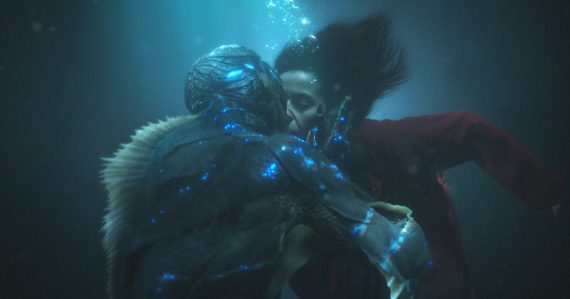
For all the faults I’ve found with The Shape of Water, it’s still heartening that a film like this can win Best Picture. Though I don’t think the quality justifies the victory, it was still refreshing to see something so stylistically unusual win the big award. That the way its plot unfolds is actually quite conventional does not take away from the impact of its beautiful cinematography by Dan Laustsen or the unique premise’s subversive frisson, and the predictable story grips sufficiently to entertain for the runtime. Ultimately, while I still find it a disappointment, The Shape of Water is better than I first thought and not a film I’d object to watching again. I just feel it’s a tragedy that I’m able to damn a film of such bold possibilities with such faint praise.
67. BIRDMAN
Watched 28 February 2023
First impressions are so important when it comes to awards season. Sometimes, with our hindsight-enhanced arrogance, we forget that some films take several viewings to reveal themselves fully, whether that be for better or worse. Certainly, Birdman was a film by which I was very impressed first time round, buzzing from the intensity of that immaculately faked film-length shot, the roaming camera and the incessant drumbeat soundtrack that strongarms your heartbeat into mimicking its rhythm. There’s that one big scene where suddenly arthouse film and mega-budget blockbuster collide, a fleeting moment tailor made to inspire rapturous post-cinema-pint punditry. In a very strong year for the category, these surface thrills seem to be what carried Birdman onto the Best Picture winner’s podium. The fact that once you strip away those superficial excitements there’s less than meets the eye is what has subsequently seen critics discount the film from consideration amongst the greatest of the 21st century.
Birdman is a clever film in many ways. It’s theme of what we embarrassingly refer to as high and low art is filled with potential and the surreal supernatural edge placed upon it by writer/director Alejandro González Iñárritu is a smart and refreshing way to explore it. But on subsequent viewings, the abundant symbols, ambiguities and tangents are not enough to cover up a sometimes feeble screenplay which relies on a strangely crass tone for much of its alleged humour. A room “smells like balls”, one character wonders why he’s “standing here with my cock out”, a critic is referred to as looking like she “licked a homeless guy’s ass”, a line Iñárritu is so proud of that he has the characters repeat it for emphasis. Naomi Watt’s character Lesley, when asked how she knows famous actor Mike Shiner, declares “We share a vagina”, which is honestly one of the worst lines I’ve ever heard and Watts delivers it with a reluctance we’ve rarely seen since the Diana press junket. It seems Birdman is aiming for a sort of poetic vulgarity, the likes of which served Withnail and I so well, but it forgets to bring the poetry, resulting in just a relentless string of clunky shock lines that feel cheap and underwritten.

It’s a shame a good chunk of the dialogue in Birdman is so poorly realised, since the film’s themes are so timely and interesting. While this was winning Best Picture, Marvel movies continued gobbling up the box office and Martin Scorsese, who apparently makes a cameo in Birdman (though I’ve yet to spot him), was only a few years away from making his “not cinema” comment. As Riggan, the former star of the titular 90s superhero franchise who is now seeking critical plaudits on Broadway, Michael Keaton is an inspired piece of casting, since the film catches him between his own 90s superhero fame in Tim Burton’s Batman films and his dabble with supervillainy in an aptly bird-related role in Marvel’s Spider-man: Homecoming. But quite apart from these opportunities for meta-references, Keaton was always a performer of great potential and Riggan gave him his first real shot at an Oscar nomination. He was probably only denied the win because of the Academy’s obsession with bestowing awards on actors pretending to be real people, in this case Eddie Redmayne’s passable crack at Stephen Hawking in the interminably boring The Theory of Everything. Elsewhere, Birdman is brilliantly cast all round. While Naomi Watts, Andrea Riseborough and Amy Ryan all get stuck with underwritten roles, Emma Stone’s excellent turn as Riggan’s daughter Sam ensures there is one memorable female character in the film, while Ed Norton is enjoyably reprehensible as the preening Mike Shiner and Zach Galifianakis is hilarious as Riggan’s best friend, lawyer and reluctant producer Jake.
The performances in Birdman frequently distract from the screenplay’s shortcomings. I’ve always been impressed by actors acting as if they’re acting, which is a phenomenally difficult thing to do (see Catherine Keener in Living in Oblivion for the finest example) and there are some good instances of that here, particularly a moment in which Shiner helps Riggan work up a scene into something far better than its starting point. There are also moments when Birdman’s script picks up a little, such as Sam’s “You’re not important” speech, which Stone performs with aplomb. But for every peak there’s a trough, like the scene in which Riggan gets locked out in his underwear, a painfully played out comedy cliche. The messy finale manages to retain a good deal of ambiguity while also offering several different concrete possibilities from the tragic to the uplifting, the dreamlike to the all-too-real. There’s an element of satisfaction to this approach and there are some very clever wrinkles involving Riggan’s appearance but ultimately Birdman ends with the same cockeyed tonal issues that have dogged it throughout. This definitely feels like a film of diminishing returns and while initial impressions suggest a densely layered experience that will reveal more with each viewing, the opposite turns out to be true. That’s probably why Birdman’s critical stock plummeted like a flightless mammal launching itself from a hospital window.
66. TITANIC
Watched 16 April 2023
I was fifteen years old when James Cameron’s Titanic first hit cinemas, which made me the perfect age to be one of those original haters. Certainly, all the boys in my class sneered at it as they jealously watched their crushes swoon over Leonardo DiCaprio and plaster their exercise books with images of Kate Winslet dangling from his arms like a ship’s figurehead. We all sneered as My Heart Will Go On topped the charts for another week, decrying the fact that whatever 60s-pillaging Britpop release we favoured had peaked at number 27 and rallying against the obvious injustice of songs that more people liked getting higher in the charts. Amidst such a toxically macho culture, how could any of us boys even entertain the idea that we might enjoy a sweeping romance like Titanic? We were too busy artificially lowering our voices and lying about all the pints of beer we hadn’t drunk that weekend.
It’s easy to be cynical about the 90s in retrospect but, for those of us who grew up in that noxiously laddish Neverneverland, there’s always a touch of nostalgia too. Ironically, that’s one of the things I enjoy about Titanic now. It is, for better or worse, a quintessentially 90s piece of filmmaking and immediately transporting in that respect. But, despite all the mute reviews delivered by way of eye-rolls at the mere mention of its name, I didn’t actually watch Titanic until well into the next decade, when the threat had waned of having to face the question “You watched what?!!”, bellowed in an accusatory voice several octaves lower than its natural inclination. Relieved of the oppressive conformity of teen years, I actually enjoyed that first viewing of Titanic, and since its three-hour runtime placed it low down the list of priorities for a rewatch, the opinion I formed of it then has been the one I have carried around ever since: that it is an impressively mounted, efficiently enjoyable Romantic Disaster movie who’s main critics are those former teenage boys who never grew out of their hormonally-jaundiced objections. But this too was an oversimplified assessment and, while there is still a certain breed of misogynistic 90s male Titanic hater that you can smell a mile off (figuratively, although all too frequently also literally), it’s fair to say that there are plenty of others with legitimate criticisms of the film that go beyond losing out in love to an image of DiCaprio with a pierced stomach where the Just Seventeen staples once were.

Titanic was one of the most Oscar nominated films of all time, tying All About Eve’s record of 14 nominations, but it was no mistake that one of those nominations didn’t go to James Cameron’s screenplay. Cameron should be given some credit for recognising the inherent possibilities for exploring issues of class, gender, life and death in a novelistic fashion bolstered by an enticing real-life undercurrent, but his ambition in writing the screenplay himself, while still admirable, is also what ultimately sinks his Titanic. Cameron accused critics of his writing of mistaking archetype for cliché, but Titanic has oodles of both. The shorthand used to make the characters instantly recognisable also makes them instantly disposable, and the over-reliance on us rooting for the central romance between Jack and Rose depends more heavily on our existing hatred of the societal boundaries that keep them apart than on any affection Cameron’s ropey dialogue inspires for them. He pushes too hard with dopey lines like “I’m flying” and Rose’s request that Jack take her “to the stars” which, for all its celestial romanticism, doesn’t really mean anything. A dedication to such relentless poppycock did result in one iconic phrase, DiCaprio’s elated “I’m the king of the world”, although its enduring place in pop culture is due mostly to persistent, well-deserved parody. One to file alongside that awful box of chocolates line from another lumbering 90s Epic. It’s no coincidence that Titanic picks up considerably in scenes where the dialogue drops out. Kate Winslet’s Rose is infinitely more engaging when reacting to escalating disaster than when she’s trying to wrap her mouth round the chewier banalities of Cameron’s screenplay.
If Winslet and DiCaprio are easy enough to root for, that may be more down to how loathsome Billy Zane is as Rose’s psychopathically entitled fiancé Cal. Zane is over-the-top at the behest of Cameron’s writing and direction, his ferocious anger peaking too soon when he throws over an entire breakfast table after Rose’s first rebellion against him. Perhaps, in a man who is essentially an overgrown toddler, this is an accurate escalation and Cameron’s decision to give him a British valet who’s ire is contrastingly cold-blooded is one of his more inspired wrinkles. It provides David Warner with an enjoyably loathsome role as a sort of Cummings to Zane’s Johnson. The simplified villainy of Cal is ultimately more enjoyable to watch than the drippy courtship of Rose and Jack but it still feels desperately thin, with his ultimate offscreen suicide following the Wall Street Crash feeling like a lazy way to satisfy the audience’s mean-spirited thirst for retribution. Of the real-life characters that Cameron includes in his story, Victor Garber’s sad portrayal of the ship’s builder Thomas Andrews stands out and I felt far more moved by his quiet, devastated lamentations than by anything that transpired between the main characters. Kathy Bates as the Unsinkable Molly Brown is a savvy piece of casting but she is woefully underused when a little more of her support for Jack and Rose’s burgeoning romance could’ve given the film real heart. Elsewhere, Cameron’s infamous depiction of First Officer William Murdoch as a man turned murderer in a moment of panic still leaves a bad taste and, given Titanic’s billion dollar box office, his donation of £5000 to the high school in Murdoch’s hometown felt like a paltry concession.

My expectation when returning to Titanic after all these years was to find a film of two halves: the first a cheesy but entertaining Romantic Drama, the second an impressive, exciting Disaster movie. This was partially accurate. Certainly the film is almost precisely a film of two halves, with the iceberg coming into view about 100 minutes into its 194 minute runtime. The Romantic Drama I had witnessed up to that point, however, was less enjoyable than I had expected. Cameron’s script is just so exhaustingly clunky, and while I’m usually forgiving of this in Disaster movies, they don’t generally take the length of an average film to arrive at the central disaster. Titanic spends so long setting up because it wants us to care about the people who’s lives are in danger, but the limited characterisation with which we are presented could easily have been achieved in a shorter timeframe. The Old Hollywood scope for which Titanic aims could’ve benefited from this runtime but only if Cameron had hired a better writer to put life into these characters. My surprising lack of investment in the film’s second half showed me how detrimental this oversight was. There are good, exciting scenes like Rose’s fire axe rescue of a handcuffed Jack (there’s even a rare moment of humour here, with Rose’s practice swings being perhaps my favourite moment in the film) and the effects are still stunning. But without the necessary emotional investment, the lengthy depiction of the ship’s descent into the ocean became something of a clamorous bore long before the band had scraped out their final tune.
I don’t hate Titanic, as I may once have adolescently claimed sight unseen, but neither do I love it. And, contrary to my expectations, I don’t really like it either. For me it exists in a sort of limbo, in which I admire its inarguable visual achievements but don’t have the enthusiasm to really be drawn on it further (hence this brief and concise review!). Though it has always been phenomenally popular, the accepted critical opinion of Titanic has fluctuated over the years, but the current consensus seems to be a positive one, with men (even some men of my age) finally seeming willing to declare their love for the film without risk of a volley of deeply un-PC 90s insults being hurled their way. I’m glad that people are feeling more liberated to enjoy an old-fashioned event picture like this, with Titanic’s initial patronising equation with teenage girls broadening into an accepted status as a crowdpleaser that incorporates all ages and genders. For all the hyperbolic lists that have preposterously voted it the worst film ever made, there’s another that names it as being among the greatest. While that might seem equally preposterous to me, the current wave of enthusiasm for anniversary screenings seems to suggest that, as far as public opinion is concerned, that ship has sailed. Now there’s a subtle piece of writing of which James Cameron would approve!
65. GIGI
Watched 1 September 2022
You don’t hear many people talking about Gigi these days, and when you do it’s usually with a sense of horror rather than the sense of delight it inspired in 1950s audiences. It’s understandable that this tale of a teenage courtesan-in-training might raise a few eyebrows with modern audiences but there seems to be such a clamour to paint it as a paedophilic, misogynistic fantasy that its historical context and intentions get swiftly (sometimes you suspect deliberately) overlooked. The opening number ‘Thank Heaven for Little Girls’ is not hard to paint as a creepy ditty but the notion that Maurice Chevalier’s elderly playboy is “ogling” small children as he sings it deliberately ignores the lighthearted spirit in which the song is meant, with a tabloid like controversy-hungry hysteria. Those who wish to paint Chevalier’s Honoré as a paedophile ignore the key reason that he is celebrating little girls: that they “get bigger every day”, not a notion a paedophile would likely relish. This iconic song is not unproblematic, given that it does put children in a sexual context, but not only do the aforementioned wildly overstated accusations not take into account the differing attitudes of the 50s when the film was made, they completely ignore the context of the early 1900s when the film is set. That many of the attitudes presented in Gigi are outdated is not in question. But to suggest none of them are presented satirically is pure naïvety.
Of course, many viewers may find Gigi hard to stomach for other reasons. At times the experience of watching it can feel like being force fed successive French pastries, a situation that is not without its benefits but which quickly leads to nausea. Its feather-light crust of a story is scarcely enough to justify its two hour runtime and so it is pumped full of stodgy jam-and-cream musical numbers that boast a pleasing wit but are staged rather statically. The focus is very much on Alan Jay Lerner’s words and Frederick Loewe’s music, which are often delightful, but I’d be lying if I said I wasn’t yearning for a dance number or two to enliven the presentation. Instead, everyone plays up their parts to the hilt, which explains why there were no acting nominations amongst Gigi’s record-setting nine Oscar nominations. Still, Leslie Caron is enjoyably winsome in the title role and Chevalier brings an intriguing hint of darkness to the edges of Honoré, a character whose role, greatly extended from the minor part he played in Colette’s source novel, incorporates that of a fourth-wall breaking master of ceremonies and a roguish antagonist. That a seemingly-telegraphed redemptive ending for him is ultimately neatly avoided is one of the biggest joys of the film.

The main problem with Gigi is that its central romance never convinces. Louis Jourdan is a tad too unlikeable as the bon vivant Gaston and his match with Gigi feels off. Their courtship feels forced and the final moments, in which he attempts to break things off before being compelled by his overwhelming feelings to return and propose, are curiously misjudged as they seem to frame the proposal as a recantation of an act of sacrifice. Perhaps it could be instead viewed as Gaston finally crediting Gigi with the maturity to make her own decisions, and one thing I will say for the film is that it does seem partially progressive in the way it does not require Gigi to change for Gaston, rather vice versa. But the lack of any spark between the characters seems to make all these questions redundant, for who can be bothered to mull them?
Gigi is considered the last great musical produced by the legendary Arthur Freed Unit, but you only have to look at the list of other films that unit produced for it to immediately feel comparatively flimsy. The brash, widescreen treatment given to performance and set design masks a strange smallness that can’t help but eventually emerge across two hours. So a striking red room in which much of the important action takes place (and which kept making me think Michael J. Anderson’s Man from Another Place was going to turn up) at first feels sumptuous but ultimately becomes oppressively overcompensatory. The breath of fresh air that Gigi initially appears to be quickly begins to taste stale. Director Vincente Minnelli does his best to balance this with some location shooting but Gigi can’t help getting repeatedly stuck in drawing rooms for its main action.

Ultimately, a film that must once have felt like a vast and comforting piece of escapism now feels a trifle clunky and overwrought, although its escapist powers are not completely lost if you tend to like this sort of confection. Luckily for Gigi, I’m a sucker for classic Hollywood musicals and, while it’s not the first one I’d reach for, I can easily look past its flaws and get some level of enjoyment out of it, hence the 3 stars I’ve awarded it. Gigi regularly appears as the bottom film on people’s rankings of Best Picture Winners but if you actually take a moment to tune into its clearly satirical depiction of turn of the century male/female relationships you’ll find its not as surface-level misogynistic as more reductive accounts would have you believe. Since Gigi constantly encourages us to drink in its prettified surfaces above all else, it’s unsurprising that few viewers dig deeper and Minnelli himself must bear some of the responsibility for that. But there’s also a laudable subtlety to the way he scatters those few poisonous eclairs amongst the dessert tray’s more harmless confections.
64. BEN-HUR
Watched 5 April 2023
It took me two days to watch the entirety of Ben-Hur, which is about average for anyone not recovering from a major operation. Where possible I prefer to watch films in one sitting but, with Ben-Hur running close to four hours, that was a virtual impossibility for a father of a three year old currently suffering from an early Spring cold. It’s interesting the effect that watching these Old Hollywood Epics in chunks has. If you view them all in one go, there’s often a sense of Stockholm Syndrome that kicks in because spending that long with one set of characters results in a sort of wearied submission, the sense of awe increased by how impressed you are at your own capacity for endurance. Some Epics are genuinely effective enough that you welcome the runtime, while others can be so tedious that you just become more restless and annoyed the longer they go on. The famous Mort Sahl review of Otto Preminger’s four hour Exodus simply went “Let my people go.” With Ben-Hur, this was never a problem but in breaking it down into bitesize chunks I do think I decreased the cumulative sense of wonder that its gigantic magnificence would otherwise have instilled. My original rating of Ben-Hur was four stars but after this viewing it lost an entire star. How much of that was due to my episodic consumption? Perhaps a little, but generally I felt a much greater disconnect from the film all round.
I still enjoyed Ben-Hur to an extent. I didn’t really become bored, partly due to my piecemeal viewing schedule but mostly because everything is so dialled up that tedium is staved off by either spectacle or ludicrousness. Though my agnosticism could’ve been a problem for the impact of a Religious Epic, I’ve generally been able to appreciate such films for their craft, as my current four star rating for Cecil B. DeMille’s The Ten Commandments attests (although this is surely due a reassessment, something I’ll get round to if I’m ever scheduled for open heart surgery). But Ben-Hur is also that unusual Religious Epic in which the religious element is often sidelined. Director William Wyler famously chose not to show Jesus Christ’s face and though Christ is pivotal to the story’s themes, his fleeting appearances ensure that Ben-Hur rarely feels preachy. Rather, we become immersed in Judah Ben-Hur’s quest for vengeance, to the point that we are sufficiently implicated to fully digest the message of peace when it arrives, regardless of personal religious stance. This comparative subtlety was beautifully parodied in the Coen Brothers’ Hail Caesar, in which an unseen actor portraying Jesus is asked by the lunchboy whether he is a principal or an extra, a point on which even the actor is unsure.

Ben-Hur sets itself up very well in its early scenes of Judah’s heartfelt reunion with his childhood friend Messala and their subsequent disagreements on political issues which make their continued friendship impossible. For anyone who has ever ended up deleting old schoolfriends from social media after one-too-many reactionary posts, this large scale ancient equivalent will strike a chord (I think they still used MySpace back then). The original screenplay called for the reunion and fallout to all happen in one scene but later drafts split it into two, a wise decision that allows the cracks to appear more gradually and the desperation of both men to hang onto their personal emotional connection to register more deeply. Although sole credit for the screenplay went to Karl Tunberg, the script passed through numerous hands during development, including those of Gore Vidal. Vidal has always claimed that Messala and Judah’s relationship was given an implied gay subtext and, while that has been disputed by some, it’s hard not to see once you know about it. Though this implication was kept from the conservative Charlton Heston, it is ironically his overwrought thesping that most emphatically sells the notion. Though he won the Oscar for his performance, Heston’s Judah Ben-Hur is one of the hammiest lead performances to take the statuette. When happy, he beams like a goon and when in pain, either physical or emotional, he winces and cringes with the same intensity. His neck veins are his most utilised form of expression. Arguably, this type of writ-large performance is right for Epic Cinema but Heston is just a little too much over the course of the runtime. You can predict which of his four facial expressions is coming in any given circumstance and the whole experience begins to feel like an advert for extremely slow-acting constipation relief.

The supporting roles in Ben-Hur are largely filled adequately, with Stephen Boyd making a fine Messala, Finlay Currie (who’s name suggests he might’ve made an even finer Messala!) a suitably reverent Balthasar and Jack Hawkins particularly impressive as Quintus Arrius. But the Academy chose to visit the deli counter again and award Ben-Hur’s other acting Oscar to Welsh actor Hugh Griffith in the role of Sheik Ilderim. You can probably get ahead of what the main problem with this piece of casting is and Griffiths’ actual performance style might’ve worked OK for a different character in a different film but it feels entirely wrong under layers of grotesque makeup and dropped into these surroundings. The other main casting problem involves Haya Harareet as Judah’s love interest Esther. I say the casting problem “involves” her because it isn’t entirely to do with her. Rather, it is Heston’s over-the-top work that completely overwhelms their romantic scenes to the extent that he may as well be seducing a mirror. It makes the whole romance feel one-sided, which is especially problematic when it already involves Judah initially having to grant Esther freedom from slavery. That’s already a tricky power dynamic to navigate without Heston adding his overpowering performance style to the mix.
Although Judah’s lengthy character arc takes him to many different locations, Ben-Hur’s action is intermittent, with a good deal of talk in between which ranges from well-written to ploddingly functional. There are two major action set-pieces. The first, an extended sea-battle on a slave galley, alternates between impressive and overstretched. It also looks extremely artificial at times, which is mildly endearing but also distracting. In a film of such impressive opulence, the sudden obviousness of the actors floating in a water tank exacerbates the stagey elements, while the ropey back-projection that could be so endearing in Hitchcock films is harder to countenance in what was then the most expensive film ever made. Fortunately, Ben-Hur’s other set-piece is virtually flawless and it is chiefly on this which the film’s classic reputation rests. The chariot race sequence comes immediately after the intermission and it’s a phenomenal way to open a second half that will ultimately end up flagging terribly. Though often misattributed as director William Wyler’s achievement, the nine minute race was actually entrusted to second unit directors Andrew Marton and Yakima Canutt, the latter of whom was also responsible for a lesser-known but also magnificent chariot sequence in Anthony Mann’s underrated Epic The Fall of the Roman Empire. Wyler’s contribution is not to be ignored though, as he contributed all the preceding scenes of pageantry that create the necessary atmosphere, not to mention the preceding two hours. For all the smug suggestions that the best cut of Ben-Hur is a nine minute Youtube video of the chariot race, the sequence benefits hugely from being the culmination of a plot strand. Without the storyline surrounding it, it is merely spectacle. With a bit of emotional investment, the enjoyment is significantly heightened. Those nine minutes themselves are undoubtedly the film’s peak though, with astonishing stunts, crashes and even a real accident incorporated into the footage. It’s a thrilling experience which took nearly a year to prepare but which went down in Hollywood history.

Unfortunately, the chariot race is not Ben-Hur’s end point and it can’t quite get that level of awe back, even when it ends on the crucifixion of Christ. Before that (surely a far more effective moment for believers in the audience), we have to endure the scenes in which Judah discovers that his mother and sister now reside in a leper colony, having contracted leprosy during a lengthy stay in an unsanitary prison cell. These scenes, aiming to make a devastating emotional impact, are both interminably boring and highly questionable. The way in which the leper colony is portrayed makes the inhabitants into cheap spooks, moaning from beneath their hoods as the repulsed Judah picks his way through them and callously recoils from any that aren’t his own flesh and blood. Similarly, when Judah’s relatives are miraculously cured at the end of the film, only the most cold-blooded audience members can possibly rejoice with them while not wondering about all those other sufferers we know nothing about and whom we are seemingly encouraged to care about less. I find the leprosy plot a very sour way to wrap up the film and, though the source text must bear some responsibility for this, the scenes are handled with a clanging insensitivity.
It’s easy to see why Ben-Hur made such an impact in its day but it doesn’t hold up especially well today. There’s an excitement in putting yourself in the shoes of audiences of the era and it’s not hard to channel that awe at the sometimes breathtaking presentation. But across the course of nearly four hours there’s just not enough to keep that level of excitement going and, though boredom is largely kept at bay by insistent extremes, there are times when irritation or revulsion make tedium seem almost enviable by comparison. Big, bloated, fleetingly amusing and vaguely tasteless, Ben-Hur inspired some imitators, even some very good ones, in subsequent years but audiences quickly started to tire of such gargantuan entertainments. This rapid downhill trajectory has lead Ben-Hur to be seen as the ultimate Epic, with its status as an initiator and that one astonishing action sequence doing a lot of heavy lifting in that regard. But there are better films of this type, not least Anthony Mann’s aforementioned The Fall of the Roman Empire, which was unfortunately a victim of arriving at the tail end of the Epics trend.