



 Director: Peter Collinson
Screenplay: Scot Finch
Based on the novel by: Louis L’Amour
Starring: Richard Crenna, Stephen Boyd, Rosanna Schiaffino, Farley Granger, Patty Shepard, Angel del Pozo, Howard Ross, Aldo Sambrell
Country: United Kingdom, Italy and Spain
Running Time: 96 min
Year: 1973
BBFC Certificate: 15
When you think of the Western film genre, British films probably don’t spring to mind. Westerns are often thought of as being American or Italian, though many have been made in other countries. Yet British Westerns were a thing, at least briefly, in the late 1960s and early 1970s, including the likes of the Raquel Welch-starring Tigon production Hannie Caulder, and the parody Carry on Cowboy.
Boutique Blu-ray label 88 Films released the former as part of their Tigon Collection, and now they bring us another British Western in the shape of The Man Called Noon. Now, the actual national identity of the film is tricky to pin down. It was helmed by British director Peter Collinson, famed for The Italian Job, and produced by Euan Lloyd, yet it was also co-financed with Spanish and Italian financiers and was shot in Spain, like so many Italian Spaghetti Westerns. So technically it’s a Euro Western, but, given that the production was led by a British director and producer, it’s easy to see why there’s a strong British flavour.
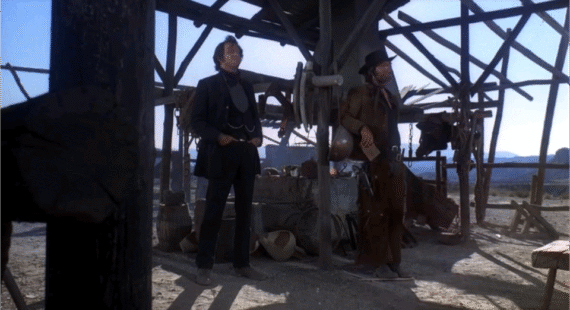
The film follows Noon (Richard Crenna), a gunslinger who has amnesia and tries to discover his identity. He is helped by an outlaw called Rimes (Stephen Boyd). We discover that Noon’s wife and child have been killed, and that there’s a fortune hidden somewhere. Along the way, Noon meets, among others, a strong female character called Fan (Rosanna Schiaffino), who falls for Noon, a woman who plots against our hero called Peg (Patty Shepard), and a dodgy judge, Niland (Farley Granger).
We open with a classic Western feel. Deserted streets, a man riding into town on horseback, dust flying in the wind, and the addition of a thunderstorm under way. These shots are juxtaposed with a man we’ll come to know as the lead Noon getting dressed in a room, whilst the newcomer in town clambers up a building, rifle in hand. The pair are soon introduced to each other.
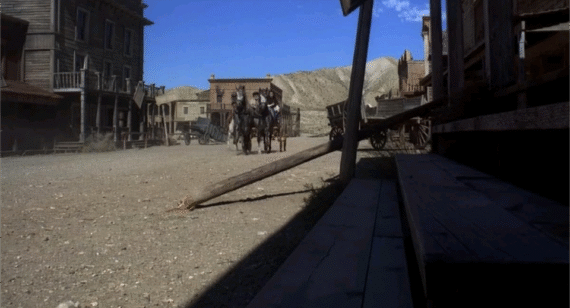
The newcomer in town attempts to shoot and kill Noon, who falls from the window to his room when the first shot is fired, and dodges more bullets as he weaves his way through town before escaping on a train that’s just arrived at the station.
It’s a tense and excellent way to open the film, throwing us straight into the action and leaving us with plenty of questions, not least who the men are. On the train, Noon meets Rimes, and reveals he can’t remember anything.
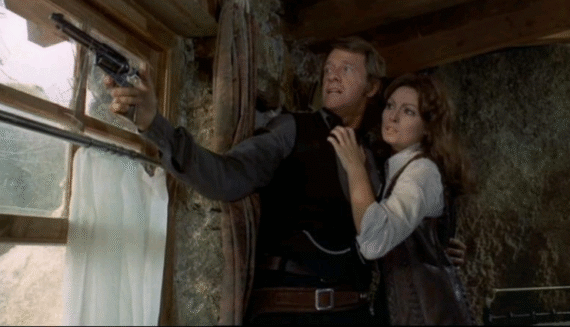
There’s a fabulously staged scene at a railway station as Noon and Rimes await a train, which reminded me of Sergio Leone’s Once Upon a Time in the West’s opening. In fact, there are several scenes involving trains, which are all wonderful.
One of the strong elements of The Man Called Noon is the relationship between Noon and Rimes. We get an almost straight-faced buddy movie between the pair as their friendship grows and they try to figure out who Noon is, with other characters introduced as the story progresses, before things become more complicated between the pair in the final act.
The action is sporadic but, when it comes, it’s brief and to the point, with a little bit of blood thrown into the mix. There’s that memorable opening, a sequence at a funeral parlour, and a couple of other shootouts that are well handled.
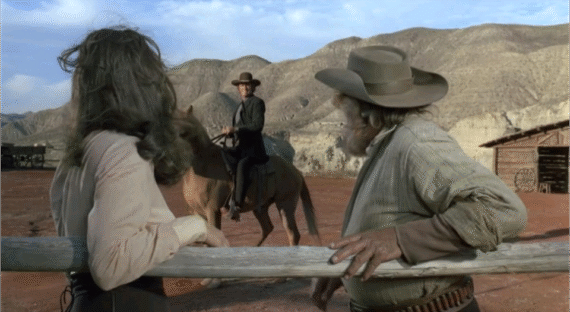
There’s some marvellous cinematography by John Cabrera, with some really interesting views of the Almeria landscape in Spain, where the film was shot; vistas are showcased and the landscape really comes into its own as a character. But there’s also some fabulous use of depth of field, with numerous shots through buildings with the characters in the background, as well as other images highlighting close-ups of faces, shoes and guns.
For example, Noon and Rimes arrive in a town early on and they’re framed through a window that’s rattling in the wind, through stairs and more. Two-thirds of the way in, there’s another bravura shot as the judge is sat at a chess table which is framed large in the foreground, with Noon stood in the background like a piece on the chess board. It’s fantastic. The cinematography may be the highlight of the feature for me, with shots frequently feeling well thought-out and looking great; it’s never dull as a result.
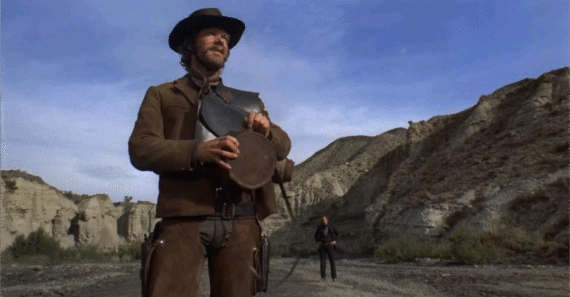
Luis Bacalov’s score is also intriguing, quite dramatic when it needs to be but also fun and playful at others. It’s not always used, though, with the soundscape put to good effect in a number of sequences, the wind prominently used, and that thunder in the opening scene.
There are some strong performances throughout, headlined by TV and film actor Crenna as Noon, who is ably supported by Boyd as Rimes, Schiaffino as Fan, Granger, who pops up late on in an important role as the judge, and Shepard as Peg. There’s also some delightfully familiar faces for fans of Spaghetti Westerns, including a role for the prolific actor Howard Ross.
Flashbacks are sporadically used, first with Noon recalling the opening sequence, and then on occasion as he recalls what happened in his past. It’s not a rare narrative device, but is well used here.
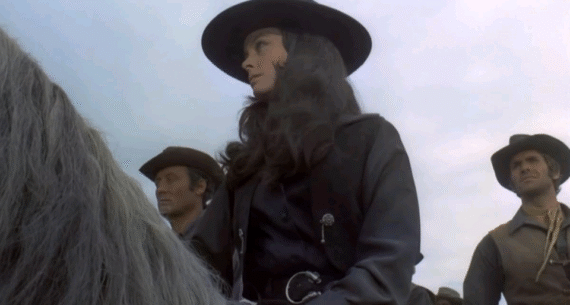
The final act is great, not least because we get Granger as the judge, but also because the backstory is interestingly told, and the action ratchets up as the plot threads all come together. The finale itself is dark, brutal and violent, with some great shootouts and a good choice of final image.
In closing, I enjoyed The Man Called Noon. It’s not a top tier Western but is very entertaining, mysterious and beautifully shot with some gorgeous landscapes and ingeniously framed images. The story is compelling throughout and it all builds to an entertaining and satisfying conclusion.
Film: 


The Man Called Noon is released by 88 Films on Blu-ray and DVD on 8th September 2025. I reviewed the Blu-ray edition. The high-definition transfer is generally good with plenty of fine detail and a natural look and feel, though the occasional scenes look softer and there’s some occasional print damage too. The audio is fine overall.
Limited edition features:
O-ring slipcase with new art by Sean Longmore
Booklet by Lee Broughton
Special features:
High-definition Blu-ray presentation in 1.85:1 aspect ratio
Original Mono 2.0 Audio
Optional English SDH
Audio commentary by Western expert Lee Broughton
Audio commentary by film historians Troy Howarth and Eugenio Ercolani
Image gallery
Original and newly commissioned artwork by Sean Longmore
The commentary by Western expert Lee Broughton is excellent. It touches on the tricky to pin down national identity for the film, the direction, some of the key scenes, and background on the director and others involved in front of and behind the camera. It’s a commentary rich with detail, which I greatly enjoyed.
The other audio commentary with Eugenio Ercolani and Troy Howarth is outstanding. They point out the comparisons with Italian and Spanish Westerns, including the films of Sergio Corbucci, the tone, and plenty of the stars involved. I particularly enjoyed Ercolani’s well researched and delivered overview of some of the actors who star, outlining some of the other productions they featured in. The pair have popped up together in a number of commentaries in recent months, and they’re always really entertaining and informative.
The image gallery plays for around a minute and contains around 14 stills, lobby cards and also shows off the new artwork without text.
I wasn’t provided with the booklet to comment on, but Broughton’s commentary is great, so I’d imagine his booklet essay is well worth a read.
In closing, it’s a small but well-formed collection of extras for a very interesting and well produced Western, with a British flavour. It would have been nice to have had some interviews and visual essays, but the two commentaries are both fantastic listens and complement each other well, and the film looks and sounds pretty good overall. Highly recommended for Western fans.
Disc/Package: