



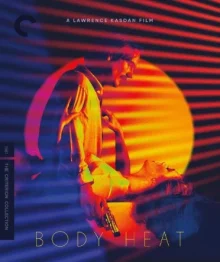
Director: Lawrence Kasdan
Screenplay: Lawrence Kasdan
Starring: William Hurt, Kathleen Turner, Richard Crenna
Country: United States
Running Time: 113m
Year: 1981
With his debut feature, acclaimed writer-director Lawrence Kasdan brilliantly updated the conventions of 1940s film noir for the 1980s, resulting in one of the steamiest and most influential arousing thrillers ever made. On the sultry South Florida coast, lawyer Ned Racine (William Hurt) is drawn into a torrid affair with unhappily married housewife Matty Walker (Kathleen Turner, in a star-making performance)—and it’s not long before they’ve hatched a scheme to murder her wealthy husband. Featuring ingenious plot twists, memorable hard-boiled dialogue, and an atmosphere so evocative you can practically feel the humidity, Body Heat is a languorously seductive tale of greed and desire, one that paved a new path for American crime cinema.
This month’s new release from Criterion is an opportunity to re-evaluate Body Heat. The debut for Lawrence Kasdan, it feels like it fell through the cracks a little. Perhaps it’s the recycling of an old genre; or that Kasdan himself, a fantastic filmmaker, nonetheless has since deployed his talents in the manner of a scattershot. There’s no obvious through-line from Body Heat, a film with a reputation for being too rude to watch with your nan.
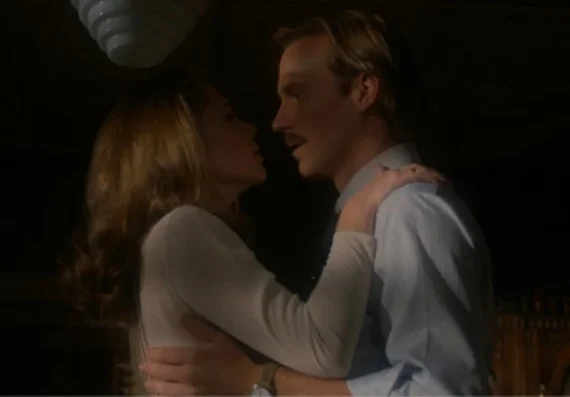
That observation is still relevant, but Body Heat is a much better film than that overall and the synopsis is sound. It does feel like Kasdan followed the 70s brat method of recycling the classical methods and dusted off Film Noir. Perhaps we’re making too much of it -I mean, Chinatown is right there, but Body Heat wants you to know its heart beats 4:3 in black and white.
It’s a full-blooded approach too. It feels like a prestige flashpoint with a Bond-style credit sequence (complete with John Barry theme); a 40s movie dragged into the modern era with a heavy focus on style. The staging is sometimes so obvious, you’d expect a honking noise to accompany it, but it’s a means to an end and the dialogue is fabulous; a hint of Bacall can be heard in Kathleen Turner’s first exchange with William Hurt, but just enough to inform, not dictate, her Femme Fatale performance. Meanwhile, Hurt has already staked his claim on the world-weary lead befitting this pastelly, sweat-soaked neo-noir.
And yes, a lot of that sweat is on copious amounts of bare flesh. It’s far more mild than you might expect, but the sex scenes still have a brazen style befitting Body Heat’s go big or go home approach. Just as Basic Instinct would come to demonstrate, these films are virile enough without the sex-scene set-pieces. Indeed, post-modern noir is often as evocative as the original era’s output. From Chinatown to L.A. Confidential, the well-trodden paths keep yielding thoroughly brilliant films.
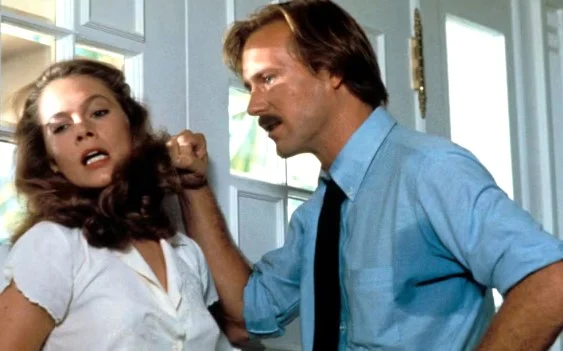
Could Body Heat work without the sex? Of course it could, but maybe it’s just being honest. The original format was always driven by men being controlled by impossible women. There’s a wider conversation about the relevance of such a narrative. Body Heat however at least gives Turner a deserved Stanwyck-inspired role, with the benefit of a modern sensibility that credits the audience to read between the lines. Even when the Double Indemnity plot takes hold, Hurt does all the talking. It’s his idea, of course. Wink-wink.
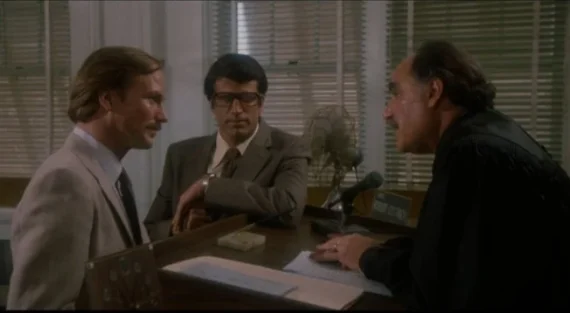
Ultimately, this is William Hurts’ film. He’s always excellent and here he retains our sympathy despite rarely deserving it. As the pressure builds around him, he never fails to convince as a man who’d lost the game before he started to play. Maybe he should have listened to the wind chimes a little more.
Body Heat as a concept is given an extra boost in several respects, not least the supporting cast. Mickey Rourke has a brief cameo, reminding us of his astonishing charisma and what could have been. Ted Danson meanwhile turns in possibly his best role, considering he spent so long on TV. He stands out with a perfectly pitched performance, at once showy and fun, but also grounded and authentic.
John Barry’s theme is not what you might expect for a picture like this, but it’s perfectly suited. There are moments the Bond aesthetic kicks in even more than the opening titles; there’s even a hat toss from Hurt using a hat he never even wears. A hat from another time that doesn’t quite fit.
Wink-wink.
VIDEO
Body Heat is intentionally soft, with plenty of blooming and flares. Smoky neo-noir, usually with rain, but this one with sweat, has often suffered on home video. A little too soft with a little too much blooming. And so this 4k presentation is excellent, allowing the film to breathe with the contrast it always needed. Colour separation is bold in many key scenes, while day-to-day sequences are bright, sharp and natural.
AUDIO
There’s a choice of original stereo and a 5.1 remix. The latter is very well done. You can’t push a remix too far otherwise it sounds off, but here the staging opens modestly to give John Barry’s score more room. Very effective and satisfying. Dialogue remains clear and centred.
EXTRA FEATURES
This is an excellent demonstration at what the boutique labels can do at their best. A fabulous presentation of the film, accompanied by a raft of insightful extras. There’s very little fat here. There’s a new interview with Kasdan which was a highlight for me, but the archival stuff is remarkably thorough.
- New 4K digital restoration, supervised by editor Carol Littleton and approved by director Lawrence Kasdan, with uncompressed stereo soundtrack
- Alternate 5.1 surround DTS-HD Master Audio soundtrack
- One 4K UHD disc of the film presented in Dolby Vision HDR and one Blu-ray with the film and special features
- New interview with Kasdan
- New conversation between Littleton and film historian Bobbie O’Steen
- Archival programs featuring Kasdan; Littleton; actors William Hurt, Kathleen Turner, and Ted Danson; cinematographer Richard H. Kline; and composer John Barry
- Deleted scenes
- Trailer
- English subtitles for the deaf and hard of hearing
- PLUS: An essay by author Megan Abbott
- New cover by Michael Boland