


 Director: Richard Fleischer
Screenplay: Stanley R. Greenberg
Based on the novel Make Room! Make Room! by: Harry Harrison
Starring: Charlton Heston, Leigh Taylor-Young, Chuck Connors, Joseph Cotten, Brock Peters, Paula Kelly, Edward G. Robinson, Stephen Young, Mike Henry, Lincoln Kilpatrick, Roy Jenson
Country: United States
Running Time: 97 min
Year: 1973
BBFC Certificate: 15
Between 1968 and 1973 legendary actor Charlton Heston starred in three separate dystopian science fiction films. All are now seen as classics of the genre and all ended with a sting or twist in the tail.
The first was Planet of the Apes (1968 – with the actor also appearing in two sequels and Tim Burton’s 2001 reimagining), the second was The Omega Man (1971) and the third was the subject of this review, Soylent Green (1973).
Prior to these Heston, on screen, had built up a glittering filmography taking in classic film noirs like Touch of Evil (1958) and epics such as The Ten Commandments (1956) and Ben Hur (1959). But as the 1960s came to a close and Heston was continuing to make historical films, including epics and alongside other genres, he turned his hand to sci-fi, and the aforementioned trilogy.
Directed by Richard Fleischer, Soylent Green was written for the screen by Stanley R. Greenberg and is based on the novel Make Room! Make Room! (1966) by Harry Harrison.
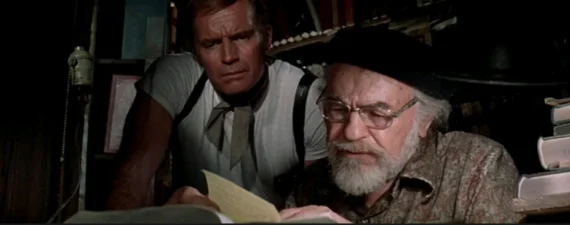
It is set in 2022, at the time of the film’s release around 50 years in the future, and focuses on a future New York City where the population has reached 40 million. The world is overpopulated and there aren’t enough resources or food to sustain the human race.
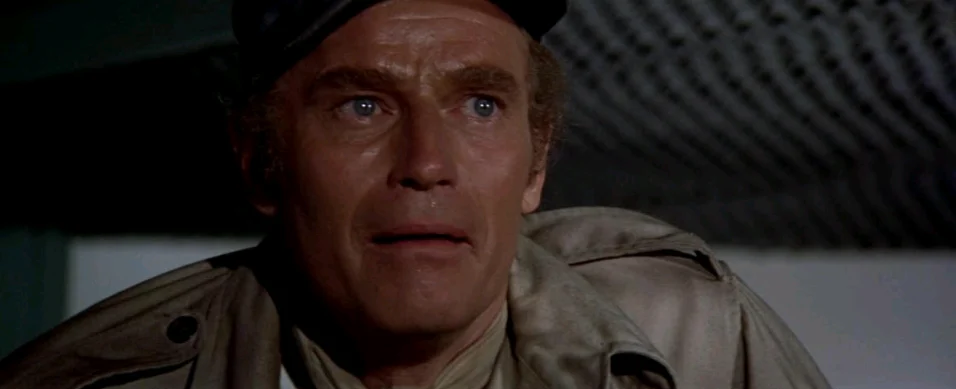
We follow Detective Robert Thorn (Charlton Heston), who is called into investigate the murder of William R. Simonson (Joseph Cotton), a member of the board of the Soylent Corporation. We see the murder though aren’t given all the information to understand why it happened.
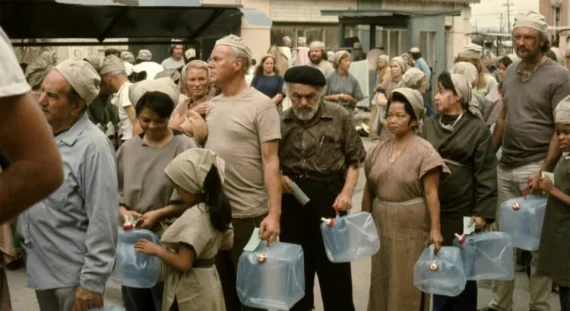
What we learn is that the organisation peddles processed food wafers called Soylent Red, Soylent Yellow and their new, more nutritious option, Soylent Green, for the masses, who can no longer eat natural food and who live in squalor. That’s not the case for everyone. The rich and elite live in walled off communities with bodyguards, sex slaves and where they can eat regular food and drink clean water.
That’s the scene for a dystopian science fiction film which is also part mystery, part conspiracy theory movie, part action film and which approaches some pretty hefty themes. The main thrusts are the mystery, both of the murder but also what Soylent Green really is, paving the way for one of cinema’s great shock finales and memorable final lines, just like Planet of the Apes before it.
Rewinding to the start though, the opening sequence, created by documentary filmmaker Charles Braverman, sets the scene well, with images showing how the world has reached a crisis – over populated and pushed to capacity alongside the destruction of the environment.
Director Fleischer helms proceedings in his usual accomplished but unshowy way, observing throughout in the same way as he did in the likes of The Boston Strangler (1968) and 10 Rillington Place (1971) before it.
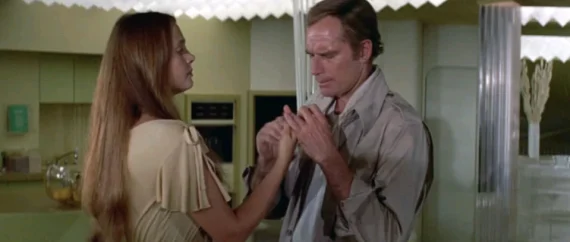
Shots are static, scenes are given time to breathe, and we’re left to take in the mystery and the wonderful acting. Scenes are shot in a matter of fact way, like the groups of people just sleeping on the stairs in the apartment block where Detective Thorn lives with his friend and older colleague Solomon Roth (Edward G. Robinson). There’s also a tough sequence to watch where food can’t be supplied and the masses are injured or killed during a riot and shootout between Thorn and the killer. It’s shot with a documentary, newsreel like feel and is all the more effective for it.
Those shots are captured by Richard H. Kline, who worked with Fleischer four times in a distinguished career which also saw him lens films for a number of well-known directors and nominated for an Oscar for best cinematography twice (Camelot in 1967 and King Kong in 1976).
Kline, together with art director Edward C. Carfagno, costume designer Pat Barto and other members of the production team, paint a solemn world where primary colours are used sparingly, the colour scheme being mostly muted.

The film’s depiction of 2022 and what it got right and wrong about how the world of today is great to see, when viewing this new release four years after the real 2022. It was certainly forward thinking in some ways, though not in others not, but certainly gave it a good go.
It’s also always good to see a film not afraid to confront issues. As one of the audio commentaries points out there were very real concerns about over population at the time the film was made and numerous books on the topic, including the one it is based on.
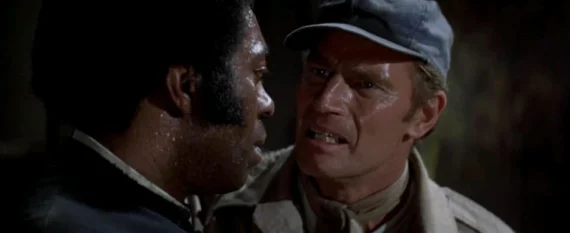
Fears for the future, over population and scarcity of food, destruction of the environment, awful treatment of women as second class citizens and sex objects, and the class divide of the privileged and poor are just some of the big issues covered.
Viewing the film through a 2026 lens is tough, when the world feels increasingly intolerant, the population continues to grow at sizeable rates and the treatment of women should be much, much better. We’re not in Soylent Green territory today but it’s not too much of a stretch to see what the film depicts as being one potential future if we don’t take more care of the world and each other.
All of this would be for nothing if the film wasn’t well acted. Thankfully it’s impeccably acted. Heston and Robinson are as good as they’ve ever been as two close friends and colleagues. Heston drives the plot forwards and at times gets to show the macho side that films often showcased. Just like in Planet of the Apes, his character gets to have an iconic final line.
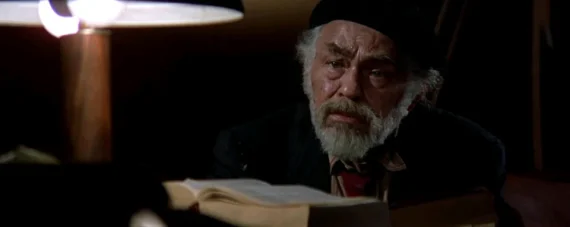
Robinson delivers the exposition and backstory that fill us in on plenty of rich detail about the world we observe, and the Soylent Corporation. It would be the actor’s final role. Another acting great, Joseph Cotten, has a brief role as the murder victim, while Leigh Taylor-Young brings to life the main female character with warmth and humanity, striking a connection with Heston’s Thorn.
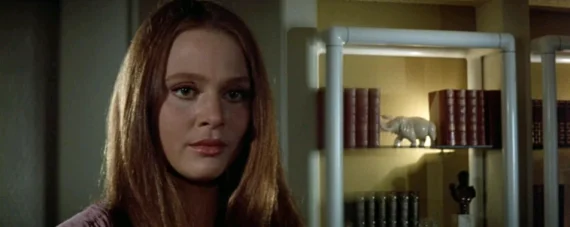
In closing, Richard Fleischer’s Soylent Green remains one of cinema’s great dystopian sci-fi classics. It paints a vivid world of scarce resources, the elite ruling with an iron fist and the masses kept down and forced to live in awful conditions with processed food. Its shock ending still retains its power and it is a film full of ideas and not afraid to tackle weighty issues, which are sadly still either an issue today or a risk for humanity 50 years later.
Film: 

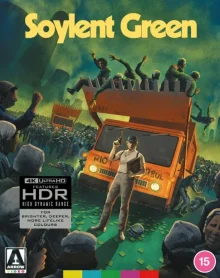
Soylent Green is released on separate limited edition 4K and Blu-ray on 27th July 2026. I reviewed the 4K edition. The new restoration by Arrow Films is a revelation, for a film that I’ve always felt could, and should, have looked so much better on home video. The restoration retains a natural colour scheme and filmic quality whilst providing crystal clear clarity and a huge amount of fine detail. Simply put, it looks outstanding. The film also sounds great too.
4K Ultra HD limited edition contents:
Brand new 4K restoration from the original 35mm camera negative by Arrow Films
4K (2160p) UHD Blu-ray presentation in Dolby Vision (HDR10 compatible)
Original lossless mono audio
Optional English subtitles for the deaf and hard of hearing
Archive audio commentary with director Richard Fleischer and star Leigh Taylor-Young
Brand new audio commentary with film historian Michael Brooke and author Johnny Mains
Charlton Heston at the BFI, an archive on-stage interview with the star of Soylent Green
Richard Fleisher at the BFl, an archive onstage interview with the director of Soylent Green
A Look at the World of Soylent Green, a vintage featurette
MGM’s Tribute to Edward G. Robinson’s 101st Film, a vintage featurette
Theatrical trailer
Image galleries
Reversible sleeve featuring original and newly commissioned artwork by Nathanael Marsh
Collectors’ booklet featuring new writing by Frank Collins and Alexandra Heller-Nicholas
First up on the extras front is an archival commentary with director Richard Fleischer and star Leigh Taylor-Young, who plays Shirl in the film. There’s plenty to glean from the track, including details on the opening titles – clutter grew in the world until there was no room, which is what we see, with the music getting more frantic. The pair were together for the track, which was recorded in 2003, and share some lovely anecdotes and morsels. It’s a really good track.
Next is a new audio commentary with film historian Michael Brooke and author Johnny Mains, which is a fantastic track. They also share details of the footage that plays over the opening titles, which is fascinating, and touch on the very real issues the film tackles, events and books of the time was made, and cover many of the scenes, as well as details on cast and crew. I’m a huge fan of Brooke’s commentaries and he and Mains clearly know their stuff and deliver it all in a really entertaining way, as well as not shying away from some of the themes and issues it covers. It’s the standout extra.
Arrow also provide two archive on stage BFI interviews, one with actor Heston discussing his career in 1985 and running for 97 minutes and the other from 1994 with director Fleischer discussing his career, which runs for 77 minutes. Both are valuable and worthwhile interviews.
The remaining extras, together with the 2003 commentary, are ported over from the previous Warner Bros Blu-ray.
First, we have A Look at the World of Soylent Green, a vintage featurette running for 10 minutes, which opens with images from other sci-fi films before running through the synopsis of the film, including the memorable opening montage. Behind the scenes footage, clips and snippets of interviews follow.
Next a five-minute MGM tribute Edward G. Robinson to mark his 101st Film. It features footage from the time of the making of the film and Heston leading a tribute to his co-star, who also shares some comments. Both of these vintage featurettes are welcome inclusions.
The theatrical trailer runs for almost four minutes and plays up the mystery, asking “what is Soylent Green?” introducing us to the main characters and spoiling the fate of Robinson’s character.
Three image galleries are included, the first containing over 10 images of posters and artwork, a second of over 230 black and white promo stills and a final one of over 160 colour promo stills.
The 32-page booklet contains two excellent new essays by Frank Collins and Alexandra Heller-Nicholas. The first is a detailed and fabulous overview of the making kit here film and the latter looks at some of its themes and is equally as good. It is lavishly illustrated throughout and well appointed.
So, Arrow have provided a phenomenal audio-visual presentation for science fiction classic Soylent Green, headlined by a stellar new restoration that breathes new life into the movie. Arrow also provide a brilliant new audio commentary and insightful booklet as well as including two interviews, totalling almost three hours, with director Richard Fleischer and star Charlton Heston. A cracking 2003 audio commentary, two short featurettes, image galleries and trailer round out a rewarding package.
Disc/Package: