

 Directed by: John Woo
Written by: John Woo, Patrick Leung, Janet Chun
Starring: Tony Leung, Jacky Cheung, Waise Lee, Simon Yam, Yolinda Yan
Year: 1990
Country: Hong Kong
Running time: 136mins
BBFC Classification: 18
Bullet in the Head was originally conceived as a prequel to Woo’s highly successful A Better Tomorrow but with the dissolvement of his and Tsui Hark’s partnership around this time Woo would re-tool the script into an original film, Hark helming (the less well received) A Better Tomorrow III himself. Still released under the Golden Princess Film Production banner, Woo poured a significant amount of his own finances into this epic film about war and greed tearing apart the brotherhood of three young friends.
The film opens in a fairly breezy manner (a cover of The Monkees I’m a Believer playing over the credits and opening scenes) in 1967 Hong Kong where three young friends B, Fai, and Wing (Tony Leung, Jacky Cheung, Waise Lee) are going about their simple lives romancing, racing bikes, and getting into fights with local thugs. B wants to marry girlfriend Jan (Fennie Yeun) but doesn’t have the cash to cover the wedding. Fai steps in and gets the money from a local loan shark. Mugged and injured on his way to the wedding, B is furious at what Fai has had to endure so he and Fai sneak out and take retaliation on the muggers, killing their leader. Fearing repercussions, they run to Ming who has an idea to get them out of the country to Saigon until the heat on them cools off.
Smuggling narcotics into the country (to sell and make money when they get there), no sooner have they arrived than the three are caught in the crossfire of a riot protesting the escalating war. Their drugs destroyed, a local hitman Luc (Simon Yam) takes them under his wing and enlists them to help steal a case of gold from a known mob boss. This proves to be no easy task as the four barely get out with their lives intact, the gold actually belonging to an official in the South Vietnamese Army who retaliates, sending the group fleeing into the jungles. The Viet Cong then captures the three from Hong Kong, thinking they’re spies, forcing them into a POW camp. Here the true testament of friendship and endurance is tested as torture, greed, and the will to save one’s own life push the friends to their limits.
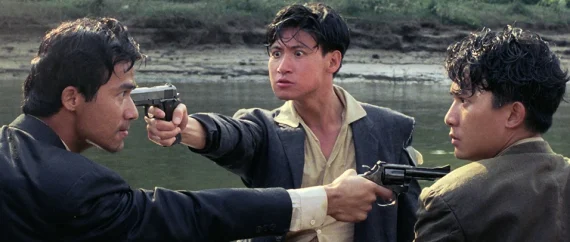
Considered by many, and even Woo himself to be his best work, the film opens in an upbeat, almost sunny manner (making you think Woo is about to make something lighter) but this is just a brief lull to prepare one for the pain and nihilism to come. Taking cues from and part homage to The Deer Hunter (a Woo favourite), Bullet in the Head is a tough watch (even still, all these years later). A brilliant film that has lost none of the pain and suffering Woo poured into it at the time of making. Drawing on his own tough upbringing in the rougher parts of Hong Kong, his disillusionment at the dark paths some of his own friends took, and the Tiananmen Square protests and massacre happening at the time (which are openly referenced in the riots depicted in this film), Woo delivers a searing tale of broken friendship, survival through extreme hardship, and his trademark blistering action.
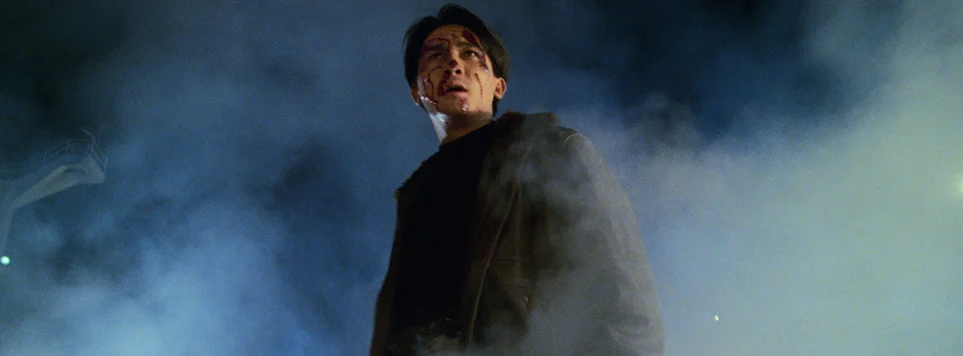
A visually striking literal descent into hell (there’s a scene where the main characters drive through the war torn land at night as a skirmish erupts around them which plays out as the moment they truly descend into their own version of hell) Woo, who has been open about the pain he was feeling at time, pours all his anger and trauma into the film. The POW sequences are still a tough watch and are still some of the darkest sequences Woo has filmed. Rivalling anything seen in the likes of The Deer Hunter or Apocalypse Now, Woo refuses to cut away forcing us to endure what the characters are going through.
Kudos must also go to the three leads Tony Leung, Jacky Cheung and Waise Lee who commit wholeheartedly to the downward spiral of their characters. Most praise usually goes to Tony Leung and Jacky Cheung, with Cheung in particular giving an outstanding performance when he’s driven mad by the pain caused by the bullet lodged his head, in the latter part of the film. However, Waise Lee is no slouch either convincingly committing to the all-consuming greed that takes over his soul (hinted at in the early scenes) and must be commended for dragging that heavy box of gold through multiple Vietnam rivers. It’s an astonishing physical performance.
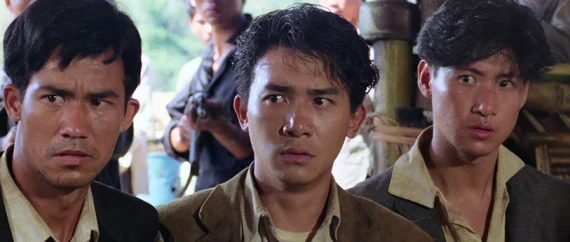
Despite the seriousness of the subject matter and less focus on the stylised aspects Woo was known for, he still packs in some walloping good action. The sustained nightclub shoot-out is up there with some of the best action Woo has staged and the running gunbattles through the Vietnamese jungles are thrilling even though Woo was seemingly going for a more raw approach than a stylised one to the action here. The car chase that concludes the film may seem at odds with the seriousness that has come before but it’s some incredibly (and very dangerously looking) staged action that can be seen as a cathartic release for one of the characters.
The tonal shifts may be too much for some not used to the Woo (or the Hong Kong movie style of the 80s/90s) but Bullet in the Head is a masterpiece of action, drama, and war trauma that has lost none of its impact. Always in the shadow of the more accessible The Killer and Hard Boiled, Bullet in the Head is just as worthy as those rightful classics and a film that showed Woo was more than just a master of gunplay action. This new 4K restoration from Arrow is stunning, showcasing the raw and breathtaking photography and location work the cast and crew endured to create a true cinematic experience.
Essential.
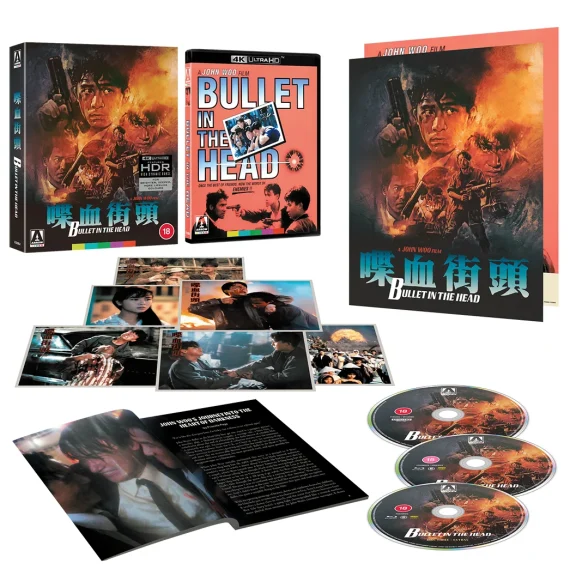
Arrow Video will release Bullet in the Head on Limited Edition 4K UHD 22nd June 2026.
4K ULTRA HD BLU-RAY LIMITED EDITION CONTENTS
- Reversible sleeve and double-sided foldout poster featuring original and newly commissioned artwork by Tony Stella – not available at the time of review.
• Six postcard-sized reproduction artcards – not available at the time of review.
• Collectors’ perfect-bound booklet featuring new writing on the film by critics Priscilla Page and Sean Gilman, archival writing by critic Arnaud Bordas and an excerpt from an interview with John Woo conducted by Stéphane Moïssakis – not available at the time of review.
DISC ONE – THEATRICAL CUT (4K ULTRA HD BLU-RAY)
• 4K Ultra HD (2160p) Blu-ray presentation in Dolby Vision (HDR10 compatible) of the Hong Kong Theatrical Cut
• Original lossless Cantonese mono and Dolby Atmos audio, and lossless English mono audio
• Optional newly translated English subtitles for the Cantonese audio and English subtitles for the deaf and hard of hearing for the English audio
• Brand new audio commentary by film critic and Hong Kong cinema expert Frank Djeng – Djeng brings his usual likability to the commentary at once seemingly chilled and wired, rattling off his bottomless pit wealth of knowledge of all things Hong Kong film. A welcome presence on any HK commentary he’s measured even though excited, never descending into brashness.
• Deleted and extended scenes – a collection of missing footage Woo was forced to cut out from his original cut (known as The Festival Cut, or Midnight Screening version) before going on general release. Mainly a collection of scene extensions and blink-and-you’ll-miss-it action beats the most notable missing scene being the infamous “piss-drinking” sequence. Cut during the nightclub scene where the trio of protagonists are meeting Mr Leung for the first time, he forces the three to drink pints of urine (supplied by his henchmen!) to prove their worth to him, as well as humiliating them. It’s not a particularly nice scene but performed with full gusto by the leads and while isn’t necessary to the overall arc of the film, provides a further example of the three friends continual decent into hell and the nihilistic feeling Woo was aiming for.
• Alternate boardroom ending – jettisoning the more well known car chase ending, this alt ending begins in the boardroom as normal where B confronts Ming but instead of walking away after delivering Fai’s skull to Ming, B then attacks Wing with a gun, pulling his jacket over head, and shooting him in the same way Ming executed Fai. It’s a more abrupt, less action-packed finale but just as downbeat. It’s perhaps not as cathartic as the original ending (B being able to take his anger out on Ming full-force) but it’s less over-the-top (as the car chase action is somewhat jarring compared to what has come before!) but it’s just as shockingly effective, leaving everything on a downbeat note.
• Alternate English opening and closing credits – slightly alternate opening titles that remove the images of the main actors seen in the Hong Kong Cut and just have their names come up on a black screen (from some reason!) which leads to a slightly slicker title reveal that leans more into the action aspect of the film (and presumably would look cooler on the eventual VHS release!). End titles are in English rather than Cantonese.
• Cantonese and English trailers – slightly different versions of the original trailer, the English version featuring the slicker title, mentioned above.
• Image gallery – cool mix of promotional, print, and lobby card imagery.
DISC TWO – FESTIVAL CUT (BLU-RAY)
- High Definition (1080p) Blu-ray presentation of the Festival Cut
• Original Cantonese lossless mono audio
• Optional English subtitles
• Extended Festival Cut, including footage previously exclusive to the Theatrical Cut – nicely restored version of Woo’s closer intended version with the footage discussed above re-instated.
• Option to play with the alternate boardroom ending – this version ends with the more abrupt alt ending discussed above.
DISC THREE – EXTRAS (BLU-RAY)
- Brilliance with a Bullet, a brand-new interview with director John Woo – recent interview with Woo who looks back on the film and those he made it with fondly. He repeats some of the stories and anecdotes he mentioned in previous interviews but goes a bit more in-depth into how incidents and friends from his younger life helped to shape the earlier scenes in the film. He’s, rightly, very proud of the film and always good to see the maestro talking enthusiastically about his work.
• The Long-Suffering Siu-Chun, a brand-new interview with actor Fennie Yuen – nice, albeit short, interview with Yeun, who plays Jane seen in the earlier Hong Kong set scenes. She talks about how she got into the business and what it was like to work with Woo. She also talks fondly of her male co-stars, especially Jacky Cheung who she would make several movies with.
• Head Case!, a brand new interview with actor Waise Lee
Army of One, a brand new interview with regular John Woo collaborator Terence Chang
Apocalypse Woo, a brand new interview with editor David Wu
Tumultuous Times, a brand new interview with associate producer Catherine Lau
– nice mix of new interviews from some of the core collaborators on Bullet in the Head, all them touching on how important the film was for Woo. The Terence Chang interview is frustratingly short (more a quick soundbite really!): one would think he would have a lot more to contribute having been one of Woo’s closest collaborators for many years. However, the interview with Waise Lee makes up for this, he happily talking about his experiences making the film, his career, and how Woo basically got him into movies: he cast Lee in a small but important role in the seminal A Better Tomorrow, and Lee has been acting steadily ever since.
• Hong Kong Confidential: Inside Bullet in the Head, a brand-new interview with author and Hong Kong film expert Grady Hendrix – horror author Hendrix gives an overview on the genesis, production, and reception of the film. Curiously, he notes this was the only film to produced under and branded with the logo of JW Production, the company Woo set up after his partnership and friendship dissolved with Tsui Hark after the making of The Killer.
• Apocalypse How, a brand-new interview with author and historian Dr Lars Laamann – fascinating look at the real life events/protests of 1967 and 1989 that inspired the backdrop that Bullet in the Head is set against.
• Archival interviews with John Woo, David Wu, actors Jacky Cheung, Waise Lee, Simon Yam, stunt coordinator Lau Chi-Ho and associate producer Patrick Leung – nice selection of archival interviews from a previous release with cast and crew sharing their experiences making the film.