


Director: Shuji Terayama
Screenplay: Fumio Ishimori, Rio Kishida, Shuji Terayama
Starring: Bunta Sugawara, Kentaru Shimizu, Masumi Harukawa
Country: Japan
Running Time: 94 minutes
Year: 1977
BBFC Certificate: 18
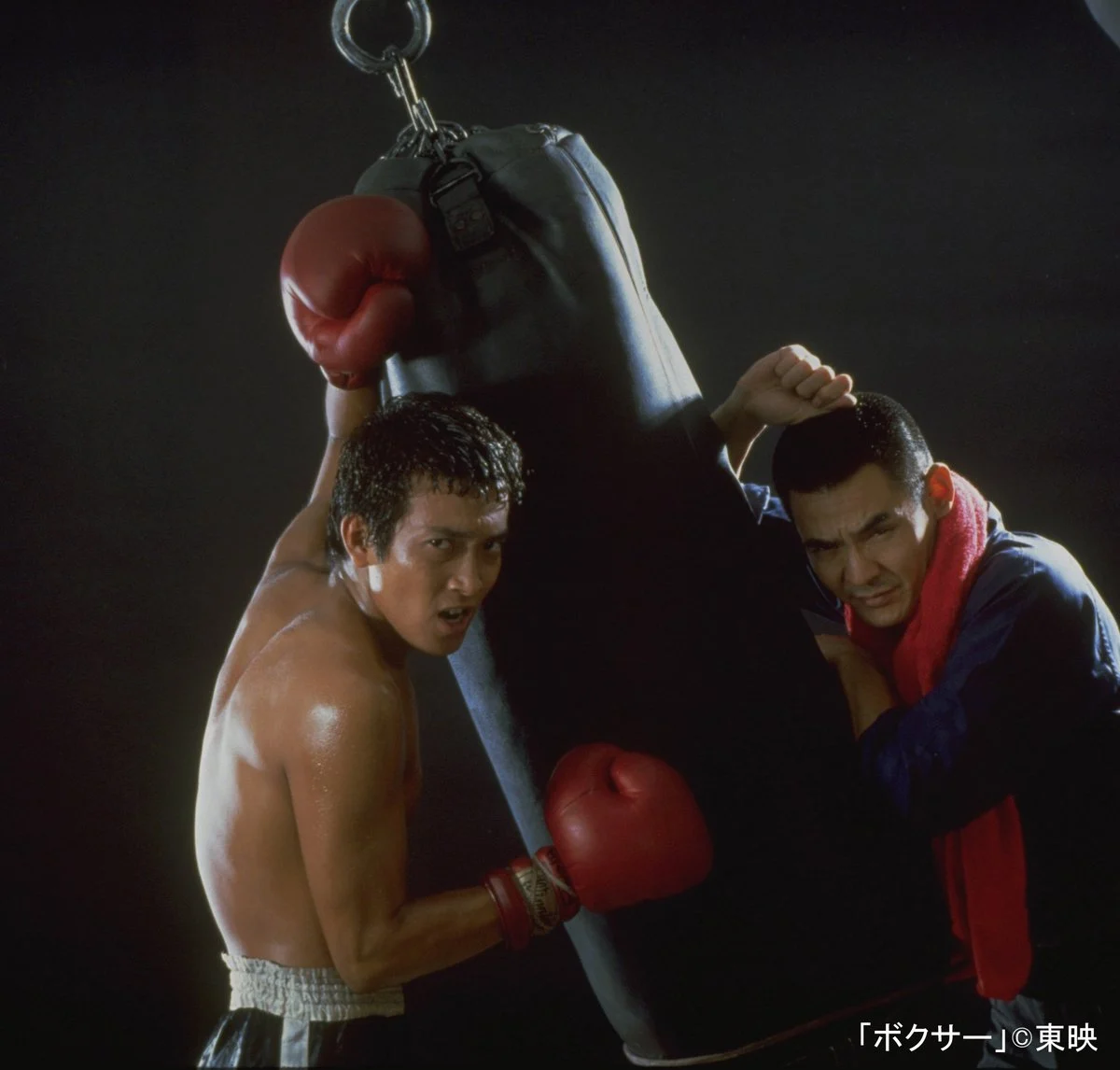
There are a few actors in Japanese genre cinema who are dear to my heart – Noboru Ando and Koji Tsuruta chief among them – but the actor that has captivated me the most in recent times is Bunta Sugawara. From his utterly nihilistic performance in Kinji Fukasaku’s Street Mobster (1972) to a picture of stylish cool in Hideo Gosha’s Violent Streets (1974), the man could literally do anything onscreen. And here, in Shuji Terayama’s The Boxer, he is vulnerability personified as Hayato, a washed-up former boxer down on his luck. Clearly inspired by the huge success of Sylvester Stallone’s Oscar-winning Rocky, The Boxer was yet another desperate move by those running Toei studios to emulate Hollywood trends. They clearly thought that this idea was a box office winner: what could possibly go wrong?
With his crumpled physique and hangdog expression, Sugawara confers an aura of tattered honour upon Hayato, a former champion reduced to a ruin living in squalor with only his aged Doberman dog as his companion. The opening title sequence conveys the peril at the heart of a boxer’s existence: as one man walks towards his fate in the ring, those who have left it physically altered stagger – or are carried – past him. The stark black and white then blasts into fierce colour as his match begins. It is a thoroughly impactful entrance into this cinematic study of loss, melancholy and pain.
Kentaro Shimizu co-stars as Tenma, an aspiring young fighter who crosses paths with Hayato due to a tragedy that binds the two men together, an event which in other hands would play out far more broadly and sentimentally, narratively speaking. The decision to entrust the project to the great countercultural figure Shuji Terayama proved to be an inspired one. It is to his immense credit that every boxing movie trope you can think of is either studiously avoided, or reconfigured in any entirely new way. The sparring/training sequences are filmed with a sparseness and grit that reinforces the physical punishment, and the matches themselves are filmed in real time, without stunt doubles. It really is Shimizu in the ring. On paper, Tenma is the archetypal wannabe boxer, a weak young man with more guts than skill, but Shimizu imbues his character with ingenuity and nuance. The ensemble cast, assembled from regulars of Terayama’s Tenjō Sajiki theatre company, provide the supporting comedic characters, who are the light relief from the ever-increasing grimness of the in-ring combat.

A sorrowful litany of boxers who have died prematurely weaves the real lives of fighters into the fiction we’re watching, aided by the presence of retired boxers in the crowd for the climactic set piece. There is no championship title to be fought for here, only a man’s pride, whilst his crumbling mentor can only bear witness to what unfolds. Framed by cinematographer Tatsuo Suzuki in diffused blue and purple light, The Boxer is torn straight from the shadow world of late 70s Japan, of bruised and faded people clinging to each for comfort and company. Terayama’s use of surreal imagery undercuts the solemnity of the subject matter, whilst J.A. Seazer’s sparse, otherworldly score provides a gilded layer of elegance to this down at heel tale.
There are great films about boxers (Raging Bull) and then there are great boxing films (Body and Soul, Champion, Fat City). The Boxer belongs in the latter category not just for its verisimilitude, or the raw intensity of the performances. It belongs there for reminding us that the physical toll on those who dare step through the ropes is inevitable, and that whatever will be left of them is uncertain. When Hayato is asked about a decision he once made in the ring, Bunta Sugawara’s expression displays everything you could ever want to know about a boxer’s suffering.
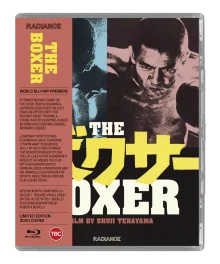
BLU-RAY LIMITED EDITION SPECIAL FEATURES
- High-definition digital transfer
- Original uncompressed mono audio
- Interview with composer J.A. Seazer (2026, 19 mins)
- New visual essay on Toei studio in the year 1977 by Tom Mes (2026, 12 mins)
- New and improved English subtitle translation
- Reversible sleeve featuring artwork based on original posters
- Limited edition booklet featuring new writing by Maria Roberta Novielli
- Limited edition of 3000 copies, presented in full-height Scanavo packaging with removable OBI strip leaving packaging free of certificates and markings
The special features on the disc are spare but of exceptional quality. 1977:The Year Toei Failed is another outstanding visual essay from Tom Mes, who goes into great detail about the problems the studio was enduring, and their varied attempts to generate box office hits, notably by copying Hollywood hits Some were successful, such as The Japanese Godfather and its sequels (Sadao Nakajima), whilst others such as the Legend of Dinosaurs & Monster Birds (Junji Kurata) and Hokuriku Proxy War (Kinji Fukusaku) were box failures. The Boxer was also another of those failures, but Mes is at pains to point out that these films are rightly receiving wider attention thanks to blu ray reissues. He even mentions a film due out in September via Radiance Films: Kon Ichikawa’s The Inugami Clan.
The interview with musician and composer J.A. Seazer was the real highlight of the special features for me. As a longtime fan of the Japanese counterculture and underground scenes, to hear firsthand how Seazer came to meet Shuji Terayama and collaborate with him for so long was an absolute treat. He’s one of the last remaining underground figures from that era, and his accounts of his time in underground theatre, innovating experimental theatre in the streets both in Japan and around the world, and his vital musical contributions for both stage and screen are fascinating. The booklet sadly was not available for me to review.
The Boxer is a truly brilliant minor classic, and I hope that this release is the just the start of a wider reissue series of Shuji Terayama’s filmography by Radiance.