



Director: Bernardo Bertolucci
Writers: Bernardo Bertolucci, Mark Pepole
Starring: John Lone, Joan Chen, Peter O’Toole, Ruocheng Ying, Victor Wong
Year: 1987
Duration: 163 mins
BBFC Certification: 15
Genre in Hollywood has always been a rather fluid entity. What was once vital and unassailable can become dated almost overnight, as times and tastes move on, often, it seems, without so much as a backward glance. Yet whereas some genres fade away, never again to achieve mainstream dominance (Westerns, for example) others have a much more stubborn staying power; or at least a Lazarus like ability to raise themselves from purgatory.
One such genre is the historical epic, which has risen and fallen in Hollywood popularity ever since rolls of film fluttered through the very first movie cameras. Traditional Hollywood epics, which reached their apex during the 1950s and early 60s, frequently looked to The Bible or the ancient past for inspiration, yet as the twentieth century began to enter it’s final decades, filmmakers armed with Hollywood budgets began to look to the recent past as well, bringing to life epic stories that could still be recalled within living memory. During the 1980s, for example (just over a decade before Gladiator brought back the sword and sandals epic with a bang) the tumultuous conflicts of the twentieth century provided an impossibly rich and varied vein from which to draw inspiration, as seen in films as diverse as Warren Beatty’s Reds or Richard Attenborough’s Gandhi. Yet arguably the most impressive of all of these latter day epics was Bernardo Bertolucci’s The Last Emperor, a grand, old fashioned spectacle that managed to masterfully combine the epic with the intimate.
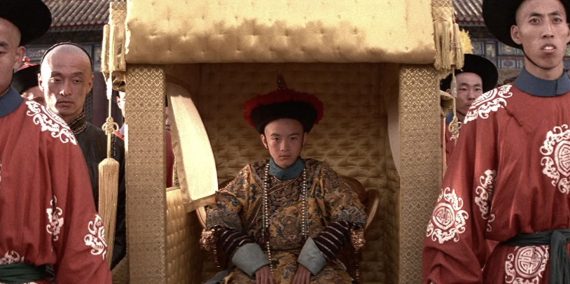
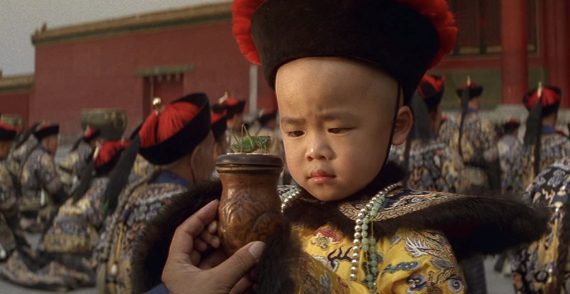
Of the two epoch shaking revolutions that occurred during the twentieth century, it is fair to say that the Chinese revolution has received far less cinematic attention in the West than the Russian one. In a way, that makes The Last Emperor feel all the more unique and special. It tells the story of Pu Yi, the last ever Emperor of Imperial China. Following his ascension to the throne in 1908 aged just two years old, the film follows his isolated childhood in the royal Forbidden City, before revolution and war see an emancipation, collaboration with the Japanese and a conclusion that finds Pu Yi in a world that feels like the polar opposite of his unique and privileged beginnings.
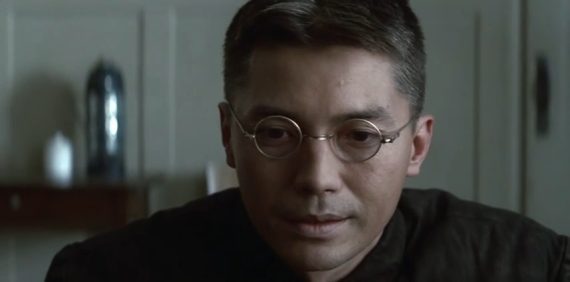
The challenge for any film trying to cram an entire lifetime into just a few hours is that they can often feel disjointed and episodic, never having the luxury of settling in one place before they are leaping onto the next significant event. The end result, paradoxically, is that the subject at the centre can often feel just as enigmatic at the end as they did at the beginning. Thankfully, that isn’t the case with Bertolucci’s film, and a significant amount of credit has to go towards the script (written by Bertolucci and Mark Peploe). With so much ground to cover, they wisely don’t attempt to tell two stories at once. The Last Emperor is very much Pu Yi’s story and pointedly not a blow by blow reconstruction of the Chinese revolution. Masterfully, Peploe and Bertolucci ensure that key historical events (from the actual revolution itself to the ascent and eventual total dominance of Mao Zedong) take place off screen; we only learn about developments as Pu Yi does, ensuring that The Last Emperor consistently feels like an intimate exploration of epic events. At times this can potentially lead to some confusion. Without a basic grounding in historical facts, the significance of people like Chiang Kai-shek will likely fly above most peoples heads. Yet this also works in the film’s favour. The audience, like Pu Yi himself, are meant to be swept along, at times not fully grasping the full implications of any given situation, sharing the naive young Emperor’s sense of fear, confusion and doubt.
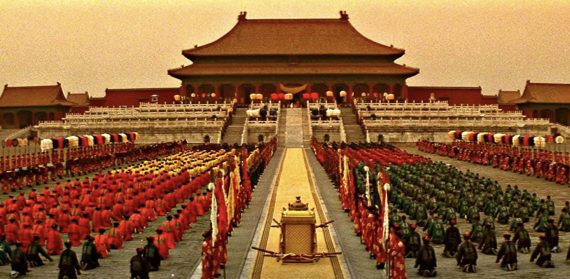
Being an epic, however, means that Bertolucci’s film is notable for more than just the fine balancing act of its screenplay. An often touted slice of trivia about The Last Emperor is that it was the first Western production to be allowed to film inside the walls of The Forbidden City (the extensive grounds which contain the old Imperial Palace in Beijing). Bertolucci doesn’t waste his golden opportunity. In conjunction with cinematographer Vittorio Storaro, production designer Ferdinando Scarfiotti and costume designer James Acheson, he ensures that The Last Emperor is a visual feast from the first frame to the last. This is never more apparent than when we are in The Forbidden City itself, as Bertolucci’s camera sweeps past the ancient architecture, capturing hundreds of extras on screen in moments that match the grand Hollywood epics of old. The film’s title feels fittingly ironic and even slightly mournful when you consider that The Last Emperor could very well also be called The Last Hollywood Epic. Released in 1987, it was the final grand historical film to achieve an epic sense of scale and wonder without the addition of CGI. It is humbling to watch, knowing that all those hundreds of extras dressed in extravagant costumes are being captured on film in real time and are not the result of pixels created on a computer. As much as CGI has opened up the imaginative scope of filmmakers worldwide, it still can’t quite match the visceral thrill of seeing the real thing.
The visuals, combined with a lush, emotive score (co-written by Talking Heads’ David Byrne) mean that The Last Emperor is never less than a feast for the eyes and ears, so much so that the film’s performances might haven gotten lost among the spectacle. Thankfully, this isn’t the case. The film boasts some great supporting turns from Hollywood character actor Victor Wong, Chinese theatre legend Ruocheng Ying and a smooth, charismatic performance from Peter O’Toole (no stranger to epics himself). Yet The Last Emperor belongs to Joan Chen and John Lone, as the titular Last Emperor and his wife. Chen brings heartbreaking, at times almost discomforting pathos to the screen (the scene where she begins to eat flowers during an Imperial Ball is especially difficult to watch) whereas Lone brilliantly manages to elicit some degree of sympathy for Pu Yi throughout, despite the character having many less than favourable qualities. His transformation from a young man into an older citizen, crushed by time and circumstance, remains powerful and convincing.
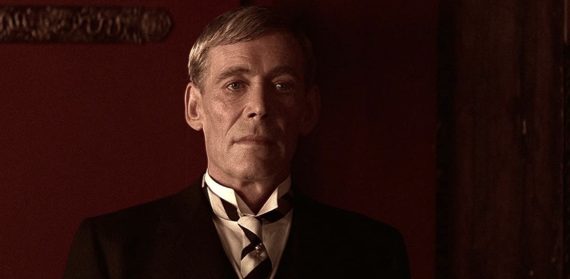
Yet for all its opulence, grandeur, sweeping directorial vision and impressive performances, The Last Emperor always leaves me feeling slightly cold. Perhaps this is down to Pu Yi himself. A weak, passive character, he has no agency in the film, making for a curiously detached viewing experience. This distance can also be felt from Bertolucci himself; he seems keen to merely be an observer of historical events rather than taking an active, emotional part in them. It all adds up to a film, at least for me, that feels intimate but cold, where emotional engagement is achieved more often through the power of its visuals than through the audacity of its storytelling.
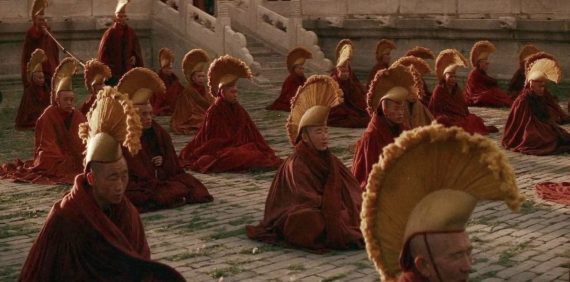
This is not to take away from The Last Emperor’s achievements. The winner of nine Oscars (including Best Picture and Best Director), it is a stately, frequently magnificent film that opens a window onto a period of history not often explored in the West, and almost never with this level of detail or authenticity. And as the last great Hollywood epic before the modern age of filmmaking and CGI, by the time its final shot fades to black, it achieves a level of melancholy poignancy that extends beyond the scope of its rather tragic titular main character.
Film:


The Last Emperor is being released on both limited edition 4K Ultra HD and Blu Ray by Arrow Video. Both releases have been struck from a new 4K restoration. I reviewed the 4K version and, for anyone coming from the previous Optimum home video release, Arrow’s new edition will come as a revelation. Everything is improved across the board – detail is, obviously, far sharper and more defined in this new 4K release but perhaps the biggest boon comes from the punch the new image has. The older release looked washed out and anaemic, whereas the Dolby Vision HDR grade on the new release gives the entire colour palette a punch and impact that simply wasn’t there before. There has been some debate and controversy about the film’s aspect ratio on home video. Needless to say, Arrow’s release contains the wider (and to my mind superior) aspect ratio of the film. The Last Emperor comes with both an original, uncompressed stereo track and a 5.1 DTS mix. There is no doubt that visually, Arrow’s new release blows the older Blu Ray completely out of the water – and for a film with such rich and opulent visuals, it makes the 4K of The Last Emperor almost essential.
Unfortunately, Arrow didn’t quite manage to match the older release on the extras front. Missing in the new release is the commentary from Bertolucci, as well as an hour long documentary. Arrow attempt to make up for this with a few new extras. The first is a short video essay narrated by David Cairns on Bertolucci’s career. This offers an interesting look at the state of Bertolucci’s career before making The Last Emperor, as well as offering more in-depth looks at The Conformist, 1900 and Last Tango in Paris.
Open the Door is an additional 20 minute video essay, again narrated by Cairns but co-written with Fiona Watson, that explores The Last Emperor in more depth, exploring the background to the film, as well as analysing its themes and characters.
Also included are three, brand new to home video, interviews that were conducted in 1987 by John C. Tibbetts. Bertolucci, Joan Chen and John Lone all have roughly ten minute interviews, of which the most interesting are certainly Chen’s and Lone’s, where they discuss topics outside of The Last Emperor, such as the Peking Opera and China’s relationship to film and cinema.
Finally, the disc also contains Postcards from China (a short home video compilation of location scouting footage), an original trailer and a brief image gallery.
It is important to note that this new release of The Last Emperor is actually a two disc affair. The theatrical version of the film and all the extras are contained on the 4K disc, whereas there is an additional Blu Ray containing the 210 minute extended TV version of the film. I wasn’t provided this disc for review, so unfortunately I cannot comment on the picture quality.
Arrow’s limited edition packages are rounded out with a collectors book, postcards and a poster.
While it is slightly disappointing that Arrow didn’t manage to license all the extras from previous home video releases, making this release just a hair’s breadth short of definitive, this new edition of The Last Emperor contains enough significant visual upgrades and new extras to still make it an absolutely essential purchases for fans of the film.
Disc/Extras:
