


 Director: Erik Skjoldbjærg
Screenplay: Erik Skjoldbjærg, Nikolaj Frobenius
Starring: Stellan Skarsgård. Sverre Anker Ousdal, Bjørn Floberg, Gisken Armand, Maria Bonnevie
Country: Norway
Running Time: 96m
Year: 1997
A detective is sent to investigate a teenage girl’s murder in a small Norwegian town above the arctic circle. As his mental state begins to crack, he struggles to keep his sanity while wrestling to solve the case amidst the unrelenting 24-hour daylight.
When we think of Film Noir, its very name conjures up images of shadows and darkness. Erik Skjoldbjærg’s Insomnia, released this month in a striking 4K limited edition from Second Sight, is occasionally so bright it threatens to blister. Top to bottom, this is pure, white Noir. Detective Jonas Engström (Stellan Skarsgård) is dropped into a land of perpetual sunlight where time has no meaning and sleep is a distant memory.
The very opening scene might catch you out as it does not fit that description at all. Instead, it is an avant garde brutal assault, befitting Se7en more than anything else. It soon gives way to a now disarmingly ordinary setup as we join Jonas and his partner Erik, flying into the island.
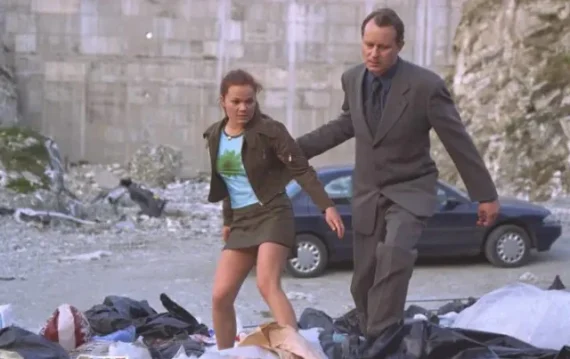
In some ways, the setup is quite similar to The Wicker Man, except Jonas is joining a very ordinary community, rocked by a murder. He is bringing his own demons, and will create a couple more. In classical noir tradition, Jonas is his own worst enemy.
Stellan Skarsgård has always been one of the finest and most charismatic screen actors. It’s fun comparing this early performance with his currently lauded turn in Sentimental Value. He’s settled into age beautifully and in Insomnia, he is more guarded and distinct. Even his voice seems more defined. He is cold, straight as an arrow and just as sharp. His inevitable unraveling, a descent into a bright, white hell, blurs the edges of his performance. What has not changed though is his ability to garner sympathy.
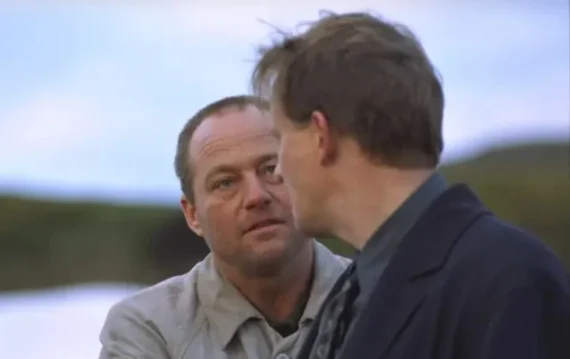
It is because of Skarsgård that we are invested in such a deeply flawed character. He has already crossed a moral line before his cat and mouse with killer Jon Holt (Bjørn Floberg). Indeed, Holt is an oddly sympathetic figure, simply playing an opportunity presented to him. He lacks any malice really and it’s a nicely judged performance from Floberg, weaselly and effectively odd, leveraging his power over Skarsgard. It makes for a fascinating dynamic between the two and the idea of protagonists and antagonists is challenged.
I first saw this story in Christopher Nolan’s fantastic remake with Al Pacino and a wonderful Robin Williams in the equivalent roles. I can see now why the narrative, stripped of a natural clock and made all the more unsettling by harsh editing, would appeal to Nolan. This original version of Insomnia is smarter and more raw, though both are different enough to co-exist. In fact, it strikes me that Nolan was twice inspired by Skjoldbjærg’s film; the back-to-front editing of Memento adopts a similar approach by unsettling the viewer. This appears to be the flashpoint for the Nolan brothers fascination with time and space in narrative.
Insomnia is pacey and while for the most part shot choices are empathic for the viewer, it steadily fractures. You can’t tell what time it is at any given moment, even less so how much time has passed. As Jonas’ grip on reality falters the longer he can’t sleep, so too are we being left adrift. Music is minimal and unhelpful.
Even language isolates Jonas. A Swede in Norway. The town is busy and functional, but we never leave his side and he is a rubbish travel companion! The film, with purpose, can be monotonous, disturbing and unsettling, while doing very little. It’s intimate and tactile; while Jonas is cold and unable to engage with this sunlit world in which he finds himself, he is frequently confronted by intimacy. He -and us- are unable to ascertain how much of this is in his head.
It’s a brilliant twist on a thriller. By compromising the detective, his brilliant deductions are also compromised and the narrative can be playful.
VIDEO
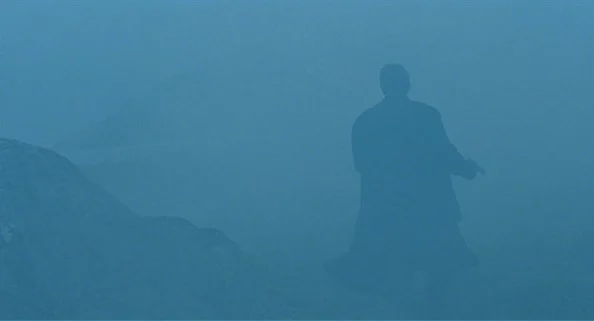
The opening scene is a dark and grainy affair, but the 4K simply makes it even more effective. So too the switch to the bright, clean landscapes that will dominate the remainder of the film. Indoor shots are particularly razor sharp in contrast and detail. The wide open and bright (obviously) landscape photography of Erling Thurmann-Andersen is as beautiful as it is sharp. The town and its buildings are routinely bland but their very existence creates a sharp contrast with the white surroundings. The fateful day in the mist is extraordinary; the depth of field disappearing quite dramatically.
EXTRA FEATURES
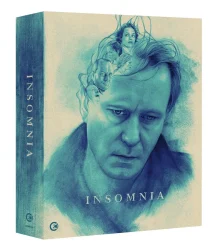
This is another excellent presentation from Second Sight who have a dependable habit of giving smaller films a stage they deserve. The extras are beautifully curated with a steady, informative commentary and a handful of interviews. Also included are three short films and the limited edition includes a substantial book. This is a wonderful edition finished off with new artwork.
- New 4K restoration presented with Second Sight Films Director Approved HDR grade with Dolby Vision
- Dual format edition including both UHD and Blu-ray with main feature and bonus features on both discs
- New audio commentary with Director Erik Skjoldbjærg and Co-writer Nikolaj Frobenius
- Running on Instinct: a new interview with Director Erik Skjoldbjærg
- Falling Into It: a new interview with Producer Petter J. Borgli
- Private Prisons: Alexandra Heller-Nicholas on Insomnia
- Erik Skjoldbjærg’s Short Films: Spor, Close to Home and Near Winter
- Limited Edition Contents
- Rigid slipcase with new artwork by Peter Strain
- 120-page book with new essays by Jenn Adams, Mitchell Beaupre, Barry Forshaw, Francesco Massaccesi, Priscilla Page and Travis Woods
- 6 collectors’ art cards