


When we think of horror films, we often picture masked killers, supernatural creatures or monsters lurking in the shadows. But what if the monster is an enormous truck, and the nightmare unfolds in broad daylight on an otherwise ordinary American highway?
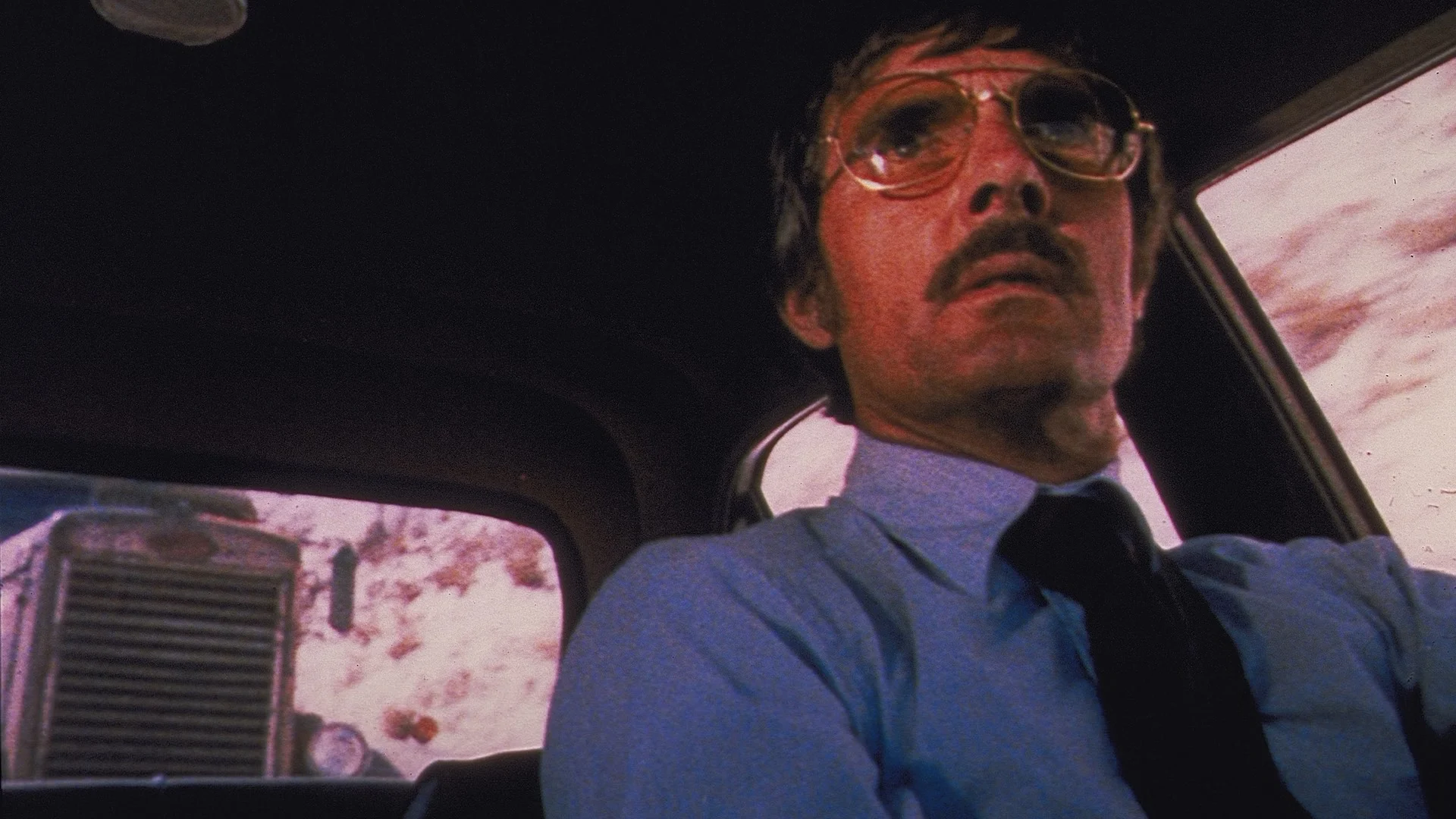
Steven Spielberg’s Duel (1971) is commonly described as a thriller, and understandably so. It follows an ordinary motorist, David Mann (Dennis Weaver), who finds himself relentlessly pursued by a mysterious truck driver for reasons that are never explained. Yet beneath its straightforward premise lies something that feels remarkably close to a horror film.
In fact, I’ve always regarded Duel as one. But what exactly makes it so frightening, and could Spielberg’s early television film be more deserving of the horror label than it’s generally given credit for?
The theatrical version of the film opens with Mann exiting his driveway, safe in the confines of an ordinary neighbourhood. As the opening credits roll, we accompany David on his journey and slowly but surely begin to feel a sense of isolation as the roads become increasingly deserted. Eventually, we see little more than an empty desert highway, which becomes the main setting for the remainder of the film.
It isn’t too long before a big, creepy and greasy-looking truck makes its appearance, seemingly dominating the highway without even doing much more than crawling along. And, of course, the “duel” soon commences between the mysterious trucker and a husband and father who, as we come to realise, is struggling with his sense of manhood and masculinity. If one were to look for an underlying theme in the film, masculinity would certainly be one of them.
Although horror films are often associated with supernatural elements and gore, that isn’t always the case. Terror and suspense, especially when delivered in large doses, can be enough to make a film feel like horror. Spielberg effectively builds the tension through carefully selected camera angles, a threatening musical score and, of course, the aforementioned isolation of the empty highway. Even when David encounters a rare opportunity to get help, the psycho behind the wheel of the old eighteen-wheeler always seems to scupper his plans, with the possibility of being killed ever present.
Composer Billy Goldenberg drew inspiration from Bernard Herrmann’s score for Alfred Hitchcock’s Psycho (1960), and the similarities can be heard in the sharp, stabbing strings and cold, metallic sounds that seem to reflect the mechanics of the villainous vehicle. These qualities are particularly evident during the sequence in which Mann’s radiator hose begins to fail and the truck slowly creeps up behind him after David has managed to gain quite a head start.
Spielberg also does a lot with the visuals, making the Peterbilt truck appear as rusty and ancient-looking as possible, while sometimes using shadows to conceal much of it and convey a sense of imminent danger. The shot of the lorry entering a tunnel and coming to a standstill is particularly memorable, as its driver watches Mann desperately trying to convince a school bus driver that his life is in danger. We soon realise that David is going to have to solve the problem on his own.
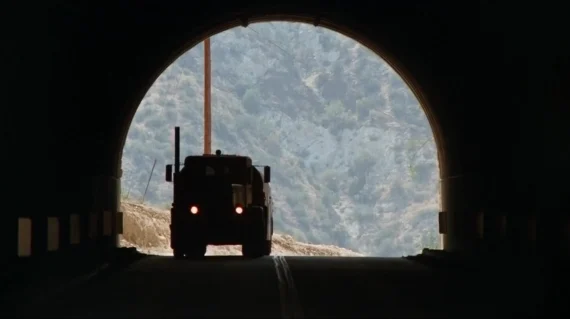
The truck becomes an almost unstoppable force on the highway, and judging by its collection of registration plates, its driver may have killed numerous times before encountering a man who was simply on his way to a business appointment.
But it isn’t just the scenes on the road that make Duel feel like a horror film. The diner scene early on creates an escalating sense of paranoia as we join David in trying to figure out who the driver is. Was he really inside the diner with him? Or was he waiting in his weapon on wheels? We get a clear shot of the cab sitting empty while the truck is parked outside, so who knows? But that uncertainty only adds to the suspense.
Last but not least is the contrast between David’s small red Plymouth Valiant and the huge, intimidating rig. The latter is the cat and the former the mouse. It’s a familiar horror scenario in which the vulnerable protagonist is pursued by something seemingly unstoppable, with little hope of escaping or fighting back.
Ultimately, Duel might not feature a masked killer or a supernatural monster, but does it really need either? It has an isolated setting, a vulnerable protagonist, an apparently unstoppable enemy and a constant feeling of dread. The fact that we never discover who the truck driver is or why he wants David dead only makes the experience more unsettling. Spielberg takes something as ordinary as a journey along a highway and turns it into a waking nightmare. And for me, that’s precisely why Duel deserves to be recognised as a horror film just as much as a thriller.