



When Will Graham talks to his son about Hannibal Lecktor in Manhunter, it becomes clear just how badly his encounter with the serial killer affected him. Catching Lecktor left Graham psychologically damaged and ultimately hospitalised. This wasn’t simply another murderer he had helped put behind bars. Lecktor had somehow managed to get inside his head.
Then we meet him.
Brian Cox’s Lecktor is intelligent, manipulative and undoubtedly dangerous. But there is surprisingly little about him that explains why this particular killer had such a devastating effect on Graham. Even the characteristic that would eventually become inseparable from Hannibal Lecter is missing. Manhunter never tells us that Lecktor is a cannibal.
Five years later, The Silence of the Lambs introduced audiences to a very different Hannibal Lecter. Before Anthony Hopkins has barely said a word, the film has already built him up as something extraordinary. We hear about the horrific things he has done, see the extreme precautions surrounding him and follow Clarice Starling deeper into the institution until she finally reaches his cell. By the time Lecter appears, we have already been taught to fear him.
Cox’s version receives no such introduction. In fact, the relative ordinariness of his Lecktor has become one of the most praised aspects of the performance. But could that also be its biggest weakness?
Manhunter wants us to believe that Hannibal Lecktor almost destroyed Will Graham psychologically. Does the Hannibal we actually meet give us enough reason to believe it?
Well, this writer is sceptical.
In Manhunter, we are not introduced to Hannibal Lecktor until well into the film. By that point, we already know that Graham has experienced something traumatic in his past, but the full extent of it isn’t immediately explained. Perhaps the scene that gives us the most detail comes later, when Graham talks to his son, Kevin.
Graham explains that Lecktor attacked and killed college girls and that one of his victims had been his patient. Graham eventually realised that Lecktor was the killer after visiting his office, only for Lecktor to attack him. Even after Graham physically recovered, he couldn’t get Lecktor’s thoughts out of his head. He stopped talking to people and eventually sought psychiatric help.
To me, that makes it difficult to buy into Manhunter’s Hannibal Lecktor as a serial killer who is significantly more unusual than the other killers Graham has probably encountered during his career with the FBI. What we do learn is that Lecktor is extremely intelligent. One of the best examples comes when he uses a telephone call, an operator and some clever deception to eventually obtain Graham’s home address.
With Anthony Hopkins’ Hannibal Lecter, however, we are shown why this man is different. We learn about the horrific, life-changing injuries he inflicted on an innocent nurse and that he actually ate her tongue. His cannibalism becomes part of his identity. He manages to psychologically torment fellow inmate Miggs to the point that he kills himself. Later, Lecter gets hold of part of a pen while restrained and uses it as part of his infamous escape, brutally murdering his guards and fooling the authorities in the process.
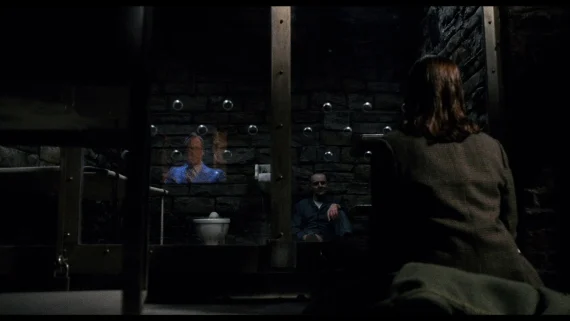
With the 1986 version, there isn’t enough that convincingly shows us why Lecktor has such an extraordinary influence over Graham or what makes him a greater threat than many of the other criminals Graham might have encountered. He is even shown sitting inside a fairly ordinary-looking cell with metal bars, which could potentially allow him to attack anybody foolish enough to get too close.
During the previously mentioned sequence involving Graham’s address, Lecktor is simply instructed to turn around and face the wall while a telephone is brought to his cell. There are no restraints or elaborate precautions. Compare that with The Silence of the Lambs, where Clarice is warned not even to approach the glass of Lecter’s cell or hand him anything other than soft paper.
It is well known that Cox based his portrayal of Lecktor partly on real-life serial killers Peter Manuel and Ted Bundy. At the time, serial killers and criminal profiling were nowhere near as familiar to the general public as they are today, so it is important to take that into consideration.
Unfortunately, I don’t think time has been entirely kind to Cox’s portrayal.
Decades of films, documentaries, television programmes, podcasts and true-crime stories have made audiences much more familiar with the idea that a serial killer can appear perfectly ordinary. What might once have been disturbing about Lecktor now seems far less unusual.
That ordinariness was exactly what Cox and Mann were aiming for. Cox has said that his Lecktor was supposed to be someone you could pass in the street without looking twice. In 1986, perhaps that was disturbing in itself. But today, after decades of popular culture have exposed audiences to countless seemingly ordinary serial killers, it doesn’t feel quite as unusual.
For me, that creates a problem. Manhunter tells us that Lecktor was extraordinary enough to leave Will Graham psychologically shattered, but the character we actually meet never quite convinces me why.