


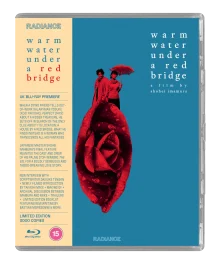
 Director: Shohei Imamura
Screenplay: Yo Henmi, Shohei Imamura, Daisuke Tengan, Motifumi Tomikawa
Starring: Kōji Yakusho, Misa Shimizu, Kazuo Kitamura, Mitsuko Baisho.
Country: Japan
Running Time: 119 minutes
Year: 2001
BBFC Certificate: 18
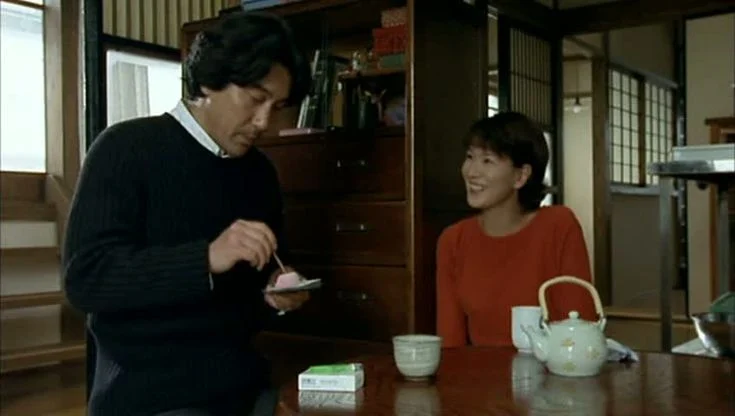
Warm Water Under a Red Bridge is the second of Radiance’s recent releases of films by the great Japanese director Shohei Imamura, and whilst there are clear similarities between both films, made as they were by the same man, this one of is of a different order. When your former protégé describes this as a ‘strange film’ which is ‘seriously weird’, and that man is the agitator incarnate Takashi Miike, you know that you are in for something far outside your expectations. And yet, this film is most definitely what a romantic comedy, about a man and a woman struggling within themselves to overcome various obstacles that block their path to each other and to happiness.
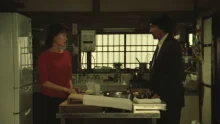
Kōji Yakusho and Misa Shimizu, the leads in Imamura’s Palme D’Or-winning film The Eel return to the fold in what would be the ageing director’s final full-length feature. Yakusho plays Yosuke Sasano, a typical salaryman who has been made redundant in middle age, estranged from his wife and son and struggling to make ends meet as he drifts further to the edges of society. His suit and overcoat are the last trappings of his previous life as he consorts with itinerant men living on the banks of a river, notably his friend Taro, a philosopher who exhorts him to enjoy life and seek out ‘lechery’ as a way to shake himself out of his midlife torpor.
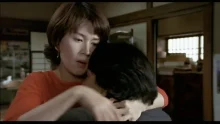
When Sasano ventures to a small riverside town to find an item secretly hidden by Taro, he encounters Saeko (Miko Shimizu), a woman with her own foibles and troubles. Their attraction to each other, and the barriers they each encounter as they journey towards each other are what give this special a very special quality. The water that ‘emanates’ from Saeko is presented literally but is also a metaphor for the wider resonance of this element in Japanese society. It is also a sign of Saeko’s agency and desire, represented as distinct from Sasano’s own ideas. Imamura’s statement about ‘the physical essence of a man is to be able to have an erection’ was a way to express what he felt about the fading of physical desire whilst still having those thoughts.
As ever, there is a double meaning behind Imamura’s words. Sasano struggles to define himself in a new world far from the one which forced him into the salaryman identity, but he embraces that change and shows himself to be adaptable and forward-looking. Similarly, Saeko’s changing fortunes have left her eking out her own life in the shadow of other people’s needs, notably her ancient grandmother (Mitsuko Baisho). Their relative disappointments in later life give them a perspective on what the future may or may not hold. However, Warm Water Under a Red Bridge is far from a sombre meditation on seizing the day, and is for the most part uproariously funny, with several interwoven comedic subplots brought to life by a cast of excellent character actors. There are surely no other films in which the leading couple go on a date to a scientific facility to learn about how neutrinos act in water!
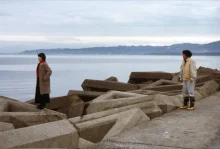
Warm Water Under a Red Bridge is a refreshing and surprising film about the lives of people in their later years trying to come to terms with each other, and is a mischievous and poetic last cinematic testament from one of the great artists of Japanese film.
BLU-RAY LIMITED EDITION SPECIAL FEATURES
- High-Definition digital transfer
- Uncompressed stereo PCM audio
- Introduction to the film by Takashi Miike (2026, 3 mins)
- Interview with co-writer Daisuke Tengan (2026, 21 mins)
- Making of documentary (2001, 22 mins)
- Archival discussion between Shohei Imamura and Takashi Miike (2002, 22 mins)
- Theatrical trailer
- Teaser trailer directed by Takashi Miike, with newly filmed intro
- Newly improved English subtitle translation
- Reversible sleeve featuring original and newly commissioned artwork by Time Tomorrow
- Limited edition booklet featuring new writing by Bastian Meiresonne
- Limited edition of 3000 copies, presented in full-height Scanavo packaging with removable OBI strip leaving packaging free of certificates and markings
Takashi Miike’s introduction to the film is short but endearing, and shows the love and respect he has for his former mentor still very much in evidence. The interview with the writer Daisuke Tengan displays the man’s no-nonsense approach, as he outlines the changes made to the previous scripts and how various elements of the narrative were changed – often at the last minute. He also voices his disapproval of the film’s ending, another example of his customary forthrightness which clearly served him well working with Imamura.
The joint interview with Takashi Miike and Imamura from 2001 is an unexpectedly comedic delight. When the great veteran is asked what he thinks of his former assistant, he replies, ‘he didn’t make much of an impression!”. Undaunted and excitable, Miike does most of the talking, and when Imamura speaks, he makes every word count. They even drink water competitively in a truly brilliant piece of impromptu slapstick.
The theatrical trailer contains yet another immortal tagline: ‘Dripping Wet Sex Fantasy Screened at Cannes’, and whilst it does give the prospective viewer some indication of what they will see, it manages to still be enigmatic. That cannot be said of Miike’s typically out-there ‘trailer’ for the film, involving his rock star friends and almost zero footage from the film itself. Imamura apparently said ‘can we even use this?’ after he saw it. The veteran knew his student all too well.
The limited-edition booklet contains an excellent and empathetic essay by journalist and author Bastian Meirsonne, providing a concise overview of Imamura’s career alongside his opinion of Warm Water Under a Red Bridge as a ‘summative work’ despite being deemed unclassifiable upon its release back in 2001. Time has most certainly been kind to this wonderfully eccentric and erotic film.