


 Director: James Bidgood
Screenplay: James Bidgood
Starring: Bobby Kendall, Charles Ludlam
Country: United States
Running Time: 71 minutes
Year: 1971
BBFC Certificate: 18
“I am myself the boy I see…I burn with love for my own self; I start the fire I suffer”
From Ovid’s ‘Metamorphoses’.
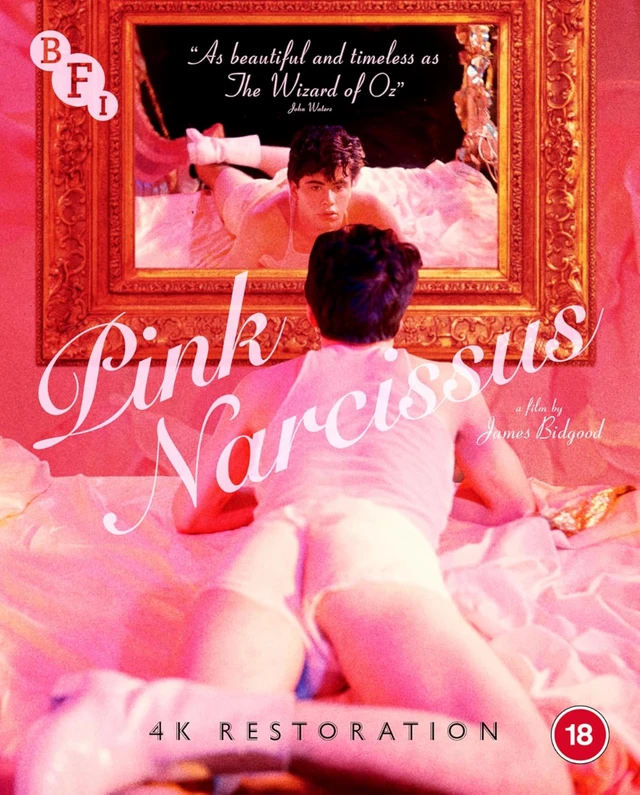
In an interview with the writer/director/producer James Bidgood that accompanies this landmark archival release, he simply says that the impulse that drove him to make Pink Narcissus was ‘to glorify the American boy’ in the same way that other media was glorifying the American girl. That simple desire would lead to seven years of pain and struggle to (nearly) complete the film, and a near-lifetime of obscurity before this extraordinary masterpiece could fully receive the acclaim that it so lavishly deserves.
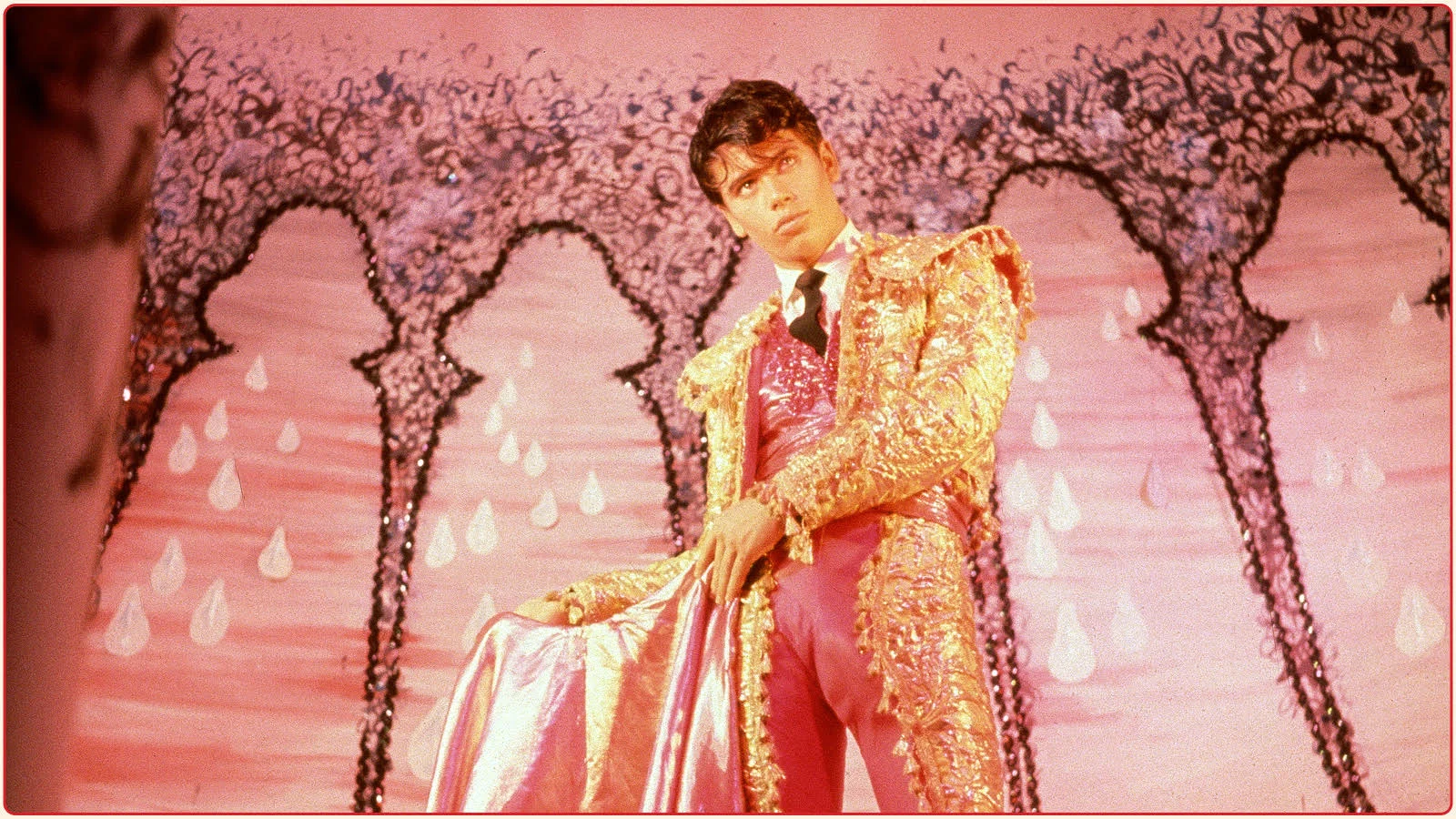
For decades, Pink Narcissus was a myth, a scarcely-seen legend that existed in underground film circles, a precious document of LGBTQ+ culture glimpsed in still photos collected in limited edition artbooks, kept alive by word of mouth and the adoration of a small cohort of fans the world over. To view the film in all of its luminescent, shimmering glory in 2026 is a powerful experience, to say the least. Above all, Pink Narcissus is paean to physical pleasure, with the barest narrative attached to the twilight fantasies of a young street hustler portrayed by ‘Bobby Kendall’, the wonderfully archetypal 1960s pseudonym chosen to hide the identity of Bidgood’s muse for this precious and highly personal project. With next to no money and only his tiny apartment as a backdrop, Bidgood proved that necessity really is the mother of invention. He garlands Kendall’s body with burning hot pinks and blazing flesh reds as his primary visual palette, whilst also softening these hot tones with gleaming golds and ice-cold blues, in particular with the stunning twilight tracking shot that opens the film.
Bidgood’s considerable skills as a costume and set designer are on full display, from the luxurious matador and Roman outfits to the plethora of jewel-encrusted items decorating his boudoir. Even the glittering motorcycle seen as part of the first sexual encounter was created from scratch. This particular narcissus is a thoroughly modern incarnation, a self-obsessed hustler who replays his sexual adventures as resplendent fantasies as an escape from the metropolis just outside his apartment window (another jaw-dropping piece of set design by Bidgood). Kendall is both participant and voyeur within flamboyant scenarios that include a Roman orgy and an Arabian Nights-style dance sequence. However, the most poetic and affecting scenes feature him alone, caressing himself with a blade of grass across his naked body, or exultant in a thunderstorm.
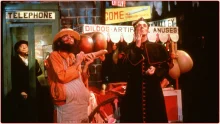
As a feat of cinematic ingenuity, Pink Narcissus has few rivals. Bidgood employs a multitude of techniques featuring stop motion animation, in-camera effects, tinted celluloid and all manner of image overlays that lend a fantastical air to something that is already oversaturated and intense. The phantasmagorical Times Square sequence, which features the celebrated theatre actor Charles Ludlam, simply has to be seen to be believed. Pink Narcissus is a powerful and provocative document of a long-lost world, rescued and restored to its rightful place in the firmament of queer cinema’s greatest treasures.
Extras
Newly restored in 4K by the UCLA Film & Television Archive and presented in High Definition
Interview with James Bidgood (2007, 33 mins) : Brian Robinson interviews the writer/director at The National Arts Club, New York
Post-screening Q&A with John Waters and Kelly McKaig (2025, 8 mins): filmed after a screening of the new restoration, this Q&A appears courtesy of Strand Releasing
Introduction by Todd Wiener (2026): filmed introduction to the UK premiere of Pink Narcissus by Todd Wiener, Motion Picture Curator, UCLA Film and Television Archive
Pink Narcissus with Jonathan D. Katz – Q&A (2011, 40 mins): an on-stage Q&A with James Bidgood, hosted by curator and art historian Jonathan D. Katz, introduced by Ira Sachs
Stills gallery featuring photography by James Bidgood
Restoration trailer
**FIRST PRESSING ONLY** Illustrated booklet featuring a new essay by Alex Davidson, an archival essay by Rupert Smith and 2010 interview with James Bidgood by Michael Kowalinkski
After watching a film as extraordinary as this, many questions arose, and a great many of them are addressed throughout this superb set of special features. The interview with James Bidgood is a wonderful document of the man’s sheer charisma and inimitable way with a story. The self-deprecating manner in which he tells the story of what inspired Pink Narcissus, from early inspirations such as Wuthering Heights (William Wyler, 1939) and The Thief of Baghdad (Michael Powell, Ludwig Berger, Tim Whelan, 1940) to his days as a costumier are a deeply rewarding watch. His love of Bobby Kendall and their time together clearly affected the rest of his life, and his tributes both here and in the Q&A are truly heartfelt. He also recounts a great story about Pink Narcissus being disparaged by Screw magazine alongside Fellini’s Satyricon as one of the worst films of that year. The Q&A from 2011 features Bidgood on great form with Ira Sachs after a screening of the film, where he again holds court and is clearly overwhelmed by the positive response that his film has garnered from the audience.
The short Q&A with John Waters and Kelly McKaig from 2025 is another gem, with Waters showing once again why he is a raconteur par excellence – of course he saw Pink Narcissus on first release back in 1971 – with McKaig providing much needed context about both the film’s soundtrack and Bidgood’s fraught relationship with Sherpix, the production company that financed Pink Narcissus and then took the film away from its creator, leading to the infamous ‘Anonymous’ credits. Todd Wiener’s introduction to the film at BFI Flare: London LGBTQA+ festival earlier this year is a brilliant addition, providing valuable biographical information about Bidgood’s life as both a costumier and as the drag act Terry Howe at Club 82 in New York. He also goes into great depth about the lengths that many individuals and entities have gone to in order to bring Pink Narcissus back from the brink of oblivion, from film companies to experts in film restoration. Wiener invokes the great cultural critic B. Ruby Rich, who described Pink Narcissus as ‘an extraordinary artefact of pre-Stonewall gay male culture’. From his iconic white ankle boots to his insouciant good looks, ‘Bobby Kendall’ was the divine inspiration for this entrancing, obsessional labour of love.
Pink Narcissus is released by the BFI as part of their celebration of Pride Month, with selected cinema screenings on the 12th of June, and a blu ray release on the 15th of June.