


 Director: Jean Rollin
Screenplay: Jean Rollin and Jacques Ralf
From an original story by: Jean Rollin
Starring: Marina Pierro, Françoise Blanchard, Mike Marshall, Carina Barone, Fanny Magier (as Fanny Magieri), Patricia Besnard-Rousseau, Véronique Pinson (as Veronique Pinson), Sandrine Morel, Delphine Laporte
Country: France
Running Time: 90 min
Year: 1982
BBFC Certificate: 18
French auteur director Jean Rollin is arguably best known for his run of deliberately paced, surreal, dreamlike and gorgeous vampire films, from his debut The Rape of the Vampire (1968) through The Nude Vampire (1970), The Shiver of the Vampires (1971), and Requiem for a Vampire (1971) right through to his latter efforts like The Two Orphan Vampires (1997) and Dracula’s Fiancee (2002).
And whilst a large portion of Rollin’s filmography contains vampire flicks, it’s not all he focused on. One of his best non-vampire efforts is The Living Dead Girl (AKA La Morte vivante), which still follows a character needing blood, but instead of being a vampire, they’re a recently resurrected dead woman, and in essence a zombie, although there’s none of the decaying features on show with this incarnation of the living dead.
Rollin had been inspired by George A. Romero’s seminal zombie film Night of the Living Dead (1968) for The Living Dead Girl, but fans of Rollin who have not seen this one will likely imagine that it’ll be a very different zombie film in the hands of the French director, one more focused on mood and style and with a dream-like quality.
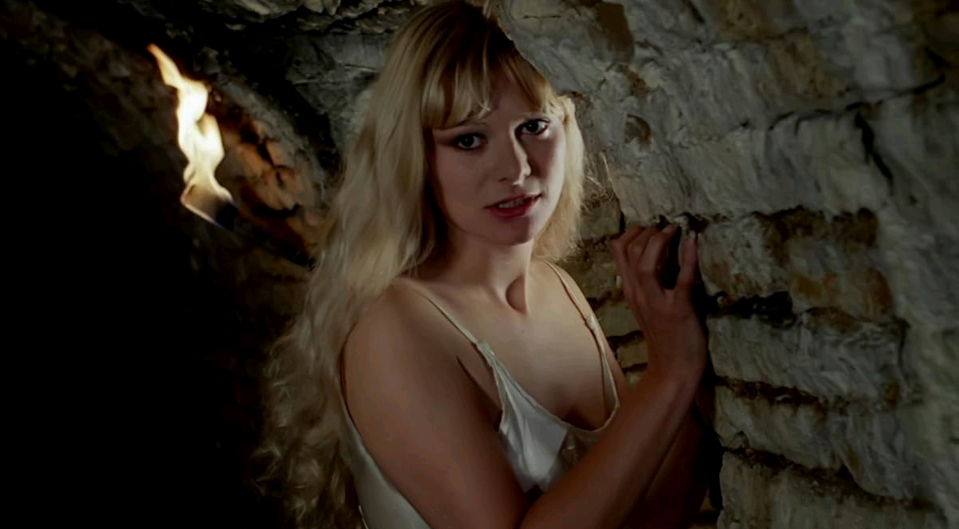
The Living Dead Girl opens with graverobbers breaking into a crypt to pilfer the graves and also dump some toxic waste, which spills when an earthquake hits, and a woman then being resurrected. That woman is Catherine Valmont (Françoise Blanchard), the titular Living Dead Girl.
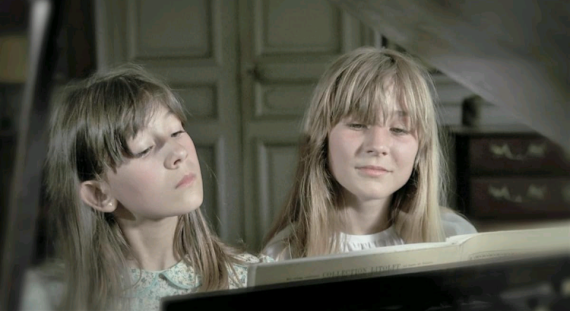
Catherine returns to her family home, a chateau, causing death along the way to fulfil her insatiable appetite for blood. Memories of her childhood, particularly a friend called Hélène (Marina Pierro) flood back. Hélène then finds her way to the house herself, finds Catherine, assumes she was missing rather than dead and helps her hide bodies, kill more people for blood and tries to get the now mute Catherine to speak again.
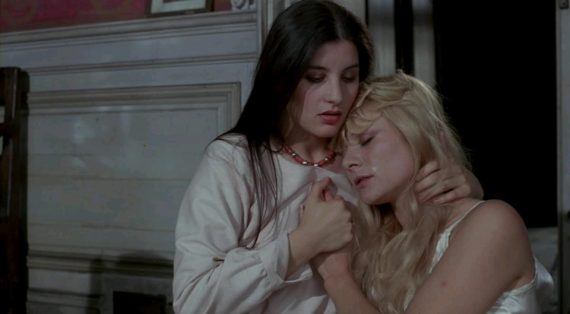
What follows is a story of love, strong friendship and bond between Catherine and Hélène, a quest to quench the former’s thirst for blood and a kind-of character study of a once dead woman, back alive and trying to survive but also remember who she was, and find her humanity again.
There’s also an interesting subplot in which an American couple, Barbara (Carina Barone) and Greg (Mike Marshall), capture a photo of Catherine walking in the woods in a very early scene, only to much later discover she’s meant to be dead and embarking on their own investigation into what on earth is happening.
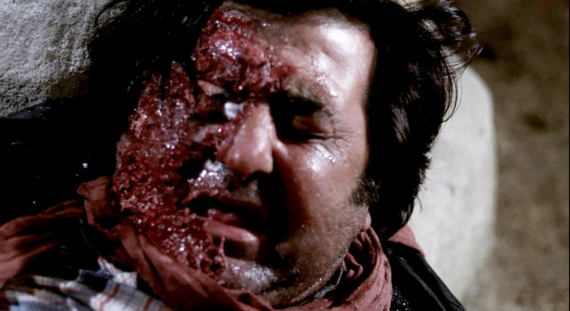
Out of the bat, The Living Dead Girl is arguably Rollin’s most graphic film. As Stephen Thrower points out on an extra feature included on the disc it’s a “Jean Rollin gore movie” with excellent special effects and graphic death sequences, the type that would become more prevalent during the 1980s, when this was made. Those special effects were created by the late great Benoît Lestang, who would later work on Brain Damage (1988), Baby Blood (1990), Brotherhood of the Wolf (2001) and whose final work would be on the French extremity classic Martyrs (2008). Those effects start with a graphic double eye gouging to one of the grave robbers and toxic waste melting half of the face of the other, with frequent gruesome death sequences ensuing.
The special effects are really grisly and well done in The Living Dead Girl and add to the incredibly visceral and graphic feel of the whole film, which is not only due to the gore but the graphic nudity and sex .
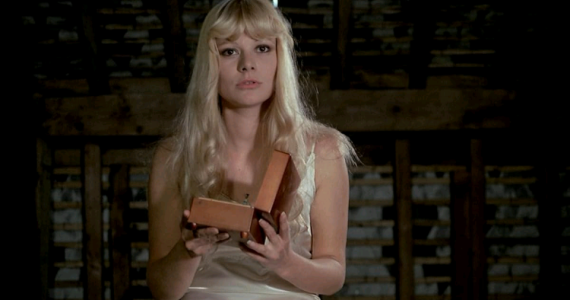
There’s also a fabulous sense of suspense. Several scenes really build up the tension like an early sex scene that plays out alongside Catherine exploring the house, her playing a key of a piano at a time, spooking the couple making love. The man leaves the room draped in a blanket and then returns, blood erupting from his neck, before Catherine enters the room and kills his lover in a similar way as she presumably killed the man. There is no music, save for the occasional notes on the piano that Catherine plays, and the scene is incredibly effective for it.
Other standout sequences include Catherine being reborn in the opening and taking out the two gravediggers in a deeply atmospheric crypt, a woman who Hélène has picked up being left alone and searching the house before ending up trapped in the vaults beneath and being killed by Catherine in a particularly graphic, zombie-genre-like way. Finally, we also have a incredibly powerful and devastating finale with a striking final shot.
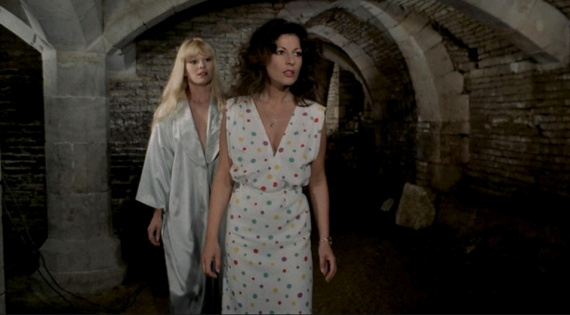
Yet aside from the horror sequences the best moments are reserved for friends Catherine and Hélène, whose relationship is the heart of the film. Hélène is grappling with helping her friend but also distraught at the growing number of corpses. Their moments together when Hélène tries to encourage Catherine to speak are particularly poignant.
As with all Rollin films, mood is key and that’s no different here, with the atmosphere building up throughout, thanks to all the components coming together from direction to music, acting to effects, production and costume design to use of locations. That music is by Philippe d’Aram and really ratchets up the tension from the outset with a use of drums. It’s an excellent score, by a composer I have a lot of time for.
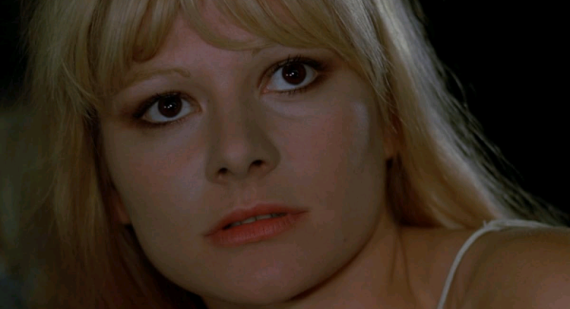
And then there’s the acting with special mention to quite remarkable performances by Marina Pierro as Hélène and, especially Françoise Blanchard as Catherine. The latter gives an incredibly moving, melancholy performance as a woman who was dead, but has now returned from the grave and has to survive whilst trying to find her humanity and who she once was. She’s almost animalistic in the murder sequences. Blanchard is quite outstanding in the role and gives the film a real emotional punch. She had been in quite a few films since debuting, but her standout role was in this one.
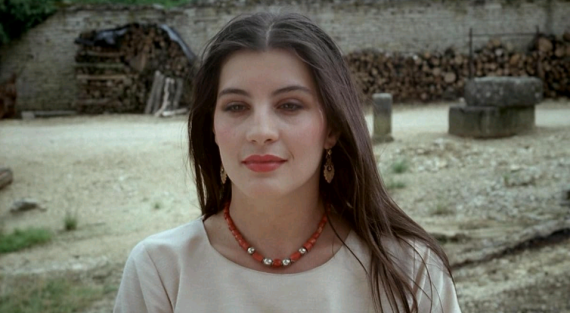
In closing, The Living Dead Girl is, for me, one of Rollin’s best films, and perhaps one that might convince his detractors of his quality as a director. Still dreamlike in quality and slow-paced, elements that may turn his detractors off, there’s more going on here on the surface than your average Rollin film and, for fans of 80s gore, really graphic use of effects to hold the attention. The story is very affecting, beautifully acted, and is a fabulous showcase for Rollin the director.
Film: 

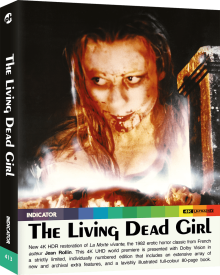
The Living Dead Girl is released in separate limited edition 4K UHD and Blu-ray editions on 27th April 2026. I reviewed the Blu-ray edition of my own personal copy, but also the picture on a 4K check-disc. The new 4K HDR restoration from the original negative by Powerhouse Films continues their trend of exceptional restorations. The film looks simply astonishing with incredibly fine detail, a beautiful but natural colour scheme and the print completely cleaned up. Powerhouse Films’ restorations are superlative and a sign of high quality and this continues that welcome trend. The original French audio also sounds great.
Indicator limited edition 4K UHD special features:
Brand-new 4K HDR restoration from the original negative by Powerhouse Films
4K (2160p) UHD presentation in Dolby Vision (HDR10 compatible)
Original French mono soundtrack
Audio commentary with director Jean Rollin (2003)
Audio commentary with film historians Kevin Lyons and Jonathan Rigby (2026)
Selected scenes audio commentary with actor Françoise Blanchard (2005)
Introduction by Françoise Blanchard (2005)
Jean Rollin Introduces ‘The Living Dead Girl’ (1998)
New edit of a 2005 interview with Rollin (2026)
Jean Rollin on ‘The Living Dead Girl’ (2007): the director in conversation at Montreal’s Fantasia Film Festival
New edit of a 2005 interview with actor Françoise Blanchard (2026)
An Interview with Jean-Pierre Bouyxou (2026): new edit of a 2012 interview with the regular Rollin collaborator
New edit of a 2005 archival interview with Jean-Pierre Bouyxou (2026)
Benoît Lestang, 17 ans (2026): new edit of a 2012 documentary featuring interviews with the young special-effects artist and Bouyxou
Music by Philippe D’Aram (2026): new edit of a 2012 interview with the composer
New edit of a 2005 interview with D’Aram (2026)
Dead or Alive (2026): updated documentary on the now-lost English-language American cut of The Living Dead Girl
Jean Rollin at Fantasia (2007): expansive documentary recording of Rollin’s time as a special guest at the festival
Alternative scenes
Original theatrical trailer
Image gallery: promotional and publicity material, and behind the scenes
New and improved English translation subtitles
Limited edition exclusive 80-page book with a new essay by Will Sloan, archival writing by Jean Rollin on the making of the film, an archival interview with the director by Peter Blumenstock, an extract from the film’s pressbook, and full film credits
World premiere on 4K UHD
Limited edition of 10,000 individually numbered units (6,000 4K UHDs and 4,000 Blu-rays) for the UK and US
Firstly, we have three options for watching the film one with and one without a Françoise Blanchard intro, and Scare, the German-language version of the film, which is sourced from a VHS with an alternative score, and is a welcome curio.
The foreword by Blanchard runs for 30 seconds and is a nice inclusion that explains there will be lots of blood. She’s not wrong!
An audio commentaries section contains three commentaries, the first being with director Rollin. The late director was always a great interviewee and this carries over to a really entertaining commentary, where Rollin shares a treasure trove of background to the film and its making of, with some wonderful anecdotes along the way.
The first new extra is, like the other completely new extra, for me the best, though that’s not detracting from the wealth of archival content which is also pretty much all first class, some of which has been updated in 2026. In fact, this is a remarkable collection of high-quality content. This commentary features Kevin Lyons and Jonathan Rigby, who if you’ve heard commentaries with them before, you’ll know are great value for money. The pair highlight all of the qualities of the film and what makes it so astonishing and provide an encyclopaedia of knowledge about the film and those involved. First class!
Actor Françoise Blanchard provides a selected scenes audio commentary which runs for 26 minutes, highlighting the make-up and how Rollin doesn’t always use real actors, such as the producer’s wife who is in one of the coffins in the opening, and the graverobbers-cum-toxic waste spillers. It’s another gold mine of information about the making of the film.
Next, we have a section on Rollin, with an introduction, interviews and documentary. First, Rollin’s archival introduction runs for two minutes, with the director referencing the effects crew and the film’s release in Europe. Brief but neat.
This is followed by Jean Rollin: Blood Ties, a 12-minute archival interview with the director who talks about trying to make something different to the vampire films he was known for. He talks about the resurrection sequence, the first killing sequence and much more in a fun interview.
Next, we have Jean Rollin on The Living Dead Girl which runs for just under three minutes. He references the importance of Romero’s The Night of the Living Dead and the inception of The Living Dead Girl. Brief but welcome.
Jean Rollin at Fantasia is a 37-minute interview from 2007 when Rollin attended the acclaimed Montreal Fantasia Film Festival. It features footage of Rollin meeting fans and doing signings. It was the first time he attended the festival and he’s also interviewed about a couple of his films, including Shiver of the Vampire, which screened at the festival. Also included is footage from that aforementioned film’s screening and the intro and Q&A he did, with Rollin attending as a celebration of his career. This is a welcome inclusion.
Souvenirs de La Morte Vivante is a 15-minute documentary on the making of the film by Rollin’s personal assistant Daniel Gouyette, featuring interviews with Rollin associates Jean-Pierre Bouyxou and Alain Petit. There are some great recollections included here about the conception of the film, its production and of the interviewees’ collaborations with Rollin.
Next, we have a cast and crew section which includes three interviews, the first being one with actress Blanchard, who talks for around 19-minutes about the role, and how she had earlier got into acting, with her spotted whilst she modelled. Her archival interview is very personal, sharing elements of her life at the time, as well as discussing the role, preparing for it, making the film and its impact on her career. Blanchard’s comments on Rollin’s approach to dialogue, are particularly illuminating. It’s a really strong archival interview.
Actor Jean-Pierre Bouyxou, who appears as one of the graverobbers, is up next with a 25-minute interview on Rollin, director Jess Franco and Eurociné, the independent French production company. This is a wonderful archival interview which sees Bouyxou take us back to the beginning of his love for cinema, how he met Rollin and got into film, working with the director Jess Franco and his thoughts on European cinema. It’s excellent.
Composer Philippe d’Aram provides a 17-minute archival interview which follows a similar format to the previous one, covering his interest in music, how he became a composer and how he came to work with Rollin. His scores are marvellous and it’s a pleasure to hear him discuss his career.
La Musique de La Morte vivante is another wonderful piece with d’Aram revisiting his score for the film. Highlights of the 15-minute interview include a detailed look at the background to and delivery of the score, including the inspirations for it and what he was looking to achieve, as well as details on some of the instruments he used for the film’s compositions. It’s another great interview with d’Aram.
Benoît Lestang, 17 ans is, like some of the other archival pieces, a new edit of an archival documentary, this time featuring interviews with the then young, and sadly no longer with us, special-effects artist Benoît Lestang, as well as Petit and Bouyxou. The 24-minute piece is another really good one, covering how the effects were achieved with the limited budget.
Dead or Alive is another archival documentary, this time running for 16-minutes which focuses on the now lost English-language American version of the film. It’s a really interesting piece which talks about a film that wouldn’t have just been a dubbed version of the original version, but a new piece with the dialogue sequences shot afresh by director Gregory Heller. It’s a really insightful interview.
Two minutes of English language outtakes then follow, essentially two scenes. This is a great inclusion.
The appreciation by Stephen Thrower is the second standout extra of this release. Running for 34-minutes, it is simply brilliant. Thrower is a huge fan of Rollin and places the film not only in the context of Rollin’s filmography, but also the more graphic 1980s films that were pervading at the time, with much more violence than had previously made it to the big screen. Thrower covers loads of ground in his usually authoritative and entertaining style.
The theatrical trailer runs for just over three minutes and focuses on the blood and nudity whilst suggesting this will also be a mood piece.
An image galleries section contains two galleries, an original promotional material one that contains around 75 images including some real gems like VHS cover art, and a behind the scenes one, containing around 20 candid images.
The booklet is another phenomenal one from Indicator, lovingly produced, lavishly illustrated and filled with fantastic new and archival material. Headlined by a fantastic new essay by writer and critic Will Sloan, it also contains a great 2005 piece by Rollin on the making of the film, an exhaustive 1996 interview with the director conducted by Peter Blumenstock and the original French pressbook.
I’ve said it before and I’ll say it again, the Indicator releases of Jean Rollin films are perfectly and lovingly created and a high benchmark for boutique labels showing how to release a gold standard series of films by specific directors.
Their release of The Living Dead Girl is no exception. The audio-visual presentation is outstanding with another gorgeous 4K restoration by Powerhouse Films.
The limited edition contains a wealth of fantastic new and archival extras, including plenty with Rollin and members of the cast and crew for the film. Best of all are a new audio commentary by Kevin Lyons and Jonathan Rigby and a 30+ minute interview with Stephen Thrower. Both of these new extras are outstanding, but the archival extras, many updated as 2026 edits, are also of exceptional quality.
Disc/Package: