


 Director: John Badham
Screenplay: Dan O’Bannon and Don Jakoby
Starring: Roy Scheider, Warren Oates, Candy Clark, Daniel Stern, Malcolm McDowell, Paul Roebling, David Sheiner, Joe Santos, Jason Bernard
Country: USA
Running Time: 109 min
Year: 1983
Director John Badham was born in Luton, England, before becoming an American citizen in 1950, aged around 11, after his mother and US Army stepfather moved to the United States. Fast forward 30 years and Badham would be a successful director, helming the likes of Saturday Night Fever (1977), Dracula (1979) and four stalwarts of my childhood, WarGames (1983), Short Circuit (1986), Stakeout (1987) and Bird on a Wire (1990).
One of Badham’s best films, but one that’s perhaps less well-remembered than some of his other movies, is Blue Thunder (1983); a high-tech action thriller starring not only a glittering cast but a souped-up and iconic helicopter too, which was successful enough to spark an 11-episode spin-off TV series in 1984.

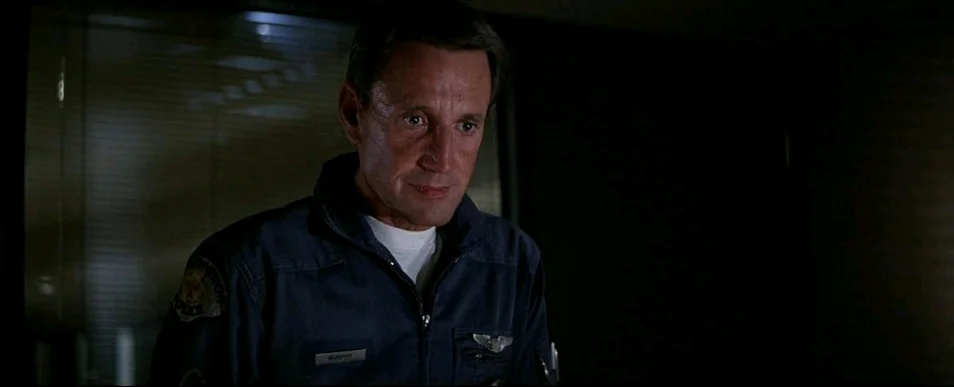
The film opens by introducing us to police air support division pilot Frank Murphy (Roy Scheider) who patrols the air above LA to give assistance to ground police officers with his observer, a rookie called Richard Lymangood (Daniel Stern).
The pair though decide to spy on a woman doing nude yoga – meaning they’re not providing necessary air support during a mugging that leads to the death of city councilwoman Diana McNeely (Robin Braxton) – and are suspended for two weeks.
Murphy isn’t suspended for long, though, and is also selected to pilot an advanced helicopter, the Blue Thunder of the title, which is due to be used for surveillance against possible terrorism or public disorder during the 1984 Summer Olympics in LA.

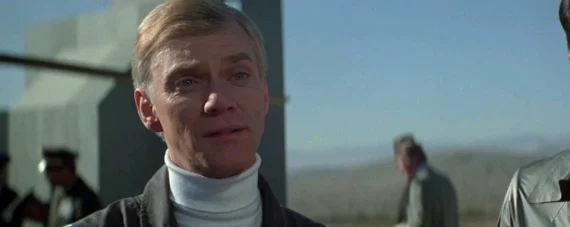
Before too long we discover that the councilwoman’s death isn’t just a random murder, leading to Murphy and Lymangood to investigate. They discover that a dangerous group intends to use Blue Thunder to stop urban disorder and is killing opponents of their plans. Murphy soon discovers that former US Army Colonel F.E. Cochrane (Malcolm McDowell), now a test pilot for Blue Thunder and who doesn’t support Murphy being involved in the programme, is involved.
Murphy and Lymangood are caught red-handed recording the audio of a meeting they have stumbled on and are watching through infrared on Blue Thunder, involving Cochrane and other members of the group where their scheme is revealed. The recording becomes a key part of the plot for the remainder of the film.

The script for Blue Thunder was written by Dan O’Bannon, best known for writing Alien (1979), alongside Don Jakoby, and was originally an apparently more political attack on the concept of a police state controlling people. The script was rewritten by Dean Riesner with input from director John Badham. Whilst it’s certainly no longer an attack on a police state, it retains the sense of paranoia and conspiracy theories and also creates a sense of concern in the audience at the level of surveillance possible.
This is cemented from some text that opens the film, stating that the hardware and tech used in the film is real and was in use in the US at the time it was made, playing into the fear of surveillance and tech paranoia that is an undercurrent throughout the film.

That paranoia filters through to the audience telling us we’re always being watched, and when we least expect it. The gear and tech used in the film has clearly come on leaps and bounds since the early 1980s, but even back when this was made the level of surveillance possible was startling.
Despite the negative connotations of the tech, it is a joy to see the Blue Thunder helicopter in action. It is a wonderful piece of production design which looks sleek and cool and contains a wealth of tech and special features, including a silent flying mode, bulletproof armour, powerful weaponry, thermal infrared scanners and microphones and cameras.
The film has also got a cracking cast headlined by Roy Scheider, who plays the cool swagger and driven elements of his character, Frank, well. He’s also dealing with trauma, following a disastrous former mission in Vietnam in which a fellow Armed Forces member plummets to his death from the helicopter Frank is piloting. This devastating moment in Frank’s past haunts him throughout the film and creates an extra layer to his character, which is sensitively portrayed by Scheider.

Malcolm McDowell plays villain Cochrane. McDowell had an intense real-life fear of flying, which he discusses in one of the extras, which add a new layer to his grimaces in the finale. It looks like he’s truly scared. Before then he is a sinister menace, whom we rightly don’t trust from his first scene.
Candy Clark gives good value for money as Frank’s girlfriend Kate, although it’s a small role all things considered until she comes into her own in a car chase sequence which saw the actor doing a lot of the actual driving. It’s also poignant seeing the great Warren Oates as Frank’s boss, in one of his final roles before he sadly passed away.

Future Home Alone (1990) burglar Daniel Stern Alps pops up as Richard, a rookie pilot more interested in spying on women doing nude yoga than finding criminals, in that aforementioned scene that leads to the pair being suspended, triggering the main thrust of the plot.
The cinematography, particularly the aerial footage – both the surveillance from the helicopter and the flying sequences – is stunning. Filmed in Los Angeles, the city is used to great effect, particularly at night with the building lights shining and creating a futuristic look.
And then, this essentially being an action movie particularly in the second half, there is the action, which the film really delivers on. The titular helicopter packs some serious fire power and looks very cool, leading to some cracking aerial chases and action sequences. The first viewing of the helicopter when its capabilities are shown is strong with other excellent sequences along the way building up to a really tense and thrilling finale involving Blue Thunder and other helicopters and military planes.
Finally, there’s a pretty decent synth-heavy score by Arthur Rubinstein, a frequent collaborator with director Badham, that is at its best in the action sequences and has a rousing theme tune. Tangerine Dream were originally earmarked to do the score.
Given how tech has progressed and the use of drones in military warfare, it feels the perfect time to reevaluate and revisit Blue Thunder. I found it to be an enjoyable watch which features some good performances and thrilling aerial chases, all of which builds up to a rousing conclusion. It’s not perfect by any means and feels dated in some elements, but overall it’s a good night’s entertainment.
Film: 


Blue Thunder was released by Arrow Video on limited edition region free 4K UHD in the United States on 5th May 2026. The 4K transfer looks really good, plenty of detail, no blemishes and a very natural filmic quality thanks to a restoration from the original negative. The audio is also fabulous, the dialogue easy to hear and the sound effects and score really popping.
4K Ultra HD Blu-ray limited edition contents:
4K restoration from the original negative
4K (2160p) UHD Blu-ray presentation in Dolby Vision (HDR10 compatible)
Original restored lossless 2.0 stereo audio
Optional DTS-HD MA 5.1 remix
Optional English subtitles for the deaf and hard of hearing
Archival audio commentary by director John Badham, editor Frank Morriss, and motion control supervisor Hoyt Yeatman
Flight Risk, a brand new interview with director John Badham
A Rollercoaster Ride, a brand new interview with actor Candy Clark
Catching Up, a brand new interview with actor Malcolm McDowell
Ride with the Angels: Making Blue Thunder, an archival three-part documentary from 2006
The Special: Building Blue Thunder, an archival featurette from 2006 on the design and construction of the iconic helicopter
Archival 1983 promotion featurette
Extended scene
Theatrical trailer
Image gallery
Reversible sleeve featuring original and newly commissioned artwork by Chris Skinner
Collectors’ booklet featuring new writing on the film by Dennis Capicik and original production notes
The archival audio commentary by director John Badham, editor Frank Morriss, and motion control supervisor Hoyt Yeatman is from 2006 and is very good. It’s a good scene-specific commentary which provides a wealth of background to how the film was made, effects sequences and plenty more. It’s almost like an additional ‘making of’ documentary.
Next, we get three new interviews. First is one with director John Badham which runs for 14 minutes. He’s on great form and clearly enjoyed filming the movie and in LA, with a personal anecdote about filming near his home one of the highlights. He shares his thoughts on some of the actors and more in a good interview.
This is followed by a new 13-minute interview with actor Candy Clark, who talks about her role and other actors in the film, how the movie was quite forward looking in terms of how tech and surveillance would advance and clearly also had a great time filming it. Clark shares that she did a number of the driving stunts, with some fun recollections. Another good new interview.
The third new interview is with actor Malcolm McDowell and runs for 14 minutes. He also speaks fondly of the production with lots of positive things to say about the film and those involved, particularly Stern and Oates. This closes our three wonderful new interviews.
A 2006 ‘making of’ can be played as one 45-minute documentary or in three parts – one for Pre-Production, one for Production and a final Post-Production section. The documentary covers plenty of ground and provides lots of good background on those involved, the concepts of the film and the production and release of it.
A 2006 featurette on the titular helicopter is great fun with some good background on the conception and look of the chopper. It runs for around eight minutes and provides some insight into the research that took place to conceive the helicopter.
A 1983 promotional featurette runs for eight minutes and does what you would expect for a promotional piece, selling the film, though it does give some insight into the tech and paranoia elements.
An extended scene from a version released theatrically outside the US and also on VHS and Laserdisc is included. It is a longer sequence of a section of the car chase involving Kate. It runs for 90 seconds and looks to have been sourced from video. It’s an interesting curio and a nice inclusion.
Closing out the on-disc extras is a 90-second theatrical trailer and an image gallery containing around 15 promotional shots and stills.
The booklet is 36 pages long and is a typically excellent one from Arrow, beautifully appointed and illustrated. It contains a brilliant essay by writer Dennis Capiciki looking at the film and rise of tech in 1980s action films. Also included are the original production notes. Text is small which means there’s a load of great information and insight in the booklet.
In conclusion, Arrow have provided a fantastic presentation for fans of the film Blue Thunder. The film itself remains a very entertaining and at times thrilling action film which features themes that very much resonate in 2026. The transfer is strong and the audio-visual presentation is very good overall. Arrow have provided three excellent new interviews, as well as a range of archival material, which includes an ace commentary and 45-minute retrospective documentary. It’s a fine package for a generally fine film.
Disc/Package: