


 Director: Jean Rollin
Story: Jean-Pierre Bouyxou, Jean Rollin
Screenplay: Jean Rollin, Christian Meunier
Starring: Marie-Georges Pascal, Félix Marten, Serge Marquand, Mirella Rancelot, Patrice Valota, Patricia Cartier, Michel Herval, Paul Bisciglia, Brigitte Lahaie
Country: France
Running Time: 85 min
Year: 1978
BBFC Certificate: 18
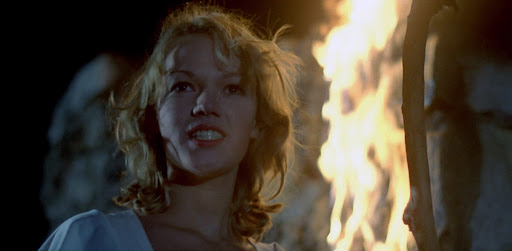
Elisabeth, a young woman travelling to meet her boyfriend in a remote rural vineyard is plunged into a nightmare when she is attacked by a seemingly infected man on a train. Escaping to a local village, Elisabeth meets a young blind girl, Lucie, and together they work to survive the night as the infected residents of the village, driven crazy by a mysterious virus, hunt them down…
I find the films of Jean Rollin fascinating. After discovering his work on Arrow’s streaming service a couple of years ago in a season focussing on the cult French director, I watched the likes of Fascination, Demoniacs, Requiem for a Vampire and, possibly my favourite, Grapes of Death. Also known to direct hardcore adult films to help fund his more avant-garde output, Rollin worked predominantly in the horror and thriller genres. But instead of some of the more extreme gore of 70’s and 80’s European horror, Rollin’s films tended to the surreal, from Fascination’s almost empty country house to the fog swept beaches of Demoniacs. Grapes of Death is perhaps his most mainstream film, but it still brings that surrealist, at times soporific edge to its narrative and visuals.
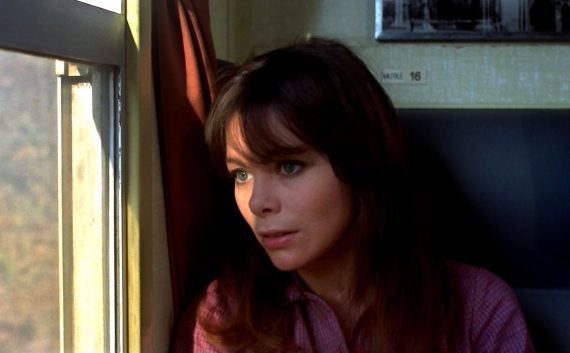
There is a persistent feeling of unease from the opening as we follow a group of young men spreading pesticide on the crops of a vineyard only to immediately get the sense of something very wrong as one of these men begins to show symptoms of some kind. When he turns up later in a train carriage with our protagonist, Elisabeth, Rollin shows a hand which bucks a trend of his previous films – Grapes of Death features some of the more popular gore effects that the director had previously shied away from.
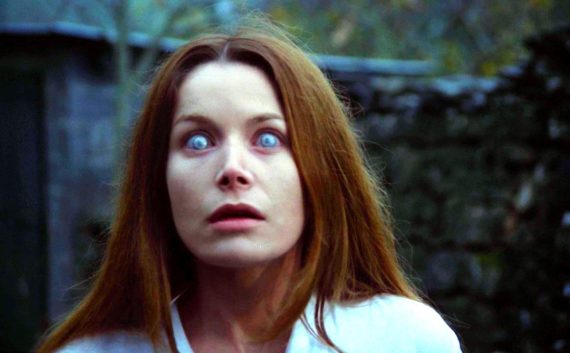
The gore on display here is, from these early scenes, disgustingly pus filled and very effective in its ability to unsettle. That early scene with the man on the train, a scabrous build up on his face gradually expanding to the point where it bursts in a splash of red and yellows is disgusting and sets the scene of what to expect from the rest of the film. Despite being made to clearly cash in on the zombie movie craze, particularly Romero’s Night of the Living Dead, Grapes of Death feels like an entirely different beast, swapping the isolated house location out for a dilapidated village full of infected. To that end, the rage virus that Rollin employs instead of straight up animated corpses also echoes Romero’s The Crazies, while also providing the start of a trail leading to the likes of 28 Days Later and The Sadness, with the more rural setting also evoking a folk horror vibe. Add to that the infected being aware of their condition and despairing despite being unable to do anything about it, asking for death while committing atrocities, and you have a fascinatingly bleak take on the infected/zombie subgenre.
Relying mostly on a sense of atmosphere to drive the story rather than outright violence, much of the initial chaos remains unseen by the audience as Elisabeth and Lucie happen upon the village following the start of the breakout. Corpses and burning buildings provide an almost apocalyptic setting and a sense of danger and peril all around, making the sudden bursts of visual violence even more savage and visceral. Rollin mentions in the special features that the special effects supervisor Alfredo Fieri was brought in from Italy, something very apparent in the film as the gore on display is very similar to Italian productions. The special features also explain that Rollin wasn’t a fan of extreme gore in films and so tried to make these sequences in Grapes of Death more theatrical, tapping into his love of grand Guignol theatre, something that becomes very apparent in the central scene of Lucie’s fate, a sequence which comes out of nowhere and is absolutely shocking in its violence.
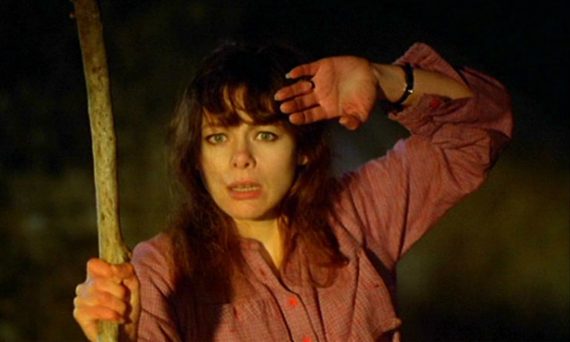
Grapes of Death is also a gorgeous film to look at, made even more so in this new transfer which is far more vivid and detailed than the previously available release from Redemption. The October setting provides some gorgeous autumnal visuals full of browns and oranges with a hint of green, a world in a natural state of decay that mirrors the decay our characters go through as part of the narrative. These sumptuous visuals put Rollin high among his Eurohorror peers, displaying a visual flair akin to the likes of Argento, Fulci and Bava, but with a distinctly Gallic flavour.
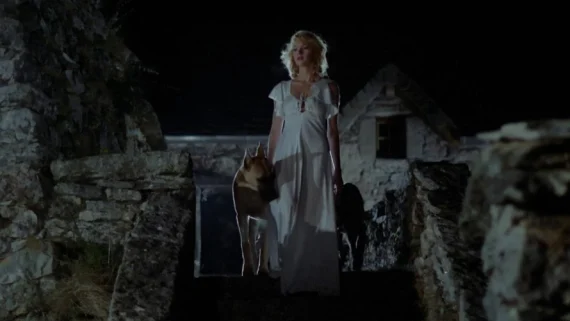
The central performances are on the whole great with Marie-Georges Pascal giving a great showing in the central role of Elisabeth, a woman who finds herself trapped in a nightmare. In a narrative that feels almost like it’s split into interconnected vignettes, Pascal is the one constant driving through all these sections. Standout, however, is the stunning Bridgette Lahaie, credited simply as “The Tall Blonde Woman”, who shows up in the third act to give a captivatingly unhinged performance.
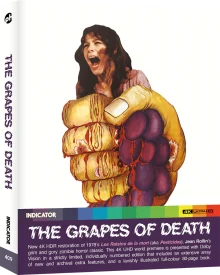
Grapes of Death is a dark and often bleak film right up to its final frame, but is easily Jean Rollin’s most accessible and mainstream piece. While it does arguably meander a little at times, and does perhaps move the story along in a rather linear fashion, it is still highly compelling. This new release from Indicator is a fascinating showing for a horror film which blends subgenres in a hypnotic way and is a highly recommended purchase for anyone curious in the directors output, as well as anyone wanting to explore different corners of 1970’s Eurohorror.
Bonus Features
- New 4K HDR restoration from the original negative by Powerhouse Films
- 4K (2160p) UHD presentation in Dolby Vision (HDR10 compatible)
- Original mono audio
- Audio commentary with Sylvia Kristel: From ‘Emmanuelle’ to Chabrol author Jeremy Richey (2026)
- Jean Rollin Introduces ‘The Grapes of Death’ (1998)
- In Vino Veritas (2026): documentary on the making of The Grapes of Death by Rollin’s personal assistant, Daniel Gouyette, featuring a new interview with co-writer Jean-Pierre Bouyxou, and contributions from writer/director Jean Rollin, actor Brigitte Lahaie, and key collaborator Natalie Perrey
- New presentation of a 2002 interview with Rollin and Lahaie (2026)
- Bloody Lips and Iron Roses (2001, 37 min): career-spanning German documentary about Rollin
- Interview with Jean Rollin (2007, 50 mins): the director in conversation at Montreal’s Fantasia Film Festival
- Critical appreciation by author and film historian Stephen Thrower (2026)
- Original French and German theatrical trailers
- Image gallery: promotional and publicity material, and behind the scenes
- New and improved English translation subtitles
- Limited edition exclusive 80-page book with a new essay by Elizabeth Purchell, an archival introduction by Jean Rollin, an archival interview with Brigitte Lahaie, an archival essay by Paul Hegarty, an extract from the film’s pressbook, and full film credits
Unfortunately we didn’t get a chance to look at the UHD release of Grapes of Death, but if the quality of the Blu-Ray release is anything to go by, the 4K version should be an absolute treat. Audio and visuals are crisp and bright and the image is incredibly clean. As previously mentioned, the extras on offer here are incredibly informative and interesting, particularly those featuring the director himself. Rollin is a bright and jolly individual, enthusiastic about the film he’s made yet never shying away from it perhaps not being his personal favourite of his output, a film made as a director and writer for hire yet one he could still put his own personal stamp on. Add to that a comprehensive companion book and this is a fantastic set that’s not to be missed.