


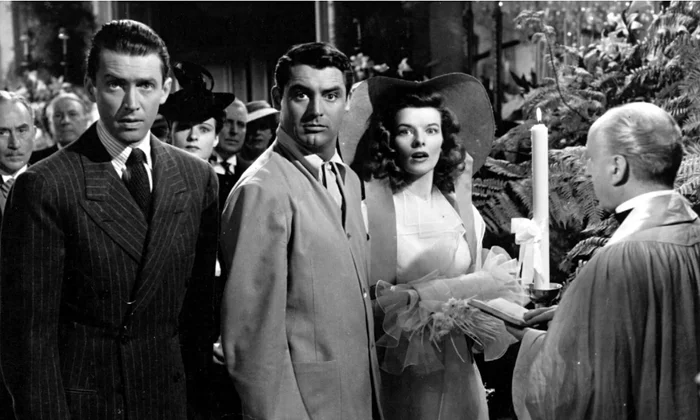
Working my way through the filmographies of the Golden Age Hollywood directors, I was excited to get to George Cukor because, as well as the many classics that I’d already seen, there were so many lesser-known works to get into. As expected with a director as prolific as Cukor, there were hidden gems to discover but also many weaker films that didn’t quite work. Once we get to part two and the top 20 of this list, things get really good but part one features mostly films that fell a bit short for me or are a combination of highs and lows. It’s still been fascinating to get to know Cukor’s filmography in full and discover his distinctive overarching style.
WHAT’S HERE AND WHAT’S NOT: Cukor was a director who often got brought in to replace directors when they had to be removed from films for one reason or another. Cukor himself was also removed from several films, most famously Gone with the Wind. The result of this is that his filmography is littered with films for which he directed varying-sized chunks but not the whole thing. I have decided to only include those films for which Cukor received onscreen credit as director, which means films like One Hour with You (for which he was credited as “Dialogue Director”) and Song Without End have been omitted. Having watched Cukor’s two late-era TV movies Love Among the Ruins and The Corn is Green, I’ve decided they don’t quite belong here amongst his theatrical works so they have also not been included.
ALL ENTRIES CONTAIN SPOILERS
48. JUSTINE
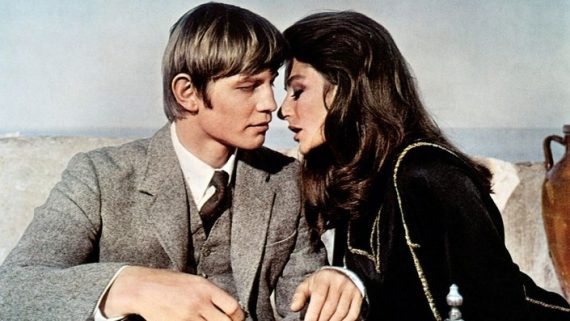
Lawrence Durrell’s novel Justine, the first part of a literary tetralogy known as The Alexandria Quartet, was long considered unfilmable and, when they finally got round to attempting it in 1969, the results made audiences wish they’d just listened to these claims. I’m not the best person to speak of Justine’s effectiveness as an adaptation since I’ve never read the book, but I can tell you that as a standalone film it bored my to tears for almost its entire runtime. Despite a good cast including Dirk Bogarde, Michael York, Robert Forster and Anna Karina, Justine is at once stuffy and confusing, sharing much in common with similarly dull foreign-set tales of the era that foreground their attractive scenery in lieu of an engaging or decipherable plot. This was one of those films in which George Cukor was brought in to replace another director, in this case Joseph Strick, and unlike with several other films in with this was the case, Cukor is given screen credit as the sole director. Unfortunately the flash of hope that comes with that credit is immediately extinguished by muddy storytelling and plodding direction that suggests Cukor phoned this one in. Justine came immediately after Cukor’s only Best Director Oscar win for My Fair Lady, a huge hit that quickly proved to be a blip on a career that had been going downhill since the mid-50s. Justine remains the nadir of the Cukor canon.
47. THE ROYAL FAMILY OF BROADWAY
The Royal Family of Broadway was the first of George Cukor’s films to receive major recognition, with an Academy Award nomination for Frederic March. Adapted from the popular 1927 play The Royal Family which satirised the American acting dynasty the Barrymores, Cukor’s film (co-directed with Cyril Gardner) features a screenplay by Gertrude Purcell (Destry Rides Again) and Herman Mankiewicz (Citizen Kane). Alas, from such promising origins springs forth a woefully dated film in which I struggled to find much in the way of entertainment value.
The reference point of the Barrymores, while once widely recognisable, has since become comparatively obscure. Even being fairly familiar with the film work of the Barrymores, the fact that the tempestuous excesses of their personal lives are the stuff of long forgotten headlines significantly dims the film’s impish wit. Accepting the limitations of the era, Cukor and Gardner seem largely content to recreate the static feel of the stage play, letting the actors and the screenplay do the heavy lifting. There is one exception, the scene in which March makes his first entrance as Tony Cavendish, the John Barrymore surrogate. March’s larger-than-life arrival simply cannot be contained by a stationary camera so, in an era before crane shots, Cukor and Gardner mounted the camera on a forklift and had twenty strong men push it, allowing it to follow March up the stairs and into the bathroom as he undresses along the way. It’s a notable highlight but if anything this burst of technical ingenuity only exacerbates the detrimental ordinariness of what’s around it.
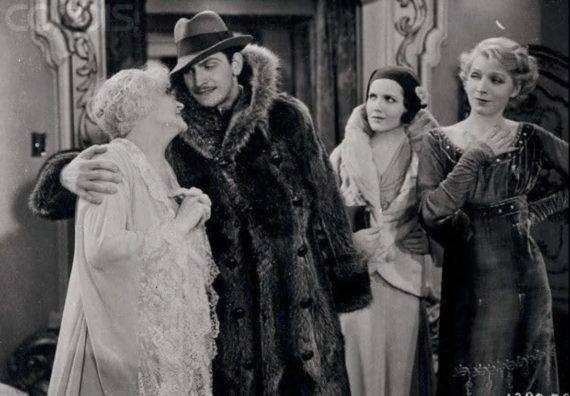
At this stage I should note that The Royal Family of Broadway has not been remastered and the version that exists, while perfectly watchable, could really benefit from an overhaul in both picture and sound. That latter point is key considering the verbosity of the screenplay. Even through the soupy melange, it’s still possible to glimpse some value in several performances, notably Ina Claire as the conflicted Julie Cavendish and March, whose effusive turn borders on irritating but also undoubtedly enlivens what can otherwise be a very dry experience. In an irony more amusing than anything in the film itself, March lost the Best Actor Oscar to Lionel Barrymore for his aptly hammy performance in A Free Soul.
46. GRUMPY
While watching George Cukor’s directorial debut Grumpy in a ropey but surprisingly intelligible version on YouTube, one line of inaudible dialogue was translated by the automatic subtitles as “I never saw a lot of fiddling face balls.” Regrettably, it was the one time l laughed out loud at this supposed comedy.
Cukor shared his director credit for Grumpy with Cyril Gardner, a French-born American actor and editor with whom Cukor would also co-direct The Royal Family of Broadway. Gardner’s career never soared to the heights of Cukor’s, although on the evidence of Grumpy you’d be surprised to note that either man achieved stardom. To be fair, I’m being too harsh on Grumpy which is, after all, fairly typical of films based on stage plays produced during the awkward transition between the silent and sound eras. Grumpy had been brought to the screen once before in 1923 as a silent film directed by William C. deMille, the older brother of Cecil. Cukor and Gardner’s version of Grumpy had two things over deMille’s: they could include spoken dialogue and they had Cyril Maude, the man who popularised the titular role on stage, as their leading man. While it’s easy to see from his scenery-chewing approximation of a curmudgeonly old buffer how Maude would have been a crowdpleaser to a live audience, it’s hardly surprising to learn that his subsequent screen career pretty much went the same way as Gardner’s. Maude only appeared in six more films, usually much further down the cast list, until his final appearance in Anthony Asquith’s While the Sun Shines seventeen years later was in the unnamed role of Old Admiral. Grumpy was assuredly Maude’s most famous role and he makes the most of the opportunity to bring it to the screen. If his sometimes interminable dominance is to the detriment of his supporting players, that is, in all fairness, what Doris Anderson’s screenplay requires and what the audience of the age wanted.
It isn’t that Maude is bad in the role of Grumpy, the retired lawyer who gets drawn into a mild caper involving a missing diamond. His geriatric rambling and affectedly faltering delivery is sometimes so unique as to appear improvised. It’s clear that Grumpy wasn’t an opportunity for Cukor to make a name for himself and as a respected theatre director, he surely understood that his job on Grumpy was largely to get out of Maude’s way. The problem with such an obvious vehicle for a single performer is that the supporting roles are so blandly written and thus forgettably performed, meaning that the plot is barely of interest and the idiosyncrasies of the central performance become all that there is to carry the viewer through. This may not have been the case in 1930, when sound was still a novelty and the majority of films had a similarly awkward aesthetic. But to most modern viewers, Grumpy will feel like a very long 74 minutes indeed.
45. THE BLUE BIRD
By the time he made The Blue Bird, George Cukor was having more success in television than in movie theatres. He’d just come off the multiple Emmy-award winning TV movie Love Among the Ruins and his next feature would be another made-for-TV production, The Corn is Green which, like Love Among the Ruins, starred Cukor’s long-term friend and collaborator Katharine Hepburn. Between these two acclaimed telefilms came the most notorious flop of Cukor’s career, the US/Soviet Union joint venture The Blue Bird, an adaptation of Maurice Maeterlinck’s classic play that was designed to ease Cold War tensions. The film wasn’t short on money or star power, with a $12 million budget and a cast including Elizabeth Taylor, Jane Fonda and Ava Gardner. Working conditions in the Soviet Union were abysmal however, with the non-Russian cast struggling to cope with the harsh weather and primitive facilities. Taylor contracted amoebic dysentery, while Cukor struggled to communicate with the Russian crew members, employing an ineffective form of sign language in lieu of any spoken Russian. Whether the strangeness of the finished product was a result of these setbacks or just a general cultural mismatch is unclear but The Blue Bird is a film for which you’ll struggle to find any positive feedback.
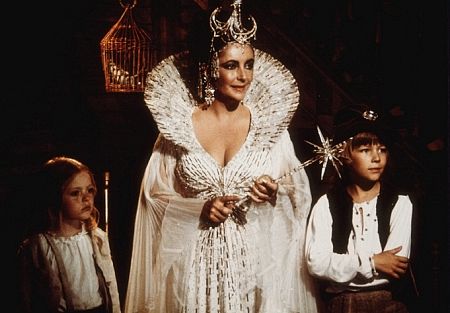
In truth, The Blue Bird isn’t as irredeemably abysmal as you might have heard. It is terribly dull but that might be partially due to its child-centric focus which gives adults very little to grab onto. If the viewer is prepared for what they are about to see, they will likely judge the film as an underachieving children’s fantasy rather than a cinematic abomination. While The Blue Bird was not one of Cukor’s TV movies, it has a similarly cheap aesthetic, instantly evoking the primitive, dowdy look and accidental creepiness of many 70s kids shows. It feels like one of those televised pantomimes you stumble upon while flipping channels at Christmas time. The cast is surprisingly recognisable, with the aforementioned Hollywood stars joined by many famous British names such as George Cole, Richard Pearson, Mona Washbourne, Harry Andrews and, in a very early role, an eight year old Patsy Kensit. But this star spotting can only carry the viewer so far and almost everyone’s performance seems tinged with embarrassment.
The Blue Bird is the sort of peculiar late-era film in a director’s filmography that signals the beginning of a career wind-down. In fact, for most directors this bluebird of unhappiness might have been a career-ender after it crashed and burned at the box office. Fortunately Cukor had enough heft to continue, making one more TV movie and one more theatrical release before his death in 1983.
44. TARNISHED LADY
During the Pre-Code era there were a lot of films about morally compromised women whose supposedly scandalous actions seem completely inconsequential to modern audiences. This is no reason to throw these films out altogether though. In fact, films are often more interesting when they require the viewer to place themselves in the mindset of a contemporary audience. Unfortunately, Tarnished Lady’s central romantic concerns are so tedious and unconvincing that its vague tangents about the Depression and muddy moral meditations on social climbing can’t begin to rescue the film from its various longueurs.
Tarnished Lady was George Cukor’s first film as a solo director and he had at his disposal an acclaimed leading actress in Tallulah Bankhead, who had just returned to Hollywood after a long break from movies in favour of stage success in the UK. Cukor also had a screenplay by Donald Ogden Stewart, with whom he would later collaborate to enormous success on The Philadelphia Story. This early partnering, however, was a damp squib that got Bankhead’s comeback off to a terrible start with indifferent audiences. Her performance here is strong enough, although Ogden Stewart’s material fails woefully at selling the notion of her fluctuating feelings.
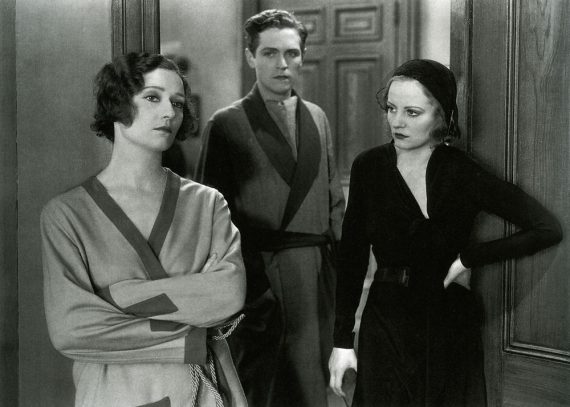
Bankhead plays Nancy Courtney, a once-wealthy socialite hit hard by the death of her father. Although she is in love with a penniless writer, she marries rich stockbroker Norman Cravath in order to secure her family’s future. Feeling that her unhappy marriage has destroyed a part of her and feeling stung by her former lover’s relationship with a rival, Nancy leaves Norman who, unbeknownst to her, has just been bankrupted by the stock market crash. It is at this point when, during a drunken bender after hearing of her husband’s misfortune, Nancy suddenly realises she does love Norman after all, and I begin to lose patience with the whole story. There’s a bit more to-ing and fro-ing before the inevitable reconciliation but the film has never given us any reason to believe in or root for the relationship between Nancy and Norman besides their pleasingly alliterative names, and the moral of the tale seems to have become tangled up with regards to whether marrying for money is a good or bad thing. Whatever the point though, the journey towards it is interminable.
Although it’s not a great film, Tarnished Lady does show an improvement in Cukor’s directorial ability compared with some of his earlier films. Unshackled from the co-directors with which he had thus far been saddled, his individual touch with elegant melodrama and humanistic character work is starting to emerge more clearly, even if it is not yet being put to its best possible use.
43. A BILL OF DIVORCEMENT
In order to enjoy films of yesteryear, it’s sometimes necessary to temporarily adjust our viewpoints in order to accommodate the dominant ideologies of a bygone era. In the case of A Bill of Divorcement, which makes an argument against the mentally ill being allowed to procreate, it’s important to remember that this was the dominant belief of medical professionals at the time. So while the film may look somewhat horrifying to us, it is also a useful and morbidly interesting historical document of 1920s and 30s attitudes to mental health and eugenics.
I knew a little about A Bill of Divorcement and the 1921 Clemence Dane play from which it was adapted before I sat down to watch it, which helped in terms of being prepared for the morally repugnant content. What bothered me more was the fact that the film, which recreates the play with stagey faithfulness, is a melodramatic bore. I love a full blooded melodrama but the performance of John Barrymore as the mentally ill father is overacted to the point where it isn’t even entertaining in a campy way. Barrymore oversells the dryly grim material with a wild-eyed mania that is both unconvincing and exhausting. It’s the sort of hamminess that would serve him well in his splendid comedic turn in Howard Hawks’ Twentieth Century, but in this solemn context it’s an acting choice that is very hard to take seriously.
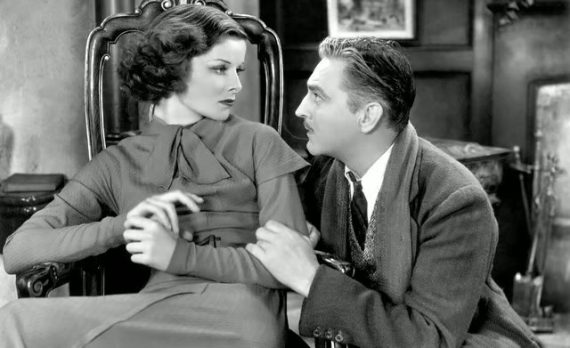
Most viewers who come to A Bill of Divorcement nowadays do so because of its status as Katherine Hepburn’s film debut. Hepburn arrives fully formed, easily claiming top acting honours amongst a cast that includes the interminable Barrymore and a miscast Billie Burke as his estranged wife. Hepburn plays the headstrong daughter who had been under the impression that her father was in an asylum due to shell shock but learns that he has a condition that all signs suggest will be passed on to her. The film concludes with her breaking off her engagement and committing herself to a life alone with her father, a decision framed as correct though tellingly not gussied up in the colours of heroic self-sacrifice of which Hollywood was so fond in this era. Hepburn’s character is instead painted as someone with no right to exist (a doctor tells her as much to her face) and her actions are depicted as a quiet, necessary corrective. For all this retrospectively toxic content, Hepburn is excellent and remains the chief reason to seek out the film. She gets beyond the surface issues in order to portray the human feelings underneath, which makes the ending hit harder. While Hepburn’s more naturalistic, if no less loud, performance clashes somewhat with Barrymore’s greasepaint-cracking over-thesping, she is able to claw back some of A Bill of Divorcement’s drastically withered dignity. The film is also notable for kicking off a successful collaborative partnership and lifelong friendship between Hepburn and Cukor, who fought hard to secure her casting in the role despite producer David O. Selznick’s objections. Cukor and Hepburn would do much better work together in future but A Bill of Divorcement’s obvious stage origins temporarily dragged Cukor back to the static confines of his earlier work, a restriction from which he’d spent the best part of the previous two years escaping.
42. OUR BETTERS
In early 1933 George Cukor was about to enter an extremely fertile creative period of classic literary adaptations which would make him one of Hollywood’s most in-demand directors. Our Betters, an adaptation of the 1917 play by W. Somerset Maugham, feels very much like the full stop on his initial run of films which, despite varying levels of quality, undoubtedly display the unmistakable hallmarks of a quickly emerging talent. In common with several of these early films, Cukor feels slightly hamstrung by the material in Our Betters, a satire on the idle rich which essentially sums up its central point in its sarcastic title. While it probably felt a good deal more subversive upon release, these sort of aren’t-the-upper-classes-awful entertainments often have all the appeal of actually spending time in the company of such monstrously entitled bores. Although it features a handful of amusing lines, the screenplay by Jane Murfin and Harry Wagstaff Gribble perhaps captures the merry-go-round of inconsequential mini-scandals and hedonistic indifference a little too accurately to make it anything more than tediously repetitive. It’s likely a sign of my own classist tendencies but my kneejerk prejudice suggests that the ideal candidate for effectively mounting a takedown of the aristocracy might not be someone named Wagstaff Gribble.
I’m oversimplifying here, given that Our Betters is also an examination of moneyed American socialites marrying into the British aristocracy and the culture clash that comes along with that, but it doesn’t take long for those underpinnings to be forgotten in favour of depicting everyone as approximately equal in dreadfulness and consequently rather boring to watch. Salaciousness becomes dull when the portion is inedibly large and is served with no counterbalancing beverage. Our Betters is teeming with characters, many of whom are seemingly superfluous, and their similarities make for a confusing watch, especially since their lack of redeeming qualities ultimately leads the audience to quickly stop caring. You can make a film filled with reprehensible people but you have to make them interesting in their individuality. Our Betters quickly becomes wearing with its endless jabber that feels like it could be issuing forth from any of these indistinguishable toffs.
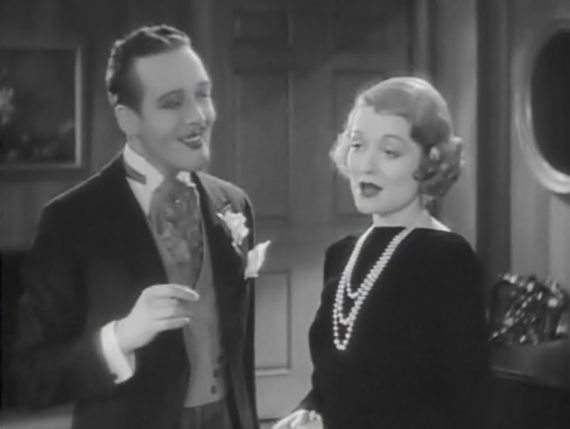
There are a couple of redeeming features in Our Betters that places it higher in my ranking than some of Cukor’s other formative efforts. This was the third in a trilogy of collaborations between Cukor and Constance Bennett, who is excellent as always and, as with the previous Rockabye, significantly better than the material she is given. Cukor’s direction displays a growing ability to make a screenplay that is clearly derived from a stage play feel cinematic, a significant improvement on his largely stagebound stabs at The Royal Family of Broadway and A Bill of Divorcement. Finally, there is a brief cameo from Tyrell Davis that arrives right at the end of the film in which he plays an effete dance instructor named Ernest. It is wonderful to see a clearly gay character depicted so openly and, while Ernest is certainly comic in his extravagance, he is never made into a ludicrous or offensive stereotype. Cukor’s own sexuality was an open secret in Hollywood and his handling of this brief comic caricature is refreshingly fun and non-judgemental. It’s a shame Ernest turns up so late as the film ends just as he gives it the boost it requires. Still, he does get the rather wonderful final line.
41. HELLER IN PINK TIGHTS
No director should ever be discouraged from trying their hand at any type of film but sometimes, in retrospect, certain artists and genres seem like an obvious mismatch. George Cukor and the western is one such example. As was the case with Douglas Sirk and Taza, Son of Cochise, it only took one shot at the genre to confirm that Cukor’s particular talents were not the best fit for the iconography of the Old West. To be fair, Heller in Pink Tights is not your conventional Western, focusing on a troupe of touring actors whose potential fame is scuppered by the constant pursuit of debtors, thanks to the careless spending habits of star performer Angela Rossini. Its tone is caught somewhere between sluggish comedy and unconventional western, with a hint of romantic drama thrown in. I’ve seen Heller in Pink Tights described as a western spoof and a campy comedy in the clothes of a western, but the description that most stuck with me was that of Paul Simpson in The Rough Guide to Westerns, in which he referred to the film as “How the West Was Fun.” This, coupled with the fact that it was included in his canon of 50 greatest westerns, led me to believe I was in for a hidden gem, but the reality was much more disappointing.
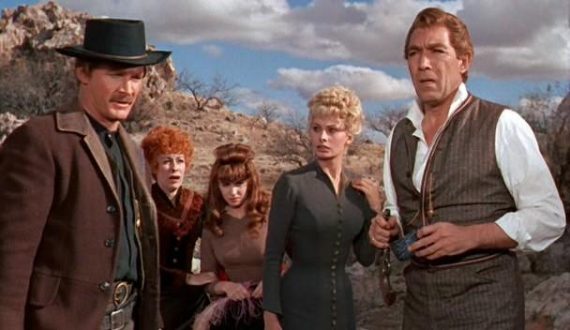
Another slightly misleading claim about Heller in Pink Tights that I’d often heard was that Cukor had stuffed it with vivid colours that made Edith Head’s elaborate costumes pop like an explosion in a paint factory. I don’t know if it was just the print I watched but to me the Technicolor cinematography by Harold Lipstein looked washed out and added to the overall drabness of a film that plodded along with a wearied air of its own failings. The cast features some interesting names, notably former child star Margaret O’Brien and a coolly effective Steve Forrest, but sadly the film can’t get past the miscasting of its leads, Sophia Loren and Anthony Quinn. Loren would seem like the ideal choice for Angela, the titular hellion, but her heart just doesn’t seem in it, perhaps due to the deeply unbecoming blonde wig she is forced to wear. Quinn, meanwhile, must be congratulated for trying hard to make his role as head of the troupe Tom work, but his enthusiastic attempts cannot seem to convince. Given how crucial these two roles are, Heller in Pink Tights struggles to overcome this inaugural hurdle in which it has become tangled.
I wish I had more to say about Heller in Pink Tights but it just simply failed to connect with me on any level. It has the bloated stodginess of the worst 60s westerns, which makes it feel more like a case of How the West was Done. Thankfully, after this, Cukor was done with the West.
40. RICH AND FAMOUS
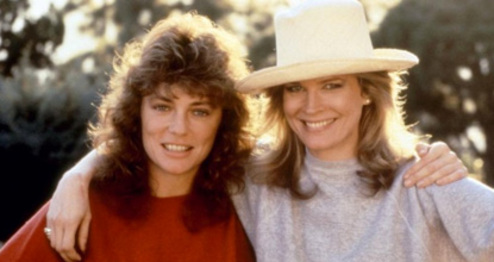
George Cukor’s final film Rich and Famous is perhaps a glimpse of the sort of filmmaker he might have become had he lived longer into the 80s. With its examination of the relationship between two women across a few decades, it feels like a forerunner for James L. Brooks’ Terms of Endearment, crossbred with the soapy storytelling that was starting to dominate television schedules of the era. Although it is based on the 1940 play Old Acquaintance which had been previously adapted for the screen as a Bette Davis and Miriam Hopkins vehicle in 1943, Rich and Famous has a distinctively 80s feel, not least in its numerous sex scenes. As the two old friends who become successful writers with very different career outlooks, Jacqueline Bisset and Candice Bergen have strong chemistry that is enough to overcome Bergen’s faltering southern accent. Unfortunately, on the numerous occasions when they are not on screen together, Rich and Famous feels stilted and often ludicrous. Although it won a Writers Guild of America award, Gerald Ayres’ screenplay is mired in dialogue that seems to be aiming for poetic but keeps tumbling into risible, and the film doesn’t really seem to know what it is trying to say. There were those who were content to just enjoy the trashy titillation but, much as I enjoy a bit of melodrama, I found this particular example irredeemably empty.
39. TWO-FACED WOMAN
Much has been made over the years of the part George Cukor’s film The Philadelphia Story played in helping Katharine Hepburn save her flagging career. Quite understandably, less has been written about how a couple of other Cukor films contributed to ending the screen careers of two female stars soon after that. The commercial failure of 1942’s Her Cardboard Lover prompted the retirement of its star Norma Shearer, while the critical savaging doled out to Two-Faced Woman would lead Greta Garbo to cede the silver screen. None of this is the fault of Cukor, of course. In the case of Two-Faced Woman, he hated the film as much as Garbo did. But Garbo was the face of it and, while it did decent enough business, the embarrassment of her miscasting and uncharacteristically goofy performance stuck with her. She did intend to carry on making pictures, but with the arrival of war the inviability of the European markets on which her popularity relied caused several projects to fall through. Still, it was Two-Faced Woman to which she would come to refer as “my grave.”
Two-Faced Woman’s reputation as a dud is deserved, and yet for all its undeniable flaws it is reasonably watchable. The story follows fashion magazine editor Larry Blake and ski instructor Karin Borg as they meet at a ski resort, undergo a whirlwind romance, marry and then immediately clash over Larry’s insistence that they move back to New York. Unable to reconcile their differences, Larry goes home and takes up with an old flame while Karin follows him and invents the character of a twin sister named Katherine, for whom several of Larry’s associates fall. The preposterous plot feels like a retread of material handled better by Preston Sturges in The Lady Eve earlier that same year, although honestly I’ve always found that revered film a little too silly for its own good as well. But Sturges storyline was at least clear in the motivations of its players, whereas the coherence of Two-Faced Woman seems to have been scuppered by attempts to appease the National Legion of Decency, who objected to the notion of Larry attempting to cheat on his wife with her imaginary twin. Without the blessing of Cukor, new shots were cut in that implied Larry immediately sees through Karin’s disguise. But while this may have made Larry’s actions more palatable for the puritanical viewer, it also rendered many of them nonsensical. Worse still, it killed the essential power-shifting dynamic on which screwball comedy rests. The Awful Truth, an earlier film which Two-Faced Woman evokes to some extent, worked so beautifully because its warring husband and wife were allowed to take turns in the seat of power. Two-Faced Woman’s new shots, however, create an imbalance in Larry’s favour, making Karin seem utterly silly at points when she should be ahead.
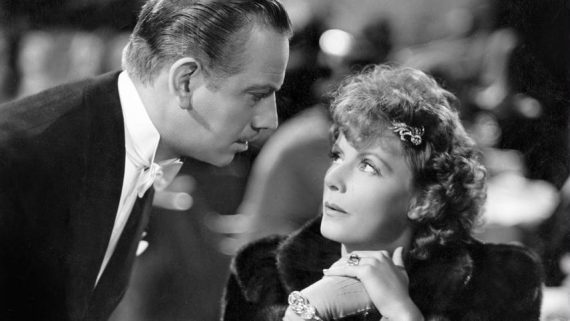
A memorable review in Time compared Garbo’s performance in Two-Faced Woman to “seeing your mother drunk.” It’s fair to say that Garbo is terribly miscast here, and yet her game attempts to keep things afloat are the chief reason to watch. Leading man Melvyn Douglas also hated the film and both he and Cukor seem to be working on reduced vitality, leaving it up to Garbo to throw herself hard into the role of the effervescent Katherine. Strong support comes from Constance Bennett, whose casting was a favour from her friend Cukor, with whom she had collaborated at the peak of her popularity in the 30s. But Bennett does not have enough screen-time to save the film, so Garbo is left to shoulder that burden. Although she did get a few good notices at the time, and even won The National Board of Review of Motion Pictures Best Acting Award, the performance is a gallant effort rather than a success. The material is too weak and Cukor is too obviously disinterested, a fact that is evident in a major dance sequence which never finds the energy it requires. Garbo, who disliked dancing, had to take lessons for the scene and reportedly hated it so much that she once hid in a tree to escape her instructor. Ultimately, she does fine, but the routine is another oddly out of place moment in a hopelessly messy movie.
While it’s somewhat unfortunate that Two-Faced Woman became Garbo’s final film, it’s comparative obscurity is the happy ending she deserved, allowing Camille to remain the major Cukor collaboration for which she is remembered.
38. KEEPER OF THE FLAME
Keeper of the Flame was taken very seriously in its time. Screenwriter Donald Ogden Stewart called his script the pinnacle of his career, considering the assignment to be a redressing of the balance after what he described as years of persecution by Hollywood for his left wing views. The right wing also had strong reactions to the film, denouncing it as propaganda and demanding changes be made to the Production Code in response. But amidst these political divisions, the critical and commercial reaction was decidedly lukewarm and the film became the most forgotten of the collaborations between Spencer Tracy and Katherine Hepburn. One recurring feature of many reviews was an unfavourable comparison with the previous year’s Citizen Kane. While both films were strongly influenced by the life of William Randolph Hearst, Kane’s faceless reporter is merely a framing device for the story of its central figure. In Keeper of the Flame, it is that central figure who is kept offscreen and the reporter who becomes the central focus. The result is something far more tedious and heavy handed. While Kane drip-fed information and never revealed the whole picture, Keeper of the Flame holds back for as long as it can before unleashing a huge climactic information dump that is all the more ineffective for how distant its subject has been kept by the evasive screenplay.
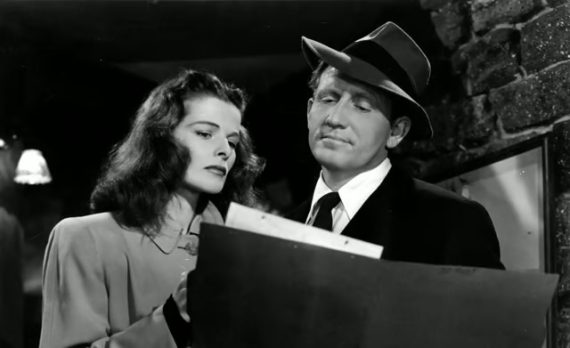
Keeper of the Flame begins promisingly with a frantic action sequence that results in the death of national hero Robert V. Forrest. Enter journalist Stephen O’Malley, who intends to write a hagiographic book about Forrest but must obtain access to his notoriously inaccessible family to do so. These early scenes are well paced, with Tracy making O’Malley a suitable combination of charismatic and enigmatic, and his jocular exchanges with his old press chums creating a realistic atmosphere of professional camaraderie with a hint of personal complications. Audrey Christie steals the show in her screen debut as reporter Jane Harding, a witty and resourceful woman with a thing for O’Malley. Had the film been about their relationship, it might have been more interesting but the arrival after 25 minutes of Hepburn’s Christine Forrest takes the film in an oddly ethereal and inert direction. In a rare occurrence, Hepburn is terrible in the role, having never quite got a handle on it and having had her suggestions for script alterations rejected. Although it came after her career rejuvenation with The Philadelphia Story, Hepburn’s performance in Keeper of the Flame feels like it comes straight from her “box office poison” years, when audiences reportedly found her too intense, annoying and unrelatable. Her climactic scene in particular is overwrought and embarrassing. Tracy, meanwhile, never really gets a chance to build on his initial impact. The character remains stuck in his initial groove, unable to develop under the weight of the wearisomely overloaded plot.
You’d think a film that examines the rise of fascism on a domestic level would hit hard in the current political climate but Keeper of the Flame’s admirable thesis is delivered with such tiresome rigidity that even Ogden Stewart grew to dislike the film, the screenplay for which he once prized as his crowning achievement. Given the current complacency towards fascism that is happening in plain sight, one might argue that we need films like Keeper of the Flame right now, but one could definitely argue that we also need them to be better.
37. THE ACTRESS
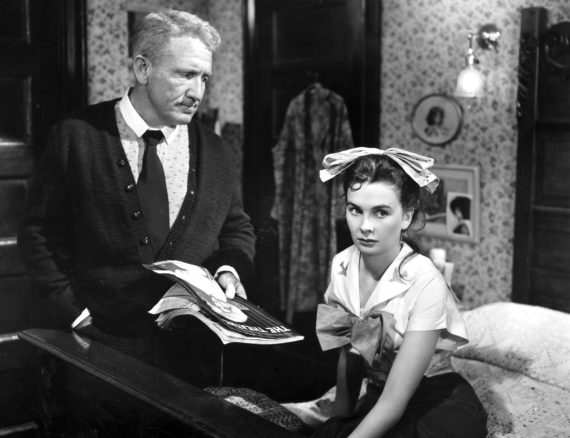
Across the late 40s and early 50s, George Cukor formed an extremely fruitful partnership with husband and wife screenwriting team Ruth Gordon and Garson Kanin. Following four films written by the duo, three of which received Best Original Screenplay Oscar nominations, Gordon and Kanin ended their association with Cukor with a solo film each. Kanin wrote the Judy Holliday vehicle It Should Happen to You, while Gordon submitted The Actress, an autobiographical work based on her stage play Years Ago. While the film’s title is more direct about subject matter, the original title gives a better indication of the musty, sentimental tone. This is a period piece and Cukor directs it with the same curiously claustrophobic air he brought to Little Women. Though clearly a very personal picture for Gordon, the tale of how she became an actress isn’t terribly interesting and Cukor seems hard pushed to get engaged with the material. While Jean Simmons plays the young Gordon, the focus of the film is aimed more towards her down-to-Earth factory worker father, who is played with memorable grit and intelligence by Spencer Tracy. His Golden Globe winning performance is the best thing in The Actress, which struggles to otherwise rise above its stage origins. While the film was selected as one of Sight and Sound’s 75 hidden gems, its comparative obscurity is entirely understandable. Amidst a run of Cukor’s liveliest films it feels like a creaky, old-fashioned bore.
36. TRAVELS WITH MY AUNT
There are few things more fascinating to me, at least in theory, than Golden Age Hollywood directors who were still working into and beyond the New Hollywood era. The films themselves are usually a mixed bag. John Huston is perhaps the director who best weathered the transition, while Alfred Hitchcock and Billy Wilder both made some interesting films post 1970 (and, in Wilder’s case, some dreadful ones too). The problem that is often cited is that films by the older directors felt outdated amidst the fresh and unrestrained aesthetic of New Hollywood. But in the case of George Cukor’s first film of the 70s I’d say if anything it was ahead of its time. With its whimsical stylisation, wilful strangeness and arch detachment, Travels with My Aunt feels far more like a product of the Independent Cinema boom of the 80s and 90s. Unfortunately, that is not to say it is any good. While the American indies of that era constituted a formative golden age for my taste in film, the fashion for aloof postmodernism and self-aware deconstructionism could just as often result in self-indulgent and disingenuous creations as it did in refreshing trailblazers. Travels with My Aunt falls very much into the former camp. While I am attracted to its bold aesthetic, which includes the vibrant colours I was promised but did not find in Heller in Pink Tights, the film is so gratingly affected that its convoluted plot becomes a chore to follow.
If Travels with My Aunt is remembered for anything these days it’s the Oscar nominated central performance by Maggie Smith. This is one of those big, theatrical caricatures that can be either thrillingly vibrant or grindingly irritating. In Smith’s case, it tends more towards the latter because she is all over-the-top exaggeration and never once gives us a glimpse of the human being beneath the facade. The role was originally meant for Katharine Hepburn but I’m not sure she could have done any better with it, given that the problem is in the writing. The screenplay by Jay Presson Allen and Hugh Wheeler is excessively verbose at the expense of character, something that was not an issue in Allen‘s other screenplay of 1972, Cabaret, for which Liza Minnelli beat Smith to the Best Actress Oscar. In a way, the role of Aunt Augusta seems like the kind Smith would receive and repeatedly nail in her later years, but here she is too young for the role and if her conspicuously artificial makeup job doesn’t hide that very well then neither do her stagey affectations.
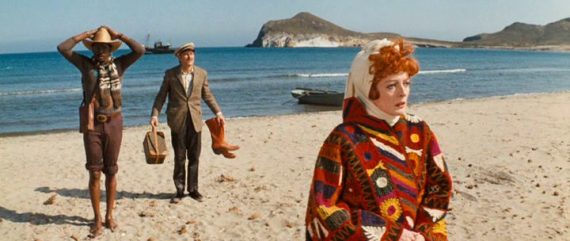
There’s a story somewhere amongst Travels with My Aunt’s catalogue of hokey eccentricities but it’s hard to care about when its characters are so thinly sketched and its details so half-heartedly delineated. The globetrotting story takes us to various countries but the insular style of the material and Cukor’s direction make it feel claustrophobic. The few pleasures of Travels with My Aunt are in the technical categories for which it was also Oscar nominated: the sumptuous cinematography of Douglas Slocombe, the art direction of John Box, Gil Parrondo and Robert W. Laing, and the costumes of Anthony Powell, who took home the film’s only statuette. But a well-dressed turkey is still a turkey and Travels with My Aunt sadly fails to live up to its potential as a fascinating forerunner of future trends in American filmmaking.
35. A DOUBLE LIFE
A Double Life began an important relationship in the George Cukor canon, with husband and wife screenwriting team Ruth Gordon and Garson Kanin. Cukor would collaborate with Gordon and Kanin, both as a team and separately, five more times, while Kanin’s play Born Yesterday also served as the basis for Cukor’s Oscar-winning film of the same name. Two-thirds of Cukor’s next nine films involved Gordon, Kanin or both, but the rest of these films would all be comedies. A Double Life began the Cukor/Gordon/Kanin association with an atypical noir-tinged drama, with a largely doleful tone and a heavy Shakespearean dimension. The screenplay was Oscar-nominated and I can’t say that was underserved. Gordon and Kanin have clearly provided a layered, literate basis for this film, with the interesting premise of an actor who becomes so immersed in his roles that they affect his personality offstage. Those who work with him on lighthearted comedies find him to be a delight, while those starring alongside him in downbeat dramas find him most disagreeable. One of the film’s best sequences comes early on where we see this actor walking the streets and encountering various acquaintances, some of whom comment on what a swell guy he is and others on how he is a tyrant. This is one of the few sequences in which Gordon, Kanin and Cukor’s comedic abilities shine through. From heron in the film gets very dark as the protagonist accepts the lead role in Othello and quickly succumbs to murderous jealousy as a result.
The main reason that A Double Life doesn’t quite work as well as it should is the casting of the central role. As celebrated thespian Tony John, Ronald Colman is hammy and unconvincing in two different ways. He is required to recite long scenes of Shakespearean dialogue and his performances, received rapturously by their onscreen audiences, just aren’t good enough to justify his supposed reputation as one of the greats. His offstage descent into madness, meanwhile, is a shallow and abrupt reading of the material which undermines the dramatic potential of the tragic acts that follow. Colman was reportedly wary of taking the part because of the Shakespearean content but Cukor convinced him that this would be a good opportunity for him to win an Oscar. As it turned out, Cukor was correct and Colman did indeed walk away with the Best Actor statuette, but this certainly seems to be an example of the Academy blurring a role’s potential with its actual execution, an issue no doubt further muddied by their penchant for films about so-called high art. Colman’s role was originally intended for Laurence Olivier and, while he may potentially have been just as hammy in the offstage sequences, Olivier would almost certainly have nailed the Shakespearean passages to a much more satisfying level, and likely walked away with the Oscar himself.
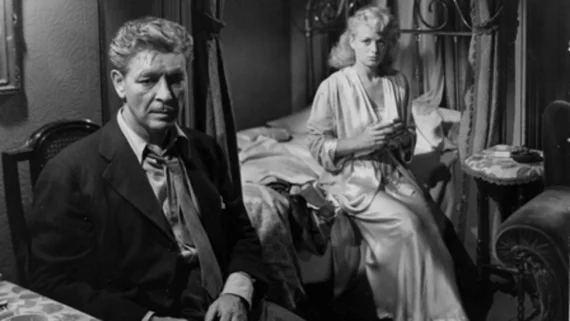
It feels harsh to place the blame for a film’s failure on the shoulders of one actor, especially an actor I generally quite like, but this is a film that pretty much lives and dies by its central turn, so intensely focused is it on that protagonist. The supporting performances by Signe Hasso and Edmond O’Brien don’t really register that strongly due to comparative underwriting, while standout Shelley Winters as down-to-Earth waitress Pat gets limited screentime due to her being Tony’s unfortunate victim. Overall, I don’t necessarily dislike A Double Life but it does feel like a film hamstrung by its own casting and, so soon after Cukor’s Gaslight, its depiction of encroaching madness is not nearly complex or compelling enough.
34. ROMEO AND JULIET
It’s difficult to place Romeo and Juliet in a ranking of George Cukor’s films because it doesn’t feel like a Cukor film at all. This Shakespearean adaptation, unusually lavish for the age, was the passion project of producer Irving Thalberg who pushed for five years to get it made and then, in a tragedy to match that of the play itself, died on the night of its L.A. premiere, aged just 39. The best that can be made of this is that Thalberg wasn’t around to see his $2 million baby receive a lukewarm critical reception and tank with audiences. Despite Thalberg’s high hopes and the film’s numerous Oscar nominations, Romeo and Juliet is part of the early sound era’s handful of shaky attempts at finally giving the Bard a voice on screen. It was preceded by a 1929 version of The Taming of the Shrew which underperformed at the box office and Warner Bros.’ 1935 attempt at A Midsummer Night’s Dream, the announcement of which spurred on MGM head Louis B. Mayer to finally grant Thalberg permission to make Romeo and Juliet, and the commercial disappointment of which predicted the fate of Thalberg’s film. Still, if Shakespeare wasn’t exactly setting the box office alight at a time when sound itself was still seen as a fad by some, Cukor’s Romeo and Juliet has at least be reappraised and received some retrospective acclaim since then.
Whether Cukor and Thalberg’s film deserves its tardy smattering of appreciation is down to individual taste. This is very much a producer’s project, with Cukor largely there to keep things on the rails and keep the focus on Norma Shearer, Thalberg’s wife around whose performance as Juliet he built his notion for the film. As is common in producer’s pictures, there’s a comparative lack of soul in exchange for which we are offered towering sets and elaborate costumes. From the point of view of technical aesthetics, Thalberg’s dreams are realised very nicely. Talbot Jennings, co-writer of then-recent hit Mutiny on the Bounty, has done a very nice job of the adaptation too, retaining much of Shakespeare’s poetic dialogue but knowing what scenes to cut and when to replace stagey descriptive dialogue with welcome action scenes. Two sword fights in a row were the highlight of the film for me! In the case of my modest rating, the problem lies with the fact that I’m not a huge Shakespeare fan. I enjoy studying his work more than I’ve ever been able to enjoy it on the level of pure entertainment. Shakespeare fans will likely warm to this film more easily than I did, and yet personal preference is not the only sticking point.
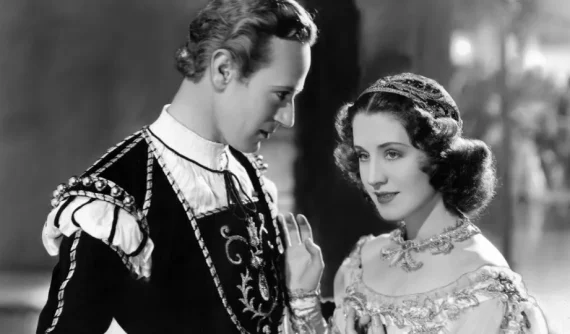
For many, the major pachyderm in the proscenium is the ages of the cast who are supposedly playing teenagers, with Leslie Howard and Norma Shearer being 43 and 34 respectively. I suppose that might be distracting if you’re a real stickler for this sort of thing, but the theatricality of the piece provides plenty of wiggle room for suspension of disbelief. After all, this is a play that would once have been performed by an all male cast. If people back then could buy a Juliet with a five o’clock shadow, I don’t see why actors with a few more years on them than their characters should make a difference. There is a limit though. While Howard’s trim build and agility make him a believably athletic Romeo and Shearer’s standout performance imbues her Juliet with an authentic youthful naivety, John Barrymore’s Mercutio looks positively geriatric. Barrymore was 54 and only six years from his own death when he portrayed a character estimated by most English literature scholars to be around 18 years of age. Still, the age issue remains an afterthought even in this case, given that Barrymore gives one of the worst screen performances I have ever seen. Always prone to hamminess, Barrymore takes it to embarrassing levels here, with the constant gesticulations and wild eyes of an inappropriately enthusiastic understudy in a school play. Basil Rathbone, who had been playing Romeo in the 1934 Broadway revival of the play which served in part as the film’s inspiration, is here demoted to the role of Tybalt. While as good as he always is, Rathbone’s Best Supporting Actor Oscar nomination always seemed a bit of a mystery to me, given that Tybalt’s role is comparatively brief and unshowy. Still, he kills Mercutio, which in this production certainly warrants some kind of award.
Amongst the rest of the supporting cast, C. Aubrey Smith’s naturalistic Lord Capulet and Edna May Oliver’s comedic nurse stand out, while Andy Devine, with his Wild West voice, stands out for the wrong reasons in the unnecessarily beefed up role of Peter the servant. But, as it should be, this Romeo and Juliet belongs to its titular lovers. Howard, with his restrained but passionate performance, is the polar opposite of Barrymore’s possessed posturing, while Shearer embraces her opportunity for a showcase in order to silence critics gesturing towards the marital nepotism behind her casting. Deserving of her Oscar nomination for Best Actress, Shearer strikes the perfect note between naturalism and theatricality, and most of the best scenes feature her. Alas, with its 125 minute runtime, one great performance isn’t enough to rescue Romeo and Juliet from its frequent dry spells. Having just watched Sylvia Scarlett, a film simply bursting with Cukor’s personality, it was odd to watch a film in which his presence is largely hidden behind towering structures, elegant costumes and the constraints of Shakespearean conventions. Having such a consummate professional at the reins probably helped Romeo and Juliet’s production run more smoothly than it might have, but the overall impression here is that a director by any other name would smell as sweet.
33. ROCKABYE
Rockabye is not a fondly remembered film in the George Cukor canon, least of all by Cukor himself. In fact, it was nearly not a Cukor film at all. In their hurry to get a new Constance Bennett film out in the wake of her success in Cukor’s What Price Hollywood?, RKO rushed Rockabye into production with French director George Fitzmaurice at the reins. The film Fitzmaurice turned in was deemed unreleasable and Cukor was brought in to fix it. His solutions included extensive reshoots, recasting of major roles and re-editing of the small amount of usable existing footage. Predictably, the results were something of a mess and the film feels like a patchwork without its own discernible tone or identity. Rockabye is perhaps most significant in the Cukor canon for the fact that it cemented his reputation as a reliable director, a trusted figure whose known abilities were an asset to his studio. And yet including Rockabye in a George Cukor retrospective feels akin to a Van Gogh exhibition that features a fence panel he once creosoted for a mate.
Rockabye begins as a courtroom drama as Bennett’s stage actress Judy Carroll testifies on behalf of her former lover, a corrupt politician and accused embezzler. This highly publicised appearance ends up costing Judy custody of the young orphan girl she was in the process of adopting, at which point we are firmly in melodrama territory. After travelling to Europe with her alcoholic mother Snooks, who seems to have flown in from a screwball comedy, Judy meets a playwright whose work she is interested in but who doubts her ability to portray the lead character in his play, a tough girl from Second Avenue. In proving to him that she in fact grew up on Second Avenue, Rockabye becomes a rom-com by way of a musical. Then, with the revelation of the playwright’s ex-wife giving birth, Judy calls off the whirlwind engagement that briefly reinstated her happiness and we’re back in melodrama territory again.
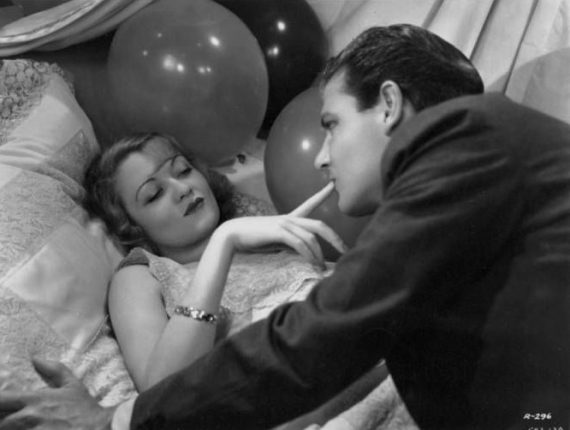
Aside from the constantly switching genres, and despite a screenplay by What Price Hollywood? scribe Jane Murfin, Rockabye is just a very poorly told story. It seems to begin in the middle, with the events discussed in the courtroom proving far too significant to be summarised in a brief newspaper headline. We know next to nothing about Judy or her relationship with her adopted daughter before she is taken away from her only minutes into the film. The absolute devastation of this event, so crucial to the success of the melodrama, is almost instantly snatched away by an unnecessary plot point in which Judy is informed that the orphan’s new parents have said Judy can see her whenever she likes. And all the while, Jobyna Howland’s Snooks babbles and pratfalls at the most inopportune moments for a comedic interruption.
Why, then, have I given this haphazard collection of incidents a relatively generous rating. Admittedly, it doesn’t work as a narrative at all but if you know the production history before watching Rockabye, it becomes a fascinating demonstration of a great director’s gallant efforts to make an already overcooked meal appear edible. There was never any way Cukor could save this ragbag of half-realised notions but what he did do was ably demonstrate why he was the man on whom the studio called in their time of need. If Rockabye stubbornly refuses to cohere, it pulls off the unlikely feat of being entertaining on a scene by scene basis. The heartbreaking separation of the mother and daughter, the lively Second Avenue singalong, the aggressive kitchen flirtation scene between Bennett and her new Cukor-appointed leading man Joel McCrea. Any of these moments could be highlights of the respective film into which they might fit, whatever that may be. Even Jobya Howland’s Snooks, perhaps the most egregious anomaly, is a performance that could’ve worked in the right context. These episodic successes, while bolstered by another committed and magnetic leading performance by Bennett, are largely down to Cukor and his growing directorial excellence, which had at this point clearly outgrown projects such as this one. In a way, the version of Rockabye we got could be said to be a true director’s picture, but it is equally a testament to the limitations of even the greatest artists when it comes to saving that which is beyond salvation.
32. LITTLE WOMEN
Before he left to work for MGM, George Cukor directed Little Women for RKO. It was released after his first MGM film, Dinner at Eight, and the difference between the two studios is clear. RKO was the smallest of the big five studios while MGM was the biggest but frequently there was a charm about the more modest scale of an RKO picture that made an asset out of limitations. In the case of Little Women however, I’ve always felt that this adaptation of Louisa May Alcott’s famous two-volume novel suffers from an air of claustrophobia that feels disproportionate to its grand novelistic ambitions. Cukor’s was the first adaptation of Alcott’s novel with sound and its immediate popularity with audiences saw it become a pivotal moment in the Cukor filmography, netting his first Best Director Oscar nomination as well as another for Best Picture and a win for Victor Heerman and Sarah Y. Mason’s adapted screenplay. While clearly regarded as a classic at the time, the enduring popularity of Alcott’s work has seen several screen adaptations since which have largely usurped Cukor’s film in the hearts of many. Greta Gerwig’s 2019 take on the novel has deservedly received particular acclaim, while Gillian Armstrong’s sweetly chocolate-boxy 1994 adaptation is beloved of my generation. For many, seeing a long bygone age depicted through the lens of 1933, itself now a long bygone age, probably feels like putting a hat on a hat, keeping a much needed sense of contemporary resonance firmly at bay. As a fan of classic Hollywood, this particular element was not a problem for me but I had other issues which kept me from really enjoying this version of Little Women.
I love Katharine Hepburn and on paper the notion of casting her in the role of Jo March seemed like a perfect choice. In practice however, Hepburn’s performance only really works in the latter stages when the character’s age begins to catch up with her own. In the earlier parts of the film when the little women are supposedly littler, the advanced ages of Hepburn and her co-stars are all too apparent and it feels a bit embarrassing watching them caper and preen in a desperate attempt to appear teenage. Only the eighteen year old Jean Parker who plays Beth was an actual teenager but her character is supposed to be 13 so even she feels inappropriately mature. Not to put the blame all at Hepburn’s door but there is an air about her that always felt assertively middle aged even when she was still in her 20s and this impression feels like it discredits the performances of all her screen partners, especially when they are engaged in particularly juvenile activities like staging a play of their own devising in the drawing room. It’s not that Hepburn is miscast per se, it’s just a shame she didn’t get the opportunity to play this role when she was actually 15, as I think she would have been able to more believably act up to her character’s age in later scenes than she can act down to a decade below her real age.
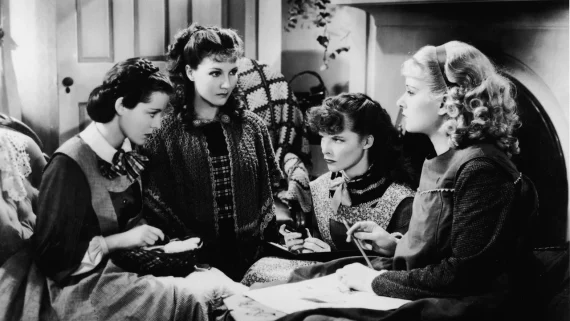
In all honesty, I may have been able to disregard these distractions had I not felt so distractible. Little Women’s loose story hinges on small events being depicted with subtle gravitas and greater tragedies being observed with moving relatability. If a director can strike the right level of warmth and authenticity, it’s a world than can draw the viewer in deeply. Cukor coaxes some lovely moments from his cast. An argument between Jo and Amy in which the tension is suddenly broken when they catch each other’s gaze for a few seconds and break into a giggle. Beth giving affectionate thanks to Mr. Laurence for a thoughtful gift. Jo being unable to reciprocate Laurie’s declaration of love. In these instances I can glimpse the emotionally satisfying work Little Women might have been. Unfortunately, there are long stretches in which the cramped mise en scène and the sometimes quaint or histrionic performances scupper the falteringly established atmosphere. Too much time and focus is placed upon Hepburn at the expense of the other sisters and, while Jo is arguably the dominant force in the story, Hepburn’s overstated performance of unconvincing youth tends to suck up everything in its wake.
One might quite rightly point out that, having not read the book itself, I’m not the best person to judge the effectiveness of a Little Women adaptation. One might even cast doubt on whether I am the target audience for this material. While I completely hold my hands up on the first count, I think the fact that I have so thoroughly enjoyed other adaptations of Little Women suggests that it is very much down to the individual adaptations themselves as to whether they connect with me or not. In the case of Cukor’s film, there is a distancing theatricality that alienates where other versions, particularly Gerwig’s, have captivated me.
31. SUSAN AND GOD
Susan and God is a peculiar film that works in fits and starts but can’t quite find its identity enough to cohere into an effective entertainment. Based on the hit play by Rachel Crothers and adapted by Anita Loos, who had done such a wonderful job with the screenplay for Cukor’s The Women the previous year, Susan and God has a surprisingly cutting satirical edge when it comes to the subject of religion. Given the Production Code explicitly forbade mockery of religion, the film is careful to differentiate between sincere belief and the glib temporary fanaticism of its titular character, but even that feels edgy amidst a contemporary Hollywood environment of stifling enforced reverence. The story of Susan and God is a strange one. It follows the destructive path of a society matron who has abandoned her alcoholic husband Barrie and introverted daughter Blossom in order to chase various whims. A trip to Europe results in her apparent full-blooded conversion to a religious movement, something which she tries to foist upon her friends and acquaintances with a forcefulness that ultimately bulldozes their lives. When Barrie asks for another chance, with the caveat that if he takes another drink he will grant her the divorce for which she has asked, Susan agrees to spend the summer with her husband and daughter. But the unexpected happiness she experiences and inspires in others begins to drive her panicked need to escape.
For a good chunk of its first hour, Susan and God appears to be a comedy. Joan Crawford’s larger-than-life portrayal of Susan is the focal point and her irritating presumptuousness and narcissistic relentlessness are amusing for a time. But when the story begins to shift towards a sentimental drama about family divides, Crawford can’t seem to get out of the comedic register in which she began. To pull off the role of Susan is a mighty task given the emotional gear shifts required and Crawford can’t quite get a handle on her. In fairness, the screenplay doesn’t give her a clear picture of the character and for once Cukor’s direction doesn’t seem to have helped unlock that mystery. One of the things that impressed me about Susan and God was its apparent message that we should put our loved ones and our duty to them before our religious beliefs, a progressive humanistic point in an often aggressively pious age. Whether the abrupt hopeful ending was a Hollywood concession I don’t know but it’s sudden shift into what appears to be a sincere religious plea ends the film on a disingenuous note.
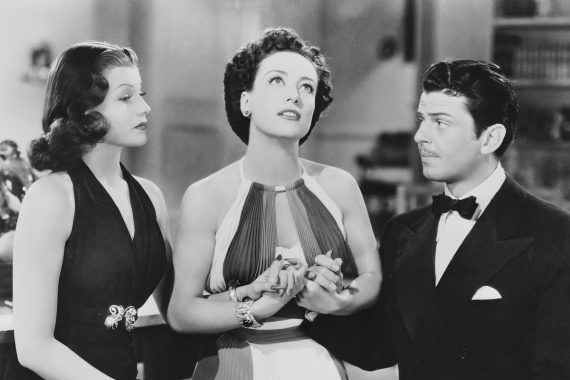
Susan and God has never been one of Cukor’s more celebrated films. It suffers from a confused tone and taxing overlength but there are points of interest. The themes being kicked around are unusual for the time and sometimes border on the subversive but perhaps the pressures of the Production Code turned any excitement that may have inspired into tentative bafflement. The supporting cast, from a muted Frederic March to an out-of-place Nigel Bruce and a sidelined Rita Hayworth, all seem unsure of themselves and how to make any kind of mark beside Crawford’s scenery-swallowing performance. Perhaps the best turn comes from the young Rita Quigley as Blossom, although her major part in the story is where the film begins to nosedive into ineffective melodrama. Released the same year as Cukor’s celebrated The Philadelphia Story, it’s little wonder that this odd film has slipped into comparative obscurity.
30. THE MODEL AND THE MARRIAGE BROKER
Following hot on the heels of two exemplary Cukor comedies, Adam’s Rib and Born Yesterday, The Model and the Marriage Broker is a significantly lighter, slighter affair. You can hear the kind of film you’re going to get in the frolicsome rhythm of its title. It has the same merry sound as The Bachelor and the Bobby-Soxer, another lightweight comedy film from a few years before. In its tale of whimsical romantic manipulation by a third party leading to bliss for an attractive younger couple, The Model and the Marriage Broker is predictable and mechanical from the off. Sometimes this is supplemented with adequate charm to pull the viewer through, while at other times it just feels tedious. As with Born Yesterday, The Model and the Marriage Broker places a lot of significance on its star, in this case the superlative Thelma Ritter (clearly the main character despite what the ageist advertising campaigns would have you believe). Ritter remains one of my favourite Hollywood stars of any era and her appearances in a string of fantastic supporting roles, both comedic and dramatic, have made her enduringly popular with audiences ever since. The notion of a film in which she is the lead was exciting to me but the movie’s lukewarm reputation, coupled with that skipping-rhyme of a title helped me lower my expectations accordingly. As such, I enjoyed watching Thelma do her stuff in this role but wished pretty much from the outset that she’d been blessed with better material.
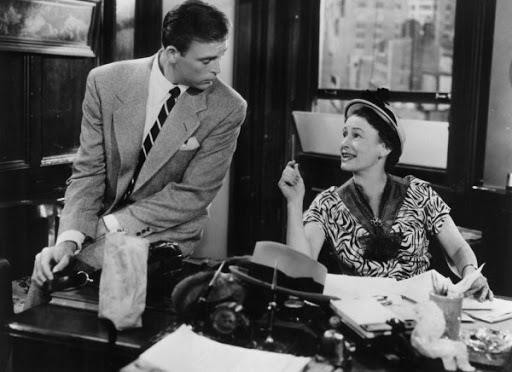
One element of The Model and the Marriage Broker that gave me hope was the name Charles Brackett in the credits. Brackett was Billy Wilder’s first long-term writing partner and a very fine writer in his own right so seeing him listed as producer and screenwriter promised more than this film actually delivered. You can detect Brackett’s presence in some of the witty zingers and brief moments of moving reflection, but ultimately the characters here are too one-dimensional to really care about. I wasn’t pulling for Jeanne Crain’s model and Scott Brady’s radiographer to get together because neither one of them made any impact on me as real people. Even Ritter’s matchmaker Mae feels beyond the actor’s considerable power to humanise. Perhaps this distance was exacerbated by the rather mean-spirited comedy involving Mae’s clients, who from the outset are portrayed as hopeless misfits with the broad brushstrokes of bad sketch comedy. Frank Fontaine’s spaced-out Swede Mr. Johannson leaves a particularly bad taste, which is unfortunate given that he is the first character with whom we really engage (or fail to).
As is the case with most of Cukor’s comparative disappointments, this is more of a mid-table shrug than a barrel-bottom scrape. I could easily imagine watching this on an afternoon while recovering from a cold and sipping a medicated beverage. But as an evening’s main event, The Model and the Marriage Broker felt insufficient in most respects and a weaker alternative to the similarly light but slightly better Brackett/Ritter collaboration of the same year, Mitchell Liesen’s The Mating Season.
29. EDWARD, MY SON
Based on the play by Noel Langley and Robert Morley and adapted by regular Cukor-collaborator Donald Ogden Stewart, Edward, My Son tells the story of the titular Edward, a character whose life we follow from birth to premature death but whom we never see or hear onscreen even once. Instead, we focus on Edward’s parents, primarily his father Arnold who will do anything, no matter how unscrupulous, to protect his son. In doing so, he moulds Edward into an entitled, rude and ruthless boy whose transformation, along with that of his amoral father, drive his caring mother towards debilitating alcoholism. Not one of Cukor’s comedies then! And yet, this heavy and somewhat repetitive film was perhaps the final straw after a long stretch of dramas that would see Cukor return to comedies for the majority of the first half of the 50s.
Although Edward, My Son has an interesting premise and an enticing gimmick, it quickly becomes repetitive. It’s fun seeing Spencer Tracy play the villain for a while but his exploits as the opportunistic and obsessively manipulative Arnold begin to grate after the first few scenes. There is a clear stage origin in the way each sequence consists of lengthy dialogues in various rooms, climaxing in an unfortunate outcome for whoever is threatening Edward’s reputation. The terrible events are numerous enough that they become expected to an extent that robs them of dramatic impact, while some of them also lack the sufficient narrative justification. The notion that Arnold ending his affair with his secretary would culminate in her suicide feels particularly overblown for the small amount of interaction and negligible amount of chemistry that we see between them. The film also suffers from a risible framing device in which Arnold breaks the fourth wall. It’s a device that you can imagine working on stage but here it makes Tracy feel like a pantomime villain. It is also used to drop a hefty piece of last minute exposition about an unexpected imprisonment which I can only imagine was Hays Code mandated, given that it comes out of nowhere and does very little to serve the plot. At the very least, Arnold’s unrepentant attitude is refreshing in a film of this era. An eleventh hour redemption would’ve been the final nail in the coffin.
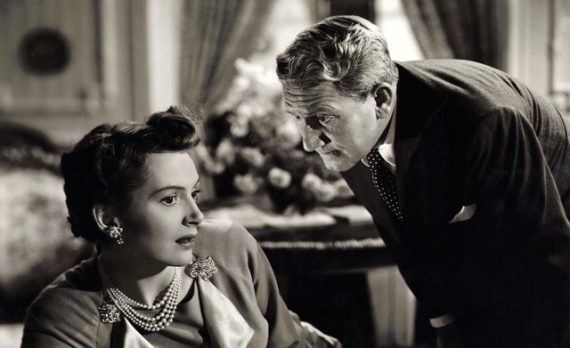
For all its obvious flaws, Edward, My Son is still a partially enjoyable watch due to its lurid melodrama and unusually loathsome protagonist. Though largely forgotten, it also secured the first of six Best Actress Oscar nominations for Deborah Kerr for her role as Edward’s mother. Though only given a fraction of the screen-time afforded Tracy, Kerr is the best thing in the film precisely because she is the worst thing in the film. I’m not usually a so-bad-it’s-good kind of guy but Kerr’s performance here is mesmerising. Her early scenes are fine and Kerr could undoubtedly act but she also had a tendency to go overboard when the performance required a more melodramatic register. You can witness that in another of her Oscar-nominated roles in Delbert Mann’s Separate Tables but that performance was just annoying. This thing, however, is a monument to camp majesty. As Kerr’s character grows more despairing she accumulates more unconvincing age makeup and affected tics, culminating in the most spectacularly abysmal drunk acting I think I’ve ever seen. Her final sequence is a must see and is presumably the moment that secured her the Oscar nomination. It may also be the moment that secure an otherwise unlikely rewatch from me someday, as I only watched it last night and already it’s starting to feel like some surreal, hilarious dream.
28. WILD IS THE WIND
Wild is the Wind is exactly the film you think it’s going to be from that title alone. Tragically romantic, excessively melodramatic, steeped in obvious metaphors and windblown landscapes. Teeming with hot-blooded American-penned immigrants whose muddy motivations are lost between their histrionic declarations at both extremes of the passion scale. Clinches. Punches. Tears every few minutes. You should be prepared for all of this going in if you want to get anything out of Wild is the Wind. You don’t want to dress for a light breeze and end up caught in a hurricane.
I’m a big fan of melodrama but it is assuredly a genre that can be intolerable if executed poorly. There needs to be some level of sincerity in order to avoid the instant turn-off of blatant audience manipulation, but a certain amount of self-awareness can also go a long way, as evidenced by the tongue-in-cheek moments that punctuate the works of Douglas Sirk, undoubtedly the king of this genre. While there’s a sincerity to Wild is the Wind’s attempts to examine the inherent problems of its central marriage of convenience, screenwriter Arnold Schulman feels like a cultural outsider when it comes to his Italian protagonists. While he shares screen credit with Vittorio Nino Novarese, this was due to a contractual stipulation since Novarese’s novel Furia served as the initial inspiration for Wild is the Wind. The film ultimately strayed far enough from its source that Schulman considered it an original work but Novarese’s name still had to be included in the credits to avoid legal action. Perhaps a little more actual input from Novarese might have made Wild is the Wind feel more authentic and less exploitatively stereotypical.
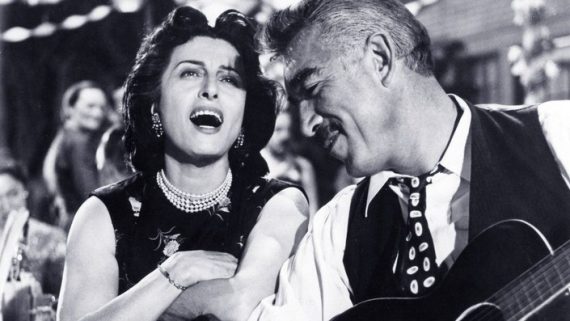
Wild is the Wind is the story of immigrant rancher Gino who, following the death of his beloved wife, travels to Italy to marry her sister Gioia whom he brings back to Nevada. Feeling out of place and neglected by her new husband who is clearly still grieving, Gioia embarks on a passionate affair with ranch hand Bene, whom Gino thinks of as a son. The inevitable fallout from this leads everyone to acknowledge some uncomfortable truths about themselves. One of the most remarkable elements of Wild is the Wind is its refusal to condemn Gioia’s infidelity, an indiscretion that most Production Code era films saw as punishable by humiliation at least and, at most, death. Instead, we get an ending in which Anthony Quinn’s Gino acknowledges his mistakes and accepts responsibility for pushing his wife into the arms of another man. Although their climactic resolution to try again feels anticlimactic, this is also in keeping with the precedent of realism set by this finale. We don’t get a passionate reunion or bitter tears of regret, but simply a quiet assessment of the situation, remorse and acceptance on both sides and a hint of hope tempered by the very real possibility of a lifetime of passionless mutual contrition. It’s a very good ending but you have to wade through a lot of clichéd bellowing to get there. In a way, that makes the ending even more satisfying but unfortunately not enough to recast the hour and a half that precedes it as anything less than a slog.
If Wild is the Wind doesn’t necessarily engage as a great story, Cukor’s direction and Charles Lang’s cinematography at least make it somewhat beautiful to look at. Working one final time in black and white, Cukor captures the tempestuous spirit of his characters in the rolling Nevadan landscapes with their constant blustering windstorms. While the Oscar nominations for both Quinn and Magnani suggest that Wild is the Wind was once seen as a great actors’ showcase, it now feels more like a strong piece of atmospheric direction, with Cukor keeping up with and, to some extent, offsetting the overwrought nature of the narrative with complementary stylistic choices that serve the same self-aware function as the deer at the end of Sirk’s All That Heaven Allows. There are no deer in this film but there are horses, wild horses which serve as an obvious metaphor for the apparently untameable spirit of Gioia. It’s a little on the nose, yet the metaphor is extended effectively with the tragic breaking of both its subjects.
Wild is the Wind feels like a great film struggling to throw off the shackles of a muddled one. According to Schulman, it was compromised by the desire of its star Magnani wanting to use it as a form of revenge against Roberto Rossellini, who had once had plans to direct a film from the same source and who had reportedly spurned Magnani romantically. As a result, Schulman acknowledged that parts of the film were “really stupid” but he was also proud of the revolutionary gender politics he managed to get into the script. Given that this account comes entirety from a man who was essentially badmouthing a woman before celebrating his own progressiveness, it’s unclear how much truth there is to it, but it neatly encapsulates Wild is the Wind’s own combination of the forward-thinking and the stereotypical.
27. WINGED VICTORY
There are certain films in directors’ filmographies which require some level of historical context to appreciate. Often around the time America joined World War II, there will be a long gap between a director’s films or a handful of wartime adventure films that forsake the artist’s established style in favour of an uncomplicated propagandist approach. So it is with George Cukor’s Winged Victory, a reverent film about a group of young men joining the Air Force and, peripherally, the women who love them. Despite being a hit at the time when such rousing entertainments were so sorely needed by audiences disheartened by the ravages of war, Winged Victory has since nosedived into obscurity. It is a difficult film to find, at least in a decent condition (the print I watched may as well have been titled The Fog of War!), and those who bother to seek it out often come away disappointed that it doesn’t feel like a Cukor film at all. This is why context is so crucial, as Winged Victory is from a time when the director’s vision took a secondary role to national morale. But if the usual trademarks of a Cukor picture are hard to detect, his consummate professionalism and directorial confidence certainly played a part in making Winged Victory a much better than average film of its kind.
So how does Winged Victory stand up today. In truth, I rather like it, although there are limits to my positivity. At 130 minutes, it is undoubtedly overlong, although this does allow it to encapsulate the lengthy experience of Air Force training in a more authentic way. The film was a co-production with the US Army Air Forces and the plentiful consultants who worked on it helped Cukor imbue its best scenes with a documentary realism that is immersive and fascinating. This offsets the inevitable corn at the heart of the dramatic passages, although there is something to be said for these uncomplicated snippets of vivid Americana as a counterbalance to the underlying seriousness of the subject matter. However idealised it might be, this depiction of comradeship and community is undeniably rousing for anyone who can set aside their cynicism long enough to enjoy a chorus of Gee, Mom, I Want to Go Home. For movie buffs, the cast is also jammed with future stars, some in larger roles (Edmond O’Brien, Don Taylor) and some in more fleeting appearances (Lee J. Cobb, Karl Malden). Winged Victory also marks the beginning of Cukor’s relationship with one of his key collaborators, Judy Holliday, who has about a minute of screen-time here but would soon become one of Cukor’s Oscar winners.
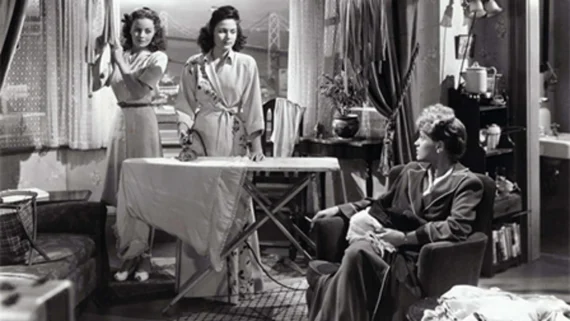
Given its status as a historical curio, my enjoyment of Winged Victory is comparatively limited but it is a film I’d like to see in a better print someday, as it does appear to be a technically accomplished picture and the star-spotting exercise would be easier if the faces were more discernible. Certainly, this is one of the better pieces of wartime propaganda I’ve seen and for those with a particular interest in this time period Winged Victory is a must-watch. For everyone else, I’ll say it again, context is key.
26. LES GIRLS
Les Girls was the last musical Gene Kelly made for MGM, the last film score by Cole Porter and one of the last big old-style Hollywood musicals of the era. MGM had lost faith in Kelly’s box office potential, leading Kelly to negotiate an exit from his contract which involved making three final films, the hugely underrated It’s Always Fair Weather, the largely forgotten The Happy Road, and Les Girls. Despite a large budget and several Oscar nominations, including a win for Orry-Kerry’s costumes, Les Girls failed to make much of an impact and now also resides in the folder marked ‘Forgotten.’ It’s not that hard to see why that is the case. Les Girls doesn’t quite work as any of the things it aims to be. It isn’t funny enough for a comedy or engaging enough for a drama, and as a musical it falls comparatively flat due to a dearth of memorable songs or routines. That’s not to say it isn’t entertaining watching Les Girls trying to pull together its disparate stylistic choices into something coherent. William A. Horning, Gene Allen, Edwin B. Willis and Richard Pefferle’s art direction is striking, with gorgeous stylised backgrounds accompanying several of the otherwise forgettable numbers. The trio of lead female performances by Mitzi Gaynor, Kay Kendall and Taina Elg are all appealing, especially when they are playing off each other without the lacklustre Kelly who, perhaps understandably given the circumstances, phones in his performance to the detriment of the film. But then the film’s major mistake is placing too much emphasis on les boys, with the tricked-up narrative eventually revealing itself to be about a whimsical male conspiracy to trick three women out of their careers and into marriage. That this ploy is ultimately successful is at odds with the smart portrayals by the three leading ladies, whose witty asides and playful dynamic suggest they are a far wilier trio than the story allows.
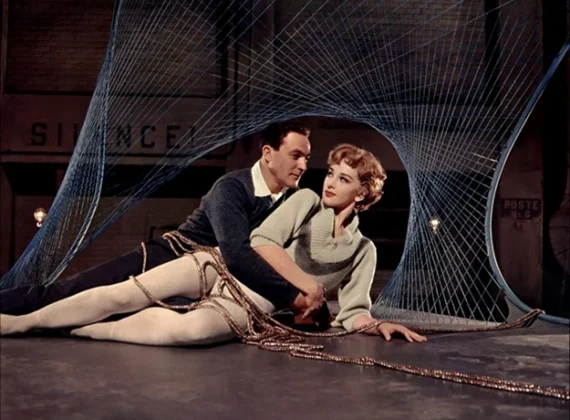
Although it is underwhelming as a collection of musical numbers, each individual routine could easily serve as a serviceable part of a larger production with more prominent peaks. The title song is given an entertaining presentation and Ladies-in-Waiting is an amusing slice of theatrical camp. By far the standout is Why Am I So Gone (About the Girl) in which Kelly plays the least convincing tough guy member of a biker gang but makes up for that by dancing a delightfully restrained duet with Gaynor against a dreamily artificial backdrop. As the final of the five numbers, the impression is that this is meant to fill the role of the big finish, but instead it feels like a partially successful rejection of that very notion. If Les Girls could have kept a grip on this subversive approach it might have worked, but then we get the dreadful You’re Just Too, Too, performed by a manic Kelly and Kendall, which just feels too, too desperate to please, so much so that it single-handedly convinces the viewer that subtlety was never intended as a prominent part of the overall blueprint. This number is also a problem in that it takes place in an apartment, whereas the majority of Les Girls’ musical moments are presented as stage performances, allowing for a pleasing vein of realism that is immediately obliterated by this aberration.
The premise of Les Girls is peculiar. It is a comedy with the semi-cerebral theme of the nature of truth, with a framing device in a courtroom in which Kendall’s Sybil is defending accusations from her former pal Angèle that her tell-all memoir slandered her with lies about a suicide attempt. Each woman is allowed to testify, with each claiming that the other attempted suicide over their unrequited love for Kelly’s Barry. Then Barry offers a third perspective to the court. Each of the three testimonies spawn a flashback that focuses on one of the three women, with Angèle’s more dramatic story being the strongest, Sybil’s the silliest (with a wildly over-the-top drunk act by Kendall) and Gaynor’s Joy getting the weakest material, which is a problem given that it constitutes the film’s culmination. Although the numerous twists and turns keep things interesting, John Patrick’s screenplay never seems to have a handle on the story and throws too many balls in the air at once. The film smartly decides to keep the actual facts of the case a mystery but even with that subjectivity, certain things don’t add up when you start to think over the whole story. The film also feels unable to make the serious subject of suicide feel digestible in such a lighthearted context and the tone quickly curdles as a result.
Les Girls is a film I sort of enjoyed watching but just because it wasn’t boring doesn’t mean it was particularly good. Still, the fact that I could easily imagine myself watching it again suggests that it’s not all bad either. But despite the obvious work that has gone into making it look so pretty, it feels like what it is: a contractual fulfilment for a star in decline.
25. LET’S MAKE LOVE
Despite the presence of Marilyn Monroe in the immediate aftermath of her iconic Some Like It Hot success, Let’s Make Love has never been held in particularly high regard. Monroe herself went on to describe her role of off-Broadway actress Amanda Dell as the worst of her career. Nevertheless, Monroe is reliably excellent here. Despite the fact that plastering her alluring image over a poster bearing the words “Let’s Make Love” pretty much guaranteeing a certain amount of bums on seats, it is her oft-underrated acting chops that keep this film afloat. Despite the fact that she allegedly had a brief affair with her leading man Yves Montand, there is little onscreen chemistry to speak of, leaving Monroe to carry their scenes together with her considerable magnetism. That’s not to say Montand is terrible, per se. The fact that he couldn’t speak English at this stage and had to learn his lines phonetically is actually somewhat of a miracle, given that you’d never realise that was the case. Part of the problem is that his character of billionaire Jean-Marc Clément isn’t especially easy to root for. Even allowing retrospectively for the fact that we’re pretty much hardwired to root against billionaires now, the notion of the long deception that plays out between him and Monroe’s Amanda as an effective courtship is impossible to buy into and, money or no, any right-thinking viewer will likely be hoping Amanda ends up with her co-performer Tony (the Liverpudlian hitmaker Frankie Vaughan). Clément’s lack of theatrical talent is perhaps supposed to endear him to us as he clumsily attempts to pass himself off as a part of the theatre troupe, but the fact that he can afford to hire Milton Berle, Gene Kelly and Bing Crosby to train him in secret is much better for Let’s Make Love’s high-profile cameo quotient than it is for its character development.
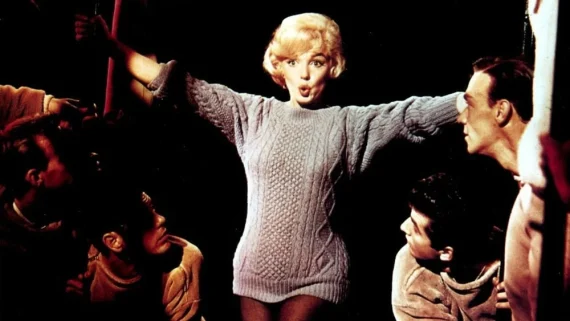
If the wheels fall off the wagon of Let’s Make Love’s rom-com aspirations quite quickly, it does at least have some high points to keep us going along the way. The aforementioned cameos have a frisson of excitement for movie fans, even if none of them are as funny as they ought to be, and Monroe’s scenes are all bolstered by her luminous charisma. In terms of music, most of the actual songs in Let’s Make Love are forgettable but there’s something about the scruffy understaging of the accompanying numbers that gives the film an appealing rough and ready quality. What we are seeing, after all, are supposed to be backstage rehearsals and so the imperfections feel authentic. While the title song is given a push as the film’s headliner, appearing in three different versions, it is Cole Porter’s My Heart Belongs to Daddy that easily steals the show. Originally written for the 1938 musical Leave It to Me!, the song is about a young woman’s devotion to her sugar daddy (which makes it less creepy than the other semi-incestuous implication, though only marginally) and here it acts as Monroe’s introduction. This is Let’s Make Love’s one great number, with Monroe performing the hell out of it while surrounded by justifiably adoring men. It is at this moment that the viewer realises the film essentially belongs to her and the stretches when she is not onscreen tend to feel dry, despite the efforts of Montand, Tony Randall and Wilfred Hyde-White, the latter two providing amusing support as Jean-Marc’s co-conspirators.
At this stage of Cukor’s career there was a muddy quality creeping into his films which made them start to feel like the laboured fruits of a great director on wind-down. In the case of Let’s Make Love, there are scenes where this unglamorous edge works in the film’s favour and helps it just about surpass Cukor’s previous, ornate musical Les Girls in terms of quality. But there’s not enough here to carry Let’s Make Love through its egregious overlength, and the central romance is misjudged to the point where I couldn’t quite believe they were actually going to see it through in the final minutes. Cukor, of course, had one more musical triumph just around the corner but on the evidence of Let’s Make Love it’s hard to imagine how he ended up being entrusted with the high profile adaptation of My Fair Lady.
24. THE CHAPMAN REPORT
Much has been made retrospectively of how The Chapman Report is a film about female sexuality that was adapted, written, produced and directed by men. Not to mention the fact that, in a cast featuring Shelley Winters, Jane Fonda, Claire Bloom and Glynis Johns, top billing is given to Efrem Zimbalist Jr. No-one can claim alphabetical order as a defence in this case! I’m not going to defend The Chapman Report against any of these offences. It is undoubtedly a film that suffers greatly from an overbearing patriarchal perspective which, amongst other things and using the parlance of the times, suggests that nymphomania inevitably leads to a tragic death and that the best way to cure suspected frigidity is to schedule a wedding and then quietly celebrate that fact in the most underwhelming final scene ever put on film. But I’m not going to spend too long tearing strips off The Chapman Report either, at least not from an ideological perspective. There are plenty of reviews out there that have done that more thoroughly and credibly than I could manage. Instead, I’m going to look at why I quite enjoyed The Chapman Report, despite it being a problematic and narratively stilted relic.
The short answer to why I ranked The Chapman Report comparatively high on my list is the acting. The film is structured sort of like an anthology movie, with four women each with a different sexual issue taking part in a sexual study based on the Kinsey Reports, and each of their vignettes being presented using the tools of a different genre. Shelley Winters gives us a melodrama about marital infidelity, Jane Fonda a romance about an abused woman rediscovering her sexuality, Claire Bloom a gritty tragedy about a sex-addicted woman’s downward spiral, and Glynis Johns a broad comedy about a married woman’s impulsive attraction to a younger man. While some stories work better than others, the women that headline them are superb without exception. Fonda is so good that it’s easy to overlook the fact that her story goes virtually nowhere, skirting the edges of her problem with a cautious approach that suggests a nervous studio. The Chapman Report is, after all, attempting to explore themes that were still being heavily policed by the censors in 1962, which led to a terrible conclusion being appended to the film that attempts to make clear that the majority of American females are sexually “normal.” In such a censorious climate, it would be almost impossible for The Chapman Report to emerge as a good film, but the four women do their best to save it. Johns is funnier than the rather weak farcical material she is given, Bloom brings an affecting authenticity to her lurid plotline, Fonda’s naturalism distracts from her story’s jumbled vagueness, and Winters is simply magnificent in the one strand that really works, a gently sad but hopeful tale writ surprisingly small.
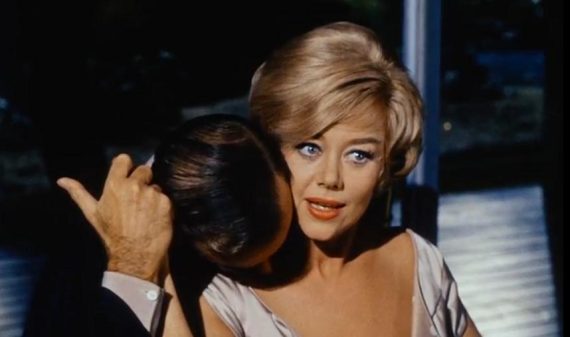
One major problem with The Chapman Report is how poorly the stories play off each other. The ability to switch between them does help the film zip by in what seems like less than its two hour runtime. But it’s hard to watch the horrific scene of Bloom’s character being gang raped and then laugh at Johns’ character being comedically mauled by her overenthusiastic younger lover, which is portrayed as lighthearted slapstick but could only work as such without that unfortunate juxtaposition. The modern style of Fonda’s scenes also clashes with the classicism of Winters’ story, which feels like it is happening in a different time and place from the rest of the film. While the whole thing fails to come together as a whole, there are individual moments that work in each segment, and cutting between the four stories does keep the attention from waning. So while I must concur that The Chapman Report is not a good film, it remains a strangely fascinating glimpse of outdated attitudes that were once considered progressive, performed with engaging aplomb by a terrific cast. And Efrem Zimbalist Jr. (top-billed).
23. THE VIRTUOUS SIN
After watching George Cukor’s stagey debut feature Grumpy I did not have high hopes for his second film, The Virtuous Sin, especially since Cukor himself was quite disparaging about it. I was delighted to discover then that The Virtuous Sin is actually quite an accomplished and cinematic work, with greater scope, better writing and more memorable performances all bolstering its impact. Co-directed with Louis J. Gasnier, whose latter day reputation seems to rest almost entirely on his infamous PSA Reefer Madness, The Virtuous Sin has an elegance that offsets its riper moments of early-talkie melodrama. It also goes in some unexpected directions, beginning as a high-minded weepie about a couple torn apart by war and finding its way to a surprisingly level-headed conclusion about love and duty by way of a delightful romantic comedy in which the two leads share a nighttime seesaw ride. What appeared in its opening moments to be a stuffy tragic romance quickly became something more captivating and unique. All of this is not to say that The Virtuous Sin is anything approaching a real classic. But in a transitional era when most Hollywood films were struggling to overcome their all-too-apparent technical limitations and tastes often tended towards the trashily sentimental, The Virtuous Sin does a convincing job of distracting the viewer from its worst excesses on both these counts.
Victor Sablin is a brilliant young Russian medical student who talks the reluctant Marya into becoming his wife, promising an unconventional path to happiness based on their relationship in the laboratory rather than the bedroom. On the verge of a crucial breakthrough that could change Russian medical history, Victor is conscripted into the army to fight in World War I. Although Marya pleads the case that he is more valuable to Russia at home than in the trenches, her words fall on the deaf ears of the rigid General Platoff, who insists the army needs men and will have them, whatever the cost. When Victor himself raises further complaints, he is sentenced to death for insubordination. Now it is up to Marya to use her feminine wiles to ensnare the General and secure Victor’s release. But she does not expect to fall for the General in the process.
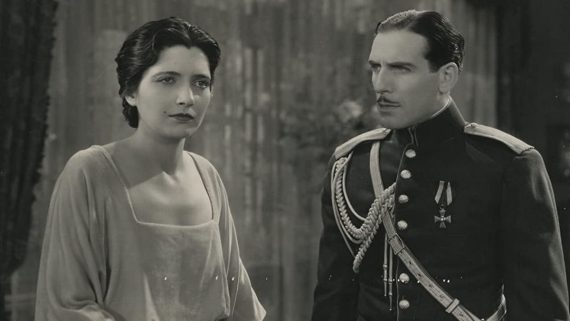
Kenneth MacKenna’s overegged performance as Victor is a bit of a sticking point early on in The Virtuous Sin but it soon becomes apparent that he is less a romantic lead than a plot catalyst. His incarceration begins a long stretch in which the film is carried by stars Walter Huston and Kay Francis. Both at the early stages of their career, Huston was a reliable, awards-garlanded actor for decades to come, while Francis, though often considered a forgotten star now, was Warner Bros. biggest box office draw and highest paid actress for a large chunk of the 30s. Both performers demonstrate their talents for melodrama and comedy, albeit in a heightened style that befits the age but may test the patience of those unused to early sound cinema. But the pre-Code delights of this era are also on full display, from a less pious attitude to the sanctity of marriage to numerous saucy scenes in a brothel, the latter affording Jobyna Howland the opportunity to tear chunks off the scenery with her teeth as the privileged, ostentatious brothel keeper. Some have noted the lack of chemistry between the central triangle but in one case that is precisely the point, while in the other it is merely a byproduct of the themes of the unlikely nature of attraction. And while a major punch is pulled in the final scenes, it is in keeping with the charming lightness of tone that Cukor and Gasnier (though I suspect mainly Cukor) achieve. A tragic denouement, after all, would perhaps have been one case of tonal whiplash too many.
I understand why, with numerous classics under his belt, an ageing Cukor might have looked back on this early entry in his filmography with some embarrassment. But decades later, as it approaches its 100 year anniversary, The Virtuous Sin stands out as one of the better American films of an artistically troubled 1930 for Hollywood.
22. A LIFE OF HER OWN
Off the back of his hit film Adam’s Rib, George Cukor was about to embark on half a decade dominated by comedies. But as a late replacement for Vincente Minnelli, Cukor kicked off the 50s with the commercially unsuccessful and largely forgotten melodrama, A Life of Her Own. Based on the novella The Abiding Vision by Rebecca West, A Life of Her Own was twice rejected by Production Code administrator Joseph Breen for its “shocking and highly offensive” depiction of adultery. Given that adultery is what the film is about, screenwriter Isobel Lennart had an uphill struggle to create a script that sufficiently condemned the central affair without making its subjects unlikeable or its tone supercilious. In the event, she did rather a good job in creating an engaging slice-of-life romance with a downbeat ending that pities its doomed lovers rather than judging them. There’s an air of the iconic about Lana Turner’s climactic walk through the nighttime streets, alone and lost. Cukor, much to his dismay, was made to tone down the original ending in which Turner’s heartbroken Lily leapt to her death. Although it fulfilled the Hays’ Office’s demand for the character to be punished, it ultimately proved too much for test audiences. For once, and despite Cukor’s protestations, the test audiences were right. The reshot ending, in which Lily must live with her romantic devastation, is far more haunting and relatable.
While modern day audiences are unlikely to be offended by the subject of infidelity, what is much harder to swallow is A Life of Her Own’s use of a disabled character as a plot device. Margaret Phillips’ plays Nora, the wife of Ray Milland’s Steve who is conducting an affair with Lily. Phillips’ almost ethereally cloying performance infantilises the wheelchair-bound Nora, reducing her to an obstacle. The notion that Nora’s paraplegia, the result of an automobile accident caused by Steve, is essentially a life-ending affliction may well be in line with the predominant attitude towards disability when the film came out. From a 21st century perspective, however, this whole plot strand leaves a bad taste and prevents the film from reaching the heights of the exemplary contemporary melodramas of Douglas Sirk.
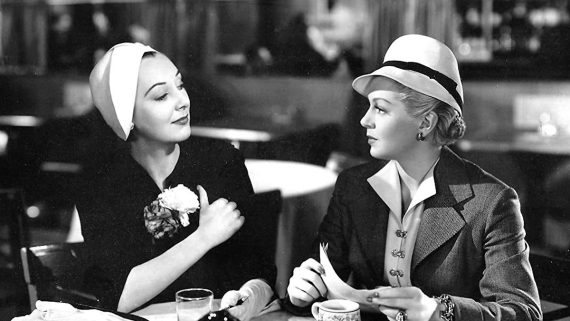
This unfortunately dated aspect aside, A Life of Her Own has much to recommend it. Despite her reputation as a less than great actor, Lana Turner is excellent as Lily, the small town girl who finds fame as a big city model. As the married man for whom she falls, Ray Milland is also memorable and the two have enough chemistry to convince audiences of the intensity of their whirlwind romance and the utter devastation of its premature climax. The standout however is the brilliant Ann Dvorak as Mary, a model whose thriving career is reaching its end and who is struggling to accept the notion of being on the scrapheap at such a young age. Dvorak has about fifteen minutes of screen time at the beginning of the film but she absolutely dominates, the tragedy of her decline and suicide somewhat upstaging the main event of the central romance. At this early stage it appears that A Life of Her Own is going to be an indictment of the harsh and shallow modelling industry and the pivot towards a doomed romance narrative instead is somewhat baffling. The film could have benefited from a little more focus on the modelling plotline which essentially dries up almost immediately. Perhaps there would have been a certain narrative circularity to Lily’s climactic suicide but given that the two deaths are not really thematically linked it would have been a very superficial flourish.
Given its numerous prominent flaws, it’s not hard to see why A Life of Her Own sank into obscurity, especially as it is sandwiched between two of Cukor’s finest comedies in Adam’s Rib and Born Yesterday. But for those who appreciate a bit of maudlin melodrama, this is worth a watch to experience Cukor’s sustained sense of yearning, tarnished romanticism, Turner’s strong lead performance and Dvorak’s film-stealing fifteen minutes.
21. THE PHILADELPHIA STORY
Generally, when reviewing a Hollywood classic (or any film, for that matter), I’d open with a broad overview of the movie itself and the context in which it emerged before arriving at the point of closer dissection. But to get to the root of why I have finally drawn the conclusion that George Cukor’s The Philadelphia Story falls short of its reputation as an indisputable masterpiece we must start at the story’s very beginning, “a very good place to start” according to Julie Andrews but, in this case, a very sour opening note. The Philadelphia Story opens with a wordless sequence in which rich socialite Tracy Lord (Katharine Hepburn) escorts her soon-to-be ex-husband C.K. Dexter Haven (Cary Grant) out of their house and symbolically snaps one of his golf clubs over her knee. Enraged, Dexter approaches her and raises his fist. Thinking better of it at the last moment, he instead places his entire palm over her face and forcefully throws her to the ground. Now, there’s no reason a romantic comedy shouldn’t begin this way but the problem is the tone in which the scene is played. This quite disturbing event is portrayed as a whimsical comment on the battle of the sexes; a japesome representation of the ups and downs of modern marriage. Its pantomime quality urges us to not take it too seriously and one can clearly imagine 1940s audience members of all genders belly-laughing their way through this opening sequence. It’s not for the film critic to try and excuse these misjudgements of tone but rather to contextualise them and obviously the many changes in predominant attitudes that have come about in the three-quarters of a century since The Philadelphia Story first hit cinemas play a significant part in explaining this disastrously dated opening gambit. But while it strikes a bum note that resonates long afterwards, it is not so much this alarming moment of spousal abuse that leaves a bad taste as it is the not-so-subtle subtext of the rest of the film which attempts to suggest that, well, maybe she deserved it.
The Philadelphia Story is regularly and at least partially justifiably celebrated for its script by David Ogden Stewart, based on the play by Philip Barry. Packed with quotable lines, poetic turns of phrase and moments of likeable goofball humour, its sparkling wit is often compared with the champagne so regularly uncorked by its cast of socialite characters. And yet, with too much champagne comes the inevitable hangover and, in this case, the subsequent remorse comes courtesy of The Philadelphia Story’s forays into drama. One of the reasons this film is so highly praised over other romantic comedies of the era is its ambition to include a vein of serious social commentary and examine human relationships with a sensitivity lacking in its more knockabout counterparts. The story begins a couple of years after its grotesque prologue, with Tracy divorced from Dexter and soon to be married to George (John Howard, struggling to make a mark in an underwritten role). As she prepares for her upcoming nuptials, Tracy is alarmed by the arrival of Dexter who brings with him two journalists from ‘Spy’ magazine. Although she is resistant to their presence, Tracy eventually finds herself drawn to reporter Mike Connor (James Stewart). So we have the makings of a classic love triangle (I say triangle rather than square because no-one in their right mind thinks Tracy will ever end up with non-entity George) complicated by the presence of Tracy’s extended family including her disgraced philanderer of a father.
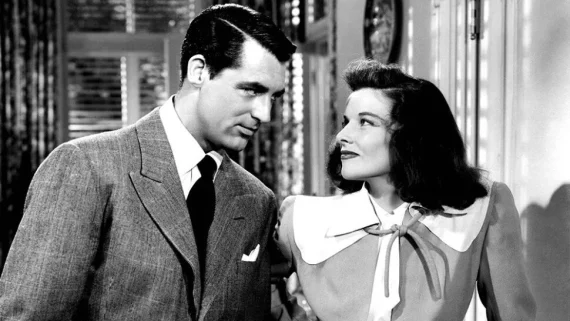
There is plenty of room in this scenario for exploring relationships, love, marriage and gender roles in depth and you’d have to be fairly naïve to expect populist views of the 1940s to marry up with present day equivalents. What’s more, The Philadelphia Story is really more concerned with commenting on basic humanism than it is interested in gender politics. The main theme is the virtue of understanding people’s weaknesses and the power of love, warmth and kindness. But the script tips its hand as regards its own prejudices by managing to put the blame for practically every negative thing that happens squarely on the shoulders of one woman. The men in Tracy’s life have made some serious mistakes. We learn that the break-up of her first marriage, and no doubt the catalyst for that brutal introduction, was Dexter’s descent into alcoholism, while her father left the family to pursue an affair with a young dancer. Fairly early on in the film, Dexter explains how his drinking increased because of Tracy’s coldness towards him over his habit. Rather than support him through his problem, she turned her back on him and drove him deeper into the bottle. There’s certainly a case to be made that Tracy’s behaviour played a part in Dexter’s deterioration but for this to have any weight Dexter himself would have to accept some responsibility for both his drinking and the crumbling of his marriage. There is no hint of remorse from him over either. He declares Tracy’s reaction to his heavy boozing to be born of impossibly high standards and portrays himself as a victim rather than a co-conspirator in his own downfall. Tracy takes Dexter’s accusatory speech to heart but what has Dexter learned from the experience? Later on in the film, we see him slipping off with some of the chaps for an “eye-opener”.
If Dexter’s denouncement seems somewhat rich, at least there is a grain of relatability in it which is more than can be said for The Philadelphia Story’s most abominable moment courtesy of Tracy’s father. As played by John Halliday, Tracy’s dad is a pillar of level-headed respectability and the script aims to underline this, despite informing us early on of his abandonment of his family in order to pursue an affair. Despite Tracy not wanting him at her wedding, dear old Pop barges his way into the celebrations (because Daddy knows best!) and then, when confronted with his actions, unleashes one of the most unbelievably bare-faced pieces of hypocritical nonsense ever uttered by a character we’re actually supposed to heed. He claims that his philandering is the result of lacking an adoring daughter, “a girl of his own, full of warmth for him, full of foolish, unquestioning, uncritical affection”. He actually blames his actions on Tracy’s lack of warmth towards him. The crux of his argument is the line “A devoted young girl gives a man the illusion that youth is still his…because, without her, he might be inclined to go in search of his youth.” Now, the psychological flimsiness of this statement aside, everyone seems to forget at this point that the man speaking has TWO BLEEDING DAUGHTERS! Tracy’s sister Dinah, wonderfully played by the young Virginia Wielder, has already appeared prominently and established herself as anything but cold and forgettable. Was one adoring young girl not enough to satiate Daddy’s lust for youth? Or is it just possible that he went after that dancer with intentions that extended beyond the need for a daughterly adoration? As with Dexter’s speech, there is little in Tracy’s father’s words to suggest he accepts much blame himself and his contention that a philanderer is better than a spinster is atrocious. The Philadelphia Story is clearly a film that puts a lot of stock in the institution of marriage but at what cost? In an early scene before they are reunited, Tracy’s mother sighs regretfully that she got her dignity back at the expense of a husband. The clear implication is that the loss of a man, however unfaithful, is too high a price to pay for a woman’s self-respect.
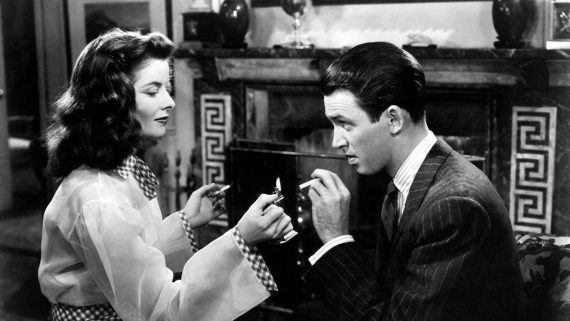
OK, so we’ve torn some strips off The Philadelphia Story but why is it so revered? Well, for one thing there’s the cast. I can barely think of three more inviting banner names than Katherine Hepburn, Cary Grant and James Stewart and to have all three of them together in one film is an embarrassment of riches. Each of these superstars has their own very distinct acting style and they play off each other beautifully, never once giving the impression that any one of them is vying for the spotlight. Stewart, in particular, is excellent in his Oscar-winning performance as the cynical newspaperman, slipping effortlessly between the roles of comedic foil and romantic lead and throwing in one of the most charming pieces of drunk acting in Hollywood history. If Stewart takes the top acting honours, Hepburn arguably has the tougher role to play. Despite her perpetual mistreatment at the hands of a string of men, Tracy is the story’s centre and her fluctuation between headstrong resilience and wounded vulnerability is the major factor in saving the persistent emotional pounding she takes from appearing even more ugly. Grant, meanwhile, is disarmingly likeable as Dexter, calmly keeping control over events and tossing in one-liners from the sidelines. The only issue with the performance is that we never once glimpse any element of the despairing alcoholic he apparently once was, but this is more a flaw in the writing which, after all, wants us to believe that none of that was really anything to do with Dexter himself!
The Philadelphia Story is often described as “beautifully written” but that is to ignore an inescapable ugliness that lurks within it. It is certainly eloquently written, often witty and sometimes laugh-out-loud funny but I’d go so far as to say there is a side of it which staggers into emotional-stupidity. For what is essentially a story with a female focus, David Ogden Stewart’s script (and presumably Philip Barry’s original play) has such a painfully, consistently male viewpoint that when Tracy declares “I think men are wonderful” at the end of the film, it feels like an uncomfortably literal statement of the moral but with the words “if only us women would treat them right” being the barely-hidden subtext. I can certainly see why The Philadelphia Story is thought of so fondly. At its best, the film really does sparkle like champagne. Unfortunately, every few minutes the viewer is compelled to chase that bubbly with a shot of vinegar.