


 Director: John Frankenheimer
Screenplay: Ernest Lehman, Kenneth Ross, Ivan Moffat
Based on a Novel by: Thomas Harris
Starring: Robert Shaw, Bruce Dern, Marthe Keller, Fritz Weaver, Steven Keats, Bekim Fehmiu, Michael V. Gazzo, William Daniels
Country: USA
Running Time: 143 min
Year: 1977
BBFC Certificate: 15
John Frankenheimer first made his mark in TV in the 1950s before transitioning into films towards the end of the decade. He hit his stride in the early-to-mid 60s, with a remarkable run of critical and often commercial successes, including Birdman of Alcatraz, The Manchurian Candidate, Seven Days in May, The Train and Seconds. As the decade ran on and the 70s began, however, Frankenheimer hit rocky ground, with many of his films struggling to find an audience and enjoying less critical acclaim than he’d previously experienced.
In 1975, however, he got the job of directing French Connection II. The resulting sequel didn’t share the resounding success of its predecessor, but it performed well enough to get Frankenheimer back in the game, leading to him being approached to direct Black Sunday.
The film was based on the debut novel of former journalist Thomas Harris (now more famous for his Hannibal Lecter novels). It wasn’t a big hit in hardback form, but, after Paramount bought the rights to adapt it into a film, the paperback version became a great success.

However, Frankenheimer’s cinematic adaptation of Black Sunday sadly wasn’t a hit itself. It wasn’t a flop, but it failed to live up to the expectations its studio had for the seemingly hot property. Two-Minute Warning, a thriller with a vaguely similar set-up, was released only six-months prior, which might have dampened its impact. Perhaps more notably, however, was the fact that audiences clearly clamoured for more fantastical fare in 1977, with Star Wars and Close Encounters of the Third Kind raking in the cash, along with the much more lighthearted Smokey and the Bandit.
Over time, however, people have stood up for Black Sunday, claiming it deserves a place alongside some of the strongest titles in Frankenheimer’s back catalogue. Now, it’s being released on Blu-ray by Arrow Video, so, being a fan of the director, I got hold of a copy to share my thoughts.
Black Sunday sees Marthe Keller play Dahlia Iyad, a member of the terrorist organisation, Black September (a real-life organisation who were behind the assassination of the Jordanian Prime Minister Wasfi Tal, as well as the infamous massacre at the Munich Olympics in 1972).
Iyad has forged a relationship with Michael Lander (Bruce Dern), a disturbed Vietnam veteran who had been a prisoner of war. Lander is keen to make a grand statement, aiming a suicidal attack at the USA, the country he blames for ruining his life. Iyad wants to use him to badge the planned attack in the name of Black September, calling attention to the plight of the Palestinians and to punish the United States for supporting Israel.

Their plan is to fly the iconic Goodyear Blimp (of which Lander is a pilot) into the centre of the Miami Orange Bowl during the Super Bowl and detonate an explosive that should kill most of the 80,000 spectators, including the President of the United States.
Hot on Iyad’s trail, however, is Major Kabakov (Robert Shaw), an Israeli Mossad agent hellbent on putting an end to Black September. After an attack on one of the terrorist organisation’s safehouses in Beirut, Kabakov learns that something is being planned in the US, so he heads over there to attempt to avert it.
Black Sunday is often lumped with the glut of disaster movies that were released in the 1970s, but, in centring its otherwise fictional story around an actual terrorist organisation and spending more time with them and the Mossad agent looking to stop them, rather than following victims trying to survive, it has quite a different feel.
What immediately stood out for me was how surprisingly balanced the film was, particularly for the era in which it was made. Whilst the terrorists’ plan is never cast in a positive light, we do hear about the events that set both Iyad and Lander down this path. They aren’t cartoon villains. They have depth.
Supposedly, the source novel wasn’t quite as kind to its villains, but the film changed during its adaptation to the screen. The initial script was written by the great Ernest Lehman, who had worked with Hitchcock on classics such as North by Northwest, as well as penning smash hits like West Side Story and The Sound of Music. His script was unreasonably long, though, so Kenneth Ross and Ivan Moffat were brought in to trim it back. They were reportedly the ones responsible for making the terrorists more human on screen.

It’s in the film’s favour, in my opinion, making for a richer, more thought-provoking experience. On release, there was a lot of controversy about its depiction of international terrorism, but, actually, domestic terrorism plays a bigger part than you might initially think through the advertising and setup of the film. Lander is the more unhinged of the terrorists, and he’s an American war veteran who wants to hit back at the country he feels failed him.
Away from the depiction of terrorists, Black Sunday works effectively as a gripping thriller. It’s a long film, but Frankenheimer effortlessly intercuts between the characters, building tension slowly up to the grand finale.
And what a finale it is. Shooting some material at the actual Super Bowl, more at the stadium away from match day and some effects shots at the studio, it’s a tremendous feat of management and editing, stitching it all together seamlessly. Granted, a couple of effects shots don’t hold up so well today, but, on the whole, it’s convincing and tremendously exciting.
Negotiating the use of the Goodyear Blimp was difficult, as you might imagine (hey, would you let us use your world-famous aircraft-cum-billboard as a deadly weapon in a film?). Frankenheimer tells an eye-opening story about how they eventually won them over. I’ll let you listen to that yourself, though.
Interestingly, John Williams composed the score for the film in the same year as his much more famous Star Wars and Close Encounters soundtracks. Whilst his work in Black Sunday is nowhere near as iconic as those scores and is used relatively sporadically, Williams’ music in the film is highly effective, particularly in the finale.

Black Sunday looks great too. DOP John A. Alonzo (who also lensed Chinatown and The Magnificent Seven) gives the film a naturalistic look, making the most of the locations, whilst still crafting some beautiful compositions, in places.
The cast is also superb. Dern gets the showiest role, and one that suits the actor’s typically nervy style. He fully commits to it and does some fine work. Shaw is suitably intense and grizzled as our ‘hero’ (though he isn’t a paragon of goodness, aiding the balanced view taken by the film). It’s the less well-known Marthe Keller, coming off the back of Marathon Man, who does the more subtly powerful and nuanced work here, though. She’s another reason the film is so successful in crafting believable characters.
Overall then, Black Friday is a tense, thrilling terrorist/disaster movie with a strong cast and a refreshingly human approach to its subject matter.
Film: 

Black Sunday is out on 9th March on region B Blu-Ray, released by Arrow Video. The transfer is fantastic, with a clean image and lovely natural colours and textures. There are three audio options – mono, 5.1 and 2.0. I opted for mono and thought it sounded great – rich, detailed and full.

LIMITED EDITION CONTENTS
• High Definition (1080p) Blu-ray presentation
• Original restored lossless mono audio, presented for the first time on Blu-ray
• Optional restored lossless 5.1 and 2.0 stereo audio options
• Optional English subtitles for the deaf and hard of hearing
• Audio commentary by film scholar Josh Nelson
• It Could Be Tomorrow, a visual essay by critic Sergio Angelini, exploring the film’s adaptation and production, and its place within the pantheon of 70s terrorism thrillers
• The Directors: John Frankenheimer, an hour-long portrait of the director from 2003, including interviews with Frankenheimer, Kirk Douglas, Samuel L. Jackson, Roy Scheider, Rod Steiger and others
• Image gallery
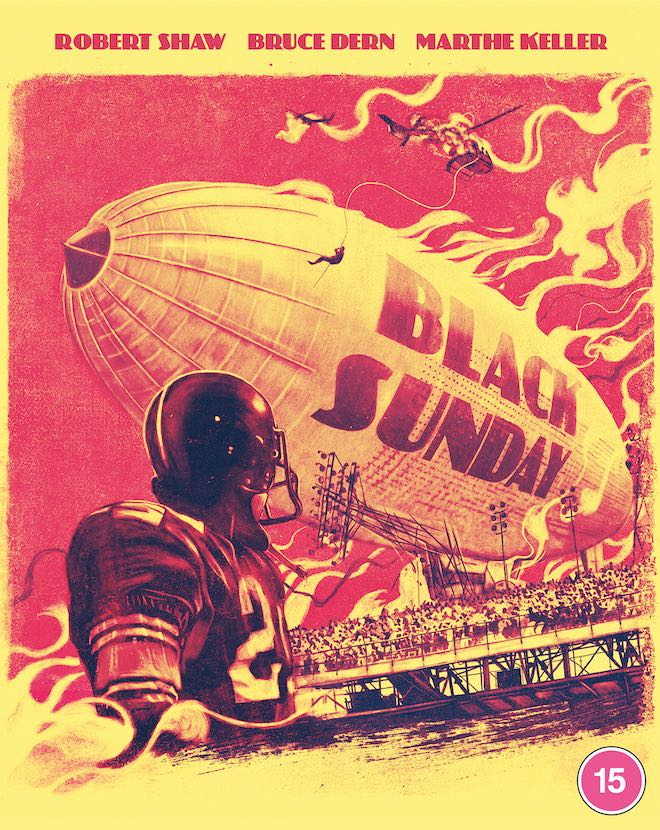
• Reversible sleeve featuring original and newly commissioned artwork by Peter Strain
• Collectors’ booklet featuring writing on the film by Barry Forshaw
Josh Nelson provides a commentary. This is excellent. He looks at the production history and the film’s depiction of terrorism, reading from a number of autobiographies and interviews of those involved along the way. It’s engrossing and immensely valuable.
There’s also an essay by Sergio Angelini about the film. It’s a valuable piece that blends contextual analysis with illuminating production background information. It makes for a strong alternative for those without the time or patience to listen to the whole commentary.
Finally, there’s an hour-long documentary about Frankenheimer on the disc. It takes us on an enjoyable chronological tour through his career with contributions from the man himself, alongside other notable stars and collaborators. There are some fun stories to tell. There’s a little ar*e kissing in it too, but not enough to spoil things.
I didn’t get a copy of the booklet to comment on that, unfortunately.
So, Arrow have done a great job with this underrated classic. There aren’t a lot of extras, on paper, but everything included is substantial and worthwhile, adding immense value to the set. Highly recommended.
Disc/Package: