



Director: Sadao Nakajima
Screenplay: Tatsuo Nogami
Starring: Tsunehiko Wasabe, Miki Sugimoto, Mitsuru Mori, Asao Koike
Country: Japan
Running Time: 100 minutes
Year: 1973
BBFC Certificate: 18
The release of Sadao Nakajima’s The Rapacious Jailbreaker was one of my favourites from Radiance last year. This wild and explosive film was an absolute revelation, introducing me to a brilliant director who most definitely blazed his own trail, firstly through the decaying studio system at Toei, and then later in independent cinema. This was recently followed by the complete release of his epic Japanese Godfather Trilogy series, and now we have Aesthetics of a Bullet, due for release on the 18th of May.

Kiyoshi Koike (Tsunehiko Wasabe) is a low-level street hustler scuffling around the back streets of Tokyo, while all around him loom the overwhelming symbols of the post-war economic boom. The opening credits are a seething collage of rampant consumerism and excess, with both people and animals stuffing their faces in gruesome close up. This visual carnage is accompanied by “Don’t Mess Around with Me”, a searing blast of hard rock by the superbly named group Brain Police. It is one of the all-time great opening sequences, and is as punk as hell. I expected Aesthetics of a Bullet to be a film from the late 70s, but in fact it was released in 1973, the year when the jitsuroku eiga or ‘true account’ yakuza films erupted into popular consciousness with Kinji Fukasaku’s landmark Battles Without Honor and Humanity.
This film is something different entirely: a character study of a man chosen by those we never see for a task that will end in certain death. Chosen to be a ‘bullet’ by a yakuza gang to cause chaos for their rivals on the southern island of Kyushu and be killed. In Koike, they have the perfect candidate: a perpetually angry, misanthropic young man who is envious of anyone who seems to have succeeded where he has not. For him, a gun, a suit and a million yen equals power, but he has just enough intelligence to realise that they are also a curse. That realisation causes him to live, in ever more desperate ways, during the time he has left.

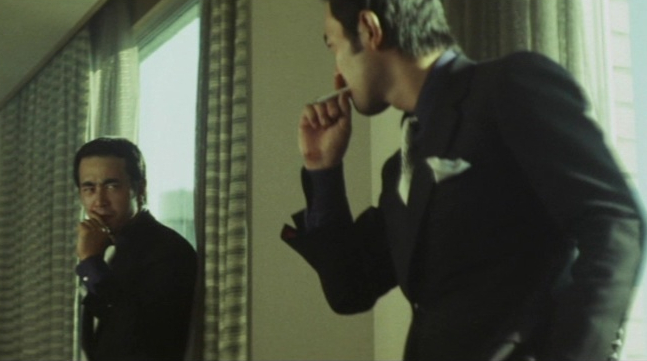
The promotional materials for this blu ray release invite comparisons between Aesthetics of a Bullet and Martin Scorsese’s Taxi Driver, principally because of key scenes where both lead actors address themselves in mirrors. However, there are huge differences: Travis Bickle’s monologue merely confirms his thirst for confrontation and violence, Koike’s confessional attempts to assume the role of a hardened yakuza summon up all of his anxieties. Despite the overall sleaziness of Bickle’s obsession with the underage Iris (Jodie Foster), De Niro never allows himself to be as vile and disreputable for Scorsese as Wasabe does for Nakajima. As Koike, Tsunehiko Wasabe unleashes one of the most unsparing portrayals of masculine inadequacy ever seen onscreen. His hard-won street smarts are undercut by his emotional instability. Whenever he does feel some glimmer of contentment, he is jarred back to reality and enacts brutality on those around him, primarily the women in his life. Certain scenes involving Wasabe and Miki Sugimoto are extremely hard to watch. Koike isn’t ‘god’s lonely man’, he is just another lamb to the slaughter.
Produced by the Art Theatre Guild – responsible for experimental classics such as Nagisa Oshima’s Diary of a Shinjuku Thief and Yoshishige ‘Kiju’ Yoshida’s Heroic Purgatory – Aesthetics of a Bullet is a masterclass in ferocious, full throttle film-making, with both cast and crew giving absolutely everything in the service of a truly exceptional director.
BLU-RAY LIMITED EDITION SPECIAL FEATURES
- High-Definition digital transfer
- Uncompressed mono PCM audio
- Newly filmed appreciation by filmmaker Robert Schwentke (2026, 30 mins)
- New interview with filmmaker Kazuyoshi Kumakiri (2026, 16 mins)
- Archival interview with Sadao Nakajima (2023, 19 mins)
- Trailer
- Newly improved English subtitle translation
- Reversible sleeve featuring designs based on original posters
- Limited edition booklet featuring new writing by Olaf Möller and two archival essays on the film
- Limited edition of 3000 copies, presented in full-height Scanavo packaging with removable OBI strip leaving packaging free of certificates and markings
The special features are of the highest calibre: Robert Schwentke’s appreciation of the film delves into many of the hidden details that illuminate the experience of watching the film, such as the background of the Art Theatre Guild, its miniscule production budget of just 10 million yen and a scarcely believable shooting schedule of only twenty days. The information about Nakajima’s deep love for Greek tragedy and especially Sophocles gives a special insight into the director’s abiding use of melodrama in his work. I always like hearing how these experts became fans of Japanese cinema, and Schwentke tells a great story about Japanese friends at college translating films as they watched for him back in the days of VHS. Kazuyoshi Kumakiri was first a student of and then assistant director for Nakajima on what would be his final film, Love’s Twisting Path in 2019. You can feel the depth of his friendship with the director in his recollections of working on the script on long days where Nakajima held court and told stories about his career. And you get to see and hear from Nakajima himself in a wonderful piece to camera, in turn displaying his love for his friend and colleague Tsunehiko Wasabe, who sadly died in 2017. And true to Kumakiri’s word, Nakajima is a truly great raconteur. The story of how one act of human kindness from one to the other was the key to a lifelong friendship is extremely moving. The trailer is a rip-roaring torrent of energy that leaves you in no doubt about what you are in for when you see this extraordinary film. The limited edition booklet sadly wasn’t available for me to review.
Aesthetics of a Bullet is a brutal and beautiful cult classic that finally has the chance to reach a brand new audience thanks to this exceptional forthcoming release by Radiance.