



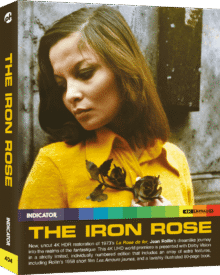
 Director: Jean Rollin
Screenplay: Jean Rollin with dialogue by Maurice Lemaitre and a poem by Tristan Corbière
Starring: Françoise Pascal, Hugues Quester, Nathalie Perrey, Mireille Dargent, Michel Dalessalle
Country: France
Running Time: 81 min
Year: 1973
BBFC Certificate: 15
By 1973, French surrealist horror director Jean Rollin’s films had focused on vampires. Indeed, all four at that time (The Rape of the Vampire, The Nude Vampire, The Shiver of the Vampires and Requiem for a Vampire) had featured the word of the fanged bloodsucker in the title, and these movies had given us a first taste of Rollin’s surreal horror, otherworldliness, breathtaking visuals, and his love of old cemeteries, chateaux and the beach at Dieppe, France.
For his fifth feature film, and a strong candidate for his best, The Iron Rose (La rose de fer), he left the world of vampires behind but still delivered on the themes and locations he would be known for: a chilling cemetery, a haunting beach and a dream-like quality, to deliver a masterpiece in atmosphere and the fantastique; a gothic horror that stays long in the memory.
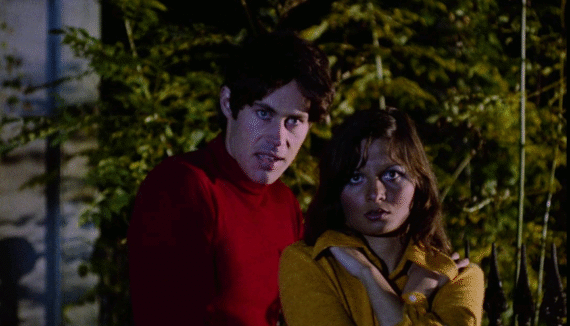
The Iron Rose follows a young man and woman played by Françoise Pascal and Hugues Quester who meet at the outset of the film at a wedding, agree to a date and then have a very strange night at a cemetery. After arriving at the gothic graveyard, which is crumbling and covered in spider’s webs, the pair make love, come across several odd characters, including a clown, and find that they are unable to leave the place. It’s best to go in knowing little else about the plot.
Like many of Rollin’s films, the visuals tell the story more than the words spoken; indeed, there are frequent dialogue-free sections in The Iron Rose. But the visuals and locations more than do the work here, creating a mood that feels very much as though we’re witnessing a waking dream, that’s very surreal at times (just what is a clown doing leaving flowers at a grave in the cemetery, for example?).

The film features two hauntingly shot sequences on Rollin’s favoured beach-setting, the woman picking up and almost immediately throwing away an iron rose at the outset, and then wandering around naked towards the finale. Sequences in the cemetery, the main location of the film, are also beautiful compositions.
There’s a palpable sense of dread throughout, helped no end by a creepy and moving score by Pierre Raph and striking cinematography by Jean-Jacques Renon. Renon’s camera captures empty streets of a historic French town, the beauty of a historic building, a fog-swept field and, of course, the eeriness of the cemetery and beach settings. Arguably the best shot sees the camera spin as its focus is on the woman, who is looking down at her lover in a crypt.

Pascal is marvellous in what’s essentially the lead role. It would be the only film she’d appear in for Rollin, which is a shame, as based on this performance, she fits marvellously into his special cinematic vision. Quester is also great as Pascal’s character’s new lover who spends the night in the cemetery with her. The pair are the heart and soul of the film, with other characters sharing mere minutes of screentime, some just seconds. Yet, the characters who appear in the cemetery, like the clown mentioned earlier, leave their own lasting impression, despite their brief time on camera.
The film, which is experimental throughout, ends on a memorable sequence that made me ponder what had come before it, who the main woman was, and who the characters visiting the cemetery were. We’re left with a poignant final image and plenty to digest.

The Iron Rose contains many of the elements that, for me, make the films of Jean Rollin special: beautiful poetic visuals, evocative atmospheric gothic locations like a graveyard and a cold French beach, a sense of the otherworldly, and an intriguing mystery, in this case why the couple are unable to leave the central location and who the woman is. It’s a masterpiece of mood and, for me, the director’s best film. I’ve seen it numerous times and this was my personal favourite viewing yet, bolstered by an absolutely first-class new restoration.
Film: 
The Iron Rose is released by Powerhouse Films on their Indicator label on 26th May 2025 on separate limited edition 4K UHD and Blu-ray releases. I reviewed the 4K edition, and it looks simply astonishing thanks to that aforementioned new 4K restoration from the original negative by Powerhouse Films. Colours are vivid, detail is incredibly clear and rich, there’s just the right amount of visible grain, and the whole film simply looks astonishing.
INDICATOR LIMITED EDITION 4K UHD SPECIAL FEATURES
New 4K HDR restoration from the original negative by Powerhouse Films
4K (2160p) UHD presentation in Dolby Vision (HDR10 compatible)
Two presentations of the film: La Rose de fer, Jean Rollin’s original French-language version, and The Crystal Rose, the English-language version
Original mono audio
Audio commentary with film historian Tim Lucas (2025)
Jean Rollin Introduces ‘The Iron Rose’ (1998)
Archival interview with Rollin (2010): the filmmaker discusses The Iron Rose
Les Nuits du cimetiere (2024): in-depth documentary on the making of The Iron Rose by Rollin’s personal assistant, Daniel Gouyette, featuring interviews with key Rollin associates Jean-Noël Delamarre, Natalie Perrey and Alain Petit
Archival interview with Françoise Pascal (2012)
Newly edited interview with Françoise Pascal (2025)
Critical appreciation by author and film historian Stephen Thrower (2025)
The Yellow Loves (Les Amours jaunes,1958): Rollin’s impressionist interpretation of the poetry of Tristan Corbière
Marcelline Block on Tristan Corbière (2025): the academic explores the poet’s influence on Rollin’s work
Original theatrical trailers
Image gallery: promotional and publicity material, and behind the scenes
New and improved English translation subtitles for the French soundtrack
New and improved English subtitles for the deaf and hard of hearing for the English version
Limited edition exclusive 80-page book with a new essay by Nick Pinkerton, an archival introduction by Jean Rollin, a reprint of Rollin’s original 1972 scenario titled The Night of the Cemetery, an archival interview with Françoise Pascal, Jean Rollin on The Yellow Loves, an introduction to the poetry of Tristan Corbière, and full film credits
World premiere on 4K UHD
Limited edition of 10,000 individually numbered units (6,000 4K UHDs and 4,000 Blu-rays) for the UK and US

The extras start with one of two standout ones, a new commentary by the always brilliant Tim Lucas. He highlights how from the opening shot, a gorgeously framed shot of the beach at Dieppe, we know that we’re in Rollin’s world. Lucas provides so much detail about the film, the shoot, the actors and other crew, and also provides some scene-specific commentary on sequences in the film. It’s an outstanding commentary, with Lucas continuing to cement his reputation as one of the best around.
An archival one-minute introduction to the film by Rollin is a welcome inclusion but gives little time for any substance to be gleaned.
A four-minute archival interview in French with English subtitles with Rollin is also included, which touches on locations, including the cemetery. He speaks about the shoot and the rediscovery of his films, which was happening at the time of the interview.
Les Nuits du cimetiere is a newly edited version of a 16-minute archival documentary on the film, featuring interviews with Rollin-regular Nathalie Perrey, who appears as one of the visitors to the cemetery, assistant director Jean-Noël Delamarre, and frequent collaborator Alain Petit. They all share some brief but very interesting anecdotes about the making of the film.
Three archival pieces with lead actress Francoise Pascal are included. The first runs for 22 minutes and sees the actress on fine form, sharing memories of the shoot, the nudity, her take on the character, and how she hadn’t heard of Rollin before being approached to star in the film. The second is a 24-minute piece called Woman is Free, in French with English subtitles, which goes into more detail about Pascal’s upbringing and childhood, which is very interesting, before moving through some of the other actors she knew, early dance performances on Top of the Pops and other films she appeared in. It’s a good whistle-stop tour through her life and career, including a decent segment on The Iron Rose. The final piece is brief footage of a 2018 signing event with Pascal, which runs for just over two minutes.
Stephen Thrower’s appreciation runs for 31 minutes and is typically insightful, entertaining and rich with detail. It highlights the differences in the film to Rollin’s early movies, its place in his career, the director’s background (his parents had interesting lives) and how he got into filmmaking. Thrower gives a run-through of the vampire films of Rollin, the reception to his movies and how they were difficult to see at one time, before delving deeper into The Iron Rose, its themes and what makes it so special. The other standout extra on the set, together with the Lucas commentary.
Four trailers are included, two French, and two international, totalling four minutes each. Both of the international trailers feature the English language title, The Crystal Rose.
Four image galleries are also included. The first contains just over 40 original promotional materials, including black and white and colour images and VHS covers. Next is a behind the scenes gallery of almost 50 images. Finally we get almost 10 images of the dialogue continuity script, and a further near 10 of ‘La Nuit de cimetière’ a prose treatment, which is an archival short story that became the film.
The Yellow Loves (Les Amours jaunes), Jean Rollin’s first experiment in original filmmaking as a 20-year-old in 1958 is also included. The 11-minute short looks striking and features poetry by 19th century poet Tristan Corbière. It’s a visually arresting piece, the coast looking gorgeous in black and white and with some beautifully composed images and sequences. It’s a world away from vampires but shows that Rollin already had an eye for a striking visual and knew what themes and images meant the most to him.
Tim Lucas also pops up to provide a commentary on The Yellow Loves which provides detail about the short film, which was ambitiously shot on 35mm and filmed on the coast of Dieppe in France which Rollin loved so much and would return to in his feature films, like The Iron Rose. Lucas places the film in the context of Rollin’s life at the time, and what he’d done beforehand and how he got into cinema, as well as some background to Corbière and links to Rollin’s feature films to come. It’s another of Lucas’s fabulous commentaries, albeit briefer than usual.
The 80-page booklet is a typically lavish affair from Indicator, which enriches the experience of the film, providing welcome analysis and archival pieces. Nick Pinkerton provides a new essay which starts with reference to the original seven-page scenario for the film published the year before it was released before running through some of the scenes and themes. It’s a great article. Also included are several archival pieces with Rollin, including one on The Yellow Loves, in addition to a reproduction of the short scenario Pinkerton referenced in his essay, a good archival interview with lead Pascal and a 2018 look at Corbière, which provides some useful context. Indicator frequently set the standard for booklets, and this one is no different.
The love and attention given to the films of Jean Rollin on the Indicator label is a joy to behold, and this is no different for perhaps Rollin’s best film, The Iron Rose. The phenomenal new 4K restoration is a revelation, the film looking simply out of this world and setting a benchmark for the restoration of 1970s genre cinema, and Indicator have also supplemented this with a wealth of archival extras, including Rollin’s first short film, as well as essential new commentaries by Tim Lucas on the feature and short and a brilliant new appreciation by Stephen Thrower. A strong mid-year candidate for my end of year ‘best of’ list and highly recommended for fans of Rollin’s special cinematic universe.
Disc/Package: