



 Directors: Kurt Maetzig, Gottfried Kolditz, Herrmann Zschoche
Years: 1960-1976
Country: Germany
After doing a sterling job restoring pulp cinema of West Germany, Eureka! Are now doing the same to the East German side. This box set of four DEFA productions showcases the unique world of East German SF, covering DEFA’s series of ‘utopian film’, films that presented a socialist view of space exploration. Like their Yugoslavia-shot westerns (with native American protagonists), they are a unique take on traditionally Anglophone genres.
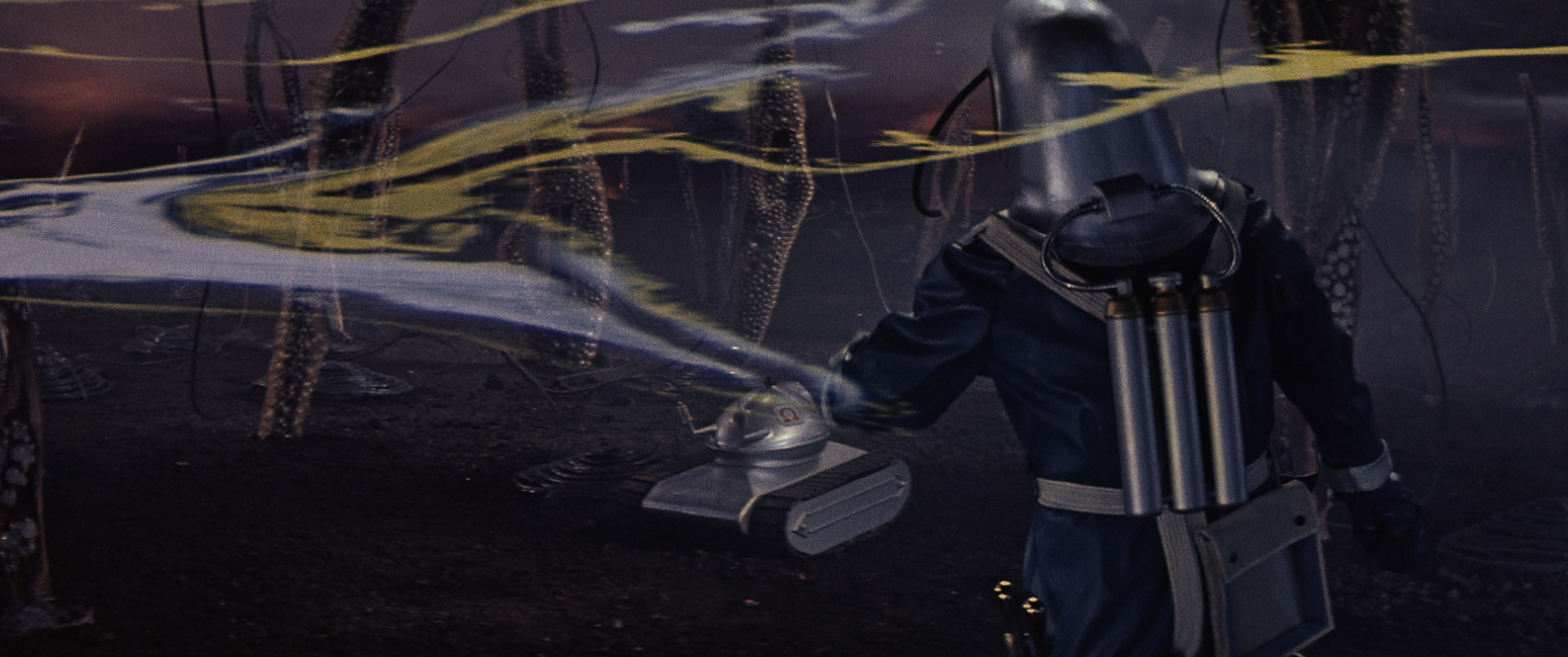
The Silent Star, better known under its US release version as The First Spaceship on Venus, is a colourful, expensive, expansive story of international space co-operation and exploration, driven by a mysterious alien object found in the Gobi Desert, that turns out to be debris from the Tunguska Explosion.
Unlike later films, The Silent Star, made shortly before the Berlin Wall went up was made with an eye on a release in the west. The film was co-produced with Poland, based on a novel by Stanislaw ‘Solaris’ Lem. plans were made to get an American, but East German bureaucracy vetoed this. Instead, DEFA recruited the French-Japanese starlet Yoko Tani, who although did work in Hollywood (My Geisha) and UK (The Savage Innocents, The Wind Cannot Read, Invasion) mainly worked in Europe (including work for CCC in West Berlin on The Secret of Dr Mabuse). Further diversity is included, with possibly the first black astronaut in film, African communications officer Talua played by a mysterious Nigerian or Kenyan medical student named Julius Ongewe, studying in Leipzig at the time, as well as a Chinese doctor (Tang Hua-Ta)
The English version interestingly swaps nationalities. The German pilot Raimund Brinkmann (Gunther Simon) becomes Robert Brinkman, while US scientist Professor Hawling (Oldrich Lukes) becomes foreigner Orloff.
I had seen this film before, but in a pretty terrible, washed-out dubbed PD print. I did not realise how beautifully shot this film was. One can see how expensive the film was, with massive Raygun Gothic sets filled with garishly dressed ‘international’ types i.e. TV report Joan Moran (Lucina Wynnicka) and the Indian Professor Sikarna (Kurt Rackelmann in very, very light brownface – only his Nehru shirt and Gandhi hat indicate his ethnicity). With a wide scale (polar stations, moonbases, radio-telescopes), the film feels perhaps even grander than any US film of the era. I often mourn that East Germany did not make its own international espionage thrillers a la Bond or even Edgar Wallace, but this almost shows what such a film might have been like. However, once it goes into space, it feels very generic, with metal bugs attacking our heroes and a proto-Roomba cute robot.
Signals – A Space Adventure (1970), directed by Gottfired Kolditz is a Polish-coproduced vehicle for the famed Yugoslavian actor Gojko Mitic who starred not only in the DEFA series of westerms playing Indian braves, but also the rival West German Winnetou series opposite the likes of Pierre Brice. Blessed with a very 2001-ish space station design and featuring more multiracial space crews, including Egyptian actress Soheir El-Morsheidy. There is a lot of sub-2001 ponderous space travel, but is livened up by an animated short film watched diagetically by the crew. This is animated by Stanislaw Dulz, whose creations Lolek and Bolek notoriously became regulars on a cash-strapped RTE in Ireland. It certainly adds variety to a film which seems like so many of these films, prototypical of Eastern bloc SF. These films never look cheap. They always look handsomely mounted, but in the case of this, it feels rather cold and dry. These are films that promote unity, but the story is a ‘realistic’ one of a potential space disaster, with little fantastical elements.

This is unlike Eolomea (1973), a DEFA co-production with the USSR’s Mosfilm and the original Soviet-era pre-Nu Image incarnation of Boyana Film of Bulgaria, written by noted Bulgarian writer Angel Wagenstein. Probably the best film, centring on the disappearance of cargo spacecraft, it is another story of international unity. Starring Cox Habbema, a Dutch actress then resident in East Berlin as a feminist hero (fittingly, Habbema later starred in Marleen Gorris’ Dutch landmark feminist film De stilte rond Christine M (1982)), it is a dreamy, beautiful film with weird nostalgic dream sequences and an idealist approach. The 70 mm photography is breathtaking, even the naff slow-motion love montages are rendered epic. The Mosfilm co-operation is obvious, reminding one of the superior Mosfilm SF The Silence of Dr Evans (1973). There is also the memorable presence of Soviet acting legend Vsevolod Sanayev as Kun, a kind of Soviet Quatermass with a penchant for old-fashioned alarm clocks.
In The Dust of the Stars (1976) is an East German-Romanian co-production. Interesting in being a pre-Star Wars space opera where Earth is never referred to, It feels like a mix of elements. With musical numbers involving alien slave girls, a slight post-2001/Space 1999 design aesthetic but Star Trek plot dynamics, and otherwise design elements reminiscent of Barbarella, it is an entertaining Eastern Bloc Euro-pud, with actors from all over the Iron Curtain including Ekkehard Schall (the son in law of Bertholt Brecht), Pole Leon Niemczyk (best known for Knife in the Water and later star of Polish soap Pierwsza Milosc/Soupy Norman) and Serbian Mitch Benn look-alike Milan Beli (a regular in international films shot in Yugoslavia like the Long Ships). However, the film though colourful and full of unique images (the heads!), it is a rather antiseptic Socialist parable in serial pulp drag.
All in all, the films are an acquired taste, but the package is informative and educational, and well worth buying for anyone interested.
Also included is Love 2002 (1970), a DEFA short film, which plays out like a psychedelic 24 minute featurette that resembles a Soviet Bloc Zeta One (1970), before becoming increasingly divided – going from TV news to opera.

Strange New Worlds : Science Fiction at DEFA is released on Blu-ray on 20th May by Eureka.
SPECIAL FEATURES
– Limited Collector’s Edition Box Set [2000 copies]
– Limited edition hardcase featuring new artwork by Carly A-F
– Limited edition 60-page collector’s book featuring an introduction by Mariana Ivanova, Academic Director of the DEFA Film Library, and new writing by DEFA historians Sebastian Heiduschke, Sonja Fritzsche and Evan Torner
– All four films presented in 1080p HD from restorations by the DEFA Foundation
– Reversible inner sleeve artwork featuring new designs for each film by Carly A-F
– Signals: A Space Adventure presented from a new 6K scan of the original 70mm camera negative
– Eolomea presented from a 4K scan of the original 70mm camera negative
– The Silent Star and In the Dust of the Stars presented from 2K scans of the original 35mm camera negatives
– The Robot (Klaus Georgi, 1968) – animated short produced by the DEFA Studio for Animation Film
– Jana and the Little Star (Christl Wiemer, 1971) – animated short produced by the DEFA Studio for Animation Film
– Love 2002 (Joachim Hellwig, 1972) – documentary short on the future of love in East Germany produced by the DEFA Studio for Newsreels and Documentary Films
– Optional English subtitles on all features and shorts, newly revised for this release
– New audio commentaries on all four features by Rolland Man and presented by David Melville Wingrove
– Marx Attacks – new video essay by Daniel Jonah Wolpert on In the Dust of the Stars
– Blast Off – new interview with science fiction scholar Mark Bould
– Red Skies – new interview with Soviet cinema expert Claire Knight
– British Filmmaker Visits DEFA (1959) – archival newsreel documenting Anthony Asquith’s visit to the set of The Silent Star
– A Rocket in the Soviet Zone (1959) – archival newsreel covering the making of The Silent Star
– Cosmonaut Dreams – archival featurette on the making of Eolomea, featuring special-effects cameraman Kurt Marks, costume designer Barbara Müller-Braumann and technician Jan-Peter Schmarje
– Dusting Off After 30 Years – archival interview with Peter Suring, director of photography on In the Dust of the Stars
– Original theatrical trailers