



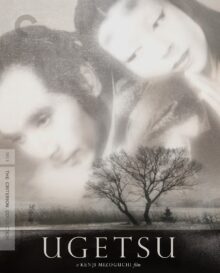
 Director: Kenji Mizoguchi
Screenplay: Matsutaro Kawaguchi and Yoshikata Yoda
From Tales of Moonlight and Rain by: Akinari Ueda
Starring: Machiko Kyo, Masayuki Mori, Kinuyo Tanaka, Sakae Ozawa, Mitsuko Mito, Kikue Mori, Ryosuke Kagawa, Ichiro Amano, Sugisaku Aoyama, Ichisaburo Sawamura
Country: Japan
Running Time: 97 min
Year: 1953
BBFC Certificate: 12
Japanese director Kenji Mizoguchi directed around 100 films during a career spanning more than 30 years, including acclaimed movies like The Story of the Last Chrysanthemums, The Life of Oharu, and Sansho the Bailiff. One of his unmitigated masterpieces, and a late career work coming just three years before he sadly passed away at the age of 58, is 1953’s Ugetsu, also known as Ugetsu Monogatari.
The film, being released in May 2025 on dual-format 4K UHD and Blu-Ray by the Criterion Collection, is credited on screen as being from Tales of Moonlight and Rain by Akinari Ueda, specifically the stories The House in the Thicket and A Serpent’s Lust, though one of its subplots is also inspired by a story by Guy de Maupassant called How He Got the Legion of Honor.

Ugetsu is set in 16th century Japan, specifically Lake Biwa in the Province of Omi, and follows the tale of farmer and craftsman Genjuro (Masayuki Mori) who is travelling to try to sell his wares to warring armies for a profit. His neighbour Tobei (Sakae Ozawa), who dreams of becoming a samurai to fulfil his ambitions of becoming rich and famous, together with Genjuro’s wife Miyagi (Kinuyo Tanaka) and young son, and Tobei’s wife Ohama (Mitsuko Mito) flee their village after it is looted. The wives had wanted to stay at home and live a simple life, but their husbands are stubborn and fixated on fame and fortune.
They travel across Lake Biwa and encounter a boat in thick fog, whose only passenger gives a stark warning. Genjuro decides to leave his wife and son on the bank of the river to continue selling his wares, promising to return in ten days but encounters Lady Wakasa (Machiko Kyo) and her female servant who ask him to help them return to their home. Genjuro falls in love with the Lady (little knowing she’s not as she seems) and Tobei also goes his own way to fulfil his dream of becoming a samurai and finding his own wealth and celebrity.

Ugetsu becomes increasingly atmospheric, spooky and haunting as the plot develops. It begins on the lake with that encounter with a boat. It’s an incredibly atmospheric and rightly lauded sequence as the boat appears from the mist, a warning is issued, and the way is paved for the more supernatural elements of the tale that are still to come.
This is ostensibly a ghost story and the spookiness soon comes to the fore after the boat sequence, with Genjuro’s encounter with the Lady, who he falls in love with, and her servant; spoiler alert for those yet to see the film… they are dead, their home destroyed sometime earlier, and they and their abode are only visible to Genjuro, with their interactions completely taking place in his head.

These elements of the film are among the most striking and memorable. The atmosphere and tensions build to a crescendo, from that amazing sequence on the lake, to some incredibly spooky moments with the Lady and her servant. These are underpinned by an off-kilter, eerie score by Fumio Hayasaka.
The lake sequence might be hailed as the film’s best, but it’s not the only beautiful, visually-arresting one in the film. Throughout the near 100-minute running time the cinematography is a joy to behold, with lengthy tracking shots (one that moves from night to day is particularly impressive), 360-degree shots, and scenes framed like works of art. It is widely considered to be one of the most beautiful films ever made, with frequently interesting shots and an oft-moving camera.

Performances are also exquisite, particularly the female performers, led by Machiko Kyo as Lady Wakasa (very otherworldly), Kinuyo Tanaka as Genjuro’s wife Miyagi and Mitsuko Mito as Tobei’s wife Ohama, as well as Genjuro himself, played by Masayuki Mori.
The tension and atmosphere in Ugetsu builds and builds until, ultimately, the fates of Genjuro and Tohei are sealed by their greed and vanity; they want to secure fame and fortune, and refuse to listen to their wives and anyone else who warns them, too fuelled by their ambitions.

Genjuro does return home but there’s a sting in the tail, which I won’t spoil other than to say the film ends with a sense that he is now the main his wife wants him to be, yet this is tinged with poignancy and sadness for him and he presumably wishes he’d never left his wife and son on the banks of the lake.
The film is rightly considered to be one of Mizoguchi’s best films and won huge acclaim at the time of its release, including the Silver Lion Award at the 1953 Venice Film Festival. It is acclaim that is justified; Ugetsu is a masterpiece of mood and atmosphere, with incredibly intoxicating visuals, a haunting score, and some fantastic performances.
Film: 
Ugetsu is released by the Criterion Collection as a dual-format 4K and Blu-ray edition on 19th May 2025. The release follows the label’s Blu-ray only release of the film in the UK in 2019. The picture quality on the 4K disc is outstanding; fine details, wonderful black and white colour contrast, and the film looking phenomenal. The audio and subtitles are also great and I had no issue with these.
Extra features:
4K digital restoration, with uncompressed monaural soundtrack
One 4K UHD disc of the film and one Blu-Ray with the film and special features
Audio commentary by critic, filmmaker, and festival programmer Tony Rayns
Kenji Mizoguchi: The Life of a Film Director, a 1975 documentary by Kaneto Shindo
Two Worlds Intertwined, a 2005 appreciation of Ugetsu by Masahiro Shinoda
Process and Production, a 2005 interview with Tokuzo Tanaka, first assistant director on Ugetsu
Interview from 1992 with cinematographer Kazuo Miyagawa
Trailers
PLUS: An essay by film critic Phillip Lopate and three short stories that inspired the film

The UHD disc only contains one extra, but it’s a fantastic one: an archival commentary from 2005 by the Asian cinema expert Tony Rayns, that’s also on the Blu-Ray. It’s a rich and detailed commentary, as is to be expected from Rayns, touching on the film’s place in Mizoguchi’s filmography, the creation of Daei studios, the stories it’s based on and the changes the director made to these in translating them to the big screen. Rayns also touches on the ghostly atmosphere, Buddhism and spiritual dimensions, and much more. It’s a wonderful commentary.
The rest of the extras are on the accompanying Blu-Ray. I was only provided with the UHD disc for review, but have a copy of the original Blu-Ray release, so have reviewed the extras from that disc, which seems to be the same as the second disc in the new set.
Kaneto Shindo’s 1975 documentary Kenji Mizoguchi: The Life of a Film Director, is an amazing inclusion; it’s absolutely brilliant. It covers the director’s 30-year career, from his early silent works through to the 1950s and his latter-day masterpieces, including Ugetsu. It’s packed with interviews with Mizoguchi’s friends and collaborators. Running for two-and-a-half-hours it’s a lengthy watch, but is a fantastic portrait of the director and the man; as well as a look at some of his works. It’s mostly a talking-heads affair, interspersed with some film clips and photos and stills, but is riveting. Essential viewing.
Two Worlds Intertwined, is an appreciation of Ugetsu by Pale Flowers, Samurai Spy and Double Suicide director Masahiro Shinoda. Dating from 2005, it runs for 14-minutes, with Shinoda providing an evocative explanation of why he’s such a fan of the film, his first watch of it, and why it’s a film of different realities. It’s a very good interview.
Process and Production is another 2005 interview, this time with Tokuzo Tanaka, first assistant director on Ugetsu. This one runs for 20-minutes, and starts with an overview of the predominant themes of the films before moving through to Tanaka’s recollections of filming it and working with Mizoguchi. It’s another strong interview.
Also included is a 1992 interview with cinematographer Kazuo Miyagawa who, as well as Ugetsu, Sansho the Bailiff, and Street of Shame for Mizoguchi, lensed Akira Kurosawa’s Rashomon, and Yasujiro Ozu’s Floating Weeds. The interview is carried over from the 1992 laserdisc release of Ugetsu and runs for 10-minutes. Miyagawa recalls first working with Mizoguchi, providing some interesting insights. It’s another decent interview.
Rounding out the on-disc extras are the three-minute Japanese trailer and an incomplete Spanish trailer, which runs for one-minute.
The booklet seems to be the same as the one accompanying the original Blu-Ray release from the listing. This means we get an excellent essay by Phillip Lopate and three shorts, those mentioned in my main review by Ueda and de Maupassant. The shorts are welcome inclusions; they are great stories in their own right but their inclusion also provide an opportunity to compare and contrast them with the film.
In conclusion, Ugetsu is a work of immense beauty which is frequently listed among the best films ever made for good reason. It’s a masterpiece by one of the great directors. The film is incredibly well served on a first-class dual-format 4K and Blu-Ray edition by the Criterion Collection, which packs an outstanding audio visual presentation and ports over all of the marvellous extras from the original Criterion Blu-Ray release from 2019, including a riveting commentary and fascinating 1975 documentary about the director Mizoguchi. Highly recommended.
Disc/Package: