


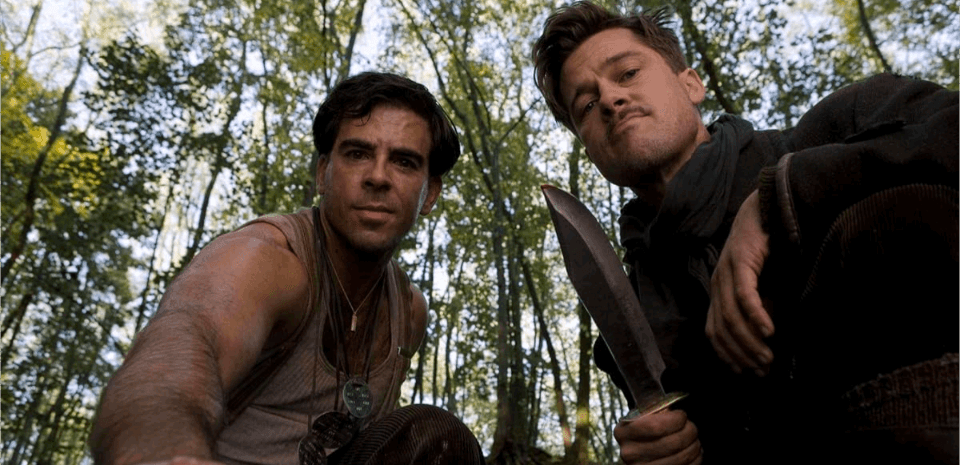
 Starring: Brad Pitt, Christoph Waltz, Michael Fassbender, Eli Roth, Diane Kruger, Daniel Brühl, Til Schweiger, Mélanie Laurent
Director: Quentin Tarantino
Screenplay: Quentin Tarantino
Country: United States
Running Time: 153 min
Year: 2009
BBFC Certificate: 18
Director Quentin Tarantino has worked across a number of genres in his small but perfectly formed filmography of nine films (the director classes Kill Bill Volumes One and Two as a single movie, for those understandably thinking he’s directed ten films): crime, horror, martial arts, western and comedy drama. For his sixth film Inglourious Basterds, Tarantino turned to the war genre, specifically the Second World War, and the men on a mission style of film that proliferated in the 1960s and 1970s in particular. Though, this being Tarantino, the film is more of a drama that just happens to be set during the Second World War, well, the director’s fictitious version of that battle and time period, his alternate history.
The film opens “Once upon a time in Nazi occupied France” setting the scene for this being a fictional story, just set during a real war and with versions of real historical figures. Hans Landa (Christoph Waltz), an SS Colonel known as “The Jew Hunter”, appears at the home of the LaPadite family to kill Jews the family is hiding beneath their floorboards. One of the Jews, young Shosanna (Mélanie Laurent) escapes unharmed, whilst the rest are massacred.

We then meet U.S. Army Lieutenant Aldo Raine (Brad Pitt) who is putting together a crack group, the titular Inglourious Basterds, to kill and scalp Nazis, sending a message of fear to other German soldiers. The crack group of would-be warriors includes Sergeant Donny “The Bear Jew” Donowitz (Eli Roth), Privates First Class Smithson Utivich (B.J. Novak) and Omar Ulmer (Omar Doom), rogue German Sergeant Hugo Stiglitz (Til Schweiger), and Austrian-born translator Corporal Wilhelm Wicki (Gideon Burkhard).
Meanwhile, Shosanna has reached Paris, changed her name to Emmanuelle Mimieux and is now running a cinema, a few years after escaping the massacre at the LaPadite farmhouse. She meets Fredrick Zoller (Daniel Brühl), an elite Nazi sniper who is starring in a propaganda film called Nation’s Pride. Zoller becomes infatuated with ‘Emmanuelle’ and persuades Joseph Goebbels, head of the Nazi propaganda machine, to hold the premiere of the propaganda movie at the cinema.
Two deadly plots then unfold: Shosanna plotting to burn the cinema down during the premiere and the Inglourious Basterds planning to storm the premiere and set off explosives, both with the same ultimate aim of killing the Nazis in attendance, including senior officials and members of the Nazi High Command.

The Inglourious Basterds work with British Commando Lieutenant Archie Hicox (Michael Fassbender), a former film critic who won’t be out of place at the premiere due to his movie knowledge, who poses as an SS official, as he is able to speak fluent German. He is enlisted by General Ed Fenech, a fabulous cameo by Mike Myers, and William Churchill (Rod Taylor) and works alongside German film star and undercover allied agent Bridget Von Hammersmark (Diane Kruger). That’s the lengthy setup, essentially the first half of the film, for a tense and brutal finale that I shan’t spoil.
The first two elements that are outstanding in the film are the acting and the script. It’s essentially a series of conversations interspersed with action and graphic violence. Yet, despite it being a very, very talky film, the beauty of the script means it’s incredibly well paced, the conversations ratcheting up the tension in each scene. This is very much Tarantino’s take on the Second World War, so he takes a lot of liberties with the story to create an alternate history, but it works, really well. As mentioned at the outset, we get an immediate insight into this being a piece of fiction when Tarantino opens with the aforementioned “Once upon a time…” scene setting piece of text on screen.

The film is paced and edited to perfection, broken into chapters which initially introduce us to the key players before the major focus of the film, the movie premiere, is brought to the forefront. The first three of the film’s five chapters each introduces a character (Landa, then Raine and the Inglourious Basterds, then Shosanna with her new identity in Paris). It’s novelesque and a great structure for the film.
The script is delivered marvellously by an outstanding all-star cast on the top of their game, particularly Waltz, who gives my personal favourite of his performances. He received a number of accolades for his chilling portrayal of Landa, including the Best Supporting Actor award at the Academy Awards, the only Oscar win for the film despite eight nominations. Laurent is also great as Shosanna, starting off as a terrified woman escaping persecution and becoming more driven and calculated as the movie develops, plotting to make a major dent in the Nazi’s war effort in revenge.

Those aforementioned chapters include some fabulous lengthy dialogue scenes that are nerve shredding at times in the way they build tension, the best being Landa’s conversation at the LaPadite farmhouse which opens the film. Other memorable conversations including one when Landa again meets Shosanna and you’re left wondering if he recognises her from a few years prior, and finally a scene in a bar where a game of guess who is playing out. This latter scene builds and builds to an almost unbearable level of tension as Fassbender’s character’s German accent is hotly debated by Nazis in attendance and threatens to uncover him as the British agent he really is. I shan’t spoil the end of this scene, for those who have yet to see the film.
The movie is not for the faint hearted. Though infrequent and making up a small proportion of the two-and-a-half hour runtime, the flashes of violence are incredibly graphic and brutal; stabbings, scalpings, baseball bats to the head and a lot of shooting and bloodshed. It could be argued it’s glorifying violence, but another take is that it shows the brutality of war and is done in a comic book style, exaggerated way. Either way, if you don’t have a stomach for violence, please go in forewarned.
Production design, costumes and cinematography create a feast for the eyes. The film looks phenomenal. There are some gorgeous shots of the landscape, excellent tracking and sweeping shots which add to the tension, and the world feels real and lived in, thanks to the costumes and production design.

No review of a Tarantino film would be complete without referencing the soundtrack. Tarantino’s movies always have eclectic soundtracks featuring some great compositions, carefully selected to accompany each scene, and this is no different. Here we have fabulous use of cues from the likes of Ennio Morricone (eight pieces of music), Lalo Schifrin, David Bowie and Giorgio Moroder, Charles Bernstein, Dimitri Tiomkin, Elmer Bernstein and Riz Ortolani. The music comes from an equally eclectic mix of films, including Zulu Dawn, Eastern Condors, the 1982 remake of Cat People, White Lightning, Kelly’s Heroes and more.
The final line of the film sees Brad Pitt’s character proclaiming “I think this might just be my masterpiece”. For me, the film may be Tarantino’s masterpiece. I love Pulp Fiction and Jackie Brown, and there’s a strong argument for those being the director’s best movies, but there’s just something about Inglourious Basterds that after each of my many viewings, has always left me incredibly impressed. It stays with me and I often think of lines and scenes. The visuals, synergy with wonderfully selected music, editing, dialogue, multiple tense and incredibly memorable scenes, and acting masterclasses; it all comes together into one outstanding package and a very, very fine film. So, yes, for me, it may just be Tarantino’s masterpiece.
Film: 
Inglourious Basterds is released in separate limited edition 4K and Blu-ray editions on 13th January 2025. I watched the Blu-ray edition. I’ve not been provided with the booklet so don’t have the technical information about the transfer but it doesn’t appear to be new. However, I thought it was great, no blemishes, fine detail, rich colours and excellent detail. The audio is also very good, the dialogue, sound effects and music cues each coming across strongly and distinctly.
Two-disc limited edition contents:
Limited edition ‘Operation Kino’ packaging with new art by Dare Creative
60-page ‘Films & Filmmakers’ collector’s book with writing by film critics Dennis Cozzalio and Bill Ryan
Double-sided fold-out poster
Replica Nation’s Pride Premiere programme booklet
La Louisianne beermat
3 postcard sized double-sided art cards
Strudel recipe card
Reversible sleeve with original and newly commissioned artwork by Dare Creative
Disc 1 – Film (4K disc in the 4K release and Blu-ray disc in the Blu-ray release):
Brand new audio commentary by film critic and author Tim Lucas
Disc 2 – Extras (Blu-ray disc for both the 4K and Blu-ray releases)
What Would Sally Do?, a new interview with editor Fred Raskin
Blood Fiction, a new interview with special make-up effects supervisor Greg Nicotero
Doomstruck, a new interview with actor Omar Doom
Making it Right, a new visual essay by film critic Walter Chaw, author of A Walter Hill Film
Film History on Fire, a new visual essay by film scholar Pamela Hutchinson, author of BFI Film Classics Pandora’s Box
Filmmaking in Occupied France, a new interview with film scholar Christine Leteux, author of Continental Films: French Cinema Under German Control
Extended and alternate scenes
Nation’s Pride
The Making of Nation’s Pride, an archival featurette
Roundtable Discussion, an archival interview with Quentin Tarantino, Brad Pitt and Elvis Mitchell
The Original Inglorious Bastards, archival featurette
A Conversation with Rod Taylor, archival featurette
Rod Taylor on Victoria Bitter, archival featurette
Quentin Tarantino’s Camera Angel, archival featurette
Hi Sallys, archival featurette
Film Poster Gallery Tour with Elvis Mitchell, archival featurette
Trailers

The first disc contains only one extra, but it’s a magnificent one: a new audio commentary by the always excellent Tim Lucas, an author and critic. It’s amazing, as is to be expected. Lucas provides so much background about everything from the music cues and what they were originally recorded for, the film’s place in Tarantino’s filmography and links to other movies, through to details about the director, actors and other collaborators. Lucas highlights some of the smaller roles like a very small early role for future Bond girl Léa Seydoux and plenty more background, as well as his favourite lines and details about specific scenes. He points out so much, even the most ardent fan of the film is likely to learn plenty. Lucas strikes a perfect balance between focusing on scene specific comments and providing more general background, insights and details. It’s among the best commentaries I’ve heard in some time and well worth spending the film’s runtime with.
Disc two opens with a new 11 minute interview with editor Fred Raskin called What Would Sally Do? Raskin was an assistant editor on Kill Bill for the late Sally Menke, who edited six films for Tarantino as well as his segment of the anthology Four Rooms. Menke died the year after the release of Inglourious Basterds, which was her penultimate film. Raskin has edited all of Tarantino’s films since Menke passed away in 2010. Raskin looks at how he got into editing, working with Menke and Tarantino. He talks fondly about his work with the pair. He also shares how he saw a preview of the film ahead of it being shown at Cannes and his views on the film at that point. A solid interview.
Doomstruck, a new interview with actor and musician Omar Doom, who plays Private First Class Omar Ulmer, also runs for 11 minutes. We hear how Doom started out in acting, about his interests that have inspired his music, how he first met Tarantino and working on Death Proof and Inglourious Basterds. It’s a really good interview that packs a lot into its brief runtime.
Blood Fiction, is a new 22-minute interview with special make-up effects supervisor Greg Nicotero, who clearly loves working with Tarantino. He’s worked with the director throughout his career, and provides a lot of insight into working with the director as well as on the film. He talks about his cameo in the film and how a lot of the effects were created. There’s plenty to glean from a fascinating interview. A real highlight of the package.
The 22-minute Making it Right, is a new visual essay by film critic Walter Chaw, author of A Walter Hill Film, and looks at what makes a Tarantino film, including its violence and their influences, and runs through the things you might think of making up one of the director’s films. But the focus of this essay is Tarantino’s kindness. Chaw runs through how Tarantino rewrites history to be compassionate to those he feels deserve better, and how he closes out violent revenge films like Kill Bill, by leaving his heroine The Bride with effectively a happy ending. You get the gist, Chaw outlines moments that are touching and human in the director’s films. For Inglourious Basterds the essay focuses on the character of Shosanna and the importance of film and film history. A very good and different look at the director and the film.
In the 20-minute visual essay Film History on Fire, Pamela Hutchinson looks at this background to the film (which takes its title from a 1978 Euro war film which was an unofficial remake of The Dirty Dozen). She gives a good overview of the film looking at stars referenced in the movie, and the key use of film nitrate and it’s flammability, in the plot. Hutchinson points out some of the other film and real-life reference points picked up in the movie and also separates truth from fiction with a look at some of the real and fictional players in the story. It’s another fantastic piece and another real gem on the disc. It’s my favourite of the three visual essays, all of which are very good.
The next visual essay almost came out as my favourite as it’s another corker. It’s called Filmmaking in Occupied France and is a 15-minute look at wartime film in the country by author Christine Leteux. It’s a fascinating overview of the German propaganda machine at work in France during the Second World War. There’s a lot of great information and background here.
The rest of the on disc extras are archival.
The roundtable discussion features Tarantino and Brad Pitt in discussion with film critic Elvis Mitchell. Running for 30 minutes, it’s a fun interview which covers a number of topics, including the structure of the film, Pitt’s character and what the actor brought to the role, the importance of different languages in the movie and a chat about some of the other actors.
Next we get six minutes of the film within a film Nation’s Pride, which was directed by Eli Roth. It’s a decent mini-movie in it’s own right and features Daniel Brühl’s character as the star as well as some neat cameos.
The making of Nation’s Pride sees Eli Roth portray the German “director” of Nation’s Pride alongside other actors portraying their roles from Inglourious Basterds. The faux documentary is brief, at four minutes, and quite fun.
The Original Inglourious Bastards sees Roth and Bo Svenson talking about the Enzo G. Castellari film that the film got its title (with a change in the spelling of the second word, and dropping the word ‘the’ from the start of the original title) from. Svenson appeared in the original and cameos in Nation’s Pride in the Tarantino film. We see Castellari’s cameo in the Tarantino movie during the seven minute piece, which includes the trailer for the original 1978 movie. A really neat piece.
Up next is a seven-minute interview with Rod Taylor, who plays Winston Churchill in the film. There are some nice comments from the late actor, who clearly enjoyed making the movie and working with the director.
Rod Taylor on Victoria Bitter talks about the Australian beer, and a nice anecdote of Tarantino chatting to the actor at the end of a working day, having brought him a bucket of the brand of beer.
Quentin Tarantino’s Camera Angel is three minutes long and shows the clapperboard that opened the filming of scenes with a lot of choice language from the clapperboard operator.
Hi Sallys features actors and crew, including Tarantino, saying “hi Sally” and other comments at various points of filming, presumably a little in joke for editor Sally Menke to enjoy when she was editing the film.
Two extended sequences and one alternate version are included. First is an extended version of a scene called lunch with Goebbels, which runs for seven minutes. Next an extended version of the La Louisiana Card Game, which runs for two minutes. Finally, an alternative version of the Nation’s Pride beginning. All are welcome inclusions.
The film poster gallery tour with film critic Elvis Mitchell is a wonderful 11-minute piece which talks a bit about Nation’s Pride before giving an overview of some of the movie posters that feature in the background of the film, showcasing this artwork too, and why the films were chosen.
Completing the on-disc extras are four trailers; a teaser, the domestic trailer, an international trailer, and a Japanese trailer.
I wasn’t provided with the physical extras like the booklet, but all sound great and should make this a highly collectable release.
An Arrow release of Inglourious Basterds was first teased by the label many, many, many months ago through one of the postcards that accompany their releases. I’m pleased to say it was well worth the wait. The film is a five star masterpiece from Tarantino, and my personal favourite of the director’s films, the picture and audio are great and Arrow have provided a wealth of informative and entertaining new extras, as well as packing in a number of archival extras, many of which are very good. In one word, the release is… glorious! Highly recommended.
Disc/Package: