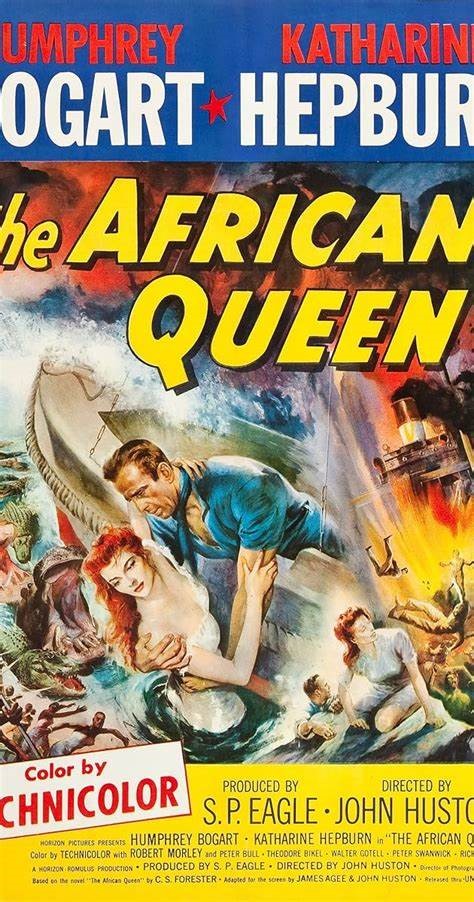



 Director: John Huston
Script: James Agee & John Huston
Cast: Humphrey Bogart, Katherine Hepburn, Robert Morley, Peter Bull, Theodore Bikul, Wetar Gotell, Peter Stanwick, Richard Marner
Running time: 105 minutes
Year: 1951
Certificate: PG
Based on the 1935 novel of the same name, by C.S Forester, The African Queen came about when John Huston was asked by uber producer Sam Spiegal to pick a project to direct. Huston liked directing material from literary sources and had enjoyed the book, hence suggested Forester’s novel. Spiegal had an ‘in’ with Humphrey Bogart, who went on to suggest Hepburn for the other lead role, as he really wanted to work with her.
Set in German East Africa, during September 1914, The African Queen sees evangelical preacher, Brother Samuel (Robert Morley), and his younger sister, Rose (Katherine Hepburn), running a remote mission aimed at trying to convert the natives to Christianity. Unfortunately, things go pear-shaped when the Germans invade the area and burn the village to the ground and take many of the men away to join their fight in the Great War. Samuel doesn’t handle the situation very well and starts to lose his marbles and grows increasingly sick. On the day of his death, Charlie (Bogart), the scruffy skipper of the equally scruffy boat African Queen, returns to the village and, after burying her brother, helps Rose to escape the remote outpost and reluctantly promises to help her to get her own back against the Germans by bringing down a strategically-placed German warship situated in a lake that’s recently become a key route for the allies; and so begins an arduous odyssey that takes the oddball couple down dangerous rapids and waterfalls, through leach-infested marshes and down a hippo and crocodile rammed river.
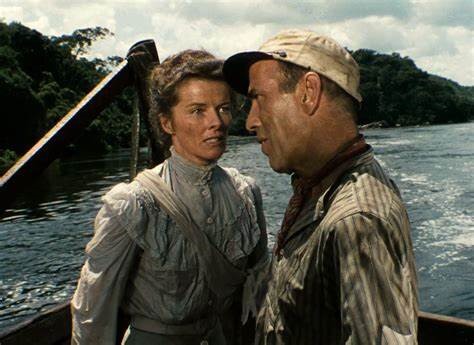
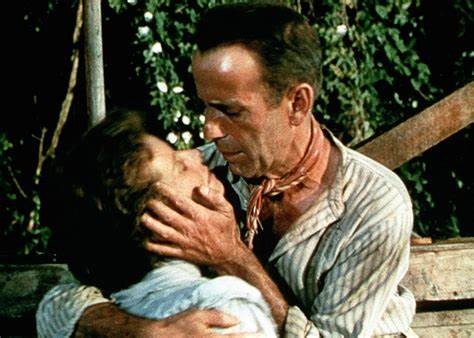
The African Queen is essentially a romantic drama with some action thrown in for good measure. However, what really makes the film special is the chemistry between the two leads, playing characters that are from very different backgrounds and political positions. Rose is a very religious idealist and Charlie only really cares about his boat and making money to keep it going. He’s an anti-hero chancer who takes things as they come and she seeks order and meaning and is a woman of firm morals. Understandably, the two argue a lot initially and spark off one another, but over time they start to fall for each other, drawn closer by the difficult situations that they have to fight their way through.
As they battle against the odds to achieve their quite frankly crazy end-goal they grow to respect one another and to enjoy each other’s company, even if he drinks too much and she can be rather over-bearing, just as many zealots are. You can’t help but root for them as they have to deal with some nasty situations, while all the time avoiding the Germans, by transferring from the more obvious, easier route, and taking a more treacherous one instead.

The film’s other strong selling point is the fact that it was filmed on location, in Africa, giving it an edge over many other films made during that time, when most were shot in studios that were made up to look like jungle settings. It’s just a shame that there’s some badly done back-projection in a few key action scenes, which immediately takes one out of the action and reminds you that you’re watching actors that aren’t under much threat.
All in all, I really enjoyed watching The African Queen again; my original viewing having been a Sunday afternoon one with my mum, watching it on our old black and white television. Hence, I was pleasantly surprised to find out the movie was actually shot in colour and looks pretty good all these years on.
Studiocanal have recently released The African Queen as part of their Vintage Classics Collection and have done a great job of restoring the movie. There are several extras included on the disc, these include:
Audio commentary with script supervisor Angel Allen and Ian Christie – An enjoyable commentary that includes someone who was actually on the shoot and has lots of anecdotes to share. Apparently, she was in charge of continuity and this was one her first films. She earned the princely sum of £9 per week, to reflect that she was also the production manager, as the original one was fired. She recalls that all of Morley’s scenes were shot in London and he found them tough to do as he was tone deaf!
Audio commentary by cinephotographer Jack Cardiff – Jack talks about the filming conditions they encountered while they were in the French Congo, including the crew having to deal with Tsetse flies, black water, lots of crocodiles and huge colour-film cameras. Apparently director Huston was very laid back, even when most of his crew were off sick.
Sir John Woolf on the making of The African Queen (4.43 mins) – Mr Woolf mostly talks about the financing of the film, but the interview is accompanied by some nice behind-the-scenes photographs.
Embracing chaos: Making the African Queen (59.20 mins) – A comprehensive documentary about the origins and the making of the film, which features lots of behind-the-scenes photographs and publicity stills and is quite harsh about some of the participants, especially producer Spiegal, who is made out to be a rather ruthless character. It also talks about Huston’s sometimes difficult relationship with Hepburn, who was a rampant conservationist, while he enjoyed hunting big game! She also surprised everyone by demanding her own private loo, which they had to take with them everywhere they went. Apparently Bogart’s then wife, actress Lauren Bacall, went on location with them and was very helpful, especially in treating the crew and actors who got sick. They also had to deal with parasitic worms and soldier ants – ouch!