



 Director: Toshio Matsumoto
Screenplay: Toshio Matsumoto, Atsushi Yamatoya
Based on a Novel by: Kyuusaku Yumeno
Starring: Yôji Matsuda, Shijaku Katsura, Hideo Murota, Eri Misawa, Kyôko Enami
Country: Japan
Running Time: 109 min
Year: 1988
BBFC Certificate: 15
Toshio Matsumoto’s 1988 film Dogra Magra was based on the cult Japanese avant-garde novel of the same name, written by Kyuusaku Yumeno. After reading it, Matsumoto believed the novel was inherently cinematic and that it felt like “The Cabinet of Dr Caligari plus Last Year in Marienbad divided by two”. He also claimed he got indigestion after reading it, due to its complex, jumbled narrative that most deemed ‘unfilmable’.
Matsumoto wanted to adapt it to the screen as his third film for the Art Theatre Guild after making Funeral Parade of Roses and Shura for them. However, at that time, the studio was struggling financially so the bosses were more interested in making commercial films than the art-house fare they used to support.
In the mid-to-late 80s though, Matsumoto met Yumeno’s son, Sugiyama Tatsumaru. He spoke with him about adapting Dogra Magra. Tatsumaru was dubious at first, describing how others had asked to adapt his father’s work but he was always unimpressed and turned them away. Matsumoto managed to talk Tatsumaru around though and production began a year later.

Dogra Magra is not as well-known as Matsumoto’s debut feature, Funeral Parade of Roses, but it’s worthy of rediscovery and Radiance Films have taken it upon themselves to give the film a new lease of life on region-free Blu-ray. I was impressed with Funeral Parade of Roses, so got my hands on a copy of his later film, to see how it compared.
Dogra Magra follows a young man, possibly named Kure Ichiro (Yôji Matsuda), who wakes up in a mental asylum with no memory of his past. Two doctors, Prof. Wakabayashi (Hideo Murota) and Prof. Masaki (Shijaku Katsura), try to help him but offer conflicting stories and advice.
As Kure tries to piece together the fragments of his identity, he is confronted with disturbing revelations about his family history and his own actions. The narrative goes on to delve into themes of insanity, identity, and the blurred lines between reality and illusion.
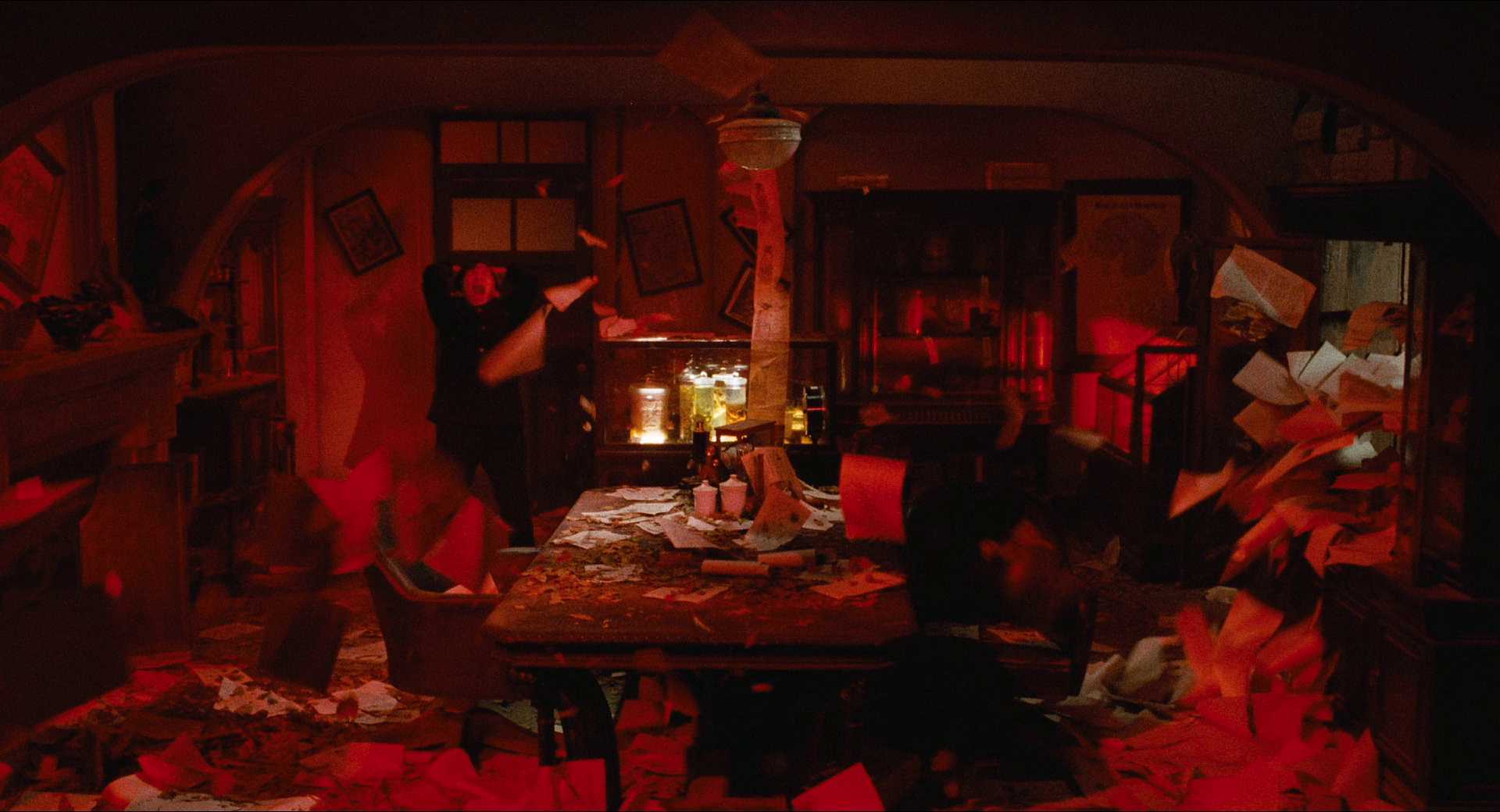
Matsumoto describes the film as a “bewildering labyrinth” that the audience attempts to travel through, alongside the protagonist. Indeed, I found it quite a challenging watch.
Dogra Magra continually jumps between time periods, dream/mental states and locations, sometimes mid-monologue. The novel is reportedly made up of various differing fragments of information – research theses, medical reports, a hymn etc. Matsumoto tries to emulate this by piecing his film’s narrative together from various perspectives. This complex, often nested structure reminded me very much of Wojciech Has’ film, The Saragossa Manuscript. Like that, I found the bewildering nature made the film easier to admire than to enjoy.
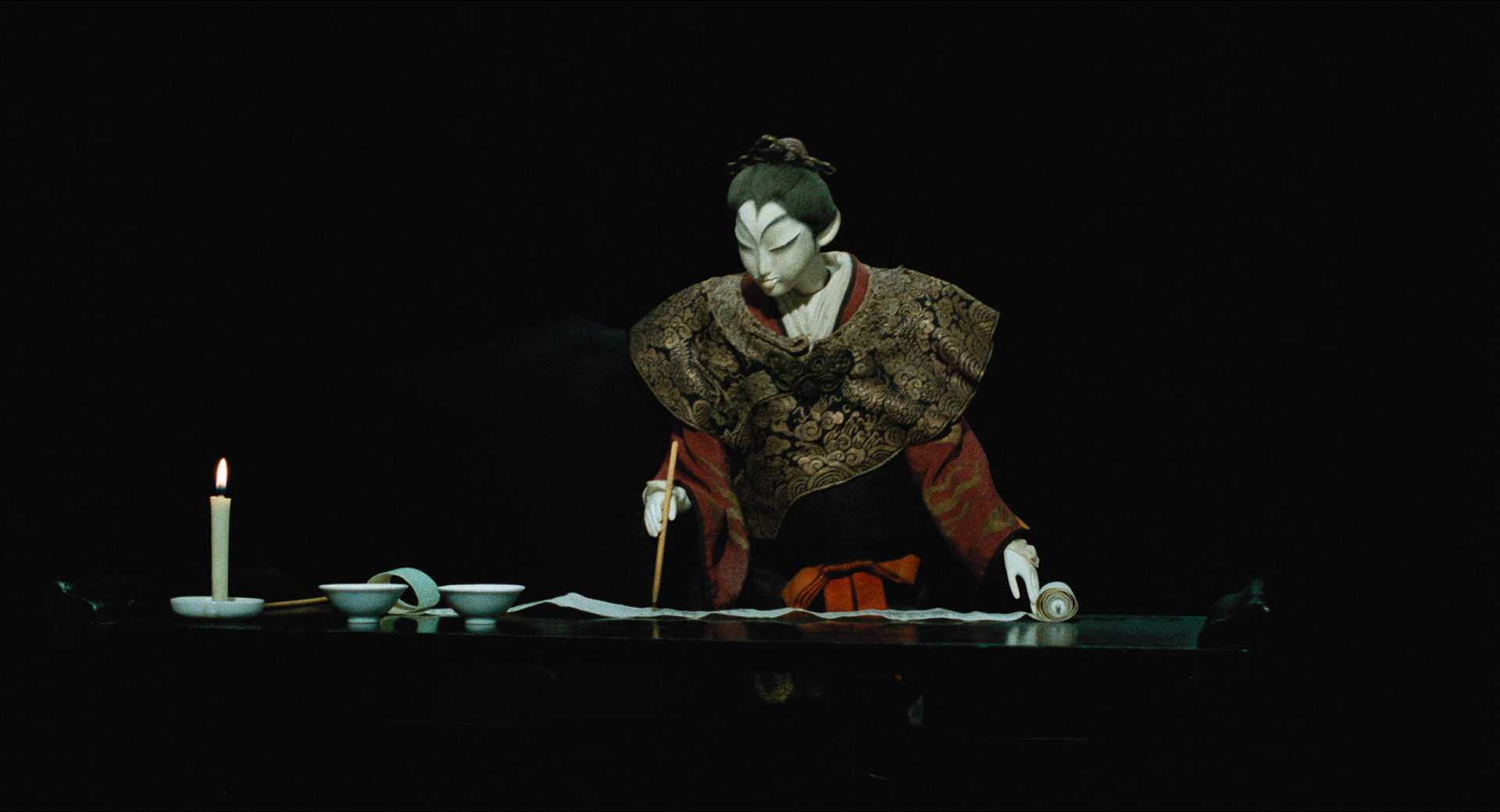
Some unique styles are used in the different segments too, such as the beautiful puppets that present an ancient story through a slideshow and later an animated retelling. Elsewhere, a look back at Kure’s childhood is done through photographs and other shifts in colour and form occur throughout.
The film was shot by Tatsuo Suzuki, who worked with Matsumoto on Funeral Parade of Roses, Shura and numerous other titles from the Japanese avant-garde and new wave. His work here is as impressive as usual. The final act, in particular, is highly stylised and provides a feast for the eyes.
The editing is boldly unusual too, with some inventive techniques used to bridge a number of the sequences together. One scene has characters from different timelines appear and disappear from a long shot whilst the character appearing in both remains.
It’s a film that can be interpreted in multiple ways and the director himself even states that you could take the whole thing as a dream, following the opening quote about what a foetus experiences before it’s born. The structure of the film suggests a comment on the nature of truth and perspective but there are other themes present, such as the nature of mental illness.
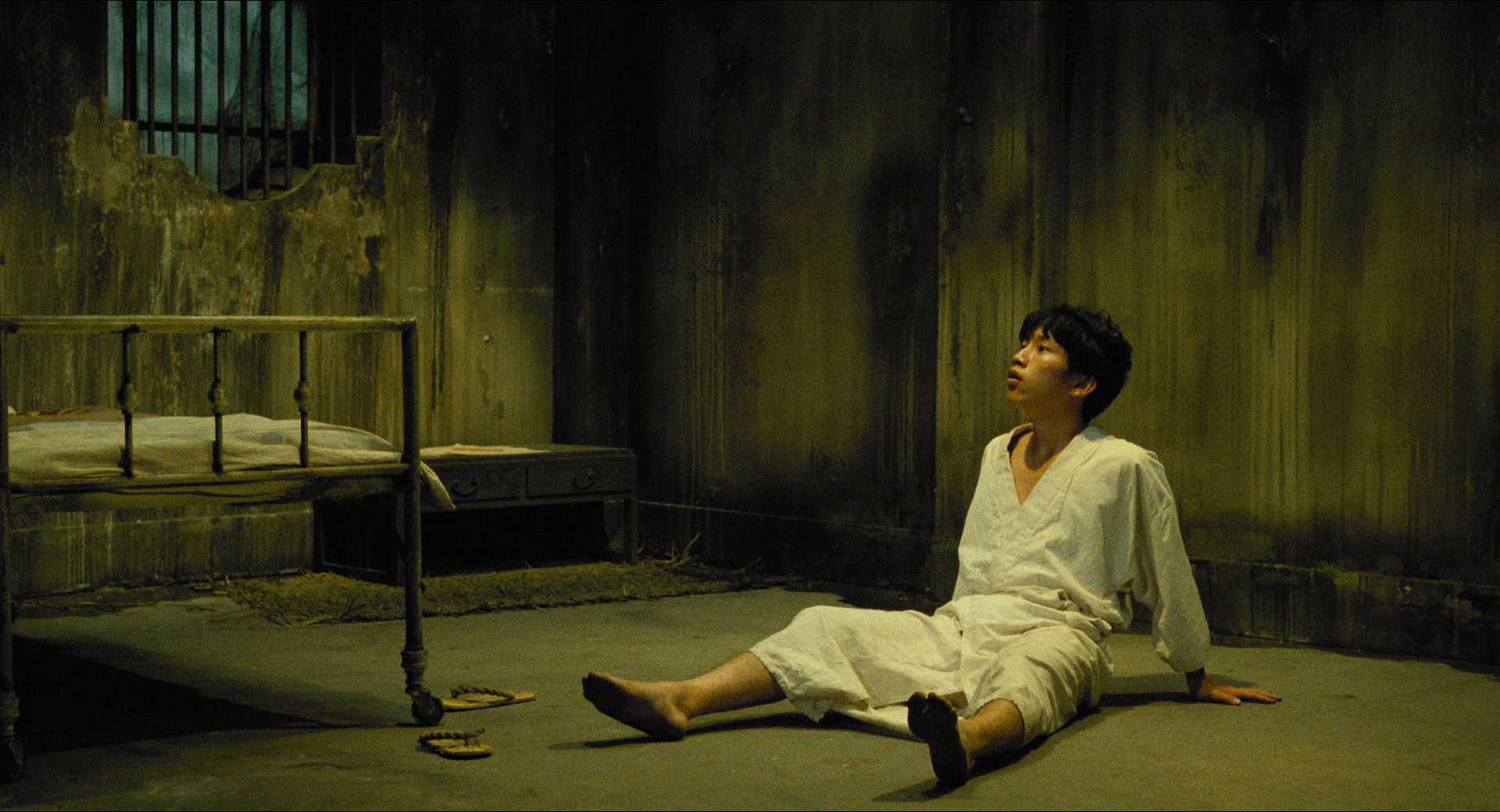
I think it’s a film that requires repeated viewing. On my first watch, I was confused and overwhelmed by the heavy reliance on dialogue, leading to the slightly lukewarm rating you may have noted below. However, after watching the film again with the director’s commentary, I was able to better appreciate and soak in what I’d seen, aided by Matsumoto’s explanatory descriptions. I’ve kept my 3.5 star rating though, because I did struggle to stay fully engaged on my initial watch.
So, though I didn’t fall head-over-heals for Dogra Magra, I think I’m likely to warm to it the more I watch it. Also, you’ve got to give Matsumoto credit for taking such a boldly unique and varied approach to the material.
Film: 


Dogra Magra is out on 28th October on region-free Blu-Ray, released by Radiance Films. The transfer is superb, with a sharp image, pleasing tonal balance and rich colours. I’ve used screengrabs throughout this review to give you an idea of how it looks. It sounds good too.
LIMITED EDITION BLU-RAY SPECIAL FEATURES
– High-Definition digital transfer supervised by director of photography Tatsuo Suzuki and producer Shuji Shibata
– Audio commentary by director Toshio Matsumoto (2003)
– Interview with Toshio Matsumoto (2003, 21 mins)
– A visual essay by programmer and curator Julian Ross (2024)
– Instructions on Ahodara Sutra (a popular Japanese chant delivered by Dr. Masaki in the film) by legendary street performer Hiroshi Sakano (16 mins)
– Trailer
– New and improved English subtitles
– Reversible sleeve featuring original and newly commissioned artwork by Time Tomorrow
– Limited edition booklet featuring new writing by Hirofumi Sakamoto, president of the Postwar Japan Moving Image Archive and author Jasper Sharp on screenwriter Atsushi Yamatoya plus an interview with producer Shuji Shibata and Matsumoto’s director’s statement
– Limited edition of 3000 copies, presented in full-height Scanavo packaging with removable OBI strip leaving packaging free of certificates and markings
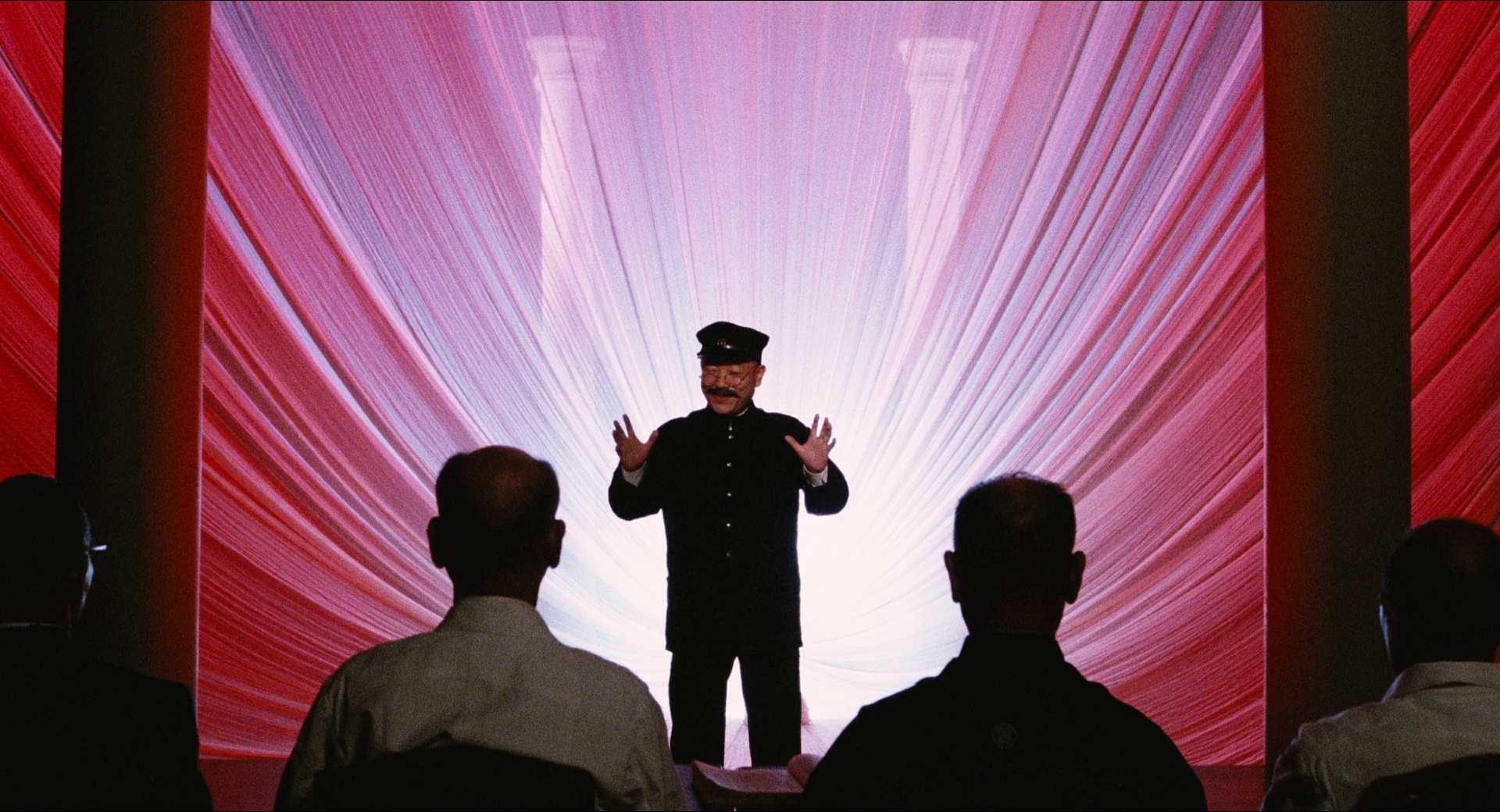
Director Toshio Matsumoto provides a commentary. He describes what his intentions were behind each scene and often compares it to the source novel. I’m not usually a fan of commentaries that spend much of the time explaining what’s going on but here the approach is welcome. He does add a little information about the production later on too.
Also included is an archival interview with Matsumoto. This offers some interesting background information on how the film came about and how he cast it. He also talks about his approach to adapting this novel that had previously been deemed ‘unfilmable’.
Julian Ross provides an essay on the disc. He looks at the similarities between Dogra Magra and Funeral Parade of Roses, as well as describing the background of the source novel and film itself. In the latter half of the piece, he looks at the work of cinematographer Tatsuo Suzuki and his collaborations with Matsumoto. It’s a valuable addition to the set.
There’s also a peculiar extra that sees Matsumoto meet with street performer Hiroshi Sakano to see how best to have Shijaku Katsura perform a particular sequence in the film. It’s a little long and rambling but you get some nice moments where you see Matsumoto working with the man to figure out the best approach to the performance.
I didn’t receive a copy of the booklet to comment on that.
Overall, Radiance have assembled an excellent collection of supplemental material to enhance the experience of watching Matsumoto’s head-scratching film. The extras are so strong, they’ve had me questioning my slightly disappointing gut-reaction rating of the film.
Disc/package: