


 Director: Gakuryû Ishii (as Sogo Ishii)
Screenplay: Gakuryû Ishii (as Sogo Ishii)
Starring: Tadanobu Asano, Masatoshi Nagase, Yoshiki Arizono, Masakatsu Funaki (voice)
Country: Japan
Running Time: 55 min
Year: 2001
BBFC Certificate: 12
Japanese director Sogo Ishii’s work has been enjoying a bit of a renaissance recently, with Arrow Video and Third Window putting out a handful of his best-known films on Blu-ray over the past couple of years. Being a lover of the more unusual side of Japanese genre cinema, I’ve been following along.
Third Window are, in fact, releasing two of Ishii’s films on the same day this month, Electric Dragon 80000V and his most recent film, Punk Samurai. I didn’t have time to cover both (though Andrew Beeken will be picking up the slack for me) but I got my hands on Electric Dragon and my thoughts follow.
It’s a very short film (only 55 minutes – so feature length, but only just) with a fairly simple plot, though with minimal dialogue it’s a little hard to decipher. From what I can gather, we follow Dragon Eye Morrison (Tadanobu Asano), a man who has had regular electric shock treatments due to his aggressive behaviour. This has caused Dragon’s body to be charged with a vast amount of electricity, which he keeps topped up regularly as it appears to keep him alive and give him superhuman strength.
To keep out of mischief, he works as a lizard hunter and, to keep his anger at bay, he unleashes his pent-up aggression and electric power by playing his guitar (electric, of course).

However, keen to be the overall master of electricity is Thunderbolt Buddha (Masatoshi Nagase). He has a similar command over the energy source after having had an accident on a pylon as a child. He uses various gadgets to channel his power in order to take down gangsters and other criminals.
When he learns of Dragon’s skills, Thunderbolt tracks him down in order to stage a massive showdown to discover who is the true master of electricity.
The film’s music creator Hiroyuki Onogawa says the film was originally inspired by him and Ishii starting a band. They brought on another couple of people, including star Tadanobu Asano, and, once the group was formed (named Mach 1.67), Ishii talked about how he thought it would be great to make a film about the band. They ran with the idea and Electric Dragon 80,000v was formed.
In another interview on the disc, Ishii explains how the film is like an introduction to the characters with the idea to possibly make a sequel or series to build on this. As such, Electric Dragon is not a film to analyse too deeply. It’s a film designed to simply be as cool as possible. In that, it succeeds but I wouldn’t go in expecting anything deep to mull over once the film has finished. It’s like an extended music video, in a way.

The brief running time further highlights the film’s simple, no-nonsense narrative intentions. Producer Takenori Sento says he wanted to make a short 55-minute film to create a world without boring an audience and because that level of tension and excitement would be too much to sustain for more than an hour.
Indeed, the film is pretty intense, using aggressive punk rock music and industrial sound effects as a soundtrack to some often fast-cutting sequences that are filled with flashes of electricity and surging power within our characters, not to mention the wild guitar-playing sequences.
Personally, I found even 55 minutes a little much, with my interest waning without much of a story or characters to sustain it. I was very tired when I watched the film though, which didn’t help.
Saying that, in terms of style the film delivers in spades, so I did find it very impressive from a technical perspective.
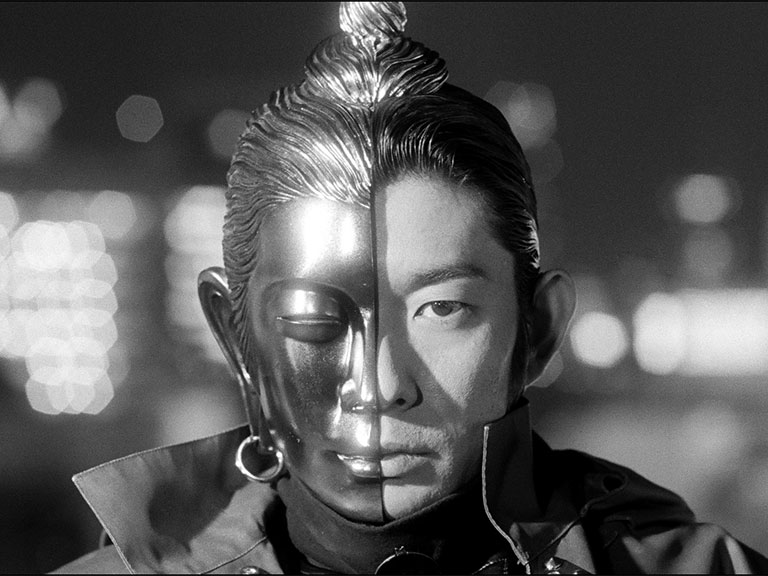
Shot in crisp, high-contrast black and white, the film looks gorgeous. This stylistic decision was partly made to make the film look like the type of manga that inspired it but it also makes for some disarmingly striking visuals. The camerawork is inventive throughout and the lighting makes the most of the format. The effects work on the electricity flashes is great too and some sharp editing adds to the energy.
So, whilst I was disappointed to find the film felt more like an extended short that was experimenting with styles and characters than a fully-fledged feature, Electric Dragon still has much to admire about it. It’s hard to deny that the film is a visual and aural marvel, shot and edited with boundless energy and style. In this sense it’s a success, even if I wanted more from the film. Others will likely be better satisfied with it, so I’d still definitely recommend the film to fans of Japanese genre movies or the ‘cinéma du look’ movement.
Film: 

Electric Dragon 80000V is out on 6th March on region B Blu-ray in the UK, released by Third Window Films. The transfer is stunning, looking pin-sharp and rich in detail and depth of shade. The aggressive soundtrack packs a punch on the disc too.
There are several special features included too:
– New HD master from the original negatives
– Director Sogo Ishii, musician Hiroyuki Onogawa and producer Takenori Sento Stage Greeting
– Tadanobu Asano Stage Greeting
– Masatoshi Nagase Stage Greeting
– Premiere Stage Greetings
– Producer Takenori Sento Interview
– Music Creator Hiroyuki Onogawa interview
– Synthesized Images with Commentary
– Storyboards
– Trailer
– Slipcase with illustrated artwork by Ian MacEwan
– Reversible Sleeve with original Japanese artwork
– Slipcase edition limited to 1500 copies
In Tadanobu Asano’s greeting, the actor spends most of the time discussing some key props that are brought on stage for him to see.
Masatoshi Nagase’s stage greeting is unusual too, with a presenter asking him questions about more weird objects, this time a bullhorn the actor brings with him and a mic stand he reportedly broke last time he was there. Nagase seems a bit bemused by it all, though he goes along with the ‘joke’ as best he can.
The premiere stage greeting sees Ishii and his two lead actors appear on stage. They don’t have a great deal to say in this short piece but it’s nice to see the excitement of the evening captured on screen.

The stage interview with Sogo Ishii, musician Hiroyuki Onogawa and producer Takenori Sento is more valuable, with the trio talking mainly about the music in the film, as well as the possibility of a sequel or series following it up. The host has to get another ‘gift’ for them to look at though!
Sento’s solo interview is fairly short at just under 10 minutes, but he fits a lot in, talking about the film’s inception, experimenting with 5.1 DTS sound and why they went with such a short running time.
The interview with Onogawa runs around 21 minutes, so is one of the lengthiest extras here. He talks about how he got into composing music for films, as well as his influences and working methods, before talking about his work with Ishii. It’s an interesting piece.
The commentary over the ‘synthesised images’ is also a great addition and again is around the 21-minute mark. I’m not sure who’s delivering it (I ripped the extra off the disc so I could watch on my laptop) but it seems to be a couple of people involved with the special effects. The piece provides a look at all the work that went into the electricity effects in the film.
So, it’s a bit of a ragtag collection of extra material but a few of the supplements are well worth your time and help give a better idea of the intentions behind this unusual film. Electric Dragon 80000V won’t be for everyone but this release does the film justice and fans of Ishii and intensely stylish genre movies will want to pick it up.
Disc/Package: 