


Director: Sergei Parajanov
Screenplay: Sergei Parajanov, Ivan Chendej
Starring: Ivan Mykolaichuk, Larysa Kadochnykova, Tatyana Bestayeva
Country: USSR
Running Time: 97 minutes
Year: 1965
BBFC Certificate: 15
When the director Sergei Parajanov was selected to direct the adaptation of a novella by the celebrated Ukrainian writer Mykhailo Kotsiubynsky, few could ever have guessed that this fateful decision by those in positions of power would lead to the emergence of one of the all-time great cinematic visionaries of post-war cinema. I first came across Parajanov through reading Mark Le Fanu’s superb monograph The Cinema of Andrei Tarkovsky (BFI, 1987), where he lavished praise on both the director and his work, particularly his most well-known feature The Colour of Pomegranates from 1968. Le Fanu also describes Shadow of Forgotten Ancestors, the film under consideration here as ‘a major masterpiece’. It most certainly is, but the path that led to its creation was both long and arduous for everyone involved.
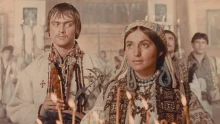
This stunning restoration by The Film Foundation’s World Cinema Project has brought forth the very best version of the film since its release in 1965. Shadows of Forgotten Ancestors is a dazzling, multi-layered exercise in ethnographic phantasmagoria. The story itself is rooted in humble but potent folk tales and rural life among the Hutsuls, an ethnic group living in the Carpathian Mountains in the eastern-most region of Ukraine. The film opens in dramatic fashion as a young boy witnesses his older brother’s death whilst felling trees in the forest. The ever-present shadow of death and the proprietary rituals and ceremonies foreground the grim reality of these rural people, living off the land and subject to its manifest dangers. Amidst these dangers (notably the violent death of his father), a love blossoms: Ivan (Ivan Mykolaichuk) grows to love Marichka (Larysa Kadochnykova), and their love for each other is the emotional core of the film’s first half, set against the looming economic hardships that will in time separate them.
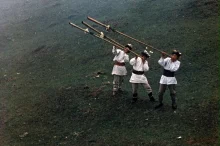
The film is a riot of colour and spectacle that displays all of the tensions that its creative forces brought to bear upon the project. The frantic movements of Yuri Ilyenko’s cinematography possess a momentum all of their own, and are so raw that on occasion you can see the shadows of the crew itself as they race alongside members of the cast. Some of his camerawork is literally death-defying, especially a dramatic river sequence that nearly cost both Ilyenko and Parajanov their lives. By contrast, Parajanov brings his aesthetic authority to bear in distilled ensemble scenes, where the rituals of daily life are calmly reconstructed. Special mention must be made of the extraordinarily vivid soundtrack completed by composer Myroslav Skoryk, which teems with all manner of folk songs, chants, howls from the forest and the dramatic use of Hutsul instruments such as the hurdy gurdy and trembita (a horn used by farmers to communicate with each other across great distances).
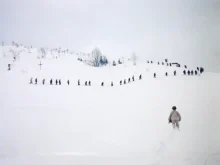
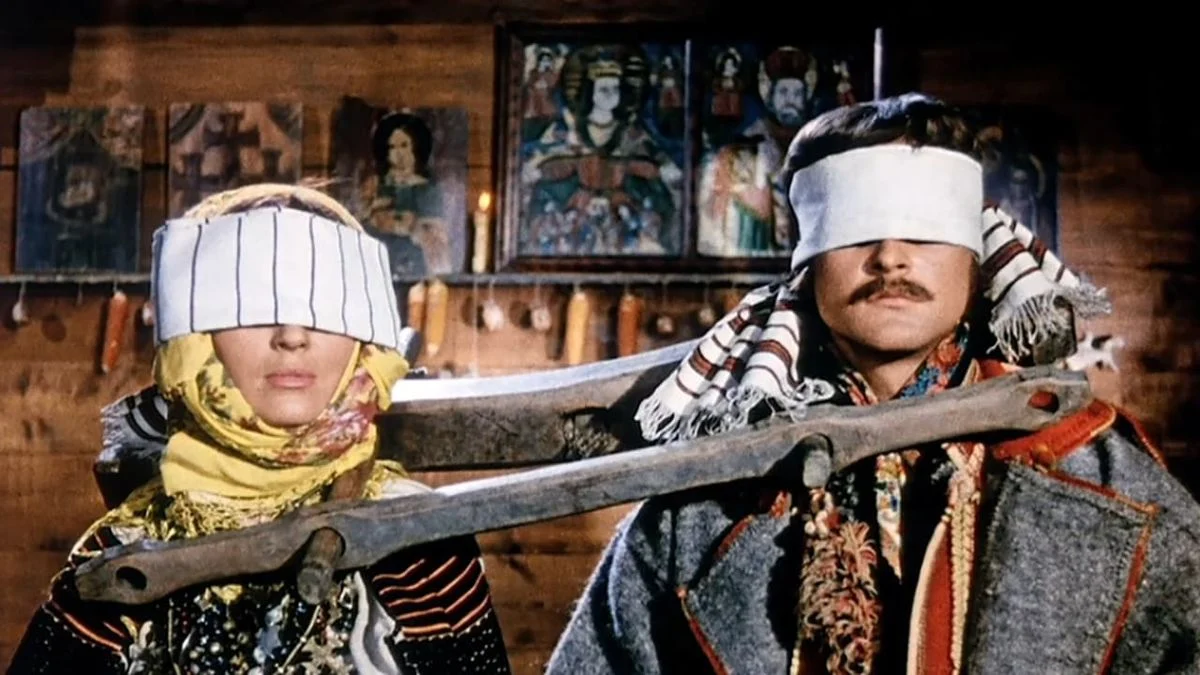
When tragedy inevitably strikes the life of Ivan once more, his retreat into solitude is visually represented by severe black and white imagery. It is yet another formal break with the orthodoxy of Soviet ‘socialist realism’ within the film that is an object lesson in just how many ways Parajanov and Ilyenko were defying the authorities of the time. Ivan is brought out of his solitude by the attentions of Palahna (Tatyana Bestayeva), a confident and entirely modernist woman who at first seems quite out of place in this timeless tale of rural folk. But her supremely proactive sensibility brings Ivan back to himself, and sets the stage for the now iconic wedding sequence which features the strikingly iconic ‘yoke’ scene. Yet even here, the seeds of Ivan’s downfall are sown and his tragic life is soon about to become a myth.
Shadows of Forgotten Ancestors is a truly phenomenal piece of cinema, with a supreme cast who all acquit themselves marvellously, and directed by a genuinely brilliant emerging talent. For a film to have been made in Ukraine by actors speaking the Ukrainian language despite the overarching censorship and manifest pressures of the USSR during those years is nothing short of miraculous. Many of those involved would pay a very high price in the years to come, but all these years later, their contributions to this masterpiece can be fulsomely celebrated.
4K AND BLU RAY SPECIAL FEATURES
New 4K digital restoration by The Film Foundation’s World Cinema Project, with uncompressed monaural soundtrack
One 4K UHD disc of the film and one Blu Ray with the film and special features
New Audio commentary by historian Joshua First
New introduction by The Film Foundation’s World Cinema Project founder Martin Scorsese
New Interview with actor Larysa Kadochnykova
‘The Lilac Wind of Paradjanov’ (2025), a feature documentary by Ali Khamraev
New English subtitle translation
‘Shadowsur‘ (2026), and experimental short film by Martiros Vartanov about director Sergei Parajanov’s son
Essay by critic Carmen Gray
New cover by Jason Hardy
This new reissue of Shadows of Forgotten Ancestors on 4K UHD and Blu ray (I am reviewing the blu ray disc) is complete with an array of all new special features, meaning that you should keep hold of your DVD copies of the previous home cinema release by Artificial Eye for the superb extras on that disc.
Martin Scorsese’s erudite introduction describes the film as ‘somewhere between a trance and a rapture’, with Ilyenko and Parajanov ‘creating their own cinematic grammar from the inside out’. I cannot disagree with anything he says in this sharp and enthusiastic extra. Joshua First’s commentary is packed with detail, delving into practically every sound and image you see onscreen, accurately describing the film as a mixture of ‘static space and frenetic chaos’. He also reveals that Ilyenko and Parajanov fell out so badly they agreed to engage in a duel, and that Ilyenko was considered the film’s true author by the authorities at the Dovzhenko Film Studios. His insights into the film’s layers of visual narrative were utterly invaluable to me for this review.
Ali Khamraev’s documentary is a warm and heartfelt tribute to his great friend Sergei Parajanov, and is all the more enjoyable for the many archive clips of the great director in full conversational flow amongst friends and colleagues alike. It is here that you can really see the charisma and the magic of the man himself. The documentary also demonstrates just how much he had to endure from the Stalinist authorities. He made an enemy of Mikhail Suslov, the USSR’S Secretary of Ideology, who did his utmost to destroy him via various periods of exile and imprisonment. That Parajanov endured all of this and returned to film-making is a testament to one man’s artistic will. I remember reading an article written by Tarkovsky in defence of Parajanov that was published in Sight & Sound in 1975. It remains one of the most passionate articulations of the right to artistic freedom that I have ever read.
‘Shadowsur‘ is a mournful tribute to Parajanov’s son Suran, who suffered just as his father had done before him. Suran sadly died in 2021.
The booklet accompanying this release was sadly not available for me to review.