


Director: Nicolas Roeg
Screenplay: Paul Mayersberg
Starring: David Bowie, Candy Clark, Buck Henry, Rip Torn
Country: USA
Running Time: 138 minutes
Year: 1976
BBFC Certificate: 18
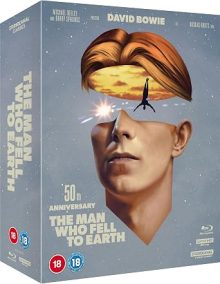
The Man Who Fell to Earth is now such a foundational achievement in the life and career of David Bowie that it has achieved almost mythic status. It was his debut feature film performance, opening the doors to many other acting appearances on stage and screen in the years that followed. It was also one of the very few projects from his past that Bowie would return to with genuine enthusiasm, resulting in the musical Lazarus, one of his final creative works before his untimely death in 2016. Despite being a Bowie fan of over thirty years standing, I have always regarded The Man Who Fell to Earth with varying levels of ambivalence. This 50th anniversary reissue of the film on 4K and blu ray offers me an opportunity to see the film in a new light.
Adapted from a novel by the author Walter Tevis, The Man Who Fell to Earth tells the story of Thomas James Newton, an extraterrestrial who has travelled to Earth in order to save his own planet from extinction. His arrival in the desert plains of New Mexico implies that he is impoverished and vulnerable, but this is proven not to be the case when he rifles through a huge roll of cash by a stream. This example of misdirection is central to Nicolas Roeg’s visual and narrative style. The suave and clinical individual we encounter hiring Oliver Farnsworth (Buck Henry) is not the man we then crumple in a physical heap inside a motel lift due to the clumsiness of Mary-Lou (Candy Clark). Bowie’s Newton is a contradictory figure; intellectually superior but physically vulnerable, and it is the contrast between these polarised forces is that are key to his ultimate undoing.

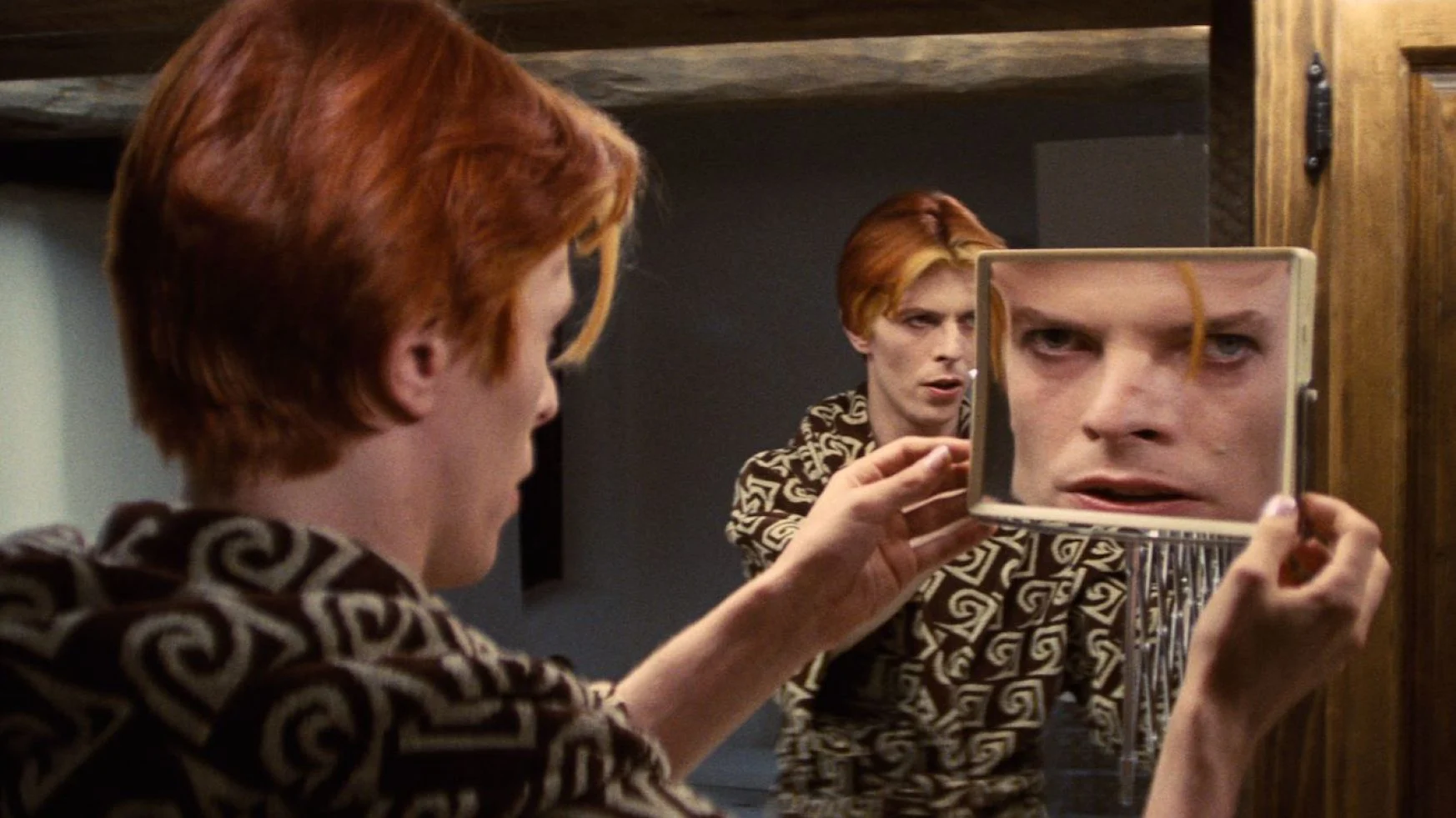
David Bowie’s performance as Newton is by far the best thing about The Man Who Fell to Earth. That should go without saying, you might think, but in my opinion his acting abilities are often overlooked and go unexamined. He brings a towering charisma to the role, in no small part aided by his outward transformation. His flame-red hair is as confrontational as his awkwardly elevated manner and out of place gestures, all perfect for the part of a creature utterly alone finding his way in a new world. Roeg’s initial choice for Newton was Peter O’Toole, but to my mind he’d already given his particular iteration of the stranger in a strange land to David Lean in Lawrence of Arabia. It is crucial to point out however that Bowie’s Newton is quite different from Walter Tevis’ literary creation. Whilst Bowie fully immerses himself in the vulnerability of the character, the film then does not fully flesh out how some of these vulnerabilities are the cause of his destruction. Newton’s alcoholism could be seen on one hand as enabling by Mary-Lou in order to keep Newton for herself, or as simply the numbing reflex of an alien desperate to fit into present day America – everyone in the film drinks copiously. The origin of his drinking problem as a cure for physical pain is not explored. His indolent reply of ‘why not?’ to Mary-Lou’s question about a glass of white wine further underscores this difference.
Candy Clark’s performance as Mary-Lou is still a divisive one, for me especially. Mary-Lou infantilizes Newton by calling him ‘Tommy’, and panders to his every whim. The scene where she accuses Newton of being an illegal alien taps into the character’s inner cynical streak and could help explain her overwhelming dependence on him. Clark has the most demanding secondary role, especially during the many (and at times unnecessary) nude scenes, and she acquits herself well. But the film overall doesn’t help her in the ways that it should. The final sex scene between Mary-lou and Newton with the revolver is gratuitous and makes no sense whatsoever, given that the table tennis scene that follows it has far more emotional resonance as their desperate final rendezvous.
Buck Henry is quietly brilliant as the precise and loyal Farnsworth, and in a rare progressive sign is shown in a fulfilling same sex relationship. But this is monstrously undercut by the utterly appalling figure of Dr Bryce, portrayed by Rip Torn. A professor with his proclivities wouldn’t just be indulged by a university, he’d be imprisoned. His uncomprehending bravado should be a red flag for the audience to his true character. There is no way that a life form of any kind would trust a man like Bryce with anything, let alone the key goal of his life.
It should be clear with those with sharp eyes that other forces are aware of Newton’s arrival on Earth, but the film is unfortunately vague about who or what they are. This plays into the many plot holes in The Man Who Fell to Earth. Who does Mr Peters (Bernie Casey) really work for? Who are the goons in the sparkling football helmets? Why do these forces wait until Newton is about to board the spacecraft to abduct him? In our present age of the billionaire ‘tech bro’, a figure like Newton would be exalted and practically worshipped. In the film he is experimented on and finally left to his vices, a seemingly spent force. That alone is one of the many unsatisfactory elements of the film that could and should have been resolved more conclusively.

That I suppose is why The Man Who Fell to Earth still connects with audiences fifty years later. It is a story of failure, of dashed dreams and of longing. Roeg soaks the film in American archetypes that soon mutate into the grotesque, where pop songs are the keys to memory and provide a solace that everyday reality cannot provide. Newton is betrayed by those he trusted and were closest to him. For me, the simplicity of the tale is excessive by Roeg, who often overrides the cutting dialogue of Paul Mayersberg’s screenplay with wasteful imagery. For this and so many other reasons, The Man Who Fell to Earth remains a curiously insubstantial film, and very far from Roeg best work.
COLLECTOR’S EDITION UHD / BLU-RAY SPECIAL FEATURES
- 1 4K UHD disc and 2 Blu ray discs
- 2-Disc Soundtrack
- 100-page booklet – including new interview with Candy Clark
- X 4 artcards designed by Nick Neocleous
- X 4 photocards
- X 4 posters including – x 2 original artwork, x 1 new artwork from Aleksander Walijewski and an exclusive poster of George Underwood’s artwork for Walter Tevi’s original book release
- Brand new documentary – The Man Who Fell to earth at 50: Bowie & Roeg: Aliens in America
- Interview with May Routh
- Interview with David James
- Interview with Sam Taylor-Johnson
- Interview with Michael Deeley
- The Lost Soundtracks
- Interview with Candy Clark
- Interview with Paul Mayersberg
- Interview with Tony Richmond
- Interview with Nic Roeg
- Watching the Alien featurette
- David Bowie – French TV 1977
This 50th anniversary edition of The Man Who Fell to Earth is a combined 4K UHD and Blu ray release, and contains many of the special features from StudioCanal’s 40th anniversary box set, such as the interviews and the Lost Soundtrack and Watching the Alien featurettes. The Lost Soundtrack featurette is particularly good, especially the contributions by Chris Campion. The set now contains the soundtrack double CD that was released in 2016, although this soundtrack is not complete. The 40th anniversary box set contains the John Phillips soundtrack CD with two bonus tracks not featured on the soundtrack reissue: Hello Mary-Lou and Bryce.
The interview with Bowie from French television lacks the subtitles that were included on the 40th anniversary set, and the interview questions that were part of the interviews on this previous set have now been removed. For everyone’s information, the man interviewing Bowie in the French TV clip is named Yves Mourousi. The various interviews are interesting, but I have to pick up on something that the late Paul Mayersberg says right at the start of the interview, where he says that he first met Nicolas Roeg whilst he was editing Performance. That cannot possibly be true; Performance was firstly edited by Antony Gibbs and Brian Smedley-Aston before being shelved and extensively re-edited by Frank Mazzola for its release in 1970. Mazzola’s heroic efforts went uncredited for decades until Kevin Macdonald and Chris Rodley’s exceptional documentary Donald Cammell: The Ultimate Performance (1998) revealed the full story.
The new elements to the reissue are an entirely new set of cover art, posters and art cards, all of which are excellent (the exclusive George Underwood poster is my favourite addition to the set), and an outstanding new documentary entitled The Man Who Fell to earth at 50: Bowie & Roeg: Aliens in America. It benefits enormously from the contributions by Ava Cherry and Geoff MacCormack (known then as ‘Warren Peace’). Their close relationships to Bowie add so much authenticity to their amazing stories from that period of his life. There is even a reference to Ola Hudson, who might be more familiar to people today as the mother of Guns N’ Roses guitarist Slash. The 100-page booklet containing a new interview with Candy Clark was sadly available for me to review.