


 Director: Riccardo Freda
Screenplay: Oreste Biancoli
Starring: Barbara Steele, Peter Baldwin, Elio Jotta, Harriet Medin, Umberto Raho, Carlo Kechler, Alberto Plebani, Graziella Granata
Country: Italy
Running Time: 96 Min
Year: 1963
BBFC Certificate: 15
Actress Barbara Steele was born in Cheshire, England but would become an overnight sensation and be forever recognised in the annals of horror history as a scream queen for her work in Italy.
Initially signed to a contract by the Rank Organisation in the 1950s, she had a number of small parts and was even due to be the female lead in Elves Presley’s Western film Flaming Star (1960) but left the production after a week.
Steele set off for Italy in the hope of appearing in films by the great director Federico Fellini, but her career would take a different path and she would soon by cast in Mario Bava’s gothic horror classic Black Sunday (1960) in a dual-role that would make her an overnight sensation. Bava apparently cast her after seeing a photo of her face and realising he had found his muse.
The actress would later star in what become classic American and British films, but she is arguably best remembered for her work in Italy, which included working with Antonio Margheriti and Riccardo Freda.
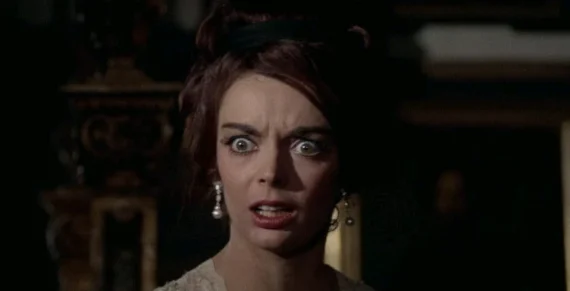
In 1962 she would star in Freda’s The Horrible Dr. Hichcock and in the following year would confusingly star as a character with the surname Hichcock in the subject of this review, The Ghost, also directed by Freda and a gothic reimagining of Henri-Georges Clouzot’s excellent Les Diaboliques (1955).
In the words of Raro Video/ Radiance, the film is set in Scotland in 1910 and sees Margaret (Steele) and her lover, Dr. Charles Livingstone (Peter Baldwin), plot to murder her wealthy, wheelchair-bound husband, Dr. John Hichcock, hoping to claim his fortune.
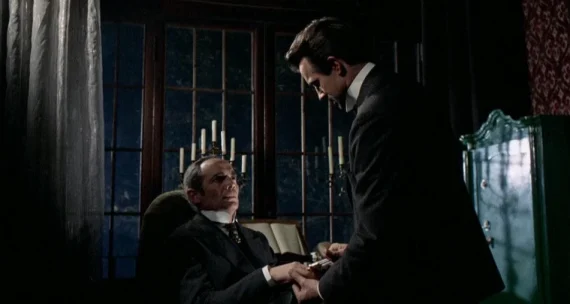
But after John’s death, their carefully laid plans begin to unravel when his inheritance vanishes and terrifying supernatural events plague the isolated estate, push the lovers towards madness and have them, and the viewer, questioning whether John has returned from the grave.
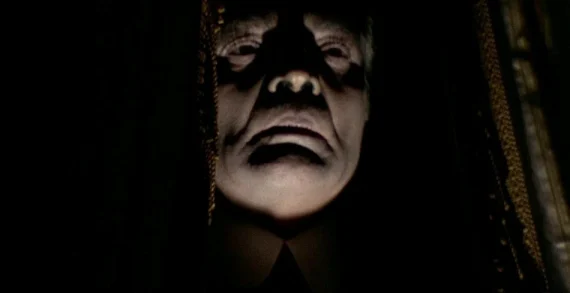
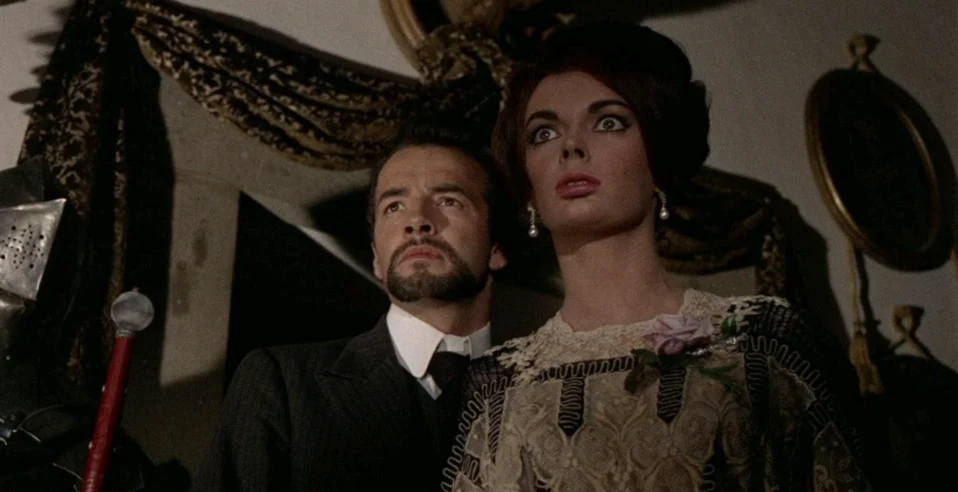
First and foremost, The Ghost is an incredibly atmospheric film. Everything comes together perfectly to create a bewitching sense of dread and paranoia, with some remarkable cinematography by Raffaele Masciocchi that focuses on close-ups and some disorientating shots like a look down a set of stairs. The editing by Ornella Micheli also helps the atmosphere no end, a brief shot of a hanging corpse for example, ratcheting up the tension. Costume and production design aid the 1910 setting and the main set of the family home is an imposing presence that is almost a character in its own right when the supernatural happenings take effect.
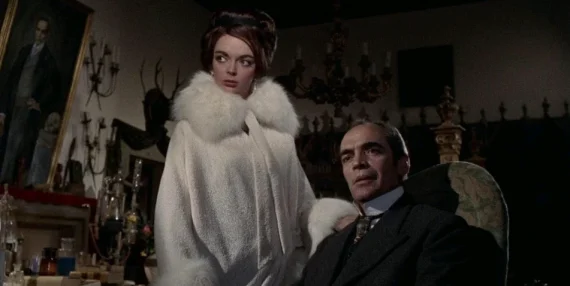
Steele is as magnetic a presence as ever, her face made for such films and she plays her role wonderfully, though it’s a shame we do not hear her voice as, like her other Italian performances, she is dubbed in Italian. The dubbing is one of the letdowns in the film, and it is not well done.
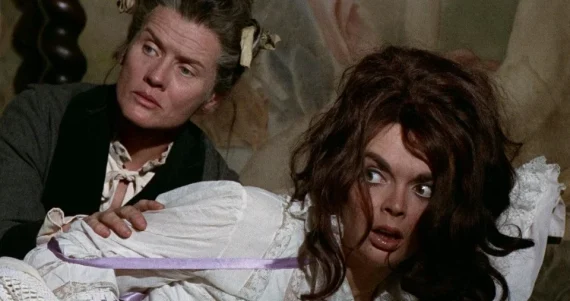
Elio Jotta is also great as her husband, at times tender, at others suicidal and, after his death, utterly chilling as a man who has apparently returned from the grave as a ghostly apparition. Special mention to for the final member of the love triangle, Peter Baldwin, who plays Margaret’s lover, the future Emmy-award winning television director would, like Steele, carve out a career for himself in Italy in the 1960s. And then there is Harriet Medin as the housekeeper Catherine. She also captivates the screen whenever she appears and plays a pivotal role in the plot.
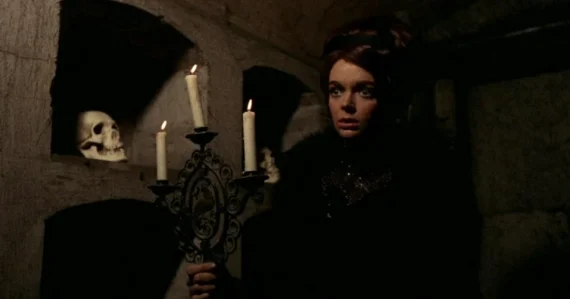
There is a rousing score by Francesco De Masi and Franco Mannino that is supplemented by some tension-building sound design, from the cracking sound of thunder to eerie noises, and also the voices that apparently come from beyond in the séance sequences.
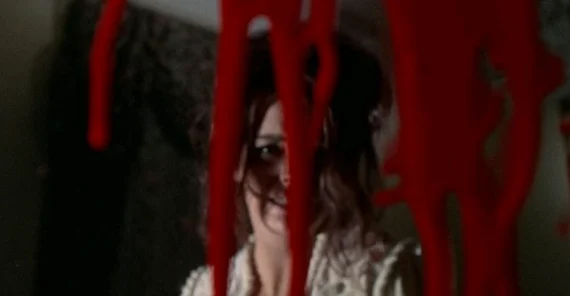
The film also features some really creepy and effective moments, including a wheelchair that rolls down stairs, a grisly decomposed body, a ghastly spirit of John that ominously walks towards Margaret holding a bouquet of flowers and cannot apparently be killed with a gun, and blood dripping from a ceiling beam. There is also a scene which is incredibly grisly as Margaret uses a razor blade to slice at the face of another character, whose name I shall not spoil, with blood oozing down the camera. It’s a shocking moment of a violence, effectively brought to the screen. Another moment where fire envelopes the screen is equally effective and stylish.
All of the great atmospheric sequences build to a memorable finale that fans of the genre may see coming, but which is no less effective for it, providing a payoff which the film has earned.
In closing, Riccardo Freda’s The Ghost is a very effective and entertaining gothic chiller that builds up the suspense and features some gorgeous cinematography and a mesmerising performance by Barbara Steele. It is only letdown by the quality of the dubbing – how Italian films would have benefited from Steele’s voice – and a plot that, whilst suspenseful, feels similar to other films, which is to be expected given its inspiration. But overall, it is a riveting watch thanks to atmosphere and tension that builds to a great climax.
A note on the names of those involved – on the opening credits the crew are given English aliases, but in this review I’ve been using their real names.
Film: 

The Ghost is released on limited edition dual format 4K UHD and Blu-ray on 7th December 2026 by Raro Video, in a release distributed in the UK by Radiance. The 4K restoration of the original camera negative, long thought lost, was carried out by Severin Films. It looks excellent, with a very natural colour scheme, and lots of fine detail – see the costumes and the books that adorn the walls of the study in the house. Audio is crisp and clear.
4K UHD and Blu-ray limited edition special features:
4K restoration of the long-lost original camera negative by Severin Films
4K UHD (HDR10) and Blu-ray presentation of the feature
Uncompressed mono PCM Italian and English audio tracks
Audio commentary by historians Nathaniel Thompson and Troy Howarth
The Horseman of the Apocalypse: A Portrait of Riccardo Freda – A newly filmed interview portrait of the director featuring screenwriter Ernesto Gastaldi, long-time collaborators Marcello Avallone and Giovanni Fago, FX artist Sergio Stivaletti and actress Martine Brochard
Audio interview with actress Harriet Medin
Give Up the Ghost – A visual essay by Tim Lucas
Who is Afraid of Franck Wallace? – A featurette on composers De Masi and Mannino, featuring film historian Pierpaolo De Sanctis and son of Francesco De Masi, Filippo
Trailers
Reversible sleeve featuring artwork based on original posters
New and improved English subtitle translation for Italian audio and English SDH for English audio
Booklet containing new writing by horror expert Kim Newman
Limited edition of 5000 copies
The 4K disc just contains the film and commentary, with the film and all extras on the accompanying Blu-ray.
The audio commentary by historians Nathaniel Thompson and Troy Howarth is fantastic. Fascinating and entertaining in equal measure it covers likely everything you’d want to know about the film from its production, to cast, crew, what works well and much more. Essential listening.
The Horseman of the Apocalypse: A Portrait of Riccardo Freda is a very good 26-minute piece looking at the director of the film through the memories and appreciative thoughts of screenwriter Ernesto Gastaldi, long-time collaborators Marcello Avallone and Giovanni Fago, special effects artist Sergio Stivaletti and actress Martine Brochard. It is a really strong piece that gives a good sense of the director as a person, as much as him as a filmmaker.
The audio interview with actress Harriet Medin is comprised of two interviews she did with Tim Lucas in 1986. It is a good 11-minute piece, with Medin talking very warmly about her work with Mario Bava, as well as her performances in Italian films. Her comments about Riccardo Freda and her work with him are particularly welcome, given this release, and I also appreciated hearing her views on dubbing in Italian films.
The visual essay by Tim Lucas runs for 29 minutes and is, as is to be expected given who delivers it, first class, informative, entertaining and authoritative. It gives a good overview of some of the scenes, similarly themed films, its cast and how it differs to the prior film, The Horrible Dr. Hichcock, which it is sometimes incorrectly referred to as a sequel to. I particularly liked the reference to names that are used in other films by the director and links or similarities to other film. It is a terrific piece.
Who is Afraid of Franck Wallace? Is another valuable featurette, this time on composers Francesco De Masi and Franco Mannino, featuring film historian Pierpaolo De Sanctis De Masi’s son Filippo. It provides some fantastic insight into film composition in Italy in the 1960s as well as insightful background into both composers.
The UK trailer runs for two minutes and is very beaten up and plays on the atmosphere.
The Italian trailer is a little longer, at just over three minutes, and in much better shape and does a great job selling the film.
I wasn’t provided with the trailer to comment on it, but it contains an essay by the great Kim Newman, so should be fantastic.
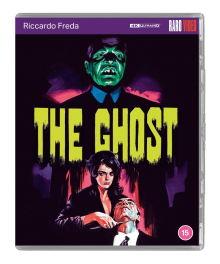
It’s a brilliant package all round for the Raro Video release of The Ghost, distributed in the UK by Radiance. The film itself is a very entertaining, atmospheric and suspenseful gothic chiller, which is presented excellently on disc thanks to a wonderful 4K restoration and beautifully pitched audio. Extras are plentiful and of a high quality, with over 90 minutes of insightful video extras, including a fantastic video essay by Tim Lucas, and a first-class audio commentary by the always fabulous Nathaniel Thompson and Troy Howarth.
Disc/Packaging: 