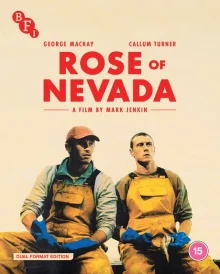
 Director: Mark Jenkin
Screenplay: Mark Jenkin
Country: UK
Running Time: 104 mins
Year: 2025
When a fishing boat, the Rose of Nevada, lost with all hands 30 years ago, mysteriously reappears in the old harbour of a forgotten Cornish village, for those who remember, it’s surely a sign. The boat must go out to sea again and maybe then the luck of the devastated village will turn. Young father Nick (George MacKay) and enigmatic newcomer Liam (Callum Turner) join captain Murgey (Francis Magee), and they head to sea. But when they return, something is amiss? They’ve slipped back in time, and the villagers greet them as if they are the original crew.
Mark Jenkin was born the year after Steven Spielberg stuck three guys in a boat and sent them out to sea to battle a shark. The result stands to this day as the best example of genuinely brilliant filmmaking paired with a ruthlessly efficient screenplay to deliver pure cinematic joy. I wonder how much Jaws played on Jenkin’s mind when he dumped George MacKay and Callum Turner with Francis Magee on a fishing boat and also sent them to sea on a journey so ill-fated it will bend time itself. Quite a bit I bet.
Jenkin is from a cine-literate generation brought up on Hollywood’s most brazen period and he encapsulates everything that can be great about Western cinema; a filmmaker employing his considerable talents to say something profound, while having an enormous amount of fun.
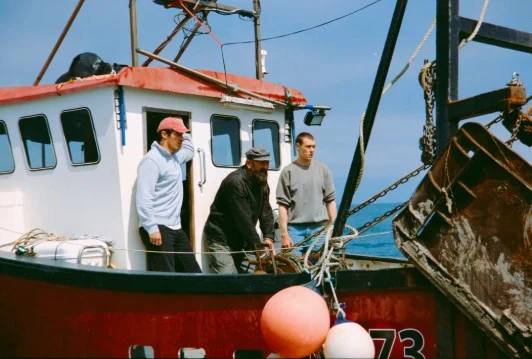
Rose Of Nevada is magnificent and, despite a bleak thread of social realism, it shares Spielberg’s mode of child-like cinematic joy. Albeit in an eerie thriller, it’s the audience being baited as much as the fish. “Emotionally accessible”, I think I heard Mark Kermode say.
Jenkin’s pure nuts and bolts approach makes for a nostalgia-fuelled film that feels like it was worked at like a painting; he’s filming with Kodak analogue on a 16mm Bolex camera, in a 4:3 square image, grainy and scratched. If we saw fingerprints, we wouldn’t mind. Watching it might be transcendent, because the result is impossibly slick. If Mark announced he was going to make a car chase filled buddy cop movie on 16mm, I wouldn’t dare bet against him.
The editing -which would have been old-fashioned cutting up bits of physical film- is incredible, especially on the boat when the boxes of fish are being stacked or they’re getting hammered by a storm at night. The claustrophobia and tension is palpable, especially in the detailed fishing scenes. Regardless of its sentimental and playful heart, the film lives in the hard detail of these characters’ lives and we feel the strain in their work.
The story takes the crew back to 1993, before the loss of the boat caused the village to slip into neglect. An interesting effect of using analogue means the film feels timeless and it could easily be from the 90s, a powerful shift that feels organic and disorientating. I suppose the story’s closest cousin is TV’s Life On Mars; it’s fantastic fun, but it can’t help but announce itself as being in a different time period, while the video quality is locked into early 2000s BBC. Here, George MacKay is dizzied by getting off the boat into a time that feels identical even to us, just busier.
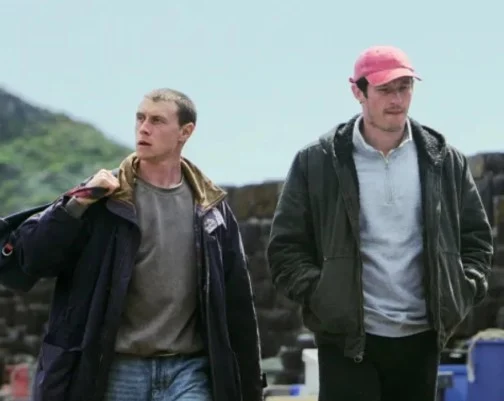
MacKay’s range of work betrays him as one of our hardest working actors and he invests himself into every part, regardless of the pitch. In an interview with Sight And Sound, Mark Jenkin explained how amazing it was to have someone like George, at home in a large budget production, equally willing to get his hands dirty in a pared back set. He takes the emotional weight of the film, but it wouldn’t work without Callum Turner’s foil or Francis Magee’s enigmatic captain. The setup is delightfully concise. The world on the boat versus that of the land. One man ready to accept the mysterious changes, the other railing against a capricious fate.
The characters and their stricken existence alone would make for an effective film, similar to a Shane Meadows production. Certainly more in-line with Jenkin’s earlier work like Bait. I know on paper it’s a hard-sell as a popcorn movie, but Rose Of Nevada looks fabulous despite, or even because of, the Sellotape that can’t have been far away. And it’s bloody time-travel. For a certain generation, that’s cinematic cat-nip.
As cinema begins to draw the lines against AI, it’s invigorating to see a film so successfully engineered, and not even limited by imagination. It’s inspiring when filmmakers like Jenkin or Sean Baker prove you can make something engaging with anything, be it your phone, an IMAX rig or a scrappy antique camera lying about in a loft.
VIDEO
I’ve already mentioned the look of the film, but specifically for this Blu-ray release from the BFI, it’s important to say it is a strikingly beautiful image. While it looks rough, because it is, and that roughness adds to the story and how you engage with it, the damage relates directly to the nostalgic ache running through the film. And the run-down dilapidated dirt-encrusted world is brought to life by unexpectedly vivid colours. It has a rich, deep contrast in the colours regardless of the daylight close-up work in fishing detritus, or night-time horrors of dealing with a storm. There’s a healthy grain popping and scratching throughout that never detracts from the detail, especially in faces. A lot of the film lives in George MacKay’s expansive bewilderment.
AUDIO
The sound design is phenomenal. Because Jenkin shoots on hand-cranked 16mm, every breath, rope squeak and all dialogue had to be rebuilt in post. There is no production audio.
Because the audio is constructed, the diegetic stuff like groans of winches, or fish being gutted, or just the entire ocean, is tactile and isolated, and sometimes disturbingly loud. The physicality of the fishing boat is hyper-real, which couldn’t have been achieved on-set and the audio contributes to a heartbeat of dread in the film. Fingers-crossed Mark moves into full horror, because it would be outrageously effective.
And that finite control means the shift from diegetic to non-diegetic is poetic. A rhythmic clank on the deck becomes a pulse in the score; and Jenkin uses whitespace in a fascinating way, when sound can just disappear entirely. Dialogue feels similarly disembodied, emphasising a sense of displacement.
Ultimately, I was reminded of animation where every single decision has to be constructed. Especially in the audio, Rose Of Nevada has an organic quality no filter or gimmick could achieve. It is a masterpiece.
EXTRA FEATURES
This expansive release by the BFI is an excellent declaration of confidence in a marvellous film. There isn’t a wasted minute in the features. The behind the scenes footage is excellent and backed up by an entertaining Q&A. The audio commentary with Jenkin and Kermode is a delight as they are friends and neighbours (resulting in a great segue about shed roofs where the seminal loose slate in the film is for real). There’s also a selection of Mark’s short films, which gives us more valuable insight. And of course, this is the BFI, so there’s a couple of public information films to round out a package that could be used as a mini film studies course.
-
- Presented in High Definition and Standard Definition
- Audio commentary by director Mark Jenkin and film critic Mark Kermode
- Rose of Nevada Q&A (2026, 37 mins): director Mark Jenkin and actors George MacKay and Callum Turner discuss the making of the film in an onstage Q&A filmed at BFI Southbank
- The Jenkin Way (2025, 16 mins): behind-the-scenes documentary on the making of Rose of Nevada, featuring cast and crew interviews
- Mark Jenkin in conversation with Rowan Woods (2026, 15 mins): on memory, community and the creative freedom of short filmmaking
- Selection of short films by Mark Jenkin: I Saw the Face of God in the Jet Wash (2025, 17 mins); A Dog Called Discord (2023, 23 mins); Vertical Shapes in a Horizontal Landscape (2018, 5 mins); David Bowie is Dead (2018, 17 mins)
- Between the Tides (1958, 21 mins): a mesmerising Technicolor study of intertidal life on Britain’s rocky southwest coast, produced by British Transport Films
- Helping the Earth: Cry (1992, 1 min): a hand-painted public information film about global warming, glimpsed in Rose of Nevada
- Stills gallery
- Theatrical trailer
- Includes optional English descriptive subtitles and audio description (feature and selected extras)
- FIRST PRESSING ONLY Illustrated booklet featuring new writing by Mark Jenkin, Rafa Sales Ross, Jesse Cumming, Gwenno Saunders and Jason Wood



Rose of Nevada
Screenplay: Mark Jenkin
Country: UK
Running Time: 104 mins
Year: 2025
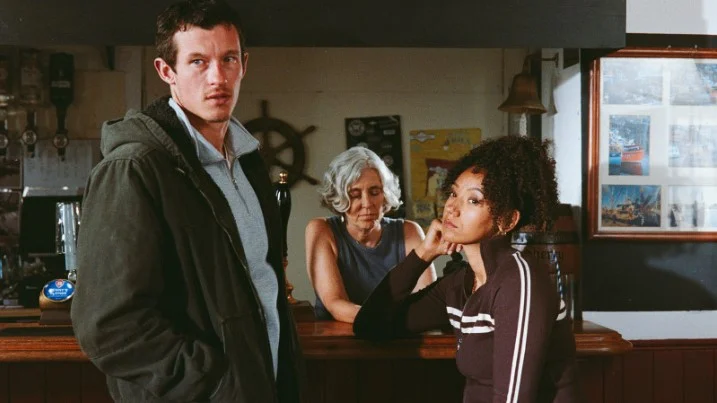
When a fishing boat, the Rose of Nevada, lost with all hands 30 years ago, mysteriously reappears in the old harbour of a forgotten Cornish village, for those who remember, it’s surely a sign. The boat must go out to sea again and maybe then the luck of the devastated village will turn. Young father Nick (George MacKay) and enigmatic newcomer Liam (Callum Turner) join captain Murgey (Francis Magee), and they head to sea. But when they return, something is amiss? They’ve slipped back in time, and the villagers greet them as if they are the original crew.
Mark Jenkin was born the year after Steven Spielberg stuck three guys in a boat and sent them out to sea to battle a shark. The result stands to this day as the best example of genuinely brilliant filmmaking paired with a ruthlessly efficient screenplay to deliver pure cinematic joy. I wonder how much Jaws played on Jenkin’s mind when he dumped George MacKay and Callum Turner with Francis Magee on a fishing boat and also sent them to sea on a journey so ill-fated it will bend time itself. Quite a bit I bet.
Jenkin is from a cine-literate generation brought up on Hollywood’s most brazen period and he encapsulates everything that can be great about Western cinema; a filmmaker employing his considerable talents to say something profound, while having an enormous amount of fun.
Rose Of Nevada is magnificent and, despite a bleak thread of social realism, it shares Spielberg’s mode of child-like cinematic joy. Albeit in an eerie thriller, it’s the audience being baited as much as the fish. “Emotionally accessible”, I think I heard Mark Kermode say.
Jenkin’s pure nuts and bolts approach makes for a nostalgia-fuelled film that feels like it was worked at like a painting; he’s filming with Kodak analogue on a 16mm Bolex camera, in a 4:3 square image, grainy and scratched. If we saw fingerprints, we wouldn’t mind. Watching it might be transcendent, because the result is impossibly slick. If Mark announced he was going to make a car chase filled buddy cop movie on 16mm, I wouldn’t dare bet against him.
The editing -which would have been old-fashioned cutting up bits of physical film- is incredible, especially on the boat when the boxes of fish are being stacked or they’re getting hammered by a storm at night. The claustrophobia and tension is palpable, especially in the detailed fishing scenes. Regardless of its sentimental and playful heart, the film lives in the hard detail of these characters’ lives and we feel the strain in their work.
The story takes the crew back to 1993, before the loss of the boat caused the village to slip into neglect. An interesting effect of using analogue means the film feels timeless and it could easily be from the 90s, a powerful shift that feels organic and disorientating. I suppose the story’s closest cousin is TV’s Life On Mars; it’s fantastic fun, but it can’t help but announce itself as being in a different time period, while the video quality is locked into early 2000s BBC. Here, George MacKay is dizzied by getting off the boat into a time that feels identical even to us, just busier.
MacKay’s range of work betrays him as one of our hardest working actors and he invests himself into every part, regardless of the pitch. In an interview with Sight And Sound, Mark Jenkin explained how amazing it was to have someone like George, at home in a large budget production, equally willing to get his hands dirty in a pared back set. He takes the emotional weight of the film, but it wouldn’t work without Callum Turner’s foil or Francis Magee’s enigmatic captain. The setup is delightfully concise. The world on the boat versus that of the land. One man ready to accept the mysterious changes, the other railing against a capricious fate.
The characters and their stricken existence alone would make for an effective film, similar to a Shane Meadows production. Certainly more in-line with Jenkin’s earlier work like Bait. I know on paper it’s a hard-sell as a popcorn movie, but Rose Of Nevada looks fabulous despite, or even because of, the Sellotape that can’t have been far away. And it’s bloody time-travel. For a certain generation, that’s cinematic cat-nip.
As cinema begins to draw the lines against AI, it’s invigorating to see a film so successfully engineered, and not even limited by imagination. It’s inspiring when filmmakers like Jenkin or Sean Baker prove you can make something engaging with anything, be it your phone, an IMAX rig or a scrappy antique camera lying about in a loft.
VIDEO
I’ve already mentioned the look of the film, but specifically for this Blu-ray release from the BFI, it’s important to say it is a strikingly beautiful image. While it looks rough, because it is, and that roughness adds to the story and how you engage with it, the damage relates directly to the nostalgic ache running through the film. And the run-down dilapidated dirt-encrusted world is brought to life by unexpectedly vivid colours. It has a rich, deep contrast in the colours regardless of the daylight close-up work in fishing detritus, or night-time horrors of dealing with a storm. There’s a healthy grain popping and scratching throughout that never detracts from the detail, especially in faces. A lot of the film lives in George MacKay’s expansive bewilderment.
AUDIO
The sound design is phenomenal. Because Jenkin shoots on hand-cranked 16mm, every breath, rope squeak and all dialogue had to be rebuilt in post. There is no production audio.
Because the audio is constructed, the diegetic stuff like groans of winches, or fish being gutted, or just the entire ocean, is tactile and isolated, and sometimes disturbingly loud. The physicality of the fishing boat is hyper-real, which couldn’t have been achieved on-set and the audio contributes to a heartbeat of dread in the film. Fingers-crossed Mark moves into full horror, because it would be outrageously effective.
And that finite control means the shift from diegetic to non-diegetic is poetic. A rhythmic clank on the deck becomes a pulse in the score; and Jenkin uses whitespace in a fascinating way, when sound can just disappear entirely. Dialogue feels similarly disembodied, emphasising a sense of displacement.
Ultimately, I was reminded of animation where every single decision has to be constructed. Especially in the audio, Rose Of Nevada has an organic quality no filter or gimmick could achieve. It is a masterpiece.
EXTRA FEATURES
This expansive release by the BFI is an excellent declaration of confidence in a marvellous film. There isn’t a wasted minute in the features. The behind the scenes footage is excellent and backed up by an entertaining Q&A. The audio commentary with Jenkin and Kermode is a delight as they are friends and neighbours (resulting in a great segue about shed roofs where the seminal loose slate in the film is for real). There’s also a selection of Mark’s short films, which gives us more valuable insight. And of course, this is the BFI, so there’s a couple of public information films to round out a package that could be used as a mini film studies course.