


Director: Junya Sato
Screenplay: Junya Sato, Kei Tasaka
Starring: Ken Takakura, Yoshio Harada, Ryoko Takano
Country: Japan
Running Time: 151 minutes
Year: 1976
BBFC Certificate: 15
The concept of the Japanese blockbuster is one that has only recently been made available for Western audiences, especially for home cinema. That omission has been corrected in recent years with the release of titles like Bullet Train, Proof of the Man, and the recent release of The Inugami Family. The steep decline in attendances and the massive onslaught from Hollywood meant that cinema in Japan was under huge pressure to stem the tide, in whatever way it could. Made during the tumultuous years in Japanese cinema history These films form a group of high concept projects that make for fascinating viewing. none more so than the subject of this review, Manhunt from 1976.
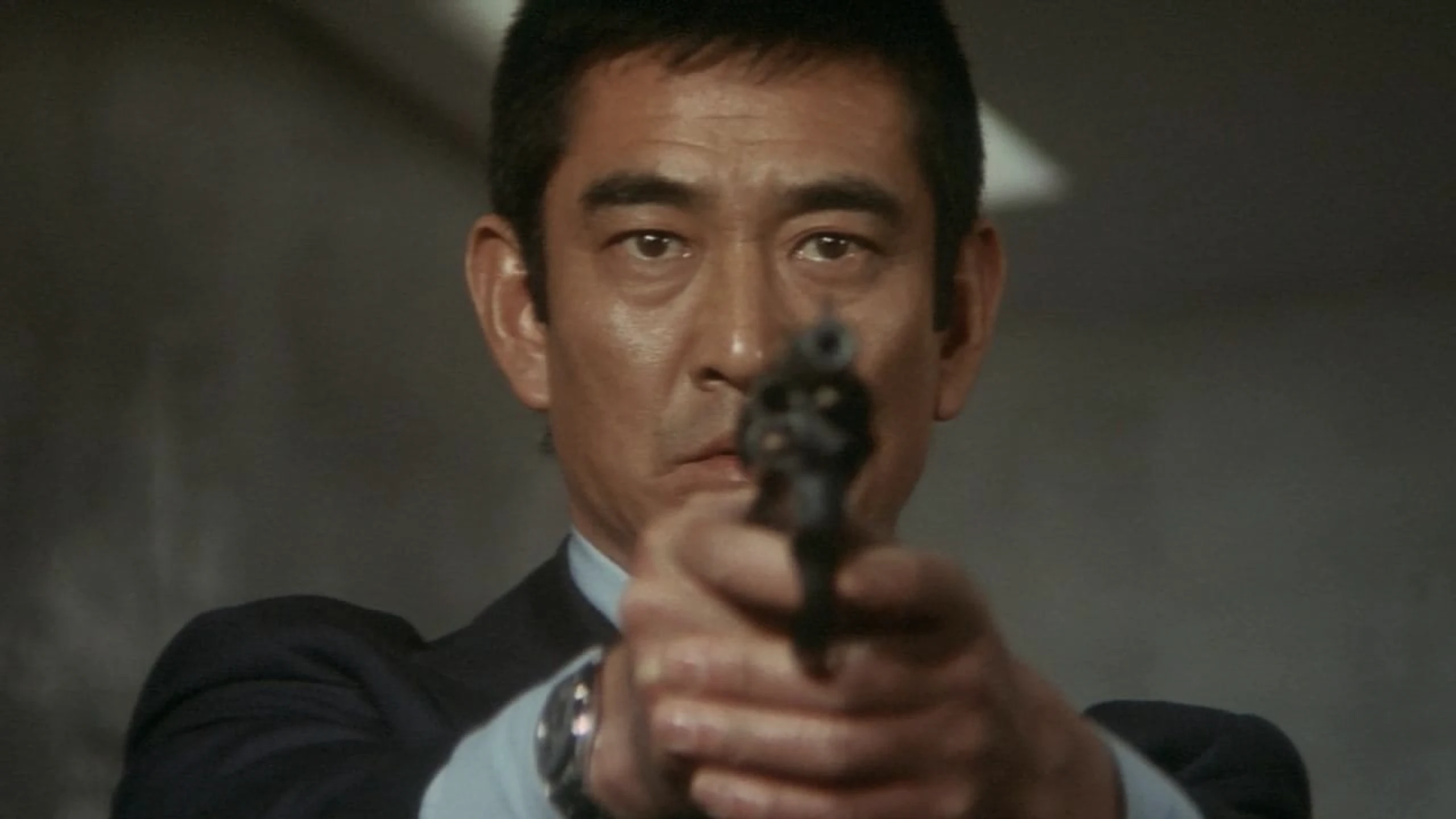
Adapted from a novel by Jukō Nishimura and directed by action specialist Junya Sato, Manhunt reunited Sato with the legendary actor Ken Takakura, with whom he had already worked on well-known films such as Bullet Train and the manga adaptation Golgo 13. Making his first film away from Toei, the studio where he had made his name and reputation, Takakura stars as Morioka, a prosecutor who finds himself accused of a set of crimes by people completely unknown to him. Framed for crimes he did not commit, Morioka escapes from police custody and goes on the run in an extraordinarily picaresque adventure to both solve the crime and clear his name. Takakura’s stoic man of action persona is perfect for the role of Morioka, an honourable man brought low by forces that swirl around him. Takakura is often referred to as ‘the Clint Eastwood of Japan’, but that label belies the emotional vulnerability at the heart of his screen persona. Beneath the hardman exterior lurks someone with a heart of gold, and ‘Ken-San’ brings all of these aspects to bear on a role which sees him perform everything from unarmed combat to flying a Cessna with only a few minutes of instruction.
With a running time of 151 minutes, Manhunt provides more than enough space for the police procedural elements to keep the audience invested as much as the plentiful action set pieces, and an all-star cast that includes Kunie Tanaka, Ko Nishimura and Yoshio Harada, all familiar faces from that era who all acquit themselves brilliantly in their various roles. As the ultra-dogged detective Yamura, Harada radiates his own particular brand of macho cool; gruff and permanently smoking, he treats a bear attack with barely a shrug. His scenes with Takakura bring the new face of masculinity up against the gold standard, and crackle with real intensity. With her passionate gaze and winsome beauty, newcomer Ryoko Takano is excellent as Mayumi, who proves herself to be invaluable to Morioka’s quest for justice, as well as the star’s love interest. It’s a shame that her character that Takano has to undergo a pointless nude scene. It is certainly one of the more outdated aspects of the film, alongside the more obviously dated visual effects shots.
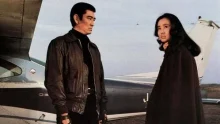
In terms of its locations, Manhunt is a feast for the eyes. Morioka’s epic month-long journey across half of Japan takes in some of the less well-known parts of the country, from the rural plains of Hokkaido to some of the most remote train stations of Honshu. Junya Sato ensured that this journey was logistically possible, even if other aspects of the narrative might not be, such as the bear attacks and the spectacular sequence involving the streets of Tokyo’s Shinjuku district, which I will not spoil as it is one of the very best moments of the film.
There is a streak of anti-authority running throughout Manhunt; everyone that helps Morioka knows that he’s an outlaw, but comes to his aid anyway. Mitsuko Baisho’s cameo as a sex worker who shelters Morioka forcefully underlines that streak, as does the hapless machinations of pretty every figure in law enforcement except the maverick Yamura. It is hard to criticize a film where almost too much is going on. Manhunt is certainly an action film, but it’s also a murder mystery, an indictment of corporate and law enforcement structures, and a grandiose morality tale. When the heroes finally confront the final boss, he is played with supreme menace by Kō Nishimura, a stunning actor who made his career portraying some of the most repellent villains in Japanese cinema – I still shudder at his performances in Kinji Fukusaku’s early classic The Threat and Tadashi Imai’s Cruel Tale of Bushido.
Stuffed to bursting with action, adventure, love and intrigue, and teetering on the verge of implausible, Manhunt is everything you could want from a Japanese blockbuster.
Special Features
NEW Audio commentary by Jasper Sharp and Amber T.
NEW Man on the Run: a brand-new introduction with Japanese film specialist Mark Schilling
NEW An Unusual Director, a discussion of the film and its production by Junya Sato biographers Masaaki Nomura and Tatsuya Masuto
NEW Scaling the Great Wall to Freedom, a text essay by James Marsh
NEW Believing in Ken Takakura, a text essay by Earl Jackson
Stills gallery
Original Theatrical Trailer
Before you can enter into the menu for Manhunt, you are treated to a couple of pre-feature trailers, in keeping with Toy Robot’s retro aesthetic. One is for the brilliant Roaring Fire, and the other is for the Johnnie To’s 2006 Chinese gangster film Exiled. I’m very much looking forward to seeing this film based on the atmospheric trailer.
The dream team of Jasper Sharp and Amber T. deliver a truly blockbuster commentary. They bring to bear all their knowledge and enthusiasm to the task, and the film’s epic runtime allows both of them many opportunities to digress onto a wide array of topics. Everything from Ken-San’s charismatic aura to the plethora of animal films made in Japan are served up for our enjoyment. Sharp is especially good on points of reference in Japanese cinema, and Amber T, brings up really interesting socio-political aspects, including a reference to the obscure radical left-wing groups the East Asia Anti-Japan Armed Front.
The interview with Mark Schilling emphasizes just how popular Manhunt was outside of Japan upon its original release. Apparently close to a billion Chinese citizens saw the first when it was released there, as it was the first foreign film to be screened following the Cultural Revolution. It caused an absolute sensation and led to hero status in China for Ken Takakura and his co-star Ryoko Takano.
Unfortunately, due to technical issues, I was not able to access the text essays by James Marsh and Earl Jackson, which is a great shame. However much I like the inclusion of art cards in Toy Robot releases, I would greatly prefer a printed booklet.
The special features are rounded out by a stills gallery and a suitably bombastic trailer for the film.
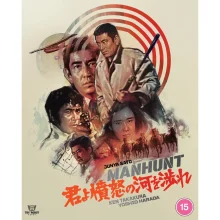
Last but by no means least, another reason for anyone to buy Manhunt is the absolutely stunning cover artwork designed by the late, great and much missed artist Tony Stella.