


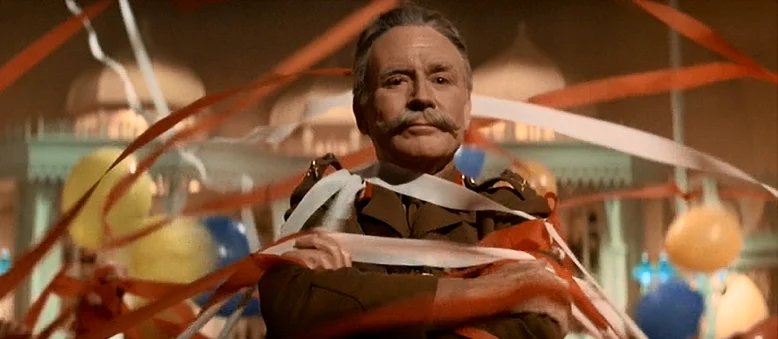
Director: Richard Attenborough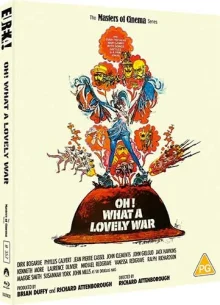
Screenplay:
Len Deighton
Starring: John Mills, John Gielgud, Ralph Richardson,
Ian Holm, Phyllis Calvert,
Kenneth More, Maggie Smith, Dirk Bogarde, Susannah York,
Jack Hawkins, Vanessa Redgrave.
Country: United Kingdom
Running Time: 144 Minutes
Year: 1969
BBFC Certificate: PG
‘Conflict and trench warfare have returned to Europe’, says the BBC correspondent Jordan Dunbar as he investigates the Battle of the Somme; elsewhere on television, Stanley Kubrick’s visceral Great War film Paths of Glory is casually broadcast on a summer Sunday afternoon. World War One surrounds us, suffuses our programming, but it can just as easily elude our understanding. To watch something as ferocious and satirical as Oh! What A Lovely War in this particular context is quite a jarring experience.
Richard Attenborough’s great appetite to become a director was made a reality by this remarkable project, brought before him by his great friend and legendary actor John Mills. Adapted from the stage musical of the same name, Oh! What A Lovely War is in stark contrast to the play created by Joan Littlewood and Gerry Raffles (itself based on the radio play The Long Trail by Charles Chilton). All hint of military uniforms were absent from the stage version, whereas Attenborough, Brian Duffy and writer Len Deighton decided to make their own way with the material. The very idea of taking an event as immense as the Great War and satirizing the very idea of war itself took no small amount of courage, and casts almost every notable (and ennobled) actor in British cinema at that time. The list is truly extraordinary – John Mills, John Gielgud, Ralph Richardson, Jack Hawkins, Ian Holm, Phyllis Calvert, Dirk Bogarde, Susannah York, Maggie Smith and Vanessa Redgrave. All of them, and a great many others put themselves forward to create one of the most piercingly political films ever made in this country.
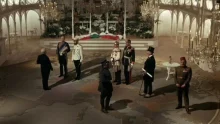
Attenborough stages the world-shaking events of World War One as an end of the pier attraction – Brighton Pier, to be exact. From the opening squabbles between the representatives of the Great Powers in the Pavillion to the admissions booths manned by General Haig himself (played with aplomb by John Mills), this is war portrayed as a laugh and a lark, an adventure for all to participate in and enjoy. We follow our constructed symbolic family, the Smiths – Bertie (Corin Redgrave), George (Maurice Roëves), Betty (Angela Thorne), Harry (Colin Farrell) and Jack (Paul Shelley) as they enlist during the first heady days after war breaks out. The war itself is staged as pure abstraction – a cavalry charge mounted on a carousel on the Sussex Downs, target practice at the pier as basic training – and that heightened atmosphere is amplified further by the bravura use of songs from the era – music hall anthems, hymns, and soldiers’ songs.
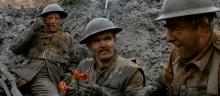
More than anything, these songs bring home the realisation that the unrelenting savagery of the war was met in turn by the unceasing flippancy of the soldiers themselves, as they literally laugh in the face of almost certain death. This is aided enormously by Len Deighton’s scabrous screenplay, which is full of fantastically brusque dialogue. At one point George and his comrades ae pinned down in a shell crater; when one of them ventures out for help and is hit, George quips, ‘if he’s got himself shot, I’ll kill him!’. At various points Haig kneels and prays to God, lying through his teeth to the Almighty about the casualties on the Western Front. Never let it be said that ‘post-truth’ and ‘alternative facts’ are a recent phenomenon.
Oh! What A Lovely War and the ‘war as a game’ are confined to the Western Front, to the tropes and iconography associated with fields of Flanders, lending it a particular sense of British parochialism that Attenborough clearly saw as the film’s target. The sense of ignorance that permeated the middle classes is best demonstrated in the scene with Bogarde and York partying on the pier amidst fireworks which rain down as flares on the trenches and the outright callousness of the ruling officer class is exemplified by Haig’s unyielding battlefield strategy. As Edward Fox murmurs memorably, ‘this is not war, sir. It’s slaughter’. Poppies are used to represent individual deaths, and cricket scoreboards keep track of each battle’s monstrous casualty rates. The horror amidst the gaiety is overwhelming.
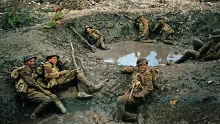
The musical performances are poignant and sharp in equal measure, but the quieter moments of the film allow for some genuine emotional resonances, such as Mary Wimbush’s anguished expression at St Pancras Station, a long tracking shot across the faces of wounded men awaiting ambulances, or Angela Thorne praying alone in the ruins of a church.
Supremely constructed by the best both in front and behind the camera, Oh! What A Lovely War is that rare beast, and possibly the last of its kind: an epic paean to pacifism with every great face and name in unison against the lunacy of war. Would that we had such a statement as vociferous as this in our day and age. This stunning blu ray edition of the film is the definitive home cinema release of this heartfelt memorial to ‘the glorious dead’ – whilst they still dared to live.
SPECIAL FEATURES
Limited edition O-card slipcase featuring original poster artwork [2000 copies]
- Limited edition booklet featuring new writing on Oh! What a Lovely War by Andy Dougan, author of The Actors’ Director: Richard Attenborough Behind the Camera [2000 copies]
- 1080p HD presentation from a restoration by Paramount Pictures
- Original English mono audio
- Optional English subtitles
- New audio commentary with British cinema scholars Melanie Williams and Lawrence Napper
- Archival audio commentary with director Richard Attenborough
- Your Country Needs You – new interview with film historian Simon Brown on depictions of World War I in British cinema, from The Battle of the Somme to 1917
- Extensive making-of documentary presented in three parts: “Welcome to World War I,” “The Smith Family Album” and “Keep the Home Fires Burning”
The limited-edition booklet contains an essay by Andy Dougan entitled ‘Richard Attenborough: The Turning Point’, which is a good biographical primer on the life and career of the great actor, director and producer, although it does say more about The Angry Silence than it does about Oh! What A Lovely War.
Recorded in 2004, the commentary with Richard Attenborough is like having the great man himself sat your side as he quietly regales you with anecdotes from the making of the film, and gives wonderful detail about the themes and ideas that he used to bring this project to life. The new commentary with Melanie Williams and Lawrence Napper is full of superb contextual detail and discursive conversation, taking in everything from the spectacle of musicals in 1960s film history to the use of iconography of World War One in popular memory, the differences between the stage version of Oh! What A Lovely War and the film, and the iconoclastic response to the film by New Left critic Tom Nairn.
The making of documentary comprises three separate parts, but they run together as one neat extra with interviews with Attenborough, Corin Redgrave, Edward Fox, Angela Thorne and Susannah York, all of whom pay fulsome tribute to each other and everyone associated with the film’s production. The most interesting and humorous contributions are by continuity assistant Ann Skinner.
Your Country Needs You is an excellent interview with historian Simon Brown, who goes through the various cinematic depictions of World War One in British cinema, from The Battle of the Somme (which contains the fake battlefield footage that the BBC still uses to this day) to 1917 with a good deal of authority and detail. Brown identifies certain themes at play throughout this visual history, such as remembrance, sacrifice and honour, which led me to realise that there is one significant omission from his list of films: Derek Jarman’s immensely moving War Requiem from 1989.