


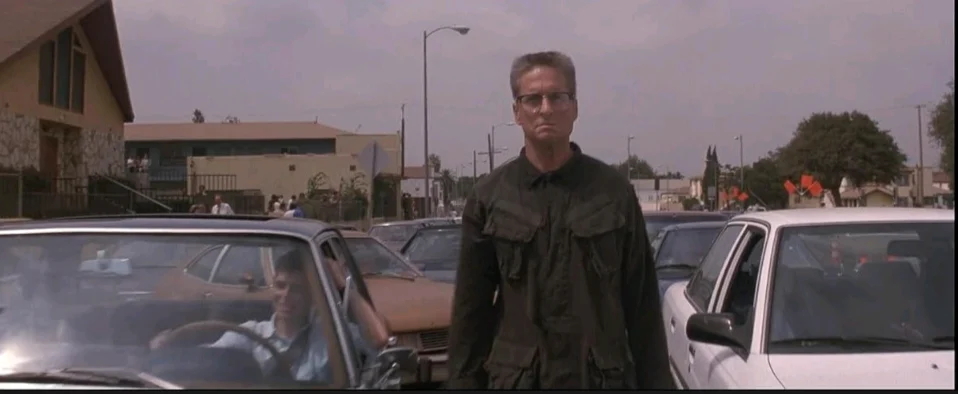
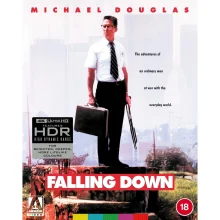
 Director: Joel Schumacher
Screenplay: Ebbe Roe Smith
Starring: Michael Douglas, Robert Duvall, Barbara Hershey, Rachel Ticotin, Tuesday Weld, Frederic Forrest, Lois Smith, Joey Hope Singer, Michael Paul Chan, Raymond J. Barry, D.W. Moffett, Steve Park
Country: United States
Running Time: 113 min
Year: 1993
BBFC Certificate: 18
Screenwriter Ebbe Roe Smith started his film career as an actor. You may have seen him in the likes of The Big Easy (1986), Turner & Hooch (1989), Fletch Lives (1989) or episodes of 1980s TV shows like the reimagined The Twilight Zone, Amazing Stories and Cheers.
Yet his biggest break came in 1993 when his script for Falling Down was brought to the big screen by director Joel Schumacher. Given the quality of his first-time script and the subsequent film, it’s hard to believe that Smith has hardly any film credits after this point. Yet he certainly left his mark, with an incendiary, controversial work that stands the test of time.
Falling Down immediately throws us in and introduces us to a man clearly on edge and agitated, stuck in a traffic jam in searing heat in Los Angeles. That man is played by Michael Douglas and is known as ‘D-Fens’, the name given to him by the police from his vanity license plate whilst they try to determine who he is. We will learn his real name is William Foster, but for the purposes of this review we will stick with D-Fens.
D-Fens gets out of his car and proclaims that he is going home. What follows is his journey across LA to get home to his family. It’s a journey that becomes increasingly violent as he has a chip on his shoulder and bone to pick with virtually everyone he meets. D-Fens is not of stable mind to start with, but he becomes increasingly unhinged and prone to bouts of violence which escalate as the film progresses, leading to the police trying to identify who he is so they can track him down and apprehend him.
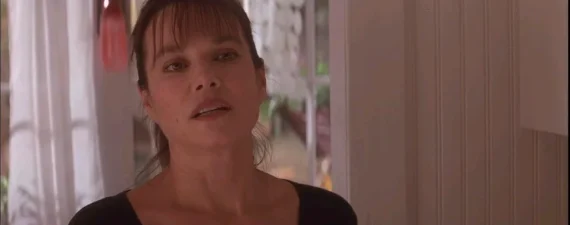
Through the course of the film we learn that D-Fens is unemployed, having been fired from his defence job about a month before the single day in which the film is set, has been divorced by his wife Beth (Barbara Hershey) and is trying to get home to see her and their daughter Adele (Joey Hope Singer) for the latter’s birthday.
The police chase is led by Sergeant Prendergast (Robert Duvall) who is just hours away from retirement before becoming embroiled in the efforts to stop D-Fens.
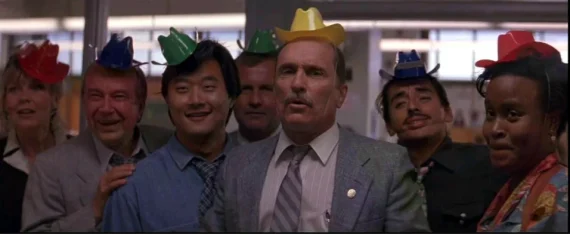
That’s the premise for a film of great scenes, that is gripping from opening minute to end credits. The wonderful opening that sets us on our odyssey with D-Fens is brought to life through quick editing, a nerve shredding score and fantastic use of sound.
D-Fens then becomes embroiled in situations – some of his own making and others that he finds himself unfortunate to find himself in and as the audience we brace ourselves for how things will escalate and how angry he will get.
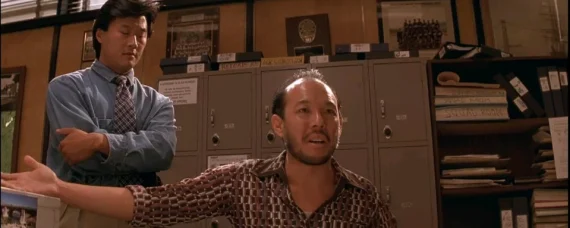
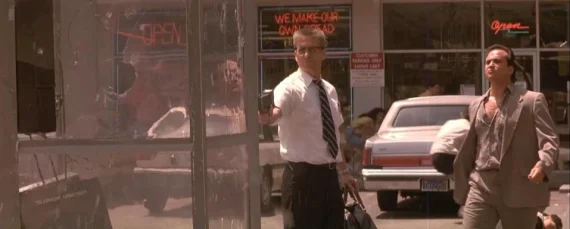
Some are difficult to watch. For example, D-Fens turning racist with a Korean shopkeeper as he is trying to get some change to make a phone call. The shopkeeper refuses to give him any change unless he buys something and the scene turning ugly when D-Fens chooses a can of soda but bulks at the price as it will not leave him with enough money to make a phone call.
This scene is one of the toughest to watch and it’s one of those which left me with no empathy for D-Fens. He says he’s standing up for his rights as a consumer but the way he goes about it is racist and criminal, assaulting the shopkeeper and trashing the place when he doesn’t like the price of goods.
It’s a provocative scene, and not the only one, but that’s the intention – we’re seeing the rage of the main character bubbling over, warts and all. Screenwriter Smith wanted to give a character to the news stories he was seeing of the guy next door: the every-men who seemingly no one suspects or has any idea would ever turn violent.
Smith wanted to focus on these individuals rather than pure evil criminals and look at how everyone has the potential to just snap one day if they are pushed too far or if they lose their place, and faith, in society.
D-Fens is this character – alienated, divorced, jobless and feeling as though his country it not only a place he does not recognise anymore but has also let him down and underappreciated him. All of this leads him to just snap and in his mind he’s the hero hard done to not the bad guy.
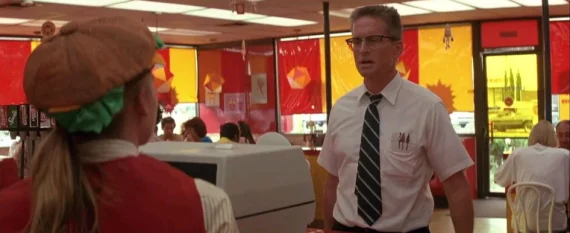
Another key scene is one set in a fast-food restaurant that I’d imagine is the first that comes to mind for many when thinking of the film. D-Fens just wants to order breakfast but he’s just a few minutes too late and it’s not being served anymore. He turns violent and angry when he’s repeatedly told he can’t have breakfast.
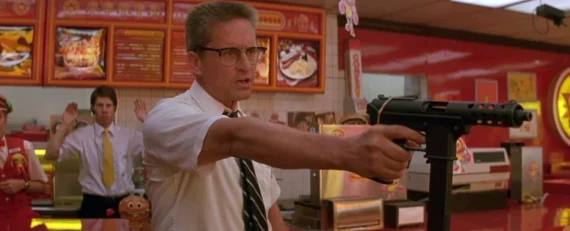
When the terrified staff finally acquiesce to his demands and it looks like he will finally get his breakfast, he changes his mind, orders lunch and receives a burger that looks tragic compared with the delicious-looking one in the promo poster at the restaurant. Cue more anger.
It’s a quite remarkable scene that starts off as dark humour before turning even darker as D-Fens pulls out a machine gun, terrifying staff and customers alike.
Duvall’s cop Prendergast is much more likeable and relatable, and on his own journey to get through his final shift. He is frequently called by his wife who just wants him to come home but turns increasingly erratic in the calls, which is understandable as the couple lost their child unexpectedly at the age of two and she is still grieving and scared she will lose her husband to given the nature of his work.
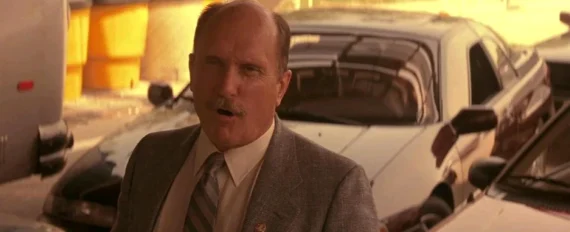
Both characters, as different as they are, show their vulnerable side with their home lives. D-Fens frequently attempts to contact his ex-wife and daughter – and at times it seems as though he hasn’t remembered he’s divorced and doesn’t live with them.
Meanwhile, Prendergast’s wife is visibly upset every time she calls her husband with a feeling of impending doom and just wants him home, safe and sound. D-Fens also shows his compassionate side on occasion and the quality of the script and the performance of Douglas pull the emotional strings, conflicting the audience’s feelings given some of the horrendous acts we’ve witnessed his character do.
The film does a good job of keeping D-Fen and Prendergast apart for the most part, the former trying to get home and the latter investigating and pursuing.
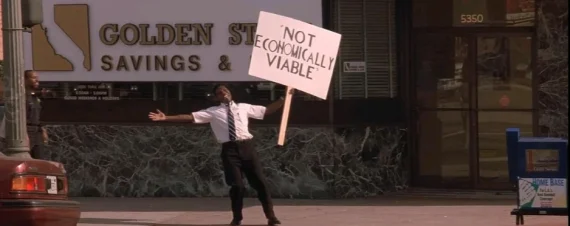
Alongside the main duo and their families, Schumacher paints a portrait of LA, highlighting those who are homeless or jobless and struggling to make ends meet and not afraid to confront the less touristy side of the city.
We also meet a number of extravagant characters who D-Fens encounters. These include a racist, sexist and homophobic surplus store owner played by Frederic Forrest, who is incredibly memorable. D-Fens is disgusted by his encounter with the fascist store owner, which gives us one of the first glimpses of a more human D-Fens. Their scenes together are in your face in their provocative nature and uncomfortable to watch.
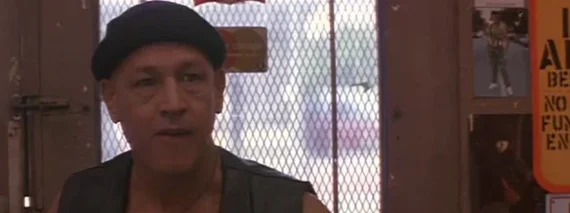
But it’s also the first time that D-Fens kills someone, his anger and hatred boiling over from threats and non-fatal violence to kill the store owner. There are eruptions of violence before this moment, D-Fens attacking a gang, the gang retaliating by trying to shoot him as he makes a call to his ex-wife, the bloody aftermath of the gang being involved in a car crash and much more, but they don’t escalate to this level until the surplus store scene.
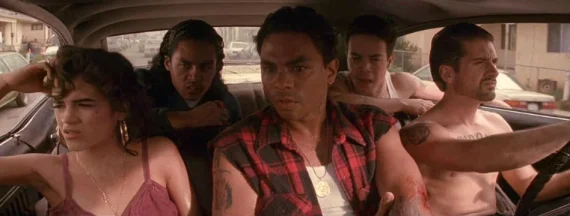
Further standout scenes involving a construction site and a bazooka, a golf course and more follow and things continue to escalate building to an unforgettable climax on a pier in Venice Beach.
The sweltering LA is a character in its own right, locations familiar and not so familiar forming a landscape that D-Fens is trying to navigate. It’s all beautifully lensed by Andrzej Bartkowiak.
James Newton Howard’s excellent, pulsating score does so much to help sustain the sense of tension and build up the feeling of impending doom and dread. Schumacher didn’t think it would be the type of score Howard could do given the content, but he pulls it off brilliantly.
It’s not just music that tickles our aural senses. Sound in its totality is so important in the film. The car horns, a buzzing fly and the voices of other people stuck in the traffic jam that opens the movie, for example, escalating D-Fens’ anger.
Falling Down is a great 1990s film which retains its power. Full of memorable sequences, incredible performances – not least Douglas as the lead – and a cracking score and sense of place thanks to the on-location filming in LA, it’s a confrontational work about a man who is pushed to the brink. Its provocative themes chime with the world we live in today which feels far from safe and tolerant, and thanks to Arrow’s excellent release, now is the perfect time to reappraise it.
Film: 

Falling Down is released in separate limited edition 4K and Blu-ray editions on 20th July 2026. I reviewed the 4K edition. Arrow have restored the film in 4K with a new restoration approved by director of photography Bartkowiak. It’s a phenomenal restoration, with plenty of excellent detail and looks gorgeous throughout, with a natural colour scheme and plenty of fine detail. The audio is also great.
4K Ultra HD limited edition contents:
Brand new 4K restoration by Arrow Films approved by cinematographer Andrzej Bartkowiak
4K UHD (2160p) Blu-ray presentation in Dolby Vision (HDR10 compatible)
Newly restored original lossless stereo 2.0 and DTS-HD MA 4.0 surround audio
Optional English subtitles for the deaf and hard of hearing
Archival audio commentary by director Joel Schumacher, editor Paul Hirsch, screenwriter Ebbe Roe Smith, LA Times writer Shawn Hubler, and actors Michael Douglas, Michael Paul Chan, Vondie Curtis-Hall, and Frederic Forrest
Man on the Edge, a brand new interview with screenwriter Ebbe Roe Smith
At War with the World, a brand new interview with composer James Newton Howard
Going Home, a brand new location featurette revisiting the real-life Los Angeles sites used in Falling Down
Deconstructing D-Fens, an archival interview with Michael Douglas
Original trailer
Image gallery
Reversible sleeve featuring original artwork
Collectors’ booklet featuring new writing on the film by film critics Alexandra Heller-Nicholas and Simon Ward
The audio commentary dates from 2009 and features cast and crew and is essentially a mix of interviews that play over the course of the film. It is very informative with lots to glean about the production, script, and those involved in front of and behind the camera, but don’t expect a traditional commentary.
The new interview with screenwriter Ebbe Roe Smith runs for 19 minutes. Smith shares how he was an actor before being a screenwriter, revealing how an LA Times news article inspired the story of the film and posed the question how could a man just snap and commit crime? He also talks about LA as an inspiration and shares some differences from his script to the finished film some of the inspirations for key scenes, like the golf course sequence, and highlights his cameo in the movie. It’s a very good and entertaining interview.
Next is a new interview with composer James Newton Howard which runs for nine minutes. The composer shares how he had earlier worked on Flatliners (1990) with director Schumacher, how Falling Down came about and how he was out of his comfort zone on it. We learn about the scoring process and some of the motifs. It’s a very strong piece, with plenty to clean despite the short length.
A fabulous new location featurette revisiting the real-life LA sites used in the film runs for 13 minutes and features narration. It not only shows how some of the locations look now but uses a map to show where D-Fen goes during the course of the movie, as well as providing some context and background. It is detailed and fascinating.
Up next is a 10-minute archival interview with Michael Douglas from 2009, in which the actor shares how he got involved in the film, how he felt the story captured the zeitgeist of the time, how the script had been turned down multiple times before being greenlit and why he wanted to make it. It is another strong interview.
Two very 90s trailers are included, which took me back some decades thanks to the instantly recognisable voiceover guy on the first one. Both run for two-and-a-half minutes and showcase different scenes.
The final on-disc extras is an image gallery containing over 160 images including stills, behind the scenes, promo shots and posters.
The 24-page booklet contains two strong essays, kicking off with one by Alexandra Heller-Nicholas, who looks at the film through the lens of the military and events in LA at the time. The second essay by Simon Ward focuses on the instantly recognisable look of Douglas’s character: crewcut, glasses, short sleeved white shirt and tie. It looks at film through the lens of similarly attired characters.
In closing, Arrow have provided a brilliant audio-visual presentation for Joel Schumacher’s Falling Down, headlined by a fantastic new 4K restoration and supplement the controversial classic with an informative archival commentary and interview with star Michael Douglas plus three great new pieces.
Disc/Package: