 Director: Guillermo del Toro
Screenplay: Guillermo del Toro, David Muñoz, Antonio Trashorras
Starring: Marisa Paredes, Eduardo Noriega, Federico Luppi, Fernando Tielve
Country: Spain, Mexico
Running Time: 108 minutes
Year: 2001
As General Franco’s fascists close in on victory during the final days of the Spanish
Civil War, 12-year-old Carlos arrives at a remote orphanage for children of left-wing families.
Soon after arriving, Carlos discovers the orphanage is haunted by Santi, a dead boy who
stalks the building’s dark hallways and seeks revenge for his tragic death…
This month sees the welcome release onto UHD of Guillermo del Toro modern ghostly fable, The Devil’s Backbone. I always think of it as his second film following Cronos, but that would be Mimic. Being given a big-budget Hollywood movie as his sophomore film might prove how well regarded he was from the beginning, but it was such a disaster, it almost cost him his career.
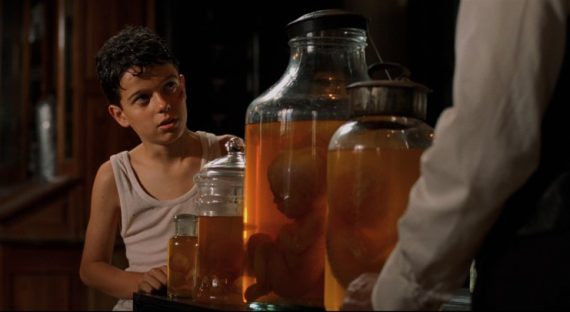
Thanks to Pedro Almodovar giving the bruised and disillusioned Del Toro a new project, The Devil’s Backbone was his true second film and it remains a glorious success. A deftly told and effective ghost story, its gentle humanism creeps under your skin.
As his masterpiece Pan’s Labyrinth would be, The Devil’s Backbone the story is told from a child’s perspective in the Spanish Civil War. Using kids is always going to have a sniff of contrived sentimentality, but it works. Just as it always did in classical fairy tales and the British ghost stories that Del Toro openly admires.
His cast of young actors carry much of the narrative weight, ably supported by stalwarts Federico Luppi and Marisa Paredes. As with most of his films, he has a fascinating ability to inject almost mundane reality into their performances. These feel like real people, moving through a fantastic story. This is particularly obvious in Hellboy, with Ron Perlman’s Big Red having an almost childlike enthusiasm. Of course, in The Devil’s Backbone, Cronos, etc, the effect is more subtle and arguably more important. Del Toro’s relationship with his casts is possibly his most underrated skill as a filmmaker.
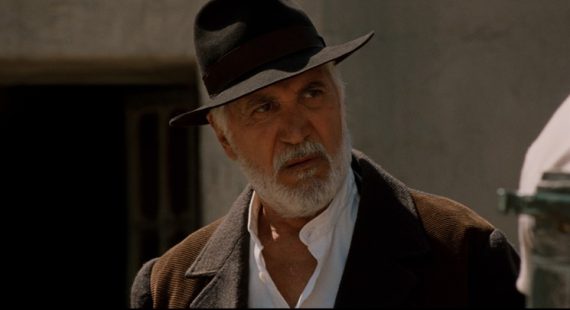
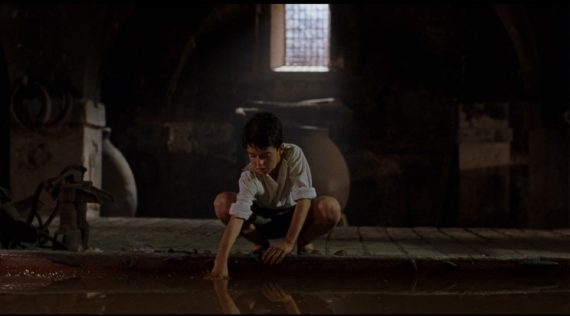
More apparent is the languid, prowling camera work and rich productions. This is a ghost story that takes place in shadows created by harsh sunshine as much as dark corridors. And water of course, often a feature. The catacombs where the ghostly boy hides are very similar to those where the young monster contemplates his fate in Frankenstein.
Quietly taking inspiration from classical filmmaking, Del Toro dusts it off and invests The Devil’s Backbone with substantial style that never detracts from the core story. An exemplary film in an underserved sub-genre, his is one of grief, regret, superstition and the things we leave behind, all wrapped in the honest deceptions and contradictions of childhood.
VIDEO
Already a gorgeous film, The Devil’s Backbone finds new life in UHD. There’s a touch of grain that makes it feel alive, and the contrast is bold. The dry, dusty atmosphere nevertheless is full of colour and contrast resulting in a tactile, satisfying image.
EXTRAS
This is a fabulous looking, gleefully indulgent release from StudioCanal, with incredible new, painted artwork for the cover. Overall, it feels like an old fashioned release, one from the early days of boutique DVD with a healthy raft of extras and an overall sense of cohesion and presentation.
It helps having the enthusiastic director front and centre of the extras, as he often is. Aside from three, brilliantly informative commentaries, Del Toro also has a new introduction. It’s an interesting insight into his inspirations such as the BBC and M.R. James.
- NEW Introduction by director Guillermo del Toro
- Audio commentary with Guillermo del Toro (Sony, 2004)
- Audio commentary with Guillermo del Toro (Optimum, 2011)
- Audio Commentary with Director Guillermo del Toro and Cinematographer Guillermo Navarro
- Video Prologue (Intro by Guillermo del Toro)
- Behind the Scenes
- Of Ghosts and Fauns: Del Toro’s Spanish Civil War
- Original EPK Featurette
- “Que es un Fantasma?” – The Making of The Devil’s Backbone
- Deleted Scenes: With Optional Commentary
- Sketch, Storyboard, Screen: Multi-Angle
- Special Effects Featurettes
- Director’s Notebook
- Picture Gallery
- Theatrical Trailer
Also, note that the Collector’s Edition includes a 64-page booklet and 2 posters.



The Devil’s Backbone (El Espinazo Del Diablo)
Screenplay: Guillermo del Toro, David Muñoz, Antonio Trashorras
Starring: Marisa Paredes, Eduardo Noriega, Federico Luppi, Fernando Tielve
Country: Spain, Mexico
Running Time: 108 minutes
Year: 2001
As General Franco’s fascists close in on victory during the final days of the Spanish
Civil War, 12-year-old Carlos arrives at a remote orphanage for children of left-wing families.
Soon after arriving, Carlos discovers the orphanage is haunted by Santi, a dead boy who
stalks the building’s dark hallways and seeks revenge for his tragic death…
This month sees the welcome release onto UHD of Guillermo del Toro modern ghostly fable, The Devil’s Backbone. I always think of it as his second film following Cronos, but that would be Mimic. Being given a big-budget Hollywood movie as his sophomore film might prove how well regarded he was from the beginning, but it was such a disaster, it almost cost him his career.
Thanks to Pedro Almodovar giving the bruised and disillusioned Del Toro a new project, The Devil’s Backbone was his true second film and it remains a glorious success. A deftly told and effective ghost story, its gentle humanism creeps under your skin.
As his masterpiece Pan’s Labyrinth would be, The Devil’s Backbone the story is told from a child’s perspective in the Spanish Civil War. Using kids is always going to have a sniff of contrived sentimentality, but it works. Just as it always did in classical fairy tales and the British ghost stories that Del Toro openly admires.
His cast of young actors carry much of the narrative weight, ably supported by stalwarts Federico Luppi and Marisa Paredes. As with most of his films, he has a fascinating ability to inject almost mundane reality into their performances. These feel like real people, moving through a fantastic story. This is particularly obvious in Hellboy, with Ron Perlman’s Big Red having an almost childlike enthusiasm. Of course, in The Devil’s Backbone, Cronos, etc, the effect is more subtle and arguably more important. Del Toro’s relationship with his casts is possibly his most underrated skill as a filmmaker.
More apparent is the languid, prowling camera work and rich productions. This is a ghost story that takes place in shadows created by harsh sunshine as much as dark corridors. And water of course, often a feature. The catacombs where the ghostly boy hides are very similar to those where the young monster contemplates his fate in Frankenstein.
Quietly taking inspiration from classical filmmaking, Del Toro dusts it off and invests The Devil’s Backbone with substantial style that never detracts from the core story. An exemplary film in an underserved sub-genre, his is one of grief, regret, superstition and the things we leave behind, all wrapped in the honest deceptions and contradictions of childhood.
VIDEO
Already a gorgeous film, The Devil’s Backbone finds new life in UHD. There’s a touch of grain that makes it feel alive, and the contrast is bold. The dry, dusty atmosphere nevertheless is full of colour and contrast resulting in a tactile, satisfying image.
EXTRAS
This is a fabulous looking, gleefully indulgent release from StudioCanal, with incredible new, painted artwork for the cover. Overall, it feels like an old fashioned release, one from the early days of boutique DVD with a healthy raft of extras and an overall sense of cohesion and presentation.
It helps having the enthusiastic director front and centre of the extras, as he often is. Aside from three, brilliantly informative commentaries, Del Toro also has a new introduction. It’s an interesting insight into his inspirations such as the BBC and M.R. James.
Also, note that the Collector’s Edition includes a 64-page booklet and 2 posters.