



 Director: Zhang Yimou
Screenplay: Zou Jingzhi
Based on a Story by: Zhang Yimou, Wang Bin, Zou Jingzhi
Starring: Ken Takakura, Shinobu Terajima, Kiichi Nakai, Ken Nakamoto, Li Jia-Min, Jiang Wen, Lin Qiu
Country: China, Japan, Hong Kong
Running Time: 109 min
Year: 2005
The Chinese director Zhang Yimou had been finding success on the festival circuit ever since his debut feature, Red Sorghum, in 1988. However, it wasn’t until the release of his wuxia masterpiece Hero and its follow-up, House of Flying Daggers, that he found more mainstream international success. The former film was the first Chinese-language title to reach the top of the US box office. In total, it made $53.7 million in the United States and $177 million worldwide.
Due to the unprecedented success of the two films, Zhang Yimou was given carte blanche to make whatever he wanted next. However, rather than direct another lavish production (Hero was, at the time, China’s most expensive film), Zhang turned back to make something much more intimate and subdued, Riding Alone for Thousands of Miles.
This largely forgotten film is being given a new lease of life on Blu-ray by Imprint Asia. Imprint also released a stunning box set several years ago called ‘Collaborations: The Cinema of Zhang Yimou & Gong Li (1988 – 2014)’, of which a standard edition is still available. I got hold of a copy of Riding Alone for Thousands of Miles and my thoughts follow.

The film sees Ken Takakura play Gôichi Takata, a lonely, ageing man who decides he should finally reconnect with his estranged son, Kenichi (voiced by Kiichi Nakai – we never see him). The now adult son is gravely ill, though, and doesn’t want to see his father.
Whilst Kenichi’s wife, Rie (Shinobu Terajima), tries to get Gôichi to stay whilst she talks her husband into seeing his father, she gives Gôichi a videotape Kenichi had made of a Chinese opera singer, Li Jiamin (playing himself), giving a performance and interview. The singer promises Kenichi a special performance of the traditional opera piece ‘Riding Alone for Thousands of Miles’, but Kenichi had to return to Japan, so he never got to see it.
Feeling this could be an opportunity to make amends with his son, Gôichi heads to Yunnan Province in China to find the opera singer, film his performance of the piece and bring it back for Kenichi to see.

However, this proves more difficult than Gôichi imagined. Doggedly pursuing his goal, and through a number of complicating factors, Gôichi ends up looking after the opera singer’s young son, Yang Yang (Yang Zhenbo). This experience deeply changes the man.
I’d heard Riding Alone for Thousands of Miles described as a ‘tearjerker’, before watching. I can certainly see where people are coming from with that, but I found the first half curiously unaffecting. Everything is presented in quite a matter-of-fact sort of fashion, often at a distance. As mentioned, you don’t even meet Kenichi face-to-face. However, once Yang Yang comes into the story, the film wormed its way under my skin. I think that was intentional, as Gôichi hadn’t yet learnt how to express his emotions. He was following a slightly misguided quest to try to patch things up with his son, not knowing how else to do it. This inability to understand and communicate how he feels provides the film’s main theme and crux of the drama.

The lead role was written with the legendary Japanese star, Ken Takakura, in mind. He provides a wonderfully understated performance, and it proved to be the elderly actor’s second-to-last film before he died in 2014. Most of the rest of the cast, however, was made up of people with no prior professional acting experience. This approach gives the film a naturalistic quality, aided by shooting on location and intentionally avoiding the lavish costumes or colour-coded production design evident in the director’s previous work.
That’s not to say the film is ugly or ‘gritty’. It’s still stunningly beautiful in places, and that’s down to the locations. Other than the odd scene in Japan (or somewhere else standing in for Japan – I don’t know), Riding Alone for Thousands of Miles is largely shot in Yunnan Province, a vast rural area of China. Zhang makes great use of the landscape, particularly the Stone Forest (Shilin) area, which is made up of dramatic and unusual limestone formations. This provides a fittingly overwhelming and labyrinthine setting for a crucial scene in the film.
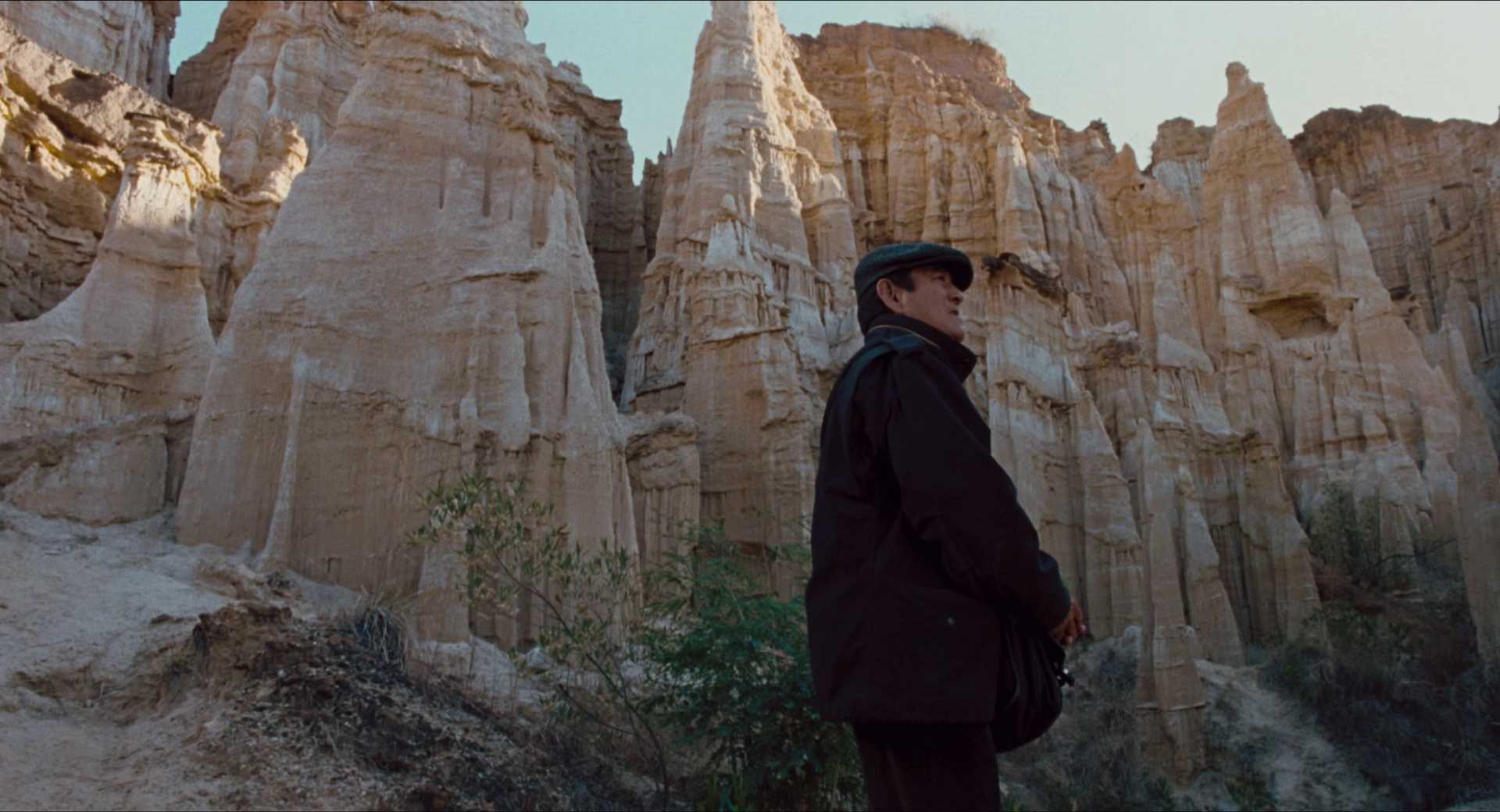
Overall, whilst Riding Alone for Thousands of Miles didn’t wow me in the same way Zhang’s more popular work did, it’s still an affecting, low-key drama with a lot to admire.
Film: 


Riding Alone for Thousands of Miles is out now on Blu-Ray, released by ViaVision as part of their Imprint Asia series. The transfer is great, with detailed, natural textures. Colours are usually gorgeous too, though I noticed a few shots that had an odd tinge to them. This might be from the source, though. I’ve used screengrabs throughout this review to give you an idea of how it looks, though these have been compressed. I had no issue with the stereo audio
Special Features & Technical Specs
– 1080p High-definition presentation on Blu-ray
– The Making of Zhang Yimou’s “Riding Alone For Thousands Of Miles” – featurette
– Audio: Mandarin DTS-HD 5.1 Surround
– Aspect Ratio 1.85:1
– Optional English Subtitles
The only special feature of note is an 18-minute ‘making of’. This is an EPK-style piece from the time of release, but it’s solid. There are interviews with various members of the cast and crew, and some welcome behind-the-scenes footage.
So, Imprint’s release of Riding Alone for Thousands of Miles is modest when it comes to extras, but it’s a decent film and fans of Zhang Yimou should give it a look.
Disc/Package: