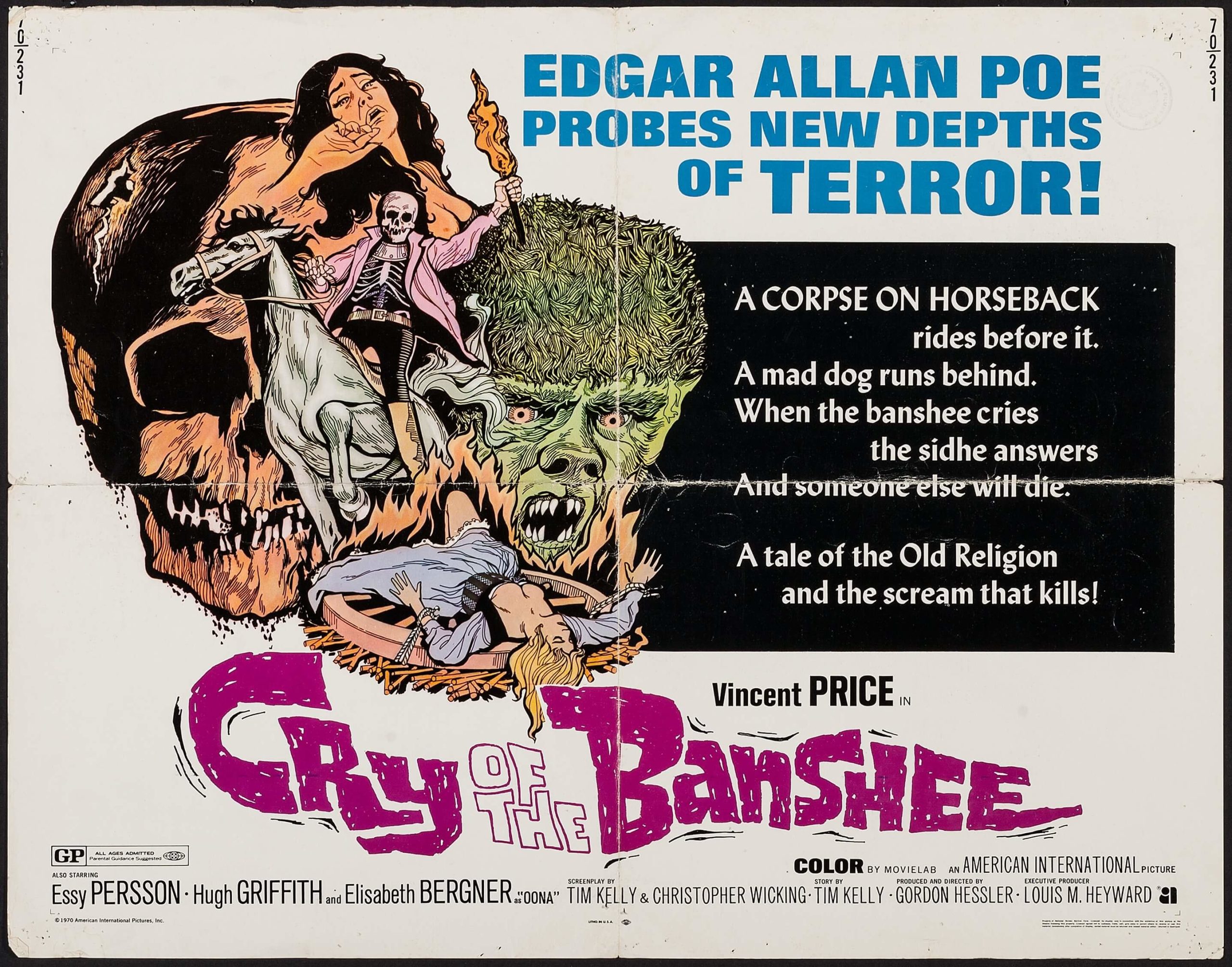



 Director: Gordon Hessler
Script: Tim Kelly & Christopher Wicking
Cast: Vincent Price, Essy Persson, Hugh Griffith, Patrick Mower, Hilary Dwyer, Stephen Chase, Marshall Jones, Carl Rigg, Sally Geeson, Andrew McCulloch
Running time: 91 minutes
Year: 1970
Certificate: 15
American International Pictures (AIP) were keen to follow-up their dual successes of Witchfinder General (1968) and The Oblong Box (1969) with another film they claimed was based on a story by Edgar Allen Poe, namely Cry of the Banshee. Gordon Hessler was brought back to direct and Vincent Price to star.
Beginning with a random quote from Poe, for authenticity reasons probably, the film’s credit sequence is unusual and fun having being designed by none other than Terry Gilliam of Monty Python fame.

Once the film starts proper, we’re quickly introduced to 16th Century Lord Whitman, played with his usual zeal by Vincent Price, who rules over a large estate, which includes villages and farms. He’s also the local magistrate and happily pronounces harsh sentences for minor crimes and fake accusations of witchcraft. He’s supported by his loutish son, Sean (Stephen Chase), who’s encouraged to seek out suspected witches and rape them for kicks. We’re also introduced to various side characters including Lady Whitman (Essy Persson), who Sean also rapes, and Lord Whitman’s daughter, Maureen (Hilary Dwyer), and her childhood companion, Roderick (Patrick Mower), who she’s fallen in love with despite his somewhat mysterious gypsy roots.
Not long after the younger son, Harry (Carl Rigg), arrives home from his studies in Cambridge and tries to bring a bit of his gentler nature to the fold. Sadly, this doesn’t really happen as the main plot, such as it is, kicks off once the Lords have stormed a pagan meeting and killed several of its attendees. The high priestess /witch, Oona (Elizabeth Bergner), swears revenge and curses the Whitmans for their crimes.

Unfortunately, it’s soon difficult to decide who to root for since Oona activates Roderick’s bestial side and he begins to chew and claw his way through the Whitman family, regardless of whether they committed any crimes against the pagans or not.
Despite the film’s title there are no Banshees in the film, just a common or garden Lycanthrope. For those unfamiliar, Banshees are female spirits from Irish folklore whose mournful cries herald death. In fact, the film’s supernatural element feels somewhat shoehorned in and the film might have been better served by focussing on the family melodrama unfolding once the younger son returns, with more open-minded ideas. Roderick himself is an interesting character, but it’s only really hinted at that he possesses supernatural powers, which seems linked to the weird amulet that he wears around his neck, which was found in his possession when he was found wandering in the forest as a boy.

Vincent Price does his best with his role, but since the character seems confused as to whether he really believes in the supernatural or not, it kind of diminishes the man. However, the cast are all solid performers, especially the likes of Hugh Griffiths, who’s always fun to watch.
The English countryside is nicely shot and the production makes good use of the Grim’s Dyke estate in the South East. There are excellent historically-sound costumes and props and the music score, by Wilfred Josephs, compliments the visuals throughout. Cry of the Banshee has a more exploitative streak running throughout, with plenty of female nudity on display and some sexual violence. And finally, it should be noted that there’s a nice twist at the end, which still works well to this day.

Hammer Films have done a great job with this release and the remastered film looks and sounds great. Extras include –
Disc 1
Audio Commentary by writer Chris Alexander– Although Chris prefers the shorter AIP cut he recommends the director’s cut too, which is probably the better version. He talks about the director, about the themes of the film and about the differences between the two versions.
Curse of Ages (13.5 mins) – Kim Newman provides his usual nuanced presentation about the film, including talking about writer Tim Kelly who sold a couple of other film outlines to AIP including one for Sugar Hill.
Image Gallery – Three posters and lots of lobby cards and stills from the movie.

Disc 2
Widescreen Theatrical version (87 mins)
Theatrical trailer (2.26 mins) – This really pushed the non-existent Poe connection.
TV Spot (0.56 mins) – Rated GP
Radio Spot (0.32 mins) – You’ll learn to fear it!
A Devilish Tale of Poe (17.52 mins) – An interview with Gordon Hessler who is very candid about his background and history in filmmaking. He also explains that he did research into witchcraft, in Eire, for the film and reveals that the estate they shot on was owned by Gilbert and Sullivan. He also sings the praises of Vincent Price and also his DoP, John Culloquin, who’d shot Witchfinder General and later filmed Straw Dogs.