


In previous articles, I’ve ranked and reviewed all the Disney, Pixar, Ghibli and Don Bluth films, so it seemed inevitable that I would eventually get round to the other big animation studio, DreamWorks. It’s taken so long partially because this is a big filmography to take on, but also because there’s always been that critical attitude towards DreamWorks as a second tier studio, at least when compared to its major contenders. While making my way through these 50 films, I’ve come to feel very warmly towards DreamWorks, a studio that I came to realise has always been there for me as I was growing up, even if I went through a stage of rejecting their wares more offhandedly than I did with Disney or Pixar’s offerings. This second part features the very best of DreamWorks, ranging from good to superb to classic. You can find Part 1 here.
ALL ENTRIES MAY CONTAIN SPOILERS.
25.Madagascar: Escape 2 Africa
I really disliked the first Madagascar film so I was preparing to feel a similar way about the whole of the franchise, if not necessarily its spinoffs (because I love those penguins!). Madagascar: Escape 2 Africa, however, proved to be quite a surprise. Despite its clunky-as-hell title, this sequel improves on its haphazard predecessor significantly. The screenplay, which counts Idiocracy and Men in Black 3 writer Etan Cohen among its contributors, is bolder, funnier and, crucially, actually has some heart to it. I watched the opening flashback sequence, which shows Ben Stiller’s lion Alex as a cub being separated from his father by poachers, with my heart in my mouth and these quickly established emotional stakes paid off, with a smart, moving plot about a father/son relationship which subtly parodies elements of The Lion King. Elsewhere, some of the other emotional beats are a bit of a stretch. Whoever said “So how about this time we have the giraffe be in love with the hippo?” really needed shouting down at the story meeting, but at least this mismatched romance (a notion rapidly becoming a DreamWorks trademark following Donkey’s dragon fetish in the Shrek franchise) is handled with a sweetness and good humour that just about justifies its patent ludicrousness.
My major fear about sitting through a second Madagascar film was that Sacha Baron Cohen’s wildly popular but deeply questionable King Julien would be overused after having been the breakout character of the first film. Madagascar: Escape 2 Africa wastes no time in reprising his theme tune I Like to Move It just seconds after its prologue is over and when he then states his intention to join the four main characters on their journey back to New York, I braced myself for 80 full minutes of jokes where a faux-Indian accent acts as a punchline replacement. Fortunately, the flight to New York does not go as planned and Julien is separated from the group. While he inevitably makes his way back eventually, the film wisely opts to use him sparingly. The same is true of the penguins, whose adventures stealing jeeps from tourist groups and leaving them stranded in the wilds of Africa is one of the film’s most unforgiving highlights.

It is not just the script that is better in Madagascar: Escape 2 Africa. The look and animation of these stylised characters feels smoother and more attractive, even just three years down the line. This is helped by the pacing of the film, which stays true to the original’s wilder inclinations but tightens up the timing so that we get more than just a blur of characters flailing around and getting clobbered. One brief joke from the first film in which Alex was beaten by a formidable old woman is extended into a great running gag in which the same woman turns up in Africa on safari, and proves to be practically indestructible in her various run-ins with ferocious animals. The voice cast largely do a better job with the improved material, particularly Jada Pinkett Smith whose flipped-body-expectations romance with will.i.am’s hefty hippo Moto Moto is the film’s most slyly adult strand. Amongst the new additions, the late Bernie Mac is strong as Alex’s father Zuba (the film was released after Mac’s tragic premature death and is dedicated to him) and Alec Baldwin is very funny as Makunga, Zuba’s persistent rival for the role of alpha.
Given that my appreciation of the Shrek franchise has slightly increased with each of its first three films, I had a vague hope that something similar might happen with Madagascar but Madagascar: Escape 2 Africa exceeded expectations. While I’ve sort of warmed to Shrek’s world, I wouldn’t call any of the Shrek films great per se, whereas I really enjoyed this. While it still shares a couple of the issues that made me rate the first film so low, Madagascar: Escape 2 Africa ably demonstrates how to make a strong sequel by addressing the problems of the original in an attempt to improve upon rather than just reproduce the parts people liked the first time.
24.Kung Fu Panda 3
Sometimes the reputations of great films are diminished by the diluting effect of the franchises they spawn. Few franchises reach a third film without some degree of dip in quality, often due to the broadening of characters or the sense that the narrative has reached its natural end and is now just spinning its wheels. The Kung Fu Panda franchise had already been opened out with the TV series Legends of Awesomeness, which did a very nice job of translating the characters and setting into a weekly instalment, but continuing the story of its big screen equivalent proved a little trickier. A third part had been teased at the end of Kung Fu Panda 2, with Po’s father suddenly realising his son was alive, but this cliffhanger was left dangling for half a decade. By the time its continuation emerged, a tonal shift had taken place which didn’t quite fit with the darker, genocidal implications of the second instalment. Whether criticisms of that grim tone that had made the second Kung Fu Panda film so special ultimately led to the goofier excesses of part 3, I’m not sure. But right from the off, there’s a lighter, more cartoonish air to Kung Fu Panda 3 which, though still effective enough, signals the beginning of that inevitable downturn in quality.
I still really like Kung Fu Panda 3. I love the world and the characters, though some of them, notably Dustin Hoffman’s Shifu, feel disconcertingly off here. The storyline sends Po to a secret village of pandas where he meets and bonds with his kind. The pandas, solemnly depicted as refugees in Kung Fu Panda 2, are used here as bubbly comic relief and isolating Po from his former cohorts The Furious Five does result in the disappointing marginalisation of the latter, a trend which would eventually see them almost completely deleted from the belated fourth instalment. The action sequences also feel more underwhelming in part 3, with JK Simmons villain General Kai proving to be something of a plodding bore in comparison with previous nemeses. It’s nice to see the return of Randall Duk Kim’s Oogway by way of the Spirit Realm though, and there’s a welcome extended role for my favourite character, Mr. Ping, allowing James Hong greater space to tickle the funnybone and tug at the heartstrings in equal measure. His love of Po and his jealousy of Po’s biological father is the most moving plot strand here.

If Kung Fu Panda 3 can’t quite live up to its excellent predecessors, it does at least deliver the sort of solid entertainment that final parts of trilogies often struggle to achieve. Of course, there is an overwhelming sense that this should’ve been the end for Po’s big screen adventures, allowing him to live on in the handful of TV spinoffs that followed. But at the very least Kung Fu Panda 3 proved that these characters had carved out their place in popular culture to the extent that even a slight disappointment comes wrapped in the warm glow of soothing recognition. Without sullying the reputation of its predecessors, this third film in the Kung Fu Panda franchise turns down the quality just enough to allow future incarnations to be taken on their own terms rather than feared as potential destroyers of something beautiful. Across three films, Po had mastered kung fu, inner peace and chi, but perhaps his most important skill by this stage was that of managing audience expectations.
23.Puss in Boots: The Last Wish
Though it’s not a popular opinion, for me the Shrek franchise got better as it went along, and I include in that assessment the 2011 Puss in Boots spinoff that easily topped any of the big green one’s adventures in terms of both laughs and thrills. So when another Puss in Boots film appeared over a decade later, I was receptive to the concept and was excited to see glowing reviews quickly emerging. But when I finally sat down to watch Puss in Boots: The Last Wish, my enthusiasm quickly dwindled as the first fight scene kicked in and a regrettable stylistic choice made itself known.
For a while before Joel Crawford took over as director, Puss in Boots: The Last Wish was due to be directed by Bob Persichetti, co-director of Sony’s hugely successful Spider-Man: Into the Spider-Verse. Though Perischetti ultimately left the project, his influence remained and Puss in Boots: The Last Wish ended up being lumbered with the deliberately artificial stylisations of the Spider-Verse film. For many, this was not a problem. In fact, audiences ate up the choppy, comic-book aesthetic that was so in vogue in the aftermath of that universally acclaimed Spidey film. I was as impressed as everyone else with Spider-Verse but its aesthetic worked so well because of the genre of the film. It highlighted and emphasised the comic book atmosphere so central to that film’s themes and ideas. The influence of this style can be seen in many subsequent films in which it seems appropriate, such as Teenage Mutant Ninja Turtles: Mutant Mayhem and KPop Demon Hunters. But Puss in Boots has more classical roots, chiefly old storybooks and Hollywood Swashbucklers. While the look of Puss in Boots: The Last Wish aims for a painterly style to evoke the former, its frantic, jerky action sequences sadly sever all ties to the latter.
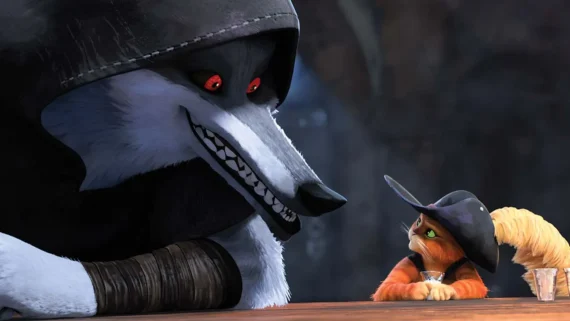
It’s a shame that the aesthetic of Puss in Boots: The Last Wish sat so badly with me because the screenplay is rather good. At first I thought it was a little too crammed full of characters and ideas, and that several of the characters were too annoying, but on a rewatch I acknowledge that I didn’t give the themes and character development enough attention because I was still reeling from how crappy that frenetic opening action scene involving a giant looked (I stand by that assessment at least. The giant really does bring back memories of late-90s/early 00s creatures that were rendered in primitive CG against hand-drawn backgrounds. Evoking Quest for Camelot in the opening minutes does a film no favours in my book). This time round, I paid greater attention to the well-handled themes of mortality, the roster of great gags and the substance that lies beneath the supporting characters. In particular, the exaggeratedly British Goldilocks and the Three Bears just got on my nerves the first time round, but this time I found their plot extremely moving and convincingly constructed in a way that delivers the sentiment as a slow progression rather than a jarring tonal shift. John Mulaney’s Big Jack Horner, meanwhile, is a hilarious baddie. Antonio Banderas continues to excel as Puss and he and Salma Hayek, who returns as Kitty Softpaws, have impressive chemistry even in animated form.
Puss in Boots: The Last Wish’s final act is particularly excellent, with all the characters coming together for a well-orchestrated finale, although it is marred once again by that stylised action that collides with the rest of the aesthetic like a computer game cutscene hurled at Errol Flynn’s moustachioed countenance. Without this awkwardly-appended stylistic misstep, I’m sure I would have ranked this film much higher. As it is, Puss in Boots: The Last Wish feels like the comic book tucked discretely between the pages of the fairy tale classic and that simply doesn’t buckle my swash.
22.Kung Fu Panda 4
Not many franchises make it to a fourth film so it is always worth applauding the achievement of those that do. That applause is usually muted, however, by the fact that the fourth instalment is almost invariably a lesser work than its predecessors. When Kung Fu Panda 4 arrived, there was skepticism even from fans of the franchise about whether it was needed. The fact that the storyline eliminated the Furious Five almost completely (they appear in a conspicuously silent cameo during the end credits) immediately gave Kung Fu Panda 4 the feel of a cash-grab that was not of sufficient quality to tempt back the original cast. But while it is undoubtedly a step down from the excellent first two Kung Fu Panda films, the fourth part feels like an improvement on the third film to me. It has better fight scenes, a better storyline, a better mix of comedy and action and a better villain. It makes an asset of its cast changes by leaning into the feel of an epilogue to the original trilogy, in the same way Toy Story 4 had. The plot involves Po being tasked with passing on the mantle of the Dragon Warrior to another, a decisively final landmark in the quadrilogy’s arc. Whether that will prove to be the case is uncertain, given that talk of Kung Fu Panda 5 has been in the air since the very tidy profit this film made. But for now, Kung Fu Panda 4 managed to get away with its exercise in franchise-stretching rather nicely.

If Kung Fu Panda 3 had a bit of a tonal problem, it is character inconsistencies that most scupper this fourth instalment. Jack Black is predictably superb as Po, a role he seems to inhabit with ease on every return visit. Dustin Hoffman’s Shifu, however, appeared to have mellowed a little more with each of the previous films but this time round reverts to a bad-tempered state that arguably out-curmudgeons his attitude in the inaugural film of the franchise. James Hong’s Mr. Ping, always my favourite character, has suddenly become overly frantic and shrill. Hong’s previous performance as an anxious but loving adoptive parent had always been as touching as it was hilarious. Now he just seems to run around shrieking. The new characters, however, are well incorporated. There was a sense of “Really, again?!” when I heard that the thieving fox Zhen would be voiced by Awkwafina but she continues to demonstrate the charisma and acting talent that have made her the go-to choice for so many mainstream animations of recent years. Viola Davis, meanwhile, is an inspired choice for villain The Chameleon, bringing a calm, commanding presence to the role that makes it suitably chilling. The way in which the plot conspires to bring back the villains from previous outings does feel a little bit like cheap fan service but it also contributes to that sense of finality that make Kung Fu Panda 4 an obvious endpoint for the franchise.
As with the aforementioned Toy Story franchise, my reaction to new instalments of Kung Fu Panda is a mixture of wearied fatigue and childlike excitement. If Kung Fu Panda 4 does prove to be the final big-screen outing for Po, I think DreamWorks have managed to assemble a very fine quadrilogy whose inevitable dips in quality do not go below an absolutely detrimental line.
21.How to Train Your Dragon 2
How to Train Your Dragon 2 is the epitome of an ambitious sequel that aims higher than its predecessor. It jumps forward in time several years and moves characters, relationships and situations forward in a convincing manner, refusing to fall back on a soft reset that would allow it to easily replay the hits. Part of the plot involves Hiccup and Astrid working on the creation of a map of unexplored lands, a clever plot wrinkle that allows the film to naturally expand its world. It’s easy to see why many fans consider How to Train Your Dragon 2 the best film of the franchise and even of the whole DreamWorks canon. Why, then, have I ranked it comparatively low? Well, it’s important to state upfront that I do like the film a lot and find it impressively mounted and intelligently conceived. Looking back on my review of the first How to Train Your Dragon film however, there’s a clue as to my cockeyed personal preferences. The big climactic battle in that film, the moment most people are waiting for, was the only part where I began to lose interest. I’ve never been one for large scale battle sequences, often finding them dull or confusing, and How to Train Your Dragon 2 has made the completely justifiable decision to go more in that direction. I’m also generally not a fan of dense, elaborate fantasy and with this second instalment, the How to Train Your Dragon franchise heads towards the sort of layered world-building that triggers my Middle Earth flashbacks.

All of this talk of my personal preferences is by way of ensuring that fans of the first How to Train Your Dragon film be aware that they’ll probably love the follow-up as well. But the things I really loved in the first film are pretty much gone this time round. The title only really makes sense in terms of brand recognition, given that the training element of the story was completed in phase 1. I’ve always been a fan of more intimate storytelling so those scenes of just Hiccup and Toothless getting to know each other and soaring through the skies unimpeded by warmongering projectiles are sorely missed from my perspective. Though those two characters are foregrounded, How to Train Your Dragon 2 is much more of an ensemble piece, bringing back all the old favourites from the first film and adding a few new ones into the mix. The narrative involving Hiccup’s family is a bit played out, to the extent that it is mirrored in the concurrent Kung Fu Panda franchise. How to Train Your Dragon 2 is willing to go to some much darker places though, with one particular plot point coming as quite a surprise and standing as testament to writer/director Dean DeBlois’s commitment to taking the story where it needs to go.
For all my aversions to the fantasy genre, it’s proof of the quality of How to Train Your Dragon 2 that I not only enjoyed it but came out of it looking forward to watching the third instalment. Unlike the overwhelmingly dark and solemn feel of Tolkien, How to Train Your Dragon 2 makes strong use of light and shade to create a world I enjoy visiting. I just prefer a leisurely dragon cruise to a full-scale scaly assault.
20.The Bad Guys
The Bad Guys is a film I just sort of let drift by me on its initial release. I remember seeing it and quite enjoying it but I don’t think I’ve thought about it again since. After this rewatch, it’s obvious to see why the film didn’t stick with me in any significant way, and yet it is also testament to just how effective these non-monumental releases can be, because I thoroughly enjoyed The Bad Guys the second time round. The fact that its plot points and gags are already fading from my mind less that 24 hours later need not be a major criticism, as this is a film that achieves its effect by keeping the viewer engaged and amused during its duration, rather than giving them much upon which to dwell in the aftermath. Its stylistic tributes to Heist films like the Ocean’s movies are a good indication of what to expect. I’ve never been particularly won over by the Ocean’s films, the superficial flash of which only carries me so far into a two-hour runtime, let alone through a three film franchise and spinoffs. The Bad Guys’ take on similar material manages to be more homage than spoof but the extra wrinkle of making the criminal crew all animals that have got a bad press over the years adds a twinkle of parodic glee that makes the experience considerably less smarmy. This trick works similarly well in the fleeting nods to the Tarantino aesthetic, a reference point that feels less painfully played out when the diner patrons are a wolf and a snake discussing the pleasures of eating guinea pig.
Comedy screenwriter Etan Cohen, fresh from the disastrous directorial double of Get Hard and Holmes and Watson, redeemed himself somewhat with this smart screenplay. Although its numerous twists are easy to see coming for more seasoned viewers, The Bad Guys acts as both a nicely pitched family-friendly take on adult genres that should amuse older audiences and provide a tantalising gateway drug to younger ones. Cohen also avoids the gaping trap into which so many similar films plummet, that of cramming the script full of winking adult gags that push the boundaries of taste for the sake of a momentary parental smirk. The worst we get here is a running gag about nervous farting, which is taken to an annoying extreme but is acceptable enough as a kid-pleasing concession. I rarely speak about animated films in terms of age demographics, given that so often animation is wrongly assumed to be a medium aimed exclusively at children, but given that its source text is Aaron Blabey’s children’s graphic novel series, I think it’s fair in this case to identify children as the major target audience. As such, The Bad Guys does a very good job of accommodating a child’s worldview without talking down to them while also drawing on several adult reference points without making the result incomprehensible to those too young to have seen the films in question.

The Bad Guys is one of several animated films that took visual inspiration from the groundbreaking style of Spider-Man: Into the Spider-Verse. While that film was a visual feast, I did become a little jaded with the amount of animations that tried to reproduce its distinctive style in the aftermath of its success. DreamWorks subsequent Puss in Boots: The Last Wish, though lauded by many, is one such film in which I didn’t think the content fit comfortably with the stylistic choices. But The Bad Guys makes good use of this style, its character designs and animation enhanced by the entirely appropriate slickness of the visuals. Also helping The Bad Guys stand out is its excellent voice cast, a well-chosen bunch of endearingly rascally figures including Sam Rockwell, Marc Maron, Awkwafina, Craig Robinson and Alex Borstein. While all well-known, these performers are perfectly chosen for their roles, given their status as character actors whose fame exists on the fringes of superstardom. It would’ve been too easy a piece of casting (if not necessarily an easy financial investment) to hand the role of the charismatic Mr. Wolf to George Clooney, but could Clooney have sold the character’s outsider status as convincingly as Sam Rockwell? Other standouts are Zazie Beetz and Richard Ayoade, whose performances tap into a sly duality which, while predictable for adults, should prove to be a satisfying introduction to narrative twists for younger audiences.
At the time of writing it is the school summer holidays and I’m currently in charge of my 5 year old son who is demanding 100% of my attention for the majority of every day. It has therefore taken me five days to write this modest four-paragraph review, on which I have worked in small snatches of stolen time between endless requests for snacks and the next 4 hour Hot Wheels tournament. As such, I have been able to test my theory that the finer details of The Bad Guys would quickly fade from my memory. While it may have something to do with being in my mid-40s and the fatigue of keeping up with someone thirty-eight years my junior, I was correct that the plot and gags of The Bad Guys have largely faded with alarming speed. But each time I return to write more of this review, I experience the same warm memory of pure, uncomplicated entertainment that has remained undimmed. Not bad, guys, not bad!
19.The Prince of Egypt
First things first, I’m not here to talk about my religion, or lack thereof. Suffice it to say, I’ve had a complex relationship with Christianity in which I’ve been a reluctant student of it, an anti-religious bigot against it, a passive observer of its effects, both positive and negative, on family and friends, and a father to a son whose attendance at a religious primary school, based on nothing but an accident of postcode, makes me fear that this whole abominable cycle could easily start over again. All of this is to say that my reaction to religious media has often been coloured by whatever stage I was at in my messy association with religion. DreamWorks’ The Prince of Egypt, then, is a film I’d never really watched properly until now. I’d seen it long ago but at a particularly militant time before my atheism was rewhittled into agnosticism, and when virtually any religious content would have a Pavlovian effect on my gag reflex. My lifelong love affair with animation compelled me to view this landmark film, but having been through a school system where I was metaphorically battered with Bibles before I could even spell ‘indoctrination’, my appreciation of the artistic achievements of The Prince of Egypt were stymied by the anger I so often misdirected at innocent bystanding believers (or pastors-by, if you’ll allow me to lighten the mood for a second with a smattering of agnostic punnery).
I’m aware I began by saying I wasn’t here to talk about my relationship with religion, before doing so for an entire paragraph. There’s no escaping the fact, however, that each individual’s reaction to The Prince of Egypt will be unavoidably affected by their own personal religious journey. I’ve learned over the years that every piece of religious content shouldn’t have the door slammed on it like the over-eager toes of an aggressive Jehovah’s Witness. While I may believe that religion should not be taught as fact in schools, I do also believe that we should learn about the different beliefs that make up our world. Perhaps this more passive approach could’ve helped me avoid the ferocious anti-religious prejudices of my youth, as well as eradicating latent predilections towards contradictions-in-terms like “aggressive Jehovah’s Witness.” Certainly, it would have equipped me to enjoy The Prince of Egypt as much as I finally did this time round, and in the end shouldn’t that be the ultimate goal of all religions? The answer is no.
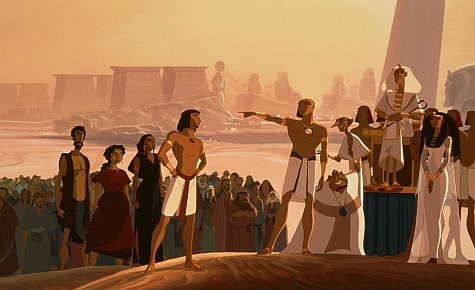
I faff and futter over this review because it touches on a lot of raw topics for me and I’m honestly concerned that some of the observations I found myself making as I watched The Prince of Egypt unfold might be construed as wanton blasphemy. For instance, I know the story of Moses. I’ve known it since school and I’ve had those memories reinforced by numerous pop culture allusions and retellings, not least the Hollywood extravaganza that served as inspiration for DreamWorks’ film, Cecil B. DeMille’s The Ten Commandments. So it came as no surprise to me when, in The Prince of Egypt, God killed the first born children of Egypt. I knew it was coming, just as I knew Bruce Willis was a ghost (unholy, in this case) when I first watched The Sixth Sense, and it altered the impact. But my mind ran to those for whom The Prince of Egypt might’ve been their introduction to this story, and I imagined that they might reasonably assume the moment the ethereal presence begins drifting into houses and offing minors, that this was the big reveal that God had actually been the villain of the piece all along. Of course, only a supervillain would choose flaming shrubbery as an appropriate conduit! That’s not the case, of course, we’re supposed to accept this in the same way we have to accept that finite evil is punished with eternal damnation, and that God allowed Satan to torture Job with the sadistic glee of an over-zealous Sims player. These are the adjustments I have to make in my mind when consuming religious content. There are some excellent stories in the Bible and you don’t have to completely align with their moral viewpoint in order to enjoy them at the level of mere entertainment. As an agnostic, I can take it all with a pinch of Lot’s wife.
It may seem blasphemous, or at least cheap, to appropriate the sacred texts of others for something as frivolous as entertainment, but these stories are, after all, there for anyone to consume and evaluate, even if we don’t deem them believable or even morally viable. In the case of DreamWorks themselves, the respectful but ideologically non-committal opening caption before the film begins suggests that, while the greatest care has been taken to respect the believers to whom this story means so much, the greater inspiration in bringing it to the screen again is the visual magnificence of its epic Hollywood predecessors. I would suggest that The Prince of Egypt probably plays much better for those who already know the Moses story, rather than as an introduction to it. This is not a film that spends a lot of time explaining itself, so when a burning bush suddenly appears, or a plethora of horrific plagues are quickly dashed off across the course of a single musical number, you may have some explaining to do if your viewing partners attend a secular school (they are out there somewhere, I’m told). This review, then, is from the point of view of someone who arrived with the benefit of Biblical spoilers. That’s the nub of the point I’ve been circling for about half a Testament now, and which I probably could’ve made in one sentence and without numerous invitations to divine smotation.

The Prince of Egypt was always meant to be DreamWorks triumphant debut, a glorious calling card to silence the doubters and announce the arrival of a major new animation studio to rival the big hitters. Then the wounded egos of feuding CEOs conspired to promote a film about ants to pole position, robbing an intended crown jewel of its significant place in the royal headdress. Still, given that the title The Prince of Egypt is ironic in its superficial glamour, perhaps this dimming of the spotlight was thematically appropriate. Either way, from a purely visual standpoint, The Prince of Egypt stood out amongst its high profile contemporaries like Mulan and Anastasia. This is one hell of a beautiful movie, combining finely crafted traditional animation with well-incorporated CG enhancements to give this Biblical tale the oomph that it demands. The character designs are realistic enough to convey the necessary gravitas and stylised enough to achieve the necessary charm. The backgrounds are monumentally imposing and the experimental moments, including a dream sequence in hieroglyphics and the climactic parting of the Red Sea, are breathtakingly arresting. I had always been of the impression that The Prince of Egypt was stiflingly self-serious and ploddingly pious but it does, in fact, move at a fantastic pace and is filled with moments of human warmth that are crucial in making it relatable for audiences of various belief systems. A key factor in this case is the central relationship between Moses and his adopted brother Rameses, voiced by Val Kilmer and Ralph Fiennes respectively. Their dynamic is portrayed as a sort of irresponsible teenage rampage that gives way to the responsibilities and realisations of adulthood, and both men portray their undimmed affection for each other beautifully, even when their split becomes irreconcilable. While some critics found The Prince of Egypt less emotionally engaging than it was visually striking, I can think of few more devastatingly moving images than that of the heartbroken Rameses cradling the sheet-wrapped corpse of his beloved son. I may not be able to feel love or respect for the being that took the life from that boy as the story would ideally like us to, but DreamWorks take on the material does not foreground a desire to win over the viewers religious allegiances so much as it just wants to tell the story accurately and with attention to the feelings that underscore every characters experience. In that way, as well as in its vehement opposition to slavery, The Prince of Egypt feels as much like a humanist film as it does a religious one.
Amidst all its other ambitions, The Prince of Egypt is also a musical, practically a necessity for any film looking to rival Renaissance-era Disney. Unfortunately, despite the song When You Believe winning the Oscar and becoming a top 5 hit for Mariah Carey and Whitney Houston, I don’t find the songs in The Prince of Egypt very memorable. They are largely of that wistful, slightly pompous variety which prizes bombast over melody, and they end up collapsing into a soggy mélange of chest-heaving bellows. Given that the action tends to continue alongside the music rather than stop for it, the songs aren’t too much of a problem as they don’t slow things down. There was one sequence for Playing with the Big Boys, a duet by Steve Martin and Martin Short, which stands out as more impressive than the song which accompanies it. Seeing these two comedy legends among the cast, I did momentarily worry that their number would be akin to that awful gargoyle song in Disney’s The Hunchback of Notre Dame but fortunately there was no tonal incongruity to report and not one person attempted to rhyme “Adonis” with “shaped like a croissant is.”
Ultimately, despite my own religious disconnect, I was mightily impressed by The Prince of Egypt as a piece of epic animation. Though reviews at the time of its release were a bit more tentative than DreamWorks CEO Jeffrey Katzenberg had hoped, over the years The Prince of Egypt has steadily been reevaluated as one of the finest animated films of its era. While my agnosticism may prevent me from embracing it as wholeheartedly as a believer, I applaud and even, to some extent, love this film for its artistry and storytelling, even if the humanist in me has to spit out certain plot points like rancid peanuts. What an auspicious debut film for DreamWorks… oh wait, this wasn’t their debut, was it? That was that other one, the one about insects. A Bugs Life, right? Why, Mr. Katzenberg, why have you turned that funny shades of purple?
18.Spirit: Stallion of the Cimarron
Shrek was a certified mega-hit and it would ultimately shape the direction DreamWorks took but back in 2002 it still felt like an anomaly amongst the studio’s traditionally animated works. Although hand-drawn animation was being overtaken in popularity by computer animation, Jeffrey Katzenberg’s vision for DreamWorks was still largely rooted in the traditionally animated classics of Disney, which he sought to trump. While Spirit: Stallion of the Cimarron combines both traditional and computer animation, it is very much aligned with the style of the former medium. With its comparatively scant plot, the film seeks to impress with its rousing visuals, more often than not succeeding. The introductory sequence, in which an eagle soars over a glorious western landscape before the flowing mane of a galloping stallion becomes a clump of lush grass blowing in the wind, is instantly marvellous and sets expectations high for what’s to come. The dangers of opening your film like this are clear, in that living up to such a high bar across an 83 minute runtime is going to prove tough. Although Spirit: Stallion of the Cimarron manages to do so a surprising amount, its stumbles are unfortunately ridiculous enough to sufficiently bar its entry into the animated classics hall of fame. Its ambition, however, ensures its place as a cult classic, perhaps a more fitting honour for a film which shares the laudable titular quality of its central beast.

Spirit: Stallion of the Cimarron is a Western but told from the point of view of a horse. The idea, conceived by Jeffrey Katzenberg and written by John Fusco (Young Guns, Young Guns II), is not a new one (Mark Twain took a similarly equine worldview nearly a century earlier in his short novel A Horse’s Tale) but the approach taken by Fusco and directors Kelly Asbury and Lorna Cook is very different from that which most studio’s would likely have taken. It would have been all too easy to make Spirit a talking horse and surround him with similarly verbose Western critters but that would’ve robbed the film of its careful differentiation between the viewpoint of animals and humans. For the most part, Spirit remains silent, communicating his thoughts and feelings through expressions and beautifully animated movements. The animators studied horses, chiefly a horse named Donner who was brought to the studio as a model for Spirit, and you can see that attention to detail in the finished product. It would’ve been a shame to spend so much time and effort perfecting the movements of a realistic horse to then have it spout one-liners or emit an exasperated horsey splutter while breaking the fourth wall with its long-faced gaze. Fusco wrote narration for the story so that the animators had a guide but unfortunately a major misstep was made when it was decided to include chunks of the narration in voiceover. Whether it was always the intention to do so or whether this was a late-game concession I don’t know, but Matt Damon’s blandly serious voiceover as Spirit feels redundant at best and disruptive at worst. It might have been even harder work to tell the story without this crutch and, given that animator James Baxter said that Spirit: Stallion of the Cimarron was one of the most complex jobs on which he’d ever worked, it’s perhaps a bit rich for me to say that the extra effort would’ve been worth it but I feel like if they’d pulled it off, Spirit may have joined the ranks of other revered, largely silent protagonists like Dumbo and WALL-E. Though nary a horse-lip quivers along with it, Damon’s narration unfairly but unavoidably consigns Spirit to the talking animals section of the stable.
There is something even more disruptive than translated neighing though. With the Disney Renaissance still a not-too-distant memory, DreamWorks just couldn’t seem to let go of the musical element even when it was clearly neither required nor advisable. As with the previous The Road to El Dorado with its Elton John soundtrack, the songs accompany the story rather than being sung by the characters themselves. Unfortunately, the songwriter hired to provide the soundtrack this time round is Bryan Adams and his songs are both musically insipid and cringingly literal. Adams’ lyrics come straight from the horse’s mouth, as it were, describing what is happening onscreen in a way that makes it seem as if Matt Damon has suddenly decided to continue his narration in a surprisingly rugged singing voice. So we see Spirit’s birth accompanied by the lyrics “Here I am, this is me, I come into this world so wild and free”, we see Spirit trying to evade a group of would-be captors accompanied by “Never gonna give in, never gonna give it up no
You can’t take me, I’m free”, and, in the most excruciating instance, we see a scene of cavalrymen trying to break Spirit rodeo-style set to an upbeat Rock song called Get Off My Back. It’s only mildly preferable to the alternative option of The Only Thing That Looks Good on Me Ain’t You!
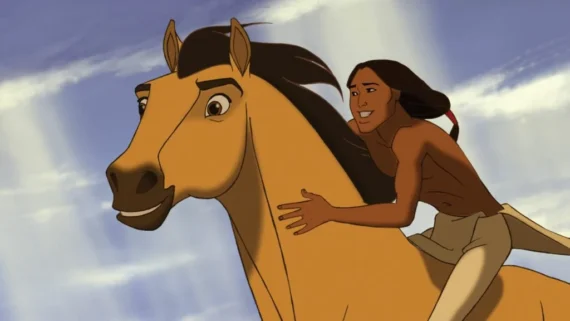
It’s a shame that these two missteps have such a detrimental bearing on Spirit: Stallion of the Cimarron as it feels like a film that could be greatly improved by hitting the mute button, did that not also mean losing Hans Zimmer’s aptly stirring score. Still, if you can get past the downsides there is a wealth of things to enjoy here. The relative simplicity of Spirit’s story allows the film to be peppered with effective and brilliantly realised set pieces that build up the stallion’s resilient character in a manner that makes Damon’s wimpy interjections seem all the more inappropriate. It’s fun to see Spirit avoid a branding by kicking the snot out of the farrier and awe-inspiring to watch him single-hoofedly destroy a steam locomotive and then flee from it as it tumbles backwards down a hill. These are sequences in which it is clear just how close Spirit: Stallion of the Cimarron came to becoming a masterpiece. As it is, I still think it is a marvellous and comparatively underrated film but there’s just no escaping that Bryan Adams/Matt Damon factor. I suppose it could’ve been worse. Phil Collins and Bobcat Goldthwait, for instance.
17.How to Train Your Dragon: The Hidden World
When I heard that DreamWorks were creating a live-action remake of How to Train Your Dragon, I was depressed to see this trend that is so disrespectful to the animated medium being perpetuated by another studio. I’ve heard many people say that the new version is very good but that doesn’t change the fact that it is redundant and implicitly sends the message that animation is a lesser medium. Still, in my attempts to find a bright side I decided that at least that shift towards a different medium might prevent any further animated theatrical instalments being made, because How to Train Your Dragon: The Hidden World is such a beautiful way to round out Dean DeBlois’s excellent trilogy that further animated films would feel almost as redundant.
How to Train Your Dragon: The Hidden World does a great job of combining the more intimate, slow-build of the first film with the grander scope of How to Train Your Dragon 2 to create a happy medium that applies a more measured approach to the increased spectacle. Almost a decade on from the original, How to Train Your Dragon: The Hidden World’s animation is noticeably more sophisticated, with the glorious settings being enhanced by skies crammed full of beautiful beasts. The storytelling is also still noticeably a cut above that of several DreamWorks franchises, blending humour into the plot in a more seamless way than some of the klaxon-like disruptions of sassier properties.

When I saw that How to Train Your Dragon: The Hidden World was set to feature a Light Fury as a romantic interest to Toothless’s Night Fury, I braced myself for hackneyed, cutesy but highly merchandisable nonsense but this plot is actually one of the best things in the film, allowing for lengthy, mostly-dialogue free scenes of dragon courtship that recall the scenes of Hiccup and Toothless first connecting in How to Train Your Dragon. There is plenty of action here as well but it’s nice to have these quiet moments back as a counterbalance, after the more intensely paced second film. F. Murray Abraham‘s villain Grimmel is also a delightful addition, his droll exasperation making for a more palatable, tonally diverse bad guy than the galumphing, humourless force of Part 2’s Drago Bludvist.
Three movies in, I don’t have that much more to say about the How to Train Your Dragon franchise. Like its predecessors, How to Train Your Dragon: The Hidden World presents its familiar fantasy tropes with a freshness and fleetness of foot which makes them appealing even to a fantasy-averse viewer like me. I’ve enjoyed my time in Berk and whenever I feel the need to return it’ll be these animated features to which I turn, not the inevitable future instalments of the live-action charm-reducer How to Drain Your Dragon.
16.The Road to El Dorado
At the beginning of the new millennium, DreamWorks were still searching for their own unique identity. At this stage, the studio seemed to be skewing in a more adult direction than their competitors, given that the main inspirations for their first three films were Woody Allen, Cecil B. DeMille and the Bing Crosby and Bob Hope Road to… movies. That latter influence was the starting point for the screenplay of The Road to El Dorado, written by Ted Elliott and Terry Rossio. Elliott and Rossio were go-to writers of Adventure narratives and would soon have major hits with Shrek and the Pirates of the Caribbean films, but more relevant in the case of The Road to El Dorado are their 90s films The Mask of Zorro and Disney’s Aladdin, whose swashbuckling and treasure-hunting components feed directly into the DNA of their DreamWorks debut. At this stage in the DreamWorks story, CEO Jeffrey Katzenberg had a penchant for large scale, prestige productions but during the making of The Prince of Egypt, perhaps worn down by its relentless reverence, Katzenberg decided the studio’s next film should be an Adventure Comedy. Although The Road to El Dorado was not a hit, it now seems like quite an important film in helping to establish the irreverent, comedic tone that would soon be cemented as a DreamWorks trademark by the success of Shrek.
The Road to El Dorado tells the story of two roguish anti-heroes, Miguel and Tulio, who win a map to the legendary lost city of El Dorado in a rigged game of dice. Evading various enemies who want them dead, the pair end up discovering the city and being taken for Gods by its inhabitants. Happily assuming their newly found roles as deities, Miguel and Tulio plot to steal the city’s copious supplies of gold and leave by boat, but they hadn’t counted on the savvy manipulations of the native woman Chel, or the malevolent machinations of high priest Tzekel-Kan. The Road to El Dorado is the sort of film that probably wouldn’t get made anymore. Indigenous rights organisations at the time criticised its stereotypes and the overly-sexualised portrayal of Chel. These aspects are obviously an issue but I think The Road to El Dorado can still be enjoyed purely as a fairy tale, with the mythical city and its inhabitants not necessarily being a representation of real indigenous peoples. Chel, meanwhile, actually seems to be quite a progressive character in terms of her sexual liberation and superior intellect. It is she who manipulates Tulio and Miguel into fulfilling her desires rather than the other way round, although admittedly her desires handily align with those of her objectifiers. Credence for the criticisms of Chel’s depiction can be found in early drafts of The Road to El Dorado in which she was dressed even more scantily and in which the lovemaking scenes were considerably more suggestive. Had DreamWorks pursued the adult inclinations of its early years further, who knows how long the studio would have lasted. In shifting the tone of The Road to El Dorado towards Adventure Comedy, however, it naturally became more child friendly, albeit with a whipsmart cynical edge, a watered down approximation of which began to creep into many 00s animations.

Many perplexed reviewers have noted that, for a film called The Road to El Dorado, the journey to the lost city is over extremely quickly. This is because the title is an allusion to the Bing Crosby/Bob Hope Comedies of the 40s, 50s and 60s, a series of films defined by goofy gags, self-interested protagonists, lively music and the chemistry between its trio of stars, Crosby, Hope and Dorothy Lamour. Lamour’s role as the object of desire for the two leads obviously influenced the controversial role of Chel, while Miguel and Tulio’s constant, witty back and forth is a good approximation of the Crosby/Hope dynamic. Voice performers Kevin Kline and Kenneth Branagh recorded their lines in the room together in order to capitalise on their chemistry and allow greater opportunities for improvisation. This approach paid off, as Branagh and Kline’s work is the driving force behind the movie, beautifully animated to capture their delightful bickering. Unlike Bing and Bob’s characters, who would remorselessly sell each other down the river in a second, Miguel and Tulio are given a bond that keeps them together. Moments in which they appear about to betray one another prove to be well-rehearsed grifts, and when they are about to go their separate ways we get a breakup song by Elton John on the soundtrack which intensifies the inevitable homoerotic reading which has latterly come to define The Road to El Dorado as it passes into the status of cult favourite.
Although DreamWorks were looking to establish their own style in competition with Disney, the influence of the House of Mouse is inescapable. Though tonally different, there are elements like the horse Altivo that feel like they come directly from a Disney film. The hiring of Elton John and Tim Rice to write the film’s songs was obviously inspired by their success with The Lion King’s soundtrack, while the decision to have most of those songs performed by John himself as a musical narration, rather than putting them in the mouths of the characters, is akin to Disney’s use of Phil Collins in the then-recent Tarzan. While the music works quite nicely and mostly allows the story to flow without stopping for songs, John and Rice’s contributions here are mostly pleasant when they’re playing and then instantly forgotten. The one exception is The Trail We Blaze, an infectious, upbeat bookend for the adventure which asserts itself as the film’s theme tune.
As a lover of old-fashioned Adventure films, The Road to El Dorado was always going to be a hit with me but it’s also quite obvious why it failed at the box office. The Crosby/Hope touchstone was hardly a fashionable reference point (although Family Guy would also begin to prominently use it that same year in the first of their own Road to… parodies) and The Road to El Dorado ultimately makes its adventure narrative subservient to its character relationships, allowing the discovery of El Dorado in the first act and consequently confining the remaining action to the city rather than exploiting the potential of the mountainous junglescape that surrounds it. I admit I would have enjoyed at least another half hour of treasure-hunting antics. Still, Tulio and Miguel are entertaining protagonists in whatever situation they are placed and Elliott and Rossio have cooked up numerous spikes in the action that capitalise fully on their comic interplay. In particular, an early scene in which their escape from a ship’s prison is complicated by Altivo’s pursuit of an apple is hilariously performed and animated.
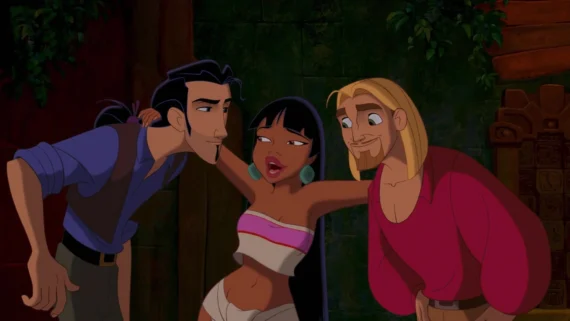
It is perhaps telling that Katzenberg did not seek the same level of guidance in ensuring historical and cultural sensitivity here as he did when exploring Christian themes in The Prince of Egypt, but ultimately The Road to El Dorado is a very 2000s film that endears as much as it alarms, at least from the point of view of the white privileged apologia of an animation enthusiast. As one of only a handful of traditionally animated DreamWorks films, The Road to El Dorado feels a bit like a lost treasure itself.
15.Wallace & Gromit: The Curse of the Were-Rabbit
As a huge fan of Wallace and Gromit from the age of 8, when A Grand Day Out made its Christmas TV premiere on Channel 4, I was initially a bit disappointed when The Curse of the Were-Rabbit arrived fifteen years later. This, I thought, was not the Wallace and Gromit I knew and loved. Having gotten used to the duo’s adventures in the 25 minute format, I felt the changes directors Nick Park and Steve Box made in order to create a film over three times that length robbed Wallace and Gromit of a beautiful simplicity which had defined my Christmases and Bank Holidays for over a decade. The earliest pair of Wallace and Gromit shorts, A Grand Day Out and the still unbeaten The Wrong Trousers, each featured three characters apiece and only one of those characters could talk. Even when the slightly more expansive A Close Shave upped the lead characters to five, three of them were still mute. Dialogue had played a very small role in these visual masterpieces, with the wider world implied through newspaper headlines, billboard advertisements and punningly-named grocery items. Suddenly, The Curse of the Were-Rabbit introduced a whole community of human characters, clamouring and panicking and spouting innuendos. It felt as jarring as those very occasional Peanuts cartoons where the adults speak English rather than a language that sounds as if it’s emanating from the brass section of an orchestra.
I underrated The Curse of the Were-Rabbit for many years but my initial aversion to Wallace ands Gromit’s newly busy community dimmed over time. After all, the move into feature films necessitates a certain level of expansion. A more decisive factor in realising the achievements I was taking for granted was the production stories I later heard about Aardman Animations uneasy partnership with DreamWorks. The constant flood of notes Nick Park received from DreamWorks attempting to instigate changes that would make his quintessentially British property more accessible to American audiences is said to have soured him on the idea of making feature films for several years. The idea of taking a popular brand like Wallace and Gromit and then trying to change the very heart of it to create some kind of homogenised, saleable product feels inherently cynical and misguided and it’s hardly surprising that the Aardman/DreamWorks partnership would crumble just one film down the line. But the fact that Nick Park stood his ground in refusing to give Wallace a trendier car and refusing to refer to marrows as melons is testament to the fact that, bustling local community or not, this absolutely was the Wallace and Gromit I knew and loved and their creator had fought hard to ensure that remained the case. In appreciating that, I let go of my overly-prescriptive notions of what a Wallace and Gromit film should be and began to enjoy The Curse of the Were-Rabbit for the logical extension it is.
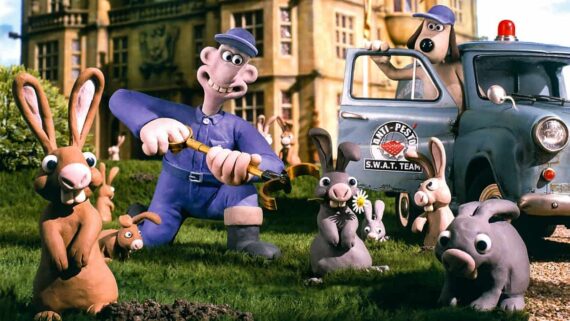
As with previous Wallace and Gromit instalments which leaned into certain genres (Jules Verne style Adventure in A Grand Day Out, Film Noir in The Wrong Trousers, Caper movies with a hint of the British War film in A Close Shave), their first feature is a smart parody of classic Horror. The one good note DreamWorks gave Park was to change the title from the innocuous The Great Vegetable Plot to the more appropriately sensationalist The Curse of the Were-Rabbit, which highlights its debt to Universal and Hammer Horror films. The plot, in which Wallace and Gromit run a humane pest control service which is in high demand in the run-up to the annual vegetable contest, is filled with good twists and red herrings, not to mention the usual beautiful stop motion animation with its expressive characters and richly detailed sets. While the expected visual gags abound, the increased amount of dialogue also introduces an extra layer of verbal wit involving a barrage of deliberately groanworthy puns that knowingly waft their Gorgonzola stench across every scene. Not everything works. The wink-wink adult content is often cheekily amusing in a seaside postcard way but it is laid on a bit thick (the female love interest, Lady Tottington, likes to be known as Tottie) and by the second time you’ve seen a female character holding two oversized round vegetables against her chest while spouting a double entendre, you might begin to wonder if the film is slightly crossing a line into naff schoolyard naughtiness. Other tropes that work so well in the 25 minute format struggle to sustain themselves across a full feature. Gromit, for instance, does his trademark eye-roll so many times that it threatens to inspire a similar reaction in the viewer.
But when The Curse of the Were-Rabbit is working, which is most of the time, it is a fantastically entertaining, inventive and funny film. If we absolutely have to have more voices in this than just Peter Sallis’s then they at least made the right casting choices. Helena Bonham Carter is fun as the plummy Lady Tottington, Ralph Fiennes relishes his role as narcissistic, trigger-happy villain Victor Quartermaine and Peter Kay was so popular as PC Mackintosh that the character returned (with a promotion) in the subsequent Wallace and Gromit feature Vengeance Most Fowl. Amongst a treasure trove of high profile bit parts for the likes of Mark Gatiss, Geraldine McEwan, Liz Smith and John Thomson, the standout is Nicholas Smith as the overdramatic clergyman Reverend Clements Hedges. His exemplary voice work is matched by the hilarious character design and animation. Speaking of animation, it is of course everything we’ve come to expect from Aardman and more. In particular, there are complex transformation scenes that are perhaps the best of their kind since An American Werewolf in London. The whole thing looks gloriously cinematic without sacrificing the homemade feel of the thumbprint covered early films or the satirically parochial smallness of the world.

While I’ve revised my lukewarm opinion of The Curse of the Were-Rabbit somewhat, I must admit it still doesn’t quite meet the high watermark of Wallace and Gromit’s opening trio of shorts and that unfair and unnecessary comparison does still dampen my appreciation to an extent. What ought to be an easy 5 star classic for an Aardman fan like myself has gradually clawed its way up to a more than respectable 4 stars. It’s a lovely film, it just seems I prefer my Lancashire hotpot in slightly smaller servings.
14.Puss in Boots
Puss in Boots was the first DreamWorks character from another franchise to get their own spinoff movie. A character with a great deal of promise, I always felt Puss was stymied by his appearances in the Shrek films, which never seemed quite sure how to use him effectively. Relieved of the burden of playing second fiddle to a neurotic ogre, Puss in Boots puts the swashbuckling kitty in the fast-paced Adventure genre for which he is clearly suited. Though the original joke about the incongruity of a fuzzy, cute swordsman is somewhat destroyed by how seamlessly Puss carries off the Errol Flynn role, the newfound sincerity of Puss in Boots’ dedication to its genre is more than worth that sacrifice. As a film set before the events of the Shrek franchise, when Puss was still a roguish adventurer, Puss in Boots makes the wise choice to avoid any allusions to Shrek, Donkey, Fiona or Far Far Away. Instead, the film is set in a land conceived as a cross between Spain and Mexico, filled with rooftops over which to leap and mountains down which to careen. The link with the Shrek world is maintained through the presence of fairy tale characters in unusual roles: murderous bandits Jack and Jill and Puss’s shady former associate Humpty Alexander Dumpty.
As a lover of Swashbucklers, I was immediately drawn to Puss in Boots in a way I never was with the Shrek films. This is a high octane adventure with good gags and a strong story to support them. Though it retains the visual style of the Shrek films for the sake of continuity, Puss in Boots is considerably more beautiful and doesn’t feel the need to fall back on an endless stream of needle drops, instead opting for a far less disruptive and more atmospheric Latin Folk influenced score by Henry Jackman. Antonio Banderas continues to strike the right tone as the voice of Puss and Salma Hayek matches his amusingly straight-faced performance as his female counterpart, Kitty Softpaws. But the film is emphatically stolen by Zach Galifianakis as Humpty Alexander Dumpty, his performance bringing a perfect awkwardness to the cumbersome egg.

While the other supporting characters from the Shrek films were all extremely popular, none of them seemed suited to carrying their own spinoff film. Although at the time of writing a film centred on Donkey is apparently in development alongside Shrek 5, the idea of listening to the blabbermouthed ass for ninety minutes makes me wonder if Shrek fans learned anything from the last film’s Careful What You Wish For message. Puss, on the other hand, was the ideal candidate, a suave swashbuckler trapped in the wrong genre who, when placed in the right one, functions in a less comedic but more thrilling fashion. That’s how Puss in Boots pulls off its deft balance of delivering a film that is very different from those of its parent franchise but remains convincingly connected with it. I can believe that Puss’s adventures here were happening while Shrek was still wiping his arse with the Brothers Grimm and montaging to Smashmouth. This glimpse into Puss’s past actually makes it a little funnier but also more frustrating when his world collides with Shrek’s and he finds himself sidelined from the hero role he was clearly born to play. Puss in Boots is the story of Puss before he was neutered.
13.The Croods
The niche subgenre of 21st century prehistoric animation is not exactly a thing of glory. Most of the big studio’s have had a crack at a Stone Age story but from Disney’s Dinosaur to Pixar’s The Good Dinosaur, Aardman’s Early Man to the rapidly diminishing returns of the Ice Age franchise, they have proven a source of relentless mediocrity at best. It’s easy to see, then, how DreamWorks’ The Croods could become lost amongst these primordial puffballs, a way to mark time between the thirteenth and fourteenth direct-to-video Land Before Time sequel. I certainly approached The Croods with this attitude when I disrespectfully half-watched it twelve years ago, and consequently I was not especially looking forward to revisiting the film as part of this DreamWorks rewatch. But part of what I love about doing these rewatches is the surprises and, as it turned out, The Croods is actually a DreamWorks gem that has been critically undervalued in the clamour to post the latest review that simply reads “It’s no Pixar!”
One problem with prehistoric-set animations is that plot and character often come second to the sheer novelty of the setting. A dinosaurs-are-enough attitude to storytelling results in baggy, episodic films or over-awed bores (or overextended franchises that start with the word Jurassic). In the case of The Croods, there is a simple but tried-and-tested journey narrative that keeps things moving nicely, while the ragbag group of rough-around-the-edges characters are always fun to be with. That doesn’t mean The Croods skimps on its own sense of awe either. Between its sweeping, colourful landscapes, inventive hybrid creatures and a rousing score by Alan Silverstri, The Croods is one of DreamWorks most beautiful films to date. The quest to find a new home allows the characters to move through these environments in a way that lets the viewer drink in the whole world. Sure, there are slapstick gags going on in front of this glorious backdrop, but that’s just further proof of how The Croods is able to use its visual beauty to enhance its purpose as a lively family comedy. I was reminded of Disney’s Strange World, a film whose art design impressed many but whose storytelling impressed few. The Croods, for my money, is far more awesome to behold than Strange World, and Kirk DeMicco and Chris Sanders’ screenplay has the chops to utilise that aesthetic appeal rather than rely on it entirely.

The Croods has a strong voice cast and, while I’ve never been a Ryan Reynolds fan and have been generally resistant to the ever-growing cult of Nicolas Cage, both do good work here. Cage’s grumpy patriarch is especially memorable and the screenplay leans into the primitivism of the family, allowing for a surprising and amusing level of brutality in their treatment of each other that feels more like an authentically primeval take on sitcom dynamics than the mean-spirited minimisation of domestic violence it might’ve become with a less astute screenplay. Emma Stone is wonderful as Eep, the eldest child whose sardonic voiceover is our way into the story but who also displays a semi-feral naivety consistent with her ragged upbringing. The ever-reliable Catherine Keener voices matriarch Ugga, and if The Croods does fall into one major sabre-toothed-tiger trap it is in creating yet another underwritten mother character. Cloris Leachman, famous at around this time for her portrayal of Maw-Maw in sitcom Raising Hope, plays the Grandmother. While it doesn’t mine quite the same level of dark humour as the dementia-comedy of that role, The Croods does follow through on its more extreme take on sitcom dynamics by portraying the relationship between Gran and her son-in-law Grug as acrimonious to the point of Grug showing delight at the momentary possibility of her death. In a world in which the set-up depicts the death of all the Crood family’s neighbours to various prehistoric threats, this dynamic makes sense, even if it is somewhat sacrificed in favour of a sentimental, if not unmoving, final act.
The Croods was a hit, spawning two TV series and a theatrical sequel, but critical response was comparatively lukewarm and the film seems to be retrospectively regarded as an unoriginal mediocrity. To an extent, all cave-age comedy must deal with the legacy of The Flintstones, and The Croods occasionally veers dangerously close to that with jokes about small creatures being used as shoes, a gag given a sassy but slightly crass edge by the fact that the female characters become instantly obsessed with the new footwear. But this nod to sexist stand-up staples of gender stereotyping is more of a fleeting anomaly than a representative moment. Unfortunately, it’s moment like these that are tailor made for trailers, along with the antics of the most merchandisable and therefore most annoying character, Belt, and so these fleeting concessions become the parts that stick in our minds. Consequently, the rest of The Croods, from its striking art design and score to its increasingly effective comedy of family dynamics, impressed me a great deal once I granted it the courtesy of my full attention.
12.Mr. Peabody and Sherman
Mr. Peabody and Sherman was one of the films, along with Penguins of Madagascar, that ended up losing DreamWorks $57 million and causing the studio to reorganise. It did seem rather an odd choice to stake so much on a film based on supporting characters from The Adventures of Rocky and Bullwinkle and Friends, especially since Rocky and Bullwinkle’s big screen outing in 2000 had proven so disastrous. Perhaps the time travel element of the original Peabody’s Improbable History shorts seemed to offer a more commercial hook, although the semi-educational, pun-filled nature of those cartoons is preserved here at the expense of a more conventional sci-fi action adventure. For viewers like myself who want to see the original spirit of classic characters respected in their updated incarnations, writer Craig Wright and director Rob Minkoff did an excellent job. For those coming to these characters without any prior knowledge, however, the episodic nature of the story and the gently paced, drily whimsical humour may seem perplexing. Perhaps the various short adventures in different time periods might seem more suited to a TV series format (a new DreamWorks series, The Mr. Peabody & Sherman Show, did appear for one season the following year) but for those who know what to expect from these characters, Mr. Peabody and Sherman does a great job of channeling that into a full-length feature.
Although the time-hopping narrative is key in sustaining the runtime, what really makes Mr. Peabody and Sherman so good is its emotional grounding. I recently failed to connect with The Boss Baby’s sentimental side because it failed to mesh convincingly with its preposterous concept. By contrast, Wright’s screenplay is so lightly moving in its examination of Mr. Peabody and Sherman’s relationship that whenever their dynamic was the focus I forgot I was watching a time-travelling genius dog and his adopted human son. The performances of Ty Burrell as Peabody and Max Charles as Sherman are key in selling the sentiment, while the starry supporting cast use their cameos effectively to keep the comedy coming as a counterbalance. There is a Spartacus joke in here that made me laugh out loud, while a montage about Peabody and Sherman’s history together set to John Lennon’s Beautiful Boy moved me to tears. This abundance of humour and heart, deftly woven together in a complimentary fashion, is what makes Mr. Peabody and Sherman such a surprisingly satisfying experience.

Another thing that Mr. Peabody and Sherman gets right is its striking visual design. While the characters have a beautifully rounded, 21st century look to them, there is also a strong influence from the visual trends of 50s and 60s limited animation, epitomised by the classic UPA shorts. This was also an influence on the aforementioned The Boss Baby several years later and it’s great to see DreamWorks allowing their creative team to draw on such bold reference points even after the initial experiment resulted in a box office disappointment. The complexities of movie finances may make Mr. Peabody and Sherman sound like a disaster but it did make $275.7 million against a $145 million budget, which means that it didn’t go entirely unseen at the time of release. Still, the film has subsequently become one of DreamWorks’ least screened or discussed projects, still yet to see a significant uptake as a cult item either. As a fan of both the film and the witty shorts that inspired it, I continue to be one of Mr. Peabody and Sherman’s small handful of vocal supporters, even if the rest of the world insists on saying “Quiet, you!”
11.Orion and the Dark
There’s a now infamous interview from 2016 in which Charlie Kaufman and Duke Johnson are interviewed by Mark Kermode and Simon Mayo about their recent film Anomalisa. The interview turns snippy and tense very early on, a fact that is usually attributed to the fact that Kermode talks enthusiastically about how much he loved Pixar’s Inside Out right after Anomalisa had lost the Oscar to that film. Further examination reveals that the tension stems from further back than that, regarding Kermode’s dislike of Kaufman’s directorial debut Synecdoche, New York and certain issues Kaufman took with that review. The matter has apparently been brought up by Kaufman just prior to the interview and so the atmosphere was compromised before the participants were even on air. Given the continuation of this feud, which included Kaufman making unflattering references to Kermode in his novel Antkind and Kermode making several tweets about this and their former clashes, it seems reasonable to believe that this collapse of the tenuous relationship between filmmaker and critic was probably attributable to more than just Kermode’s love of a Pixar film. But given that this was the peg on which many listeners hung the whole unpleasant business, Kaufman somewhat unfairly gained a reputation among many as a hater of mainstream animation. It came as a surprise then when he was announced as the writer of Orion and the Dark, DreamWorks adaptation of Emma Yarlett’s children’s book.
I should probably mention at this stage that I have been a longterm fan of Kermode and Mayo and only an intermittent fan of Kaufman, whose work I find consistently fascinating but not always necessarily engaging. In terms of the aforementioned standoff, this pre-existing bias did sour me a little on Kaufman for a while but I never actively rooted for him to produce unsuccessful work. As a fan of Eternal Sunshine of the Spotless Mind and Adaptation, I’m always interested in Kaufman’s projects but the overwhelming level of misery in his films since Synecdoche, New York has also had an effect on my enthusiasm. So the notion of him writing a DreamWorks film was irresistibly interesting to me and the result, as it turned out, was rather delightful. Not that many people noticed. Orion and the Dark was released straight to Netflix and, despite some good critical reviews, it never really built up much of a following. That’s a shame because it really is a smart and unique little film. Kaufman’s identity is not compromised by the requirements of a younger audience. The anxiety of protagonist Orion is not undersold as purely comedic and there is a deep melancholy in seeing this young boy’s life being destroyed by his own irrational fears. Kaufman recognises that these issues are very real for children and writes for that audience in an unpatronising and emotionally affecting way. One way he does find to soften the blow of the film’s hefty emotional impact is by creating an unconventional structure which reveals fairly early on that the story is being told by an adult Orion to his daughter Hypatia, to help her manage her own fears. This nesting of the narrative works beautifully and Kaufman is able to take it further than most writers would, into a mind-twisting third act in which Hypatia inserts herself into the story.

While there has always been a comedic edge to Kaufman’s films, much of his later work leans more heavily on morose drama even against the backdrop of absurd situations. It is great then to find Kaufman writing jokes again, with big laughs coming courtesy of a Werner Herzog cameo and the excellent chemistry between lead voice actors Jacob Tremblay as Orion and Paul Walter Hauser as Dark. But for all its goofball asides, Orion and the Dark is at heart a deeply philosophical, existentialist work and so Orion and Dark’s adventure through the night skies is accompanied by lengthy dialogues and complex thematic hooks. While some critics found this to be a setback, that opinion tended to come from a group who routinely underestimate young audiences. There’s a misapprehension that children will become bored if the action becomes less that frenetic but if the dialogue is relevant to their lives then a particular type of young viewer will become more absorbed by it than they would by the continual saturation of high octane set-pieces. Orion and the Dark keeps the amusing characters and situations coming, with a lot of the weightier conversations happening during nighttime expeditions through inky black vistas, but Kaufman’s screenplay pays particular attention to keep the rich thematic concerns as much to the forefront as the visual hocus pocus.
In terms of its visuals, Orion and the Dark has a more modest look than some of DreamWorks bigger theatrical releases. There’s a storybook simplicity to the design of its jittery protagonist and the night entities he encounters. But director Sean Charmatz shows an astute combination of invention and knowing when to get out of the way of the dialogue. The way Dark moves and imposes his darkness on the world around him has the endearing simplicity of a child playing make believe with a bed sheet, which is the perfect accompaniment to the densely eloquent screenplay and its eventual unexpected narrative twists and turns. The ending, which reveals a Chinese boxes approach, is a perfectly Kaufmanesque concession to the traditional happy ending. It doesn’t promise the world in terms of overcoming personal anxieties but it does illustrate how we can use our experiences to help others while simultaneously learning from them. It doesn’t betray the complexities of the subject matter by having Orion emerge as super confident or being elected class president but it does acknowledge that progress can be made and in turn the route to that progress can be imparted. It might take the best part of a lifetime, the film admits, but with the right approach the scariest qualities of darkness are only intermittent.
10.Captain Underpants: The First Epic Movie
DreamWorks had had their eye on Dav Pilkey’s Captain Underpants series of books since the very first instalment was published in 1997. Though Pilkey was particularly protective of his property, DreamWorks were fervent in their pursuit of him, which included a studio tour during which staff members wore underpants on the outside of their trousers and straight-facedly refused to acknowledge the fact as they went about their day. When he eventually caved in 2011, it was the hiring of David Soren as director that most put Pilkey at ease. Pilkey and Soren bonded over a shared love of classic Hollywood animation and their desire to create something more cartoonish than the evermore naturalistic animated features that were coming down the pipeline. In this respect, it may have been a blessing in disguise that DreamWorks were forced to produce Captain Underpants: The First Epic Movie at a much reduced budget, after the underperformance of Mr. Peabody & Sherman and Penguins of Madagascar forced the studio to reorganise. The film was animated at Canada’s Mikros Image and France’s Technicolor Animation Productions studios, which meant its style was easily differentiated from the average DreamWorks project. Instead, visuals that closely resembled Pilkey’s original drawing style were adopted, which fit the film perfectly and allowed the identity of the original IP to be retained. As the Captain Underpants books had become amongst the most controversial and banned publications in schools, the creative team felt liberated from having to soften the material for a wider audience and they stretched their creative muscles with a range of animation styles which included cell animation, flash animation, cut-out animation and even a sequence involving sock puppets created by Screen Novelties. All these elements come together to create a bold, unique film that feels as intelligently inventive as it is defiantly and hilariously scatological.
I suppose there are some elements of Captain Underpants: The First Epic Movie that could be seen as objectionable. The heroes, Harold and George, are prolific preteen pranksters whose behaviour, on the surface of it, doesn’t make them the ideal role models. But look a little deeper and you’ll see that the film sets up their school as an oppressive environment designed to crush spirits and their principal as a tyrannical opponent of creativity. The snivelling child prodigy Melvin Sneedly, despite the requisite spectacles and bow-tie, is ostracised not for his academic abilities but for his kowtowing to an oppressive regime. Unlike mean-spirited predecessors found in the pages of The Beano or Horrid Henry, Captain Underpants plays as a pointed rejection of conformity and the oppressors who enforce it, but with lashings of poop jokes thrown in for good measure. The fact that the original controversies levelled at the Captain Underpants books included their inclusion of LGBTQ+ content and perceived “anti-family” values speaks volumes about its critics rather than the books themselves. The other major issue some may have with Captain Underpants: The First Epic Movie is its depiction of bullying but, a fleeting fat joke aside, it plays this side of its story to such a knowingly ludicrous extreme (a villain whose evil ways are a result of people repeatedly laughing at his name, Professor Pee-Pee Diarrheastein Poopypants Esquire) that it is hard to imagine anyone drawing triggering real-world comparisons.
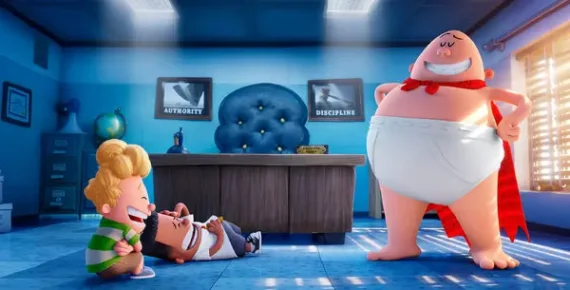
Captain Underpants: The First Epic Movie uses its ingenious premise of two kids hypnotising their dictatorial principal into believing he is the titular superhero from their independent comic series is used as a mere jumping-off point for a series of impeccably timed gags, absurdist asides, abortive musical numbers, inspiring stylistic shifts and shameless fourth-wall breaks. This rag-bag of ideas could’ve resulted in a big mess but they are pulled together so skilfully by Nicolas Stoller’s excellent screenplay that they cohere into a nimble, relentlessly entertaining 90 minutes during which you’re never quite sure what’s around the next corner. Stoller had made his name in comedy throughout the 2000s writing for shows like Strangers with Candy and Undeclared and films like Fun with Dick and Jane, Get Him to the Greek and The Muppets reboot. Captain Underpants’ cast are also plucked from this fertile comedy stable, with Kevin Hart and Thomas Middleditch as George and Harold, Nick Kroll as Professor Poopypants and Ed Helms as Captain Underpants himself, with able support from Jordan Peele and Kristen Schaal. Everyone involved throws themselves so wholeheartedly into the project that it cannot help but fizz with energy as the jokes fly and the animation charms.
Captain Underpants: The First Epic Movie made a very tidy return on its comparatively small budget but it also staked its claim to being one of DreamWorks most unusual and satisfyingly bonkers creations. Although its initial popularity didn’t translate into it becoming one of the studio’s tentpole properties, Captain Underpants: The First Epic Movie has the honour of being amongst DreamWorks more selective array of cult delights. Tra-la-la!
9.How to Train Your Dragon
Based on the children’s novel by Cressida Cowell, How to Train Your Dragon kicked off yet another big franchise for DreamWorks. By this point the studio were functioning at a much higher level of quality and consistency, making smarter choices (at least from a commercial standpoint) and achieving bigger hits and greater acclaim. If the negative comparisons to Pixar still seemed to dog their every review, DreamWorks were doing all they could to keep up and, while it did end up existing in the shadow of the mega summer hit Toy Story 3, How to Train Your Dragon emerged with its own share of acclaim and enough support to spawn successful sequels, TV series, and eventually one of those unnecessary, insulting but infuriatingly popular live-action remakes. The source material for How to Train Your Dragon was practically a surefire hitmaker if handled correctly. Various writers tweaked the screenplay to make it less whimsical and child-targeted, adding a tough fantasy edge which gave the film an epic feel and suitably high stakes, while studiously avoiding making it a grim and solemn Middle Earthy bore. The result feels perfectly pitched for most age groups, making it an instant staple amongst 21st century family films.
For my part, I am often tentative when approaching anything about which the words “lore” or “world-building” might be used. As my bitchy little dig at Tolkien probably betrayed, I’m not the biggest fan of excessively complex or serious-minded fantasy but I do enjoy the more lighthearted, playful end of magical mayhem. How to Train Your Dragon manages to deliver a satisfying, emotionally involving story with both sincerity and humour. The voice cast is uniformly excellent, with Jay Baruchel’s heartfelt Hiccup, Gerard Butler’s imposing chieftain Stoick and Craig Ferguson’s witty trainer Gobber the Belch standing out. But arguably more important than the human characters are the dragons themselves, primarily the Night Fury Toothless, whose sleek design and expressive eyes help the animators create an emotionally resonant relationship between him and Hiccup without falling into the twin traps of sentimentality or cutesiness. A significant portion of this relationship is developed through silent passages which, for me, are more effective and less desperate than their mute predecessors in WALL-E. The lack of dialogue does not call attention to itself and only after the sequence is over do you realise how deceptively simple but deeply successful the wordless storytelling has been.

Of course, How to Train Your Dragon features a lot of flying scenes and they are as magical an experience as you might hope for. Sometimes when I watch films these days I can identify the moments in which I would have become utterly enchanted as a kid. How to Train Your Dragon’s flying scenes still have the power to inspire that effect in me as an adult. Obviously, the film is moving towards a lengthy airborne battle sequence for its finale and, just as a matter of personal preference, I prefer watching the dragons soar majestically than fight brutally. But even for a viewer who struggles to stay focused during battle scenes, How to Train Your Dragon ties up its story nicely with a fight that daringly results in a grievous wound that poetically aligns the human and dragon protagonists. There’s a message here about longterm wars waged on the basis of prejudice and perpetual misinformation which is sadly relevant to whatever era you watch How to Train Your Dragon in. It’s perhaps an unsubtle moral but it’s not really trying to be otherwise. It puts the message out there and demonstrates that a hopeful passage back from such prevalent misdirected hostility is not necessarily impossible, but the film is never preachy or heavy-handed. It lets its observations stand on their own without the scaffolding of speechifying or tortuously drawn parallels.
Through a combination of good storytelling, great animation, a strong voice cast and John Powell’s rousing orchestral score, How to Train Your Dragon quickly became a modern classic of animation. It helped DreamWorks kick off a new decade on very good form with a fourth major franchise to its name. With the Shrek franchise about to wind down, it was the dragons turn to soar.
8.Chicken Run
In the early days of DreamWorks, the studio was still trying to establish its identity and Jeffrey Katzenberg doggedly pursued Aardman Animations. His persistence paid off and, while the creative collaboration was reportedly not a happy one, it did result in a handful of films that are technically included under the DreamWorks banner, even if they are recognisably the work of Aardman to any animation fan worth their salt. The first of these collaborations, Chicken Run, remains the most successful and the best. In a year when DreamWorks’ other release, The Road to El Dorado, became their first commercial stumbling block, Chicken Run helped pick up the slack and, at the time of writing, remains the most financially successful stop motion animated feature ever made. While a few of Aardman’s later features became a trifle cluttered, the high concept pitch of “The Great Escape but with chickens” had the simple vitality to be almost bulletproof, especially with Aardman’s trademark whimsical wit behind it. Co-directed by key Aardman visionaries Peter Lord and Nick Park, Chicken Run has the family appeal to make it a hit but also the gutsiness to not undersell its premise. These chickens are fighting for their lives and the fact that they’re cute and funny ain’t gonna save them, as an early, offscreen but keenly felt beheading makes clear.
Given that it is set in a confined space, Chicken Run partially relies on its visual prowess to sustain it. Right from the off, the atmosphere of the prisoner-of-war camp farm is evoked beautifully, with one of Aardman’s legendary detailed sets wowing the viewer. But there’s more to it than just the plasticine. Lord and Park evoke their reference points through script, lighting, camera angles and performance in a way that bolsters the already spectacular model work. Unlike a film such as Shark Tale, which relied on its audience being familiar with gangster films in order for the jokes to land, Chicken Run is able to evoke prison camp movies in a way which will delight older viewers but not go over the heads of the younger ones. The world is set up in a manner that explains itself to those who have never seen The Great Escape so the direct allusions make sense to those who do not get the reference, without even drawing attention to the fact that they are references. With films like Shrek, DreamWorks played a big part in establishing the 21st century trend for putting adult jokes in family animations but often they would be awkwardly incorporated, with the whole story momentarily grinding to a halt to spotlight the big wink at the camera. Chicken Run refuses to do this, instead showing a laudable dedication to making sure it is working for all of its audience, all of the time.

Thanks to films like Creature Comforts and The Wrong Trousers, Aardman Animations was already considered a national treasure by 2000 so Chicken Run had no problem assembling an impressive cast of mostly British talent. Julia Sawalha has the perfect combination of strength and vulnerability as Ginger, the de facto leader of the chickens, and it’s a great shame that she was not invited back to voice the character in Chicken Run’s belated sequel, Chicken Run: Dawn of the Nugget. Sawalha was devastated and furious, saying that the studios claim that she sounded too old to voice the character was an example of sexist ageism. It is perhaps more understandable given his subsequent history that Mel Gibson was also not invited back to voice Rocky the American rooster in the sequel. Still, Gibson does a fine job in his role too, trading convincingly on his then-unsullied movie star charisma. Other standouts include Jane Horrocks as ditzy clucker Babs, Timothy Spall and Phil Daniels as a pair of cynical rats, Benjamin Whitrow as the blustering RAF veteran Fowler, and Tony Haygarth and Miranda Richardson as Mr. and Mrs. Tweedy, the owners of the farm. Though Richardson is excellent as always, it is the model work and animation on Mrs. Tweedy that make her a genuinely terrifying villain.
As is generally the case with the best Aardman films, Chicken Run boasts a couple of terrific set pieces, notably Ginger and Rocky’s escape from Mrs. Tweedy’s new pie-making machine. Although it makes numerous allusions to classic cinema, it is moments like this that highlight Chicken Run’s dedication to being as cinematic as any of them in its own right. By the time the sequence arrives, the film has built up enough feeling for its characters, not to mention the sense that terrible things really could happen in this world, to ensure it works to maximum effect. The careful construction of Lord and Park’s story and the comedic/dramatic balance of Karey Kirkpatrick’s screenplay stood Chicken Run in good stead before a second of the painstaking animation had begun and DreamWorks’ decision to partner with Aardman proved to be an inspired one, even if it subsequently petered out with diminishing returns. The fact that DreamWorks’ backing helped Aardman make their first feature length film is justification enough and, while Park in particular would later complain of the studio’s interference in his creative process, the film that reached the screen retains Aardman’s distinctive sense of identity with aplomb.
7.Sinbad: Legend of the Seven Seas
The four traditionally animated films that DreamWorks made at the beginning of their filmography now constitute one of the more forgotten parts of the studio’s story. That’s a shame, given that they also constitute one of the most underrated parts. The success of Shrek helped DreamWorks find an identity for which it had long been searching, with irreverent computer animation becoming the order of the day. This was in sharp contrast to the reverence with which the early DreamWorks animations attempted to recreate the feel of classic Hollywood genres: the Biblical Epic in The Prince of Egypt, the Adventure Comedy in The Road to El Dorado, the Western in Spirit: Stallion of the Cimarron and the Fantasy Swashbuckler in Sinbad: Legend of the Seven Seas. The last of these films proved to be a disaster for DreamWorks, ultimately causing the studio to lose 125 million dollars and come close to bankruptcy. It’s no wonder the next film after Sinbad was an inevitable Shrek sequel. On the rare occasion that Sinbad: Legend of the Seven Seas is mentioned, it tends to be in the context of box office bombs, of regrettable studio-slaying turkeys, and few commentators get beyond the business side of things to actually discuss the film itself. Sinbad was a hideous, cash-guzzling mistake, according to the accepted narrative. Why, then, is Sinbad: Legend of the Seven Seas so damn good?!
I should mention at this stage that as well as being an animation enthusiast I am also a massive fan of Swashbucklers, so bring together that particular genre and that particular medium and my blunderbuss is primed to discharge before the trailer has even been released. But even with that qualifier, I think Sinbad: Legend of the Seven Seas has a lot going for it. A major problem seems to be that this kind of adventure story was rapidly going out of fashion. At this stage, Aladdin was over a decade ago and Disney’s Treasure Planet, which transplanted Treasure Island to space but otherwise largely played the story straight, had been a major flop the previous year. The fairy tale subversions of Shrek had led to people watching swordfights and sea battles while wondering where the jokes were. Sure, he just swung from a chandelier, vanquished a foe, rescued a prisoner and abseiled down a castle wall, but when is he going to reference The Matrix while farting? Sound bitter, don’t I? After all, films should be exclusively made with me in mind, right? No, the sad truth is that few people wanted Hollywood classicism anymore and, with Pixar’s Golden Age keeping the modern classics coming, appetites were quite understandably primed for something more than recycled tropes of old.

Unlike the more serious The Prince of Egypt and Spirit: Stallion of the Cimarron, Sinbad: Legend of the Seven Seas is a film with a lively and prominent sense of humour throughout, not to mention a handful of bawdy jokes to compliment its surprisingly forthright sexuality. From its well-toned-thigh-slapping leads to the overtly horny villain with her conspicuously vaginal realm entrance, Sinbad: Legend of the Seven Seas serves up some pretty strong medicine for its presumed audience of budding pubescents. How well it mixes this barely-concealed boner with family friendly fare will depend on individual taste, although perhaps a more instantly apparent question is how well the film mixes traditional and computer animation. The two had been blended smoothly in the previous year’s Spirit: Stallion of the Cimarron but Sinbad: Legend of the Seven Seas (geez, DreamWorks really loved a colon in their titles back then didn’t they?) attempts to push the computer animation much more forcefully into the foreground. At first I thought that this didn’t work, as in the first battle between Sinbad and the enormous squid-like sea monster the different styles of animation seem to clash wildly. But as the film goes on, I realised the otherworldliness of the various fantastical monsters is actually enhanced by their CG rendering, differentiating them effectively from Sinbad and his crews hand-drawn earthliness, in a similar manner to that in which the Fleischer brothers separated Gulliver from the Lilliputians using rotoscoping in 1939’s seminal animated feature Gulliver’s Travels.
There are a lot of positives going for Sinbad: Legend of the Seven Seas. It was written by John Logan who was fresh off his Oscar nominated Gladiator screenplay. It has a star cast including Brad Pitt in the title role and Catherine Zeta-Jones as female lead Marina. Pitt and Zeta-Jones work up an effective screwball energy between them which helps to patch over the slightly underdeveloped elements of the romance. Michelle Pfeiffer is the scene-stealer as Eris the Goddess of Chaos, a role she apparently found difficult to pin down, although it sounds like she is having a blast with it. Best of all, the swashbuckling action scenes come in quick succession and are well paced and animated. After several films that insisted on falling back on unnecessary musical interludes, Sinbad: Legend of the Seven Seas does away with the Pop songs altogether so there’s nothing to slow down the action or smother the storytelling. Disney were starting to move away from songs at around this time too, and while it would be the reinstatement of musical numbers that eventually drove Disney’s second Renaissance, DreamWorks had never come anywhere remotely close to the quality of their main rival’s catalogue of songs and unshackling themselves from this once de rigueur feature would ultimately help the studio find their own unique identity.
At the time of writing, Sinbad: Legend of the Seven Seas falls into that group of films that people now in their 20s and 30s had on VHS as kids, a phenomenon that usually results in average online ratings being driven up higher than you might expect when cross-referenced with critical notices. Sinbad: Legend of the Seven Seas, however, doesn’t seem to have ridden that wave as successfully as some of its contemporaries and many reviews even from that enthusiastic demographic are lukewarm. I suspect Sinbad’s immediate reputation as a disaster probably scuppered its chances of establishing that home video following, while smaller flops that didn’t nearly bankrupt their studios were able to slide into that space more easily. But don’t let Sinbad’s dire reputation put you off, especially if you love a rip-roaring Swashbuckler. For me, it’s definitely one of the better mainstream animated features of its era.
6.The Croods: A New Age
Even though it’s a universally recognised fact that posting a list that deviates from the received wisdom of the generally accepted order will result in unnecessarily visceral condemnation from, let’s not mince words, pricks, it seems I just can’t help myself. Just as overlong opening sentences are part of who I am, so too, it seems, are hot takes. So I make no apology for the fact that Cars 3 is my second favourite Pixar film, for the fact that Atlantis: The Lost Empire is in my top 10 Disney films, or for the fact that I don’t like Shrek but I love The Croods. I didn’t know I loved The Croods until this rewatch, when the 2013 original, a film I breezed past with little interest on my first viewing, impressed me greatly this time round. Having never seen the sequel, The Croods: A New Age, I approached it for the first time with a tentative sense of hope, tempered by the lowered expectations that I reserve for sequels and remakes. I was amazed when The Croods: A New Age crashed into my DreamWorks top 10, which I assumed at this late stage to be pretty much locked down. I wasn’t ready for the ever-clearer revelation that I love The Croods. I am a Crood dude. I’m partial to Croodité.

The Croods: A New Age reassembles the impressive cast from the first film and adds Leslie Mann, Peter Dinklage and Kelly Marie Tran to the mix. Joel Crawford makes his feature directorial debut, with a screenplay by the Hageman brothers, Paul Fisher and Bob Logan. While The Croods: A New Age opts for a slightly different tone from the first film, it crucially retains that visual beauty which is so often underrated when people undervalue the franchise. With its tale of the family discovering a lush green paradise amongst the prehistoric wastelands, if anything The Croods: A New Age is even more visually striking than its predecessor. The sitcom-esque dynamics remain intact but there is a noticeable reduction in the brutality of the family’s savagery, something that initially seems like it will be a problem given how deeply the first film drank from that well. But the change proves to be a smart one, acknowledging the characters’ potential for evolution while also sidestepping the possibility for repetition. When the character of Belt turns up before the film has even officially begun and reprises his annoying “Dun dun duuuun” routine, there’s a horrible sense that we’re about to watch a rehashed greatest hits package. In fact, this gag seems to be there mainly to deal with the fan service as quickly and unobtrusively as possible. The narrative that follows seems determined instead to wrongfoot the viewer by presenting a well-worn scenario and then subverting it immediately. In particular, a potential rivalry between Eep and new character Dawn over her closeness with Eep’s boyfriend Guy is teased and then obliterated when what seems to be an escalating rage in fact turns out to be excitement at the prospect of a new female friend. The film continues to dangle the possibility of a hackneyed jealousy narrative while consistently refusing to follow through on it. While The Croods cheerfully traded on knowingly exaggerated gender stereotypes, The Croods: A New Age goes the other way, refusing to pander to these same expectations.
While The Croods foregrounded Nic Cage’s patriarch at the expense of some of the other characters, The Croods: A New Age does a much better job of spreading the focus across the whole family while also convincingly incorporating the new arrivals. There are nice running gags such as Thunk’s addiction to windows (a TV surrogate) and Gran’s sentient hairpiece that ensure the minor players are not sidelined, while the chemistry between Emma Stone and Kelly Marie Tran as Eep and Dawn, Nic Cage and Peter Dinklage as the Dads and Catherine Keener and Leslie Mann as the Mums expands and improves upon the dynamics of the first film. The introduction of a clan of Punch Monkeys also ups the violence quotient in a satisfyingly comedic way. The good-natured mockery of New Age spiritualism is funny without being overly derogatory and the final act injects a burst of smartly slapstick action into a film that has hitherto been happy to take its time. The results are one of DreamWorks most accessibly delightful sequels yet.
With beloved cast member Cloris Leachman now gone and the general reaction from outside of my living room proving to be rather muted, it’s uncertain as to whether The Croods will make a return to the big screen for a third time. But if they do I will absolutely be buying my ticket in advance. Perhaps in the next few years, the online presence of the generation who grew up with The Croods will increase and that powerful nostalgia that eventually reclaimed films like The Goonies and Hook will do the same for these Stone Age underdogs (and, probably as an unfortunate byproduct, The Boss Baby too). In the meantime though, I’m bucking the trend and proudly declaring that to me The Croods films are better than Shreks!
5.Over the Hedge
Part of the fun of watching a studio’s entire filmography is not knowing when you might unearth a hidden gem. Having seen and enjoyed Over the Hedge many years ago, I was quite looking forward to revisiting it but I wasn’t expecting to love it as much as I did this time round. Having been thoroughly unconvinced by the early films in DreamWorks first two computer animated franchises, Shrek and Madagascar, I latched onto Over the Hedge’s more considered storytelling and less desperate humour very quickly. Based on the comic strip of the same name by Michael Fry and T. Lewis, Over the Hedge follows the adventures of RJ, a roguish raccoon who lands himself in serious trouble when he decides to steal the stashed food of a hibernating bear. Caught in the act and accidentally destroying the stash as a result, RJ is given a week to replace every item of food otherwise the bear will kill him. Meanwhile, a group of woodland animals awake from hibernation to find that the majority of their home has been turned into a housing development separated from their tiny patch of remaining forest by a giant hedge. Seeing this as an opportunity, RJ convinces the animals to raid the new houses for the snack foods he needs to repay his debt, under the pretence that he is helping them store food for themselves. The setup here is simple, the moral predictable but rewarding, and the characterisations impeccable. RJ’s life or death plight makes his manipulative gambit at least partially sympathetic and Bruce Willis plays the role superbly, supplementing the essence of a classic wisecracking 80s protagonist with the heart and vulnerability of a more modern hero. Nick Nolte’s performance as Vincent the bear is brief but pivotal, the level of genuine menace he creates driving the entire plot. The opening sequence between RJ and Vincent is exceptional, with Nolte and Willis instantly establishing a dynamic that is darkly comic and chillingly threatening.
Over the Hedge’s considerable charm is enhanced by an all-star cast who imbue the woodland animals with distinctive personalities beyond their potentially one-joke quirks. Steve Carrell’s hyperactive squirrel Hammy is an obvious standout, the sort of character who could become intensely annoying if used less sparingly (looking at you, Donkey!). Thankfully, the screenplay by Len Blum, Lorne Cameron, David Hoselton and Karey Kirkpatrick knows how to spread this material equally across its ensemble. Garry Shandling is effectively fussy as the cautious self-appointed leader Verne the turtle, William Shatner is fun as a possum who plays dead at any sign of danger, and Wanda Sykes is smartly sassy as a skunk masquerading as a cat. Although one of Over the Hedge’s minor weaknesses is the slightly grotesque design of its human characters, Allison Janney makes the gradually more hysterical President of the Home Owners Association another comic highlight.
I think I underestimated Over the Hedge’s quality because, on the face of it, it appears to be just another talking animals cartoon. The plot is not original enough to make it stand out in a trailer and it is only in the act of watching and giving in to the film’s charms that it reveals itself as a gem. There are lots of little wrinkles that make Over the Hedge smarter than the average film of its kind. There is a running gag with a tube of Pringles-like crisps called Spuddies that is particularly striking. It’s no so much a hilarious gag as a cleverly utilised recurring prop, the significance of which inevitably leads to chaos whenever it shows up. Another major strength is the music. Rather than use nostalgic but intrusive needledrops like Shrek and Madagascar had done, Over the Hedge features its own specially commissioned soundtrack by the brilliant Ben Folds. As a long term Folds fan, this was always going to boost the film for me, but songs like Heist, Family of Me and Still all complement the tone of the film perfectly. Folds even rewrote his hit Rockin’ the Suburbs in a family friendly version which plays over the end credits, along with a well-chosen cover of The Clash’s Lost in the Supermarket.
Over the Hedge was a reasonable-sized hit but not to the extent that it spawned another franchise. Although I’ll never quite understand how people wanted more of Madagascar and not of this, I’m glad that Over the Hedge remains a standalone rather than the first in a string of diminishing returns. Unlike Shrek, whose fairy tale kingdom is wide open to numerous story possibilities, Over the Hedge’s tale feels fully told at the end, even if the final image of a hyperactive squirrel running headlong into the camera is a bit of an abrupt note on which to finish. The following year, the Madagascar saga would continue and the Kung Fu Panda franchise would get underway, quickly consigning Over the Hedge to comparative obscurity, but amidst the more famous films that surround it, this is a little nugget for which it is worth digging.
4.Megamind
When Megamind was released in 2010, it found itself being accused of a lack of originality by many critics. Given that Pixar had secured another huge hit with The Incredibles several years earlier, it’s fair to say that this had almost definitely been an influence on DreamWorks making their own Superhero-themed film. But elsewhere numerous critics accused Megamind of recycling elements of Despicable Me, despite the fact that the films had been in production at the same time and Despicable Me only appeared about four months earlier. Although inter-studio pilfering sometimes occurs and DreamWorks had already been accused of it during the Antz/A Bug’s Life controversy, it seems far more likely that two animation studios made films inspired by The Incredibles which just happened to be told from the villain’s perspective. The content of Megamind and Despicable Me, and The Incredibles for that matter, is actually quite different, enough for them to coexist without anyone but the most easily distracted viewer suffering from fatigue. If this is what constituted Superhero saturation in 2010 then they didn’t know they were born. “Do we really need Megamind when Despicable Me is around?” asked Claudia Puig of USA Today. My answer would be that, given Megamind is so, so much better than Despicable Me, yes, yes we do!
Despite its superior screenplay by Alan Schoolcraft and Brent Simons, a veritable cornucopia of inventive wordplay and existentialist themes, Megamind was quickly consigned to the folder marked “Cult Items”, while Despicable Me barrelled ahead with sequels and spin-offs galore. I’m not bitter that Megamind didn’t get any theatrical follow-ups. I think its arc is pretty much over after its 96 minutes and, while it’s comparatively easy to come up with new superhero concepts, resetting Megamind’s crucial villainy would be impossible without cheap contrivances. Megamind’s cult popularity did eventually lead to a direct-to-streaming sequel and a TV series, both of which received an overwhelmingly negative reaction from fans. Whether this is validation of my theory or merely further confirmation of the tragic toxicity of the fanbases of certain genres is something on which I will reserve judgment until I’ve seen either of those later iterations. But given the ease with which they can be dismissed as non-canonical, for the purposes of this review I will continue to consider Megamind a one-shot DreamWorks film.

Unlike that other DreamWorks one-shot, Monsters vs. Aliens, Megamind is a smart film that is engaged with its chosen genre beyond the level of superficial parody. Its examination and subversion of superhero tropes suggest both a deep understanding of and affection for the dynamics on which its story is built. There are a ton of great jokes in Megamind but the artfully constructed story is never subservient to them. So the running gag of Megamind’s mispronunciation of certain words becomes both a strong character trait and, in one crucial moment, a plot point. Megamind’s alien fish henchman Minion (a name conceived before the definition evolved to mean ubiquitous, yellow and merchandisable) is both a comic sidekick and a key emotional component. There are many surprising twists on well-worn tropes. The villain actually manages to kill the hero, only to suffer an existential crisis when deprived of the nemesis whose diametric opposition is central to his sense of identity. The nerdy underdog who longs for the beautiful woman not only doesn’t get her but proves himself entirely unworthy of her in the process. The hero who we thought was dead turns out to be alive and suffering an existential crisis of his own. Not only is the script eloquent and hilarious, but it is at least as intelligent as The Incredibles in its deconstruction of the genre and of early 21st century attitudes. Perhaps controversially, I think I marginally prefer Megamind to its Pixar predecessor.
Megamind’s cast is mostly plucked from the world of comedy, with Tina Fey, Jonah Hill, David Cross and Ben Stiller all providing voices. In the title role, Will Ferrell gives what may be his best performance, enhancing jokes by hitting every beat perfectly. Brad Pitt is the major non-comedic actor in the cast, although his showboating but secretly vulnerable superhero Metro Man is also very funny indeed, with Pitt nailing the square-jawed machismo with comic aplomb. By contrast, Jonah Hill’s character, the dithering cameraman Hal, at first appears to be a comedic character but proves to be more disturbing in his growing displays of toxic masculinity and predatory entitlement. Like the Kung Fu Panda franchise, Megamind takes its genre seriously and ends up making some astute observations but with its primarily comedic thrust and tendency towards subversion, it got folded in with the sort of parodic material from which DreamWorks had decided to move away, so its modest success did not translate into a significant franchise despite Superhero films becoming massively popular at about the same time. It seems as if many agreed with Claudia Puig and felt we didn’t need the more cerebral Megamind around when we had the broader delights of the Despicable Me films. And that, dear reader, is how we ended up with the Minions movie.
3.Kung Fu Panda
With the arrival of the Kung Fu Panda franchise, DreamWorks took a huge leap forward in quality. This story of a giant panda named Po whose love of food is only trumped by his love of kung fu began life as a spoof of Kung Fu movies but directors John Stevenson and Mark Osborne pushed instead to approach the genre with sincerity. So instead of getting a tiresome parody with hackneyed gags about bad dubbing and mistimed kicks to the crotch, Kung Fu Panda became a sincere, well-told Martial Arts movie but one that just happened to star a seemingly mismatched hero. The comedy of Kung Fu Panda arises from taking the action seriously and then having the clumsy, out of shape protagonist attempting to find his place in the story. In this case, Po is suddenly thrust into the centre of the narrative when a freak accident results in him being chosen as the prophesied saviour The Dragon Warrior, much to the irritation of kung fu masters The Furious Five and their leader, Master Shifu, a short-tempered red panda who is now lumbered with the task of helping Po find his inner warrior. There follows many scenes of disastrous training sessions, given an urgency by the escape of Tai Lung, a former apprentice of Shifu’s who is heading back to the valley to claim the Dragon Scroll, the sacred document meant only for the eyes of the Dragon Warrior and which Tai Lung sees as his rightful property.
Kung Fu Panda is a great addition to the Martial Arts genre and should appeal to fans but it is also an ideal introduction to that world. Unlike, say, the Gangster film references of Shark Tale, Kung Fu Panda can be enjoyed without any knowledge of the tropes on which it is drawing, thanks to its sincere storytelling as opposed to parodic subversions. The action sequences are numerous and exciting, from the Furious Five’s frantic battle with Tai Lung on a rickety rope bridge to Po and Shifu’s battle over the last dumpling in the bowl. That latter sequence, a pivotal part of Po’s training, is one of the finest scenes DreamWorks have ever created. It combines a ridiculous premise with a straight execution to create a perfectly pitched combination of the comedic and the dramatic. This balance is reflected in the sterling work by the excellent voice cast, who do not allow goofball exaggerations to scupper their carefully drawn characters. There are many standouts, including Dustin Hoffman’s cranky Shifu, Randall Duk Kim’s assured and serene Oogway, Angelina Jolie’s tough but frustrated Tigress, and Ian McShane’s simmering Tai Lung. I’m particularly fond of James Hong’s Mr. Ping, Po’s noodle restauranteur father who happens to be a goose, an adoptive relationship that would only be acknowledged as such later in the franchise. But the heart of Kung Fu Panda, as it should be, is Jack Black’s Po. Black taps into his well-established boyish energy to create a kind, vulnerable, excitable, childlike protagonist who doesn’t have a bad bone in his bulging body. While some have seen the film’s attitude to Po’s body as fat shaming, it is careful to depict his love of food as both a joyous pleasure and an emotional crutch which Po must learn to control but which is never depicted with disgust or ridicule. Part of Kung Fu Panda’s philosophy is the diverse nature of heroism and when Po discovers his own potential, it does not come with a caveat of weight loss.
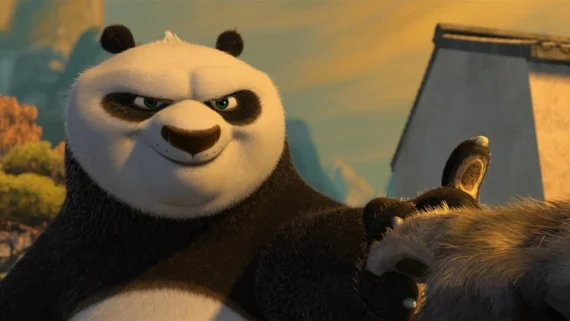
In order to enhance Kung Fu Panda’s dedication to quality, Stevenson and Osborne were committed to making it DreamWorks’ most beautiful film yet. The ancient Chinese world it depicts, the Valley of Peace, complete with its opulent Jade Palace and quaint noodle shop settings, was carefully researched by production designer Raymond Zibach and art director Tang Kheng Heng, who spent years studying Chinese art, architecture and film in order to give their designs an authenticity that eschewed the cheap Orientalism of other Western depictions of the East. While avoiding these pitfalls completely would be impossible in a Western film about anthropomorphic animal warriors voiced primarily by America actors, Kung Fu Panda’s attitude to Chinese culture was largely applauded in China, with many Chinese commentators bemoaning the fact that government oversight, lower budgets and an overly reverent attitude to history prevented films of a similar quality being made locally.
Kung Fu Panda actually encountered more controversy on its home turf, where its across the board sweep at the Annie Awards caused a Disney boycott for several years until the voting system was changed. Whether it was a DreamWorks manipulation that caused this victory when it was Pixar’s WALL-E that was winning every other animation award going, I have come to believe that Kung Fu Panda thoroughly deserved its victory. The clamour to laud WALL-E as one of the greatest animated films ever made resulted in DreamWorks’ brilliant film living in the shadow of that irritating little robot. While WALL-E remains the more revered film, I’ve never been a fan. Controversially, I actually think Kung Fu Panda is the more visually beautiful film and WALL-E certainly doesn’t sidestep bodyshaming issues as effectively as Kung Fu Panda does. Becoming the third big DreamWorks franchise, Kung Fu Panda would spawn sequels (including one instalment that is even better than the original), TV series, shorts, video games, theme park attractions and live shows. Although I was 26 when the first film was released and didn’t fully catch on until the second film, Kung Fu Panda has become one of the few franchises to emerge after my childhood that I have followed with the avid enthusiasm of my youth. It’s the kind of good-natured, joyous creation that can bring out the inner Po in all of us. Skadoosh!
2.The Wild Robot
Based on Peter Brown’s sci-fi novel of the same name, The Wild Robot was immediately recognised by audiences as a prestige project from DreamWorks. Helmed by the ever-reliable Chris Sanders, whose previous work includes How to Train Your Dragon, The Croods and, for Disney, Lilo & Stitch, The Wild Robot stood out a mile from the recent glut of sequels that had made up about 60% of DreamWorks 20s output. But who would begrudge the world another Boss Baby film if the profits get pumped into more ambitious creations like this? Sanders set his sights high, naming Bambi and My Neighbour Totoro as the major influences on the visual style of the film. The production team worked to perfect the technological advancements made on previous DreamWorks films The Bad Guys and Puss in Boots: The Last Wish, giving the CGI artwork a hand-painted look that is stunningly applied to the characters and their environments. Sanders described it as “a Monet painting in a Miyazaki forest.” A major influence on Sanders’ approach to the material was an early phone conversation with Brown in which the author described the theme of the book as being that kindness can be a survival skill. In order to bring this idea to life, Sanders needed to create an environment that felt both visually impactful and genuinely threatening. The island on which the shipwrecked robot Roz washes up, and on which the bulk of the story takes place, is an unforgettable setting, somewhere between paradise and a vicious boot camp. The elemental feel of the animation means the viewer practically experiences every warming sunbeam and icy drop of rain, and that level of connection inevitably makes the multiple dangers of the island seem very real indeed. Sanders cited Bambi as a visual influence but that film’s comparatively visceral depiction of life and death is also evident in the storytelling.
Sanders appreciated the importance of a strong voice cast and assembled a fantastic group of recognisable talents including Pedro Pascal, Kit Connor, Matt Berry, Catherine O’Hara, Stephanie Hsu, Mark Hamill, Bill Nighy and Ving Rhames. Most important of all, however, was finding the right voice for Roz, since her expressionless face meant that her gradually emerging emotions would need to be largely carried through voice work alone. It’s hard to imagine a more perfect choice, then, than the supremely talented and expressive Lupita Nyong’o, who instils in Roz a sense of enormous empathy even in the early stages when she is merely a machine searching for a task, as dictated by her programming. Nyong’o’s performance is pitched perfectly between otherworldly and deeply human, and her task of becoming a mother to an orphaned goose places her in the position of essentially being both newborn and carer, a situation that Sanders’ screenplay deftly plays for both comedy and sentiment.
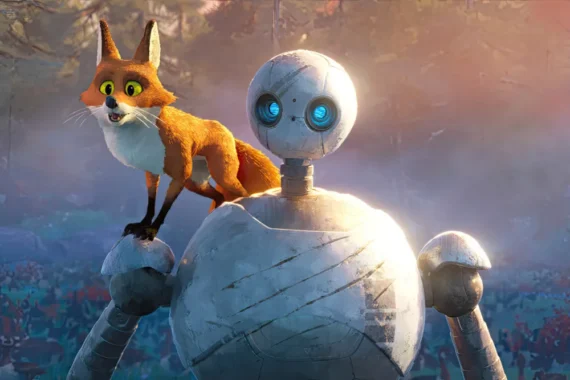
There was a lot of buzz about The Wild Robot before it arrived and I wondered if I was barreling towards a disappointment. The naive robot coming to terms with human emotions is a storyline that has been done many times before and I shamefully allowed my cynicism to get the better of me in the run-up to The Wild Robot’s release. It only took about ten minutes of runtime for me to realise that this was something special though. The film goes through several shifts, with the very impressive early sequences of Roz’s arrival on the island and attempts to adapt to her surroundings suggesting that The Wild Robot might be heading for a WALL-E-esque dialogue-light approach. As Roz runs a program to help her learn the language of the animals around her, I wondered if the film might go downhill once the animals began talking back. I needn’t have worried. This is just the first of several tonal and narrative shifts that The Wild Robot undergoes across its thrilling 102 minutes and each one manages to work within the parameters of the story, increasing the emotional intensity and octane-level of the action accordingly.
In terms of sentimentality, The Wild Robot takes some big swings that could have risked toppling over into cheesiness but which instead feel thoroughly earned thanks to the carefully laid groundwork that precedes them. As with both Bambi and My Neighbour Totoro, The Wild Robot is a story that absolutely works for children but which may work for adults even better. In this case, however, both adults and children can project onto the same central character simultaneously but in completely different ways. Sanders, who identified the source text as “deceptively simple” but “emotionally complex,” has done a remarkable job of preserving the power of that paradox in his impeccable adaptation. These emotions are further enhanced by Kris Bowers powerful, Oscar-nominated score which rises and falls at the exact right moments to punctuate and accentuate.
Bowers’ nomination was one of three that The Wild Robot received and it is only due to its misfortune of being released in one of the strongest years for the Animated Feature category that it didn’t easily walk off with the award. Early on in the awards season cycle, there was even talk of The Wild Robot being nominated for Best Picture and there are certainly several films I would’ve loved to see it elbow out of contention. It’s testament to The Wild Robot’s excellence that it would sit comfortably alongside the small handful of animations that have made their way into the Best Picture contenders list. Released 30 years on from the founding of DreamWorks Animation, The Wild Robot is a fittingly exquisite landmark to honour that occasion.
1.Kung Fu Panda 2
When asked to name a sequel that is better than its parent film, most people cite The Godfather Part II but, great though it is, I’ve never felt that it tops the original. The Toy Story sequels are often popular choices but again, I’ll take the original over its follow-ups. For my definitive answer, we have to go to another animated series of films, Kung Fu Panda. I love the first Kung Fu Panda but on my initial viewing its brilliance passed me by. It took a viewing of its fantastic sequel to make me go back and reevaluate it, because the night I first watched Kung Fu Panda 2, despite having no expectations whatsoever, was the night I fell in love with the whole franchise.
Kung Fu Panda 2 takes full advantage of all the benefits a sequel offers. It already has its characters in place, with Po now established as the Dragon Warrior and working alongside the Furious Five. This allows the film to launch into a more complex and ambitious story immediately, with the characters’ voyage to Gongmen City opening out the action on a larger scale than its predecessor. There is also the opportunity to introduce a new villain, with Gary Oldman’s menacing peacock Shen proving to be the franchise’s best baddie. His relentless ambition and genocidal tactics make Shen genuinely terrifying, yet they also make his baffled incredulity at Po’s supposed status as his prophesied nemesis even more hilarious. Oldman’s voice work is phenomenal here, rivalling that of great Disney villains like Jeremy Irons’ Scar. Ian McShane’s defeated Tai Lung aside, all of the original main cast are back and excelling in their roles. Dustin Hoffman’s Shifu is used far more sparingly here but the power of his presence exceeds the length of his screentime. The same is true of James Hong as Mr. Ping. One of my favourite characters from the first film, Mr. Ping is given some weighty, emotional material here as he comes clean to Po about how he came to adopt him and wonders if Po will still accept him as a father.

As with the first film, the action sequences are taken seriously and delivered with a genuine sense of excitement and suspense. But the joke quota in Kung Fu Panda 2 has also been ratcheted up considerably, with many laugh out loud moments throughout, mostly courtesy of Jack Black’s consistently delightful performance. Jonathan Aibel and Glenn Berger return as writers but Jennifer Yuh Nelson takes over in the director’s chair. This was a smart move as Yuh Nelson’s fresh take gives Kung Fu Panda 2 enough of a different flavour to avoid falling into the trap of a simple retread. That said, Yuh Nelson was also head of story on the first Kung Fu Panda so she brings with her a familiarity with and understanding of the world which ensures a crucial sense of continuity. Other important factors that are still present include the beautiful artwork and animation that so defines this series and a respectful attitude towards Chinese culture, with a DreamWorks staff outing to Chengdu helping to further enhance that connection. Jeffrey Katzenberg confirmed that many elements of Chengdu made it into the ancient China of the film.
For anyone casting a casual eye over the DreamWorks canon, it’d probably be easy to assume Kung Fu Panda 2 is just another sequel amidst a clump of other franchise follow-ups but that’s not the case. Unlike the Godfather trilogy (in my opinion), DreamWorks franchises often improve as they go along or at least produce sequels that are a match for the original. In the case of Kung Fu Panda, this second instalment is where the franchise peaks and, if we’re being brutally honest, Shen’s line “The only reason you’re still alive is that I find your stupidity mildly amusing” sounds like a review of Kung Fu Panda 4. There are other films, shorts and TV series associated with this property that are well worth seeking out if, like me, you are enamoured with the characters and world, but Kung Fu Panda 2 remains the one where I most find my inner peace.