



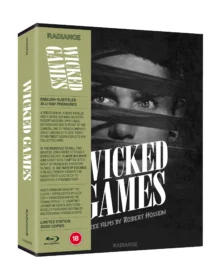
 Director: Robert Hossein
Country: France
Overall BBFC Certificate: 18
One of the things I try not to do with my film watching habits is fall into the trap of settling too comfortably into a specific genre. Readers of this site will likely note that I do have a tendency to gravitate towards genre films, particularly horror and sci-fi, but I like to balance that out somewhat with excursions into other fringes where I don’t frequently tread.
Film noir is definitely a genre I’m keen to explore in greater detail and I’m quite fond of French cinema, so when an opportunity to take a look at the Wicked Games box set from Radiance, a collection of three films from French noir director Robert Hossein, came along, I grabbed the opportunity to dive further in…
The Wicked Go To Hell (1955)
Screenplay: René Wheeler, Robert Hossein
Based on a play by: Frédéric Dard
Starring: Marina Vlady, Henri Vidal, Serge Reggiani, Robert Hossein
Running Time: 93 min
Year: 1955
BBFC Certificate: 12
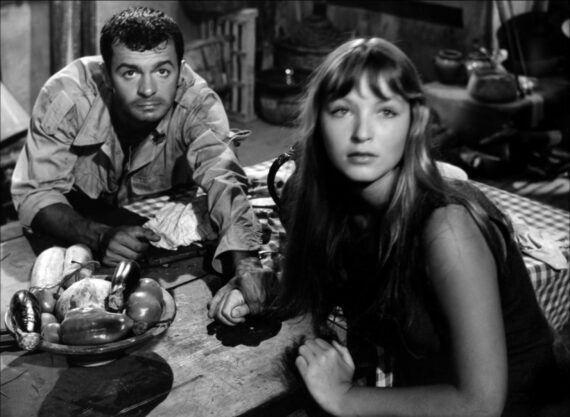
When Macquart and Rudel, two violent inmates in a hard prison, take advantage of a funeral to stage a daring escape, they quickly realise they’ve bitten off more than they can chew as they begin fighting both amongst themselves and then for their lives as a chance encounter leads to a deadly hostage situation.
Without knowing what to expect from director Hossein, my first impression of The Wicked Go To Hell was just how gorgeous it looked. A lot of this is likely to do with the new 2K restoration on this film which shows off the black and white photography stunningly, but it’s also testament to how Hossein is a very visual film maker, something we’ll revisit throughout this review, but the opening shot of this film, an almost symmetrical view above the prison’s gantry’s shows superb artistry in its framing, giving light and shadow great attention.
The story takes a while to really find its stride, giving us time to get to know our two main inmates as well as the cast of reprehensible characters that surround them. These early scenes in the prison also stood out for me with the remarkable darkness they have from a narrative perspective, featuring some remarkable levels of violence and profanity for a 1950s film. This carries through into the inmates’ escape and an eventual home invasion which leads into the final act of the film, a sequence which is genuinely shocking.
The cast is strong with Henri Vidal delivering a thuggish performance as the dominating Macquart while Serge Reggiani contrasts this as Rudel, a man filled with regret at the actions which have led him to the predicament he finds himself in. But it’s a young Marina Vlady who’s the standout here as the stunningly beautiful Eva. Wronged and menaced by Macquart and Rudel she has few lines, but her silent menace as she plots her revenge is palpable and searing.
The Wicked Go To Hell is a genuinely good slice of deliciously mean spirited noir which brings with it a very satisfying ending and some beautiful looking shots. There is a degree of unevenness to it, however, with some early plot threads left unexplored and a two act structure which betrays its stage origins. As an introduction to the work of Hossein, however, it’s a great primer.


Nude in a White Car (1958)
Screenplay: Robert Hossein, Daniel Hortis
Based on a novel by: Frédéric Dard
Starring: Robert Hossein, Marina Vlady, Odile Versois
Running Time: 92 min
Year: 1958
BBFC Certificate: 15
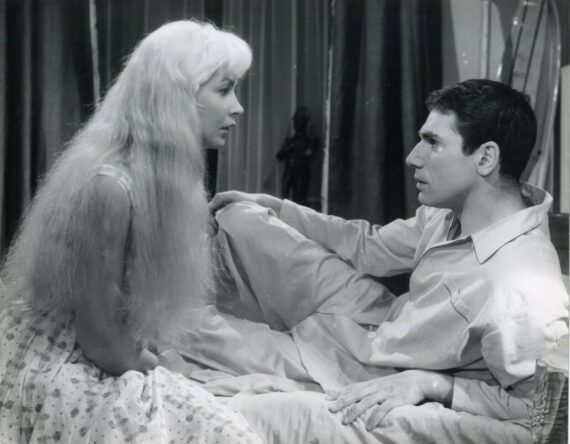
Pierre Menda is drifting through Nice when a car pulls up next to him – seduced by the nude woman who’s driving the car and who’s face he cannot see, this chance encounter suddenly becomes dangerous when the woman tries to run him down before driving off. Tracking down the car, Pierre encounters two beautiful sisters, one who is disabled and one who never leaves the house in which they live. So who was driving the car?
The second film in this collection is much more of a noir thriller very much patterned after the films of Alfred Hitchcock or Henri-Georges Clouzet. It’s also surprisingly racy for a 1950’s film with some brief nudity that Hollywood productions during the time of the Hay’s Code wouldn’t have been able to feature; in some ways it feels almost like a proto erotic thriller with the opening scenes of Pierre’s seduction and attempted murder, all of which suggest a compelling mystery lurking under the surface. Sadly the film can’t really sustain this mystery through its run time.
Casting himself in the lead, this feels largely like an excuse for Hossein to spend time in the presence (and often arms) of a pair of beautiful women. Marina Vlady returns from The Wicked Go To Hell and is once again captivating as Eva, a role that this time gives her far more dialogue and character. Playing opposite her is Odile Versios as her equally stunning sister Helene. This trio are the characters we spend the vast majority of the run time with and they are, thankfully, very watchable.
The plot of Pierre effectively moving in with the sisters, initially to investigate their possible deceit which eventually leads to the formation of a relationship between the three of them twists the plot largely away from its mystery premise and into more of a romantic character drama, but it’s this shift in the narrative which drags the film down.
It’s a real shame as once again Hossein is superb behind the camera. The film looks absolutely beautiful, shot in a wider aspect ratio to allow the beautifully expansive exteriors of the sisters house burst from the screen and incorporating the classic noir trick of utilising split diopter shots to keep characters focussed across the frame.
Despite its strong start and downbeat if predictable ending, though, the middle of the story is just too flabby and meandering and lacks the bite of The Wicked Go To Hell to be fully engaging. While Hossein clearly wants this to be on the same level as Hitchcock and Clouzet, Nude In A White Car never manages to be as compelling as any of the films from those two masters of mystery cinema.
The Taste of Violence (1961)
Screenplay: Robert Hossein, Louis Martin, Claude Desailly, Walter Ulbrich
Starring: Robert Hossein, Giovanna Ralli, Mario Adorf, Hans H. Neubert
Running Time: 85 min
Year: 1961
BBFC Certificate: 12
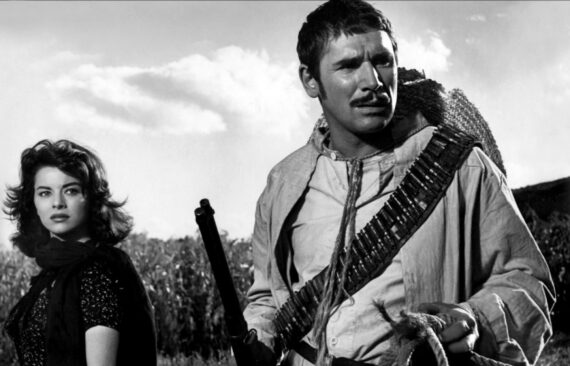
In an unnamed Latin American company, a gang of revolutionaries led by a man named Perez kidnaps Maria, the daughter of the ruling dictator, with plans to trade her for their own comrades. While transporting her across dangerous terrain, the gang begins to not only witness the cost of their uprising, but also begins to fracture as the bounty on their hostage’s head becomes more appealing than the release of their friends.
The Taste of Violence is an incredibly interesting film; here we have a Euro Western which predates the Spaghetti Western (being French, let’s call this an hors d’oeuvres Western) and digs into more philosophical ideas than it’s more violent Italian cousins, while still not holding back on its brutality.
Hossein shoots this film in stunning 2.35:1 widescreen, filling the frame with some gorgeous on location landscapes with the black and white photography aiding the illusion that its Croatia, Montenegro and Yugoslavia locations are actually in South America.
The narrative is tense, much closer to The Wicked Go To Hell than the noir mystery stylings of Nude In A White Car. Split up almost into a series of self contained vignettes as our revolutionaries find themselves in different situations and encounters, ranging from being pursued by a gang of villagers with their sights set on taking their hostage for themselves, to a good old Mexican standoff as loyalties begin to fray, The Taste Of Violence also echoes Clouzet’s The Wages of Fear – at one point Mario Adorf’s Chamango compares Maria to dynamite, a volatile cargo which could, through the situations they find themselves in, be the end of them at any moment.
The group of revolutionaries, led by Hossein as Perez, are remarkably well rounded with their characters coming out through the well paced but slow burn narrative that the film builds. But the standout here is Giovanna Ralli as Maria, the precious and volatile cargo. Remaining largely silent for the first half of the film, quietly playing the gang off against each other, Maria gradually becomes not only more vocal but more sympathetic to the cause as she sees first hand the results of her father’s rule.
The Taste Of Violence is ultimately an incredibly melancholic film which does peter out narratively towards its end and perhaps won’t have the conclusion many would expect or even hope for given the genre, but its reflective exploration of loyalty and the futility of combat makes this an incredibly unique Western.
Bonus Features
- 2K restorations by Gaumont for each film, presented on three discs
- Original uncompressed mono audio for each film
- Audio commentary on each film by critic and author Tim Lucas (2025)
- Picking Strawberries – A newly created ‘making of’ featurette with historian Lucas Balbo, featuring archive interviews with Hossein and Jean Rollin (15 mins, 2025)
- Behind Marked Eyes: The Cinematic Stare of Robert Hossein – A newly created featurette by Howard S. Berger about Hossein and his work (27 mins, 2025)
- Interview with actor Marina Vlady (9 mins, 2014)
- The Evolution of the Femme Fatale in Classic French Cinema – A visual essay by critic Samm Deighan (17 mins, 2025)
- The Taste of Violence appreciation by filmmaker and Western authority Alex Cox (7 mins, 2025)
- Interview with author C. Courtney Joyner on The Taste of Violence and the Zapata Western subgenre (26 mins, 2025)
- Trailers for each film
- Reversible sleeves featuring original and newly commissioned artwork by Time Tomorrow
- Limited edition booklet featuring new writing by Walter Chaw and newly translated archival writing by Lucas Balbo
- Limited Edition of 3000 copies, presented in a rigid box with full-height Scanavo cases and removable OBI strip leaving packaging free of certificates and markings
Radiance have filled this release with some compelling bonus features which only work to shed more light on the director and his work. The archive interviews with Jean Rollin in particular were very eye opening, largely because he is a filmmaker I wasn’t really expecting to see among these more high brow features!
The new 2K restorations here are also superb, allowing the black and white image in the films to truly shine. One scene which particularly stood out to me comes towards the end of The Taste of Violence and features some absolutely superb night time photography in a beach setting which is absolutely stunning.
Overall Wicked Games is an intriguing look at three films from a director with a very distinct visual talent, exploring a broad spectrum of genres. It’s fascinating seeing how Hossein adapts this visual style between these films, changing up the aspect ratios he’s shooting in to give a very different visual feel to these distinct narratives.
It’s obviously easy to draw comparisons to the likes of Clouzet or Hitchcock and while I think Hossein sits in the same ballpark as these luminaries, the films shown here don’t quite raise him up to that level for me. While Hossein is clearly incredibly skilled with his visual atmosphere, his narratives, as detailed with Nude In A White Car, sometimes lose focus. Watching these films, however, has absolutely piqued my interest to explore the director’s filmography further and I’d recommend it for anyone else curious to see something new.