



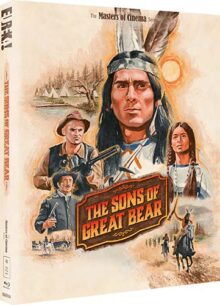
 Director: Josef Mach
Screenplay: Margot Beichler and Hans-Joachim Wallstein
Based on: The Die Söhne der Großen Bärin series by Liselotte Welskopf-Henrich
Starring: Gojko Mitić, Jiří Vršťala, Hans Finohr, Günter Schubert, Hannjo Hasse, Horst Kube, Henry Hübchen, Adolf Peter Hoffmann, Sepp Klose, Franz Bonnet, Kati Székely, Rolf Römer, Hans Hardt-Hardtloff, Gerhard Rachold
Country: Germany
Running Time: 91 Mins
Year: 1966
BBFC Certificate: 12
Earlier in 2025 I reviewed Eureka’s superlative release of the DEFA fantasy film Heart of Stone (you can read my review here). It was one of my favourite first-time watches for some time, and one of my Blu-ray highlights of the year. I also thoroughly enjoyed watching the Eureka boxset of four DEFA science-fiction films, Strange New Worlds. So, when I saw another DEFA release was planned, Western The Sons of Great Bear, I jumped at the opportunity to review it.
I’m delighted to say that it mostly, though not entirely, lived up to my expectations of the quality of DEFA films and is another excellent release by Eureka. But, let’s not get ahead of ourselves by looking at the Blu-ray disc, and firstly look at the film.
The Sons of Great Bear, adapted from Liselotte Welskopf-Henrich’s book series of the same name, was the first Western film made by DEFA, the state-operated studio of East Germany. Just like Heart of Stone had done for fairytales and fantasy stories, The Sons of Great Bear sparked an entire series of Westerns (around 17 in total between the mid-1960s and mid-1980s), like Trail of the Falcon, Ulzana, Blood Brothers and Severino.
This series of films, known as ‘Red Westerns’ because of their socialist politics, was made to compete with a series of Westerns that had become extremely popular in West Germany. But it was also intended to correct the American frontier myth, placing its Native American protagonists against violent White settlers. Whilst it was far from the first film to depict Native American characters in such a progressive and less savage light, the way it portrayed such characters was certainly against the norm at the time, and is refreshing.
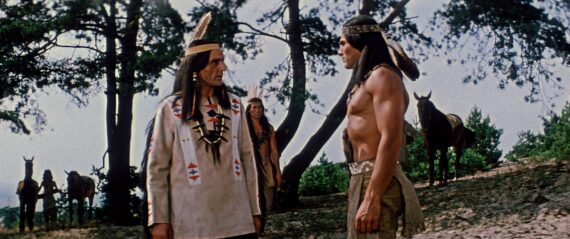
The Sons of Great Bear follows Tokei-Ihto (Gojko Mitić), a Native American warrior from a Dakota tribe who, as a young man, witnesses his father’s murder at the hands of Jim Fred Clark (Jiří Vršťala), who is also known as ‘Red Fox’. Red Fox is a scout in search of gold on the Dakota lands. What follows is a ‘Native Americans versus White settlers’ tale as Tokei-Ihto is forced to defend his people from Red Fox and his efforts to find and take the gold – with the Native Americans as the protagonists.
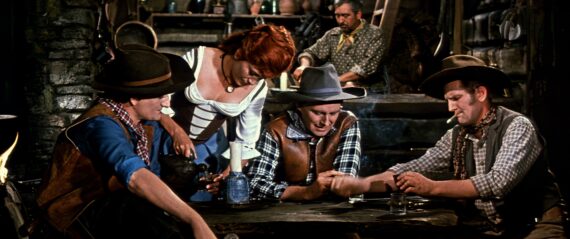
It’s a decent enough story which certainly feels more progressive than some of the Westerns of the 1960s and earlier in its depiction of Native Americans, though despite this it still felt a bit cliched at times, and with a little bit of filler, like a song sequence in a bar (admittedly a hangover from Hollywood Westerns). Overall, I really enjoyed the tale, which culminates in a pretty good finale, containing a decent chase, though a slightly too jovial score for my liking for what should be a serious and dramatic moment. Its positive and sympathetic portrayal of Native Americans was very refreshing, though it’s hard to get away from the fact that the characters are portrayed by White actors, which is difficult to watch in 2025.
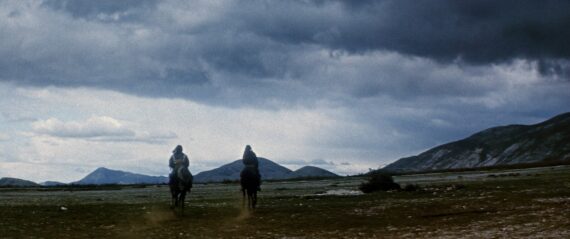
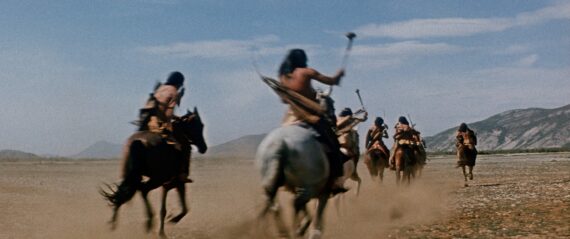
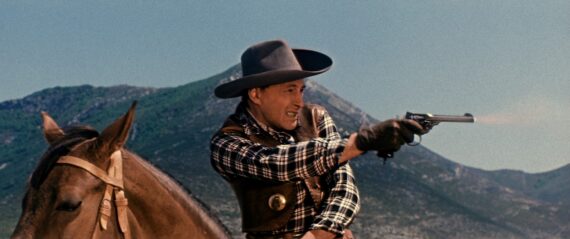
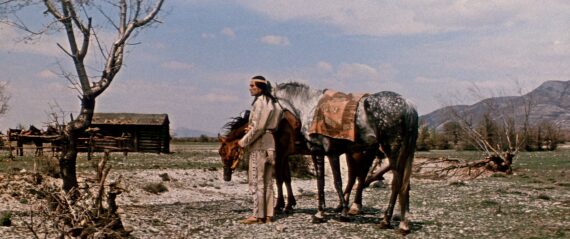
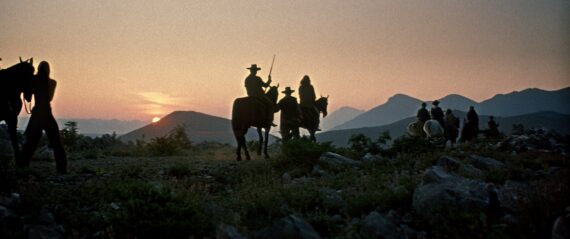
The action sequences are generally pretty good, well edited and with some decent gun battles. The opening battle and a tense confrontation with a bear in a cave, in particular, are great sequences, but there are several other shootouts which are well lensed and create tension. Speaking of the way the film is shot, there are some gorgeous vistas, and sequences of characters riding horses almost silhouetted against the beautiful landscape that compete with some of the American and Italian Westerns that are famed for their gorgeous cinematography and landscapes.
The film made a star of Serbian actor Gojko Mitić and it’s easy to see why. The actor was dubbed but despite this, he’s given every chance to shine in his own right; with a striking look and commanding screen presence. It’s difficult to watch him and other White actors wearing makeup to appear as Native Americans, though, certainly when viewed through a modern lens.
That aside, it’s easy to see why Mitić featured in a number of other German Westerns. He’s supported by a good cast, including some familiar faces from other DEFA movies, like Czech actor Jiří Vršťala (who was also dubbed for the film) as his foil, ‘Red Fox’. Vršťala will be familiar to fans of a number of Czech films like Ikarie XB 1.
The score by Wilhelm Neef is a good listen overall – there’s a drumbeat that appears on a number of occasions and drives the action forward, which is particularly effective. At other times the score feels quite traditional and like American Westerns of the time, including some light-hearted moments, which weren’t as strong for me, and that aforementioned finale music that undercuts the drama in too blithe a way for my tastes. Overall, though, it’s a good score, which becomes great when the drumbeat occurs.
In closing, I enjoyed The Sons of Great Bear a good deal, though it’s my least favourite of the DEFA films I’ve seen so far. The story, though undoubtedly very progressive for the time in its treatment of Native Americans, albeit with some parallels with the American Western, was a tad cliched for my liking and some of the sequences felt like filler, without adding much. Yet the cinematography, action sequences and elements of the score are great and there are some strong performances. It’s certainly an entertaining watch and an important film, which launched a series of Westerns at DEFA.
Film: 


The Sons of Great Bear is released on limited edition Blu-ray by Eureka as part of their Masters of Cinema series on 21st July 2025. The new 2K restoration looks great overall, the colours shining through but feeling natural, with rich detail and the vistas looking gorgeous. It does allow the make-up some of the actors wear to appear more obvious than perhaps in early prints, but it’s not too distracting and is far outweighed by the strengths of the transfer. The film also sounds great; the score is rousing, sound effects have weight and the dialogue is crisp and clear. A note on the censorship of the film – opening text provided by Eureka before the film starts highlights that three brief shots involving horse falls have been censored in accordance with the Cinematograph Films (Animals) Act 1937. The screen goes black for these shots, all of which happen during the opening shootout, about 15 minutes in.
Special features:
Limited Edition [2000 copies]
Limited edition O-card slipcase featuring new artwork by Colin Murdoch
Limited edition collector’s booklet featuring new writing on The Sons of Great Bear and DEFA’s approach to the Western by Mariana Ivanova, Academic Director of the DEFA Film Library
The Sons of Great Bear presented in 1080p HD from a 2K restoration of the original camera negative by the DEFA Foundation
Optional English subtitles, newly revised for this release
New audio commentary by Western scholar Jenny Barrett
World Wide West – new discussion of The Sons of Great Bear in a global context with Austin Fisher, author of Radical Frontiers in the Spaghetti Western
Homelands – new video essay on the depiction of Native American life in The Sons of Great Bear by Lee Broughton, author of The Euro-Western
Eyewitness Report on The Sons of Great Bear – archival newsreel featuring a report on the making of DEFA’s first Western
New Masters of Cinema trailer
Original theatrical trailer
The new audio commentary by Western scholar Jenny Barrett is a really good one with plenty of background to the making of the film provided, as well as some insight into elements of the plot and themes, and some scene-specific comments. Barrett’s expertise in talking about Westerns are clear to hear and she provides an authoritative yet entertaining look at the film, which I gleaned plenty of information from. A strong commentary, which I’d highly recommend to fans of the film.
Austin Fisher’s piece runs for 17-minutes and is very interesting and entertaining. It provides an introduction to German Westerns, and in particular what led to the first DEFA Western film being made. Fisher highlights parallels with the film and American Westerns, the importance of the year for Westerns (Damiano Damiani’s fantastic A Bullet For The General came out in the same year), some of the symbolism and themes in Italian and German Westerns, and the film’s progressive nature. It’s a really good piece.
The video essay by author Lee Broughton is also strong. Running for 27-minutes, it focuses on the positive depiction of Native Americans in East German Westerns. Broughton runs through why East German cinema focused on such a depiction, and highlights some of the key Westerns released in Germany. It’s a really informative essay which cites some key works by authors like Christopher Frayling to add to its analysis, and provides plenty of great trivia, as well as adding numerous films to my growing ‘to watch’ list. Like the other two new extras mentioned above, it’s an excellent new feature.
Newsreel footage which ran in the week beginning 18 October 1965 is included. The 10-minute piece was an instalment of Der Augenzeuge (The Eyewitness), a weekly newsreel series produced by DEFA to accompany its theatrical releases. In the short text that opens the extra, Eureka outlines that it has also censored some of the footage in the documentary for the same reason as they did those three shots in the film. The piece is a welcome inclusion and shows other historical moments before the final couple of minutes focus on the film, and safety efforts to keep the human and animal actors safe (containing very brief censored footage), and the attempt to tell a Western from a different perspective to the norm at the time.
Rounding out the on-disc package are a three-minute trailer which focuses on the action, whilst interspersing this with a few scenes that share a little bit about the story, and a two-minute trailer for this very Eureka release, which shows off the new restoration.
The 20-page booklet is another gem from Eureka, beautifully illustrated with a solitary essay by author and associate professor Mariana Ivanova, which is excellent. The essay focuses on the origins of the German Western, specifically the DEFA ones, and then moves on to look at how the filmmakers collaborated on these films with other countries, including filming outside of Germany, and the ideology behind the movies. It’s a really fascinating article and well worth a read.
In closing, Eureka have provided a strong audio-visual presentation for an entertaining and important German Western, which is packaged with three fantastic new extra features that provide a wealth of background, insight and analysis which enrich the viewing experience. It’s another strong DEFA release on the Masters of Cinema label which has whetted my appetite for the German Western (it’s the first I’ve seen), and I hope Eureka bring more from the genre to UK boutique Blu-ray in the future.
Disc/Package: