



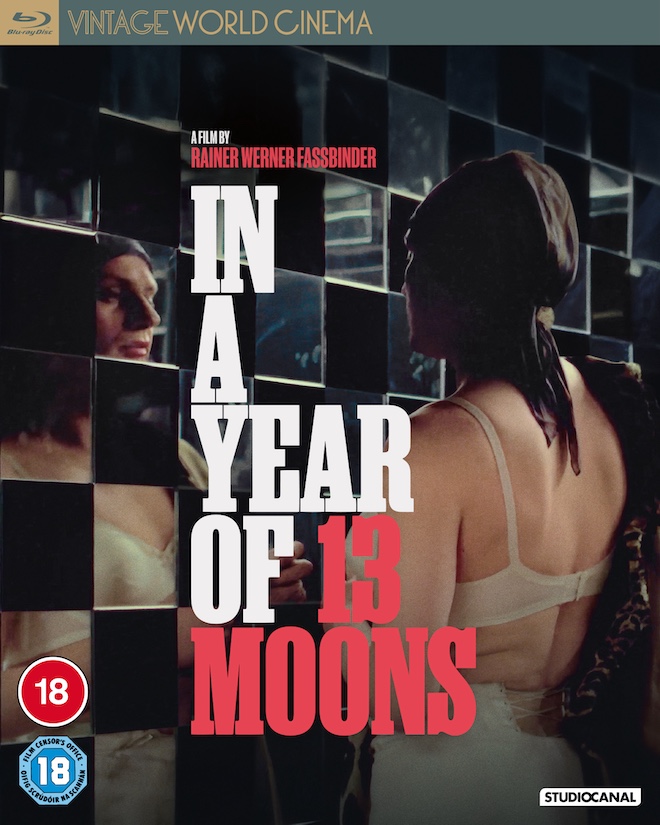
 Director: Rainer Werner Fassbinder
Screenplay: Rainer Werner Fassbinder
Starring: Volker Spengler, Ingrid Caven, Gottfried John
Country: West Germany
Running Time: 124 min
Year: 1978
BBFC Certificate: 18
In a world where it is now cool to be transphobic, where ‘punk is the new TERF’ (even though if 99.9 per cent of the world support anti-trans legislation as it is claimed, then it ain’t punk, is it?), Rainer Werner Fassbinder’s In A Year of 13 Moons (1978, a.k.a. In A Year with 13 Moons) feels both ahead of its time and curiously naive. The fact that in today’s times where most gays and lesbians ALLEGEDLY want the TQ separated from the LGB, a gay man was willing to make a film that was pro-trans but also focusing on all the elements of transness that have caused lesbians and gay men to reject trans people feels incredible. Based around Fassbinder’s feelings about the suicide of his lover Erwin Meier, it ends up being something that ends up like a TERF, despite very clearly intending not to be.
Elvira Weishaupt is very much of the ‘cross-dressing man’ school of trans person, what TERFs would call an autogynephile (thanks to their adherence to the flawed Blanchardian hypothesis of transgenderism) were it not for the fact that Elvira is a gay man who took a sex change to appease their gay lover and to legitimise their relationship. In the early parts of the film, we mostly see Elvira as a middle-aged, somewhat portly man in women’s underwear, very much the comical idea of a pathetic, perhaps somewhat creepy transvestite man. Fassbinder knew actual trans women (he was a regular at Romy Haag’s nightclub), but Elvira is portrayed as the most stereotypical idea of a transsexual – a depressed, broken, pitiful soul without identity.
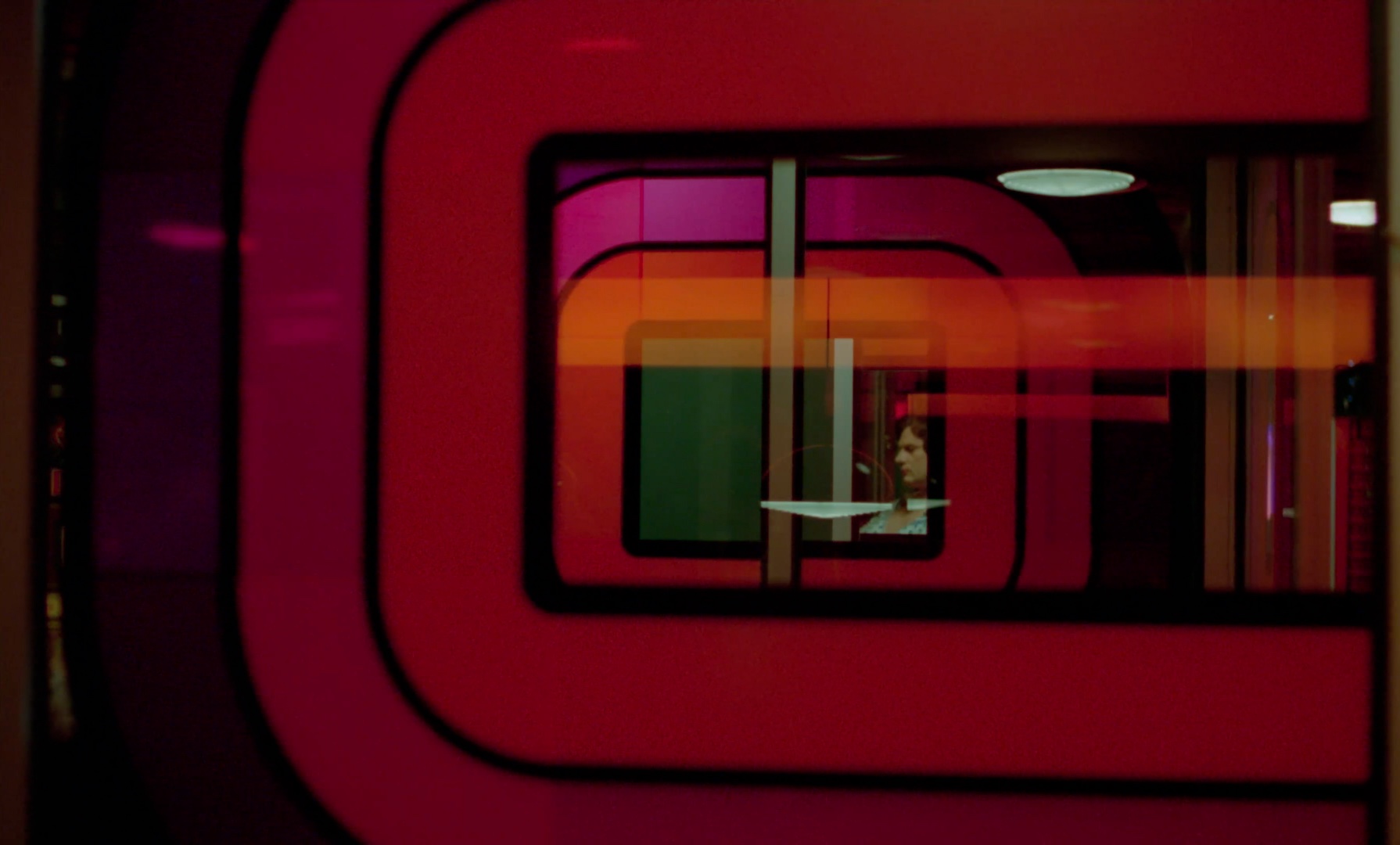
However, Fassbinder does his best to make Elvira the best portrayal of a depressed, broken, pitiful soul without identity that he can – someone who took a sex change merely for love not for themself but for their lover. Spengler, in his Bet Lynch leopard print coat and headscarf is a tragic presence. Elvira feels like the cows that they as a butcher rely on. Their Fuhrer-like screeching speeches about their gender played over shots of real footage of an abattoir (that it must be said, did not shock me) conveys the sudden rage and mood swings a gender non-conforming person like myself can have. However, as Willow Catelyn Maclay states in her review of the film, is this just saying that trans women are mutilated men? When she wanders around a video arcade, around such early cabinets as SEGA’s Heli-Shooters, Elvira looks almost passable. But is clear they can’t cope with being a woman. They are almost the sort of tragic soul who TERFs seek to use as a case study – that if one trans person is this, then aren’t they all? The film is basically using transness as an excuse to construct a film about tragedy, rather than using tragedy to construct a film about transness.
As Maclay notes, Elvira isn’t really trans. She is a man forced into a female role. She is not an authentic idea of transness, but a regurgitation of the cliched idea of the AGP. She is the type of person who TERFs love to complain about, the ‘cross-dressing man who calls a lesbian a bigot when she doesn’t want to sleep with him’. She reminds me of a person I once read about on a forum thread about ‘local eccentrics’. And there was one somewhere in Britain who was IIRC a gay man who had begun a sex change to appease their lover, then the lover died, and this person remained stuck halfway between man and woman, that they had not entirely willingly given up their manhood for love, and when that love faded, they were left this strange halfway house. I don’t know if they suffered the recursive dysphoria that Elvira undoubtedly has, but they seemed a tragic figure who would tour discount shops in a scruffy wig, staring at toiletries and having conversations with themselves. Elvira is like the bleaker version of this person.
While it is a brilliantly made film, it does feel now like what TERFs want trans people to be. That we aren’t women in men’s bodies, but tortured souls who were deluded. That we are all either mentally ill or pervy liars. That for us the only salvation from our ‘square peg in a round hole’ existence is death, a death that will liberate us from the manhood we weren’t comfortable in or the womanhood that we can’t truly enter because it is offensive to ‘real’ women.
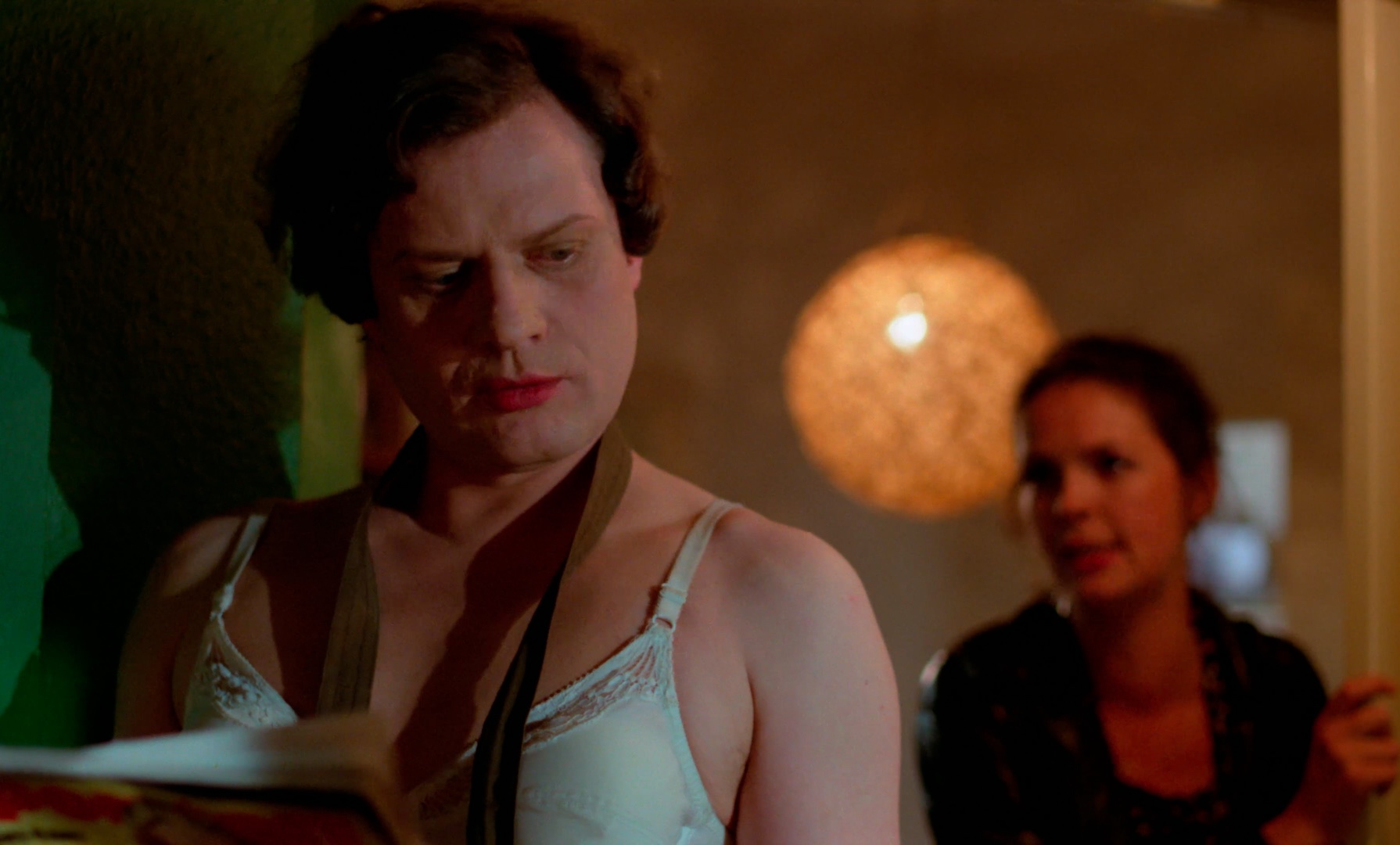
Though it is undoubtedly Spengler’s film, it is nice to see the usual Fassbinder faces like Gunther Kaufmann and especially Gottfried John. There is an especially brutal scene where Kaufmann and Spengler recreate a musical number from the Martin and Lewis picture You’re Never Too Young (1955), only for Elvira to become the victim of an assault. This is a powerful yet typically cliched scene where we see Elvira isn’t ‘like other men’. The final moments of the film where Elvira detransitions, puts on a suit, cuts their hair and tries to straighten themself out feels so cliched, that any power it may have has been left to wither by years of this trope being hammered down our neck.
One wonders now if Fassbinder, were this film made today, would have been so incensed by the reaction by a certain loud contingent of trans people backed up by an even louder contingent of sad, bearded straight men, that as has happened in several recent cases, he would have doubled down and forced himself to become a TERF, as a way of trying to find a community who would accept him. Maybe, this film is a lesson that maybe we shouldn’t criticise media for being transphobic, when the intent was not that. This is a good film that nonetheless is the story of a stereotype. And I do think this film is a little more problematic than Emilia Perez, in terms of its transness. However, it is a good film unlike the catastrophe that was Emilia Perez.
Film: 

In a Year Of 13 Moons is out now on DVD & Blu-Ray, released by Studiocanal as part of their Vintage World Cinema range. I didn’t receive a physical copy of either disc, so can’t comment on the picture quality or extras. Here’s what will be included though:
EXTRAS:
– NEW Fassbinder in Focus: A Conversation between Juliet Jacques and Alex Davidson
– Love And Despair: Werner Schroeter On Fassbinder’s In a Year of 13 Moons
– The Roots Of the Wounds: Juliane Lorenz On Fassbinder’s In a Year of 13 Moons
– Introduction by Richard Linklater
– Original German Trailer