



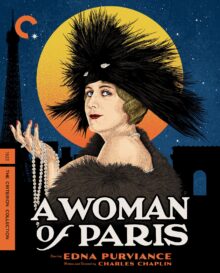
 Director: Charlie Chaplin
Screenplay: Charlie Chaplin
Starring: Edna Purviance, Clarence Geldart, Carl Miller, Lydia Knott, Charles K. French, Adolphe Menjou
Country: United States
Running Time: 82 min
Year: 1923 (re-released in 1976)
BBFC Certificate: PG
Think of Charlie Chaplin and comedy and his character The Tramp are likely the first thing that spring to mind. He’s often lauded as one of the big screen’s greatest comedians, a huge star in the silent era, and the creator of some of the most memorable comedic sequences of all time. By 1923 he’d starred in a series of hugely successful shorts, and made his feature film debut, as director, writer and star, in the fondly remembered The Kid in which his co-star was a young Jackie Coogan, who played the titular child.
Audiences anxiously awaiting his next film would have been forgiven for expecting more of the same; more laughs and a straight comedy starring Chaplin. Yet what they got was very different; a serious drama directed by Chaplin but not featuring him on screen save for a blink and you’ll miss it cameo. Called A Woman of Paris, the film was a huge left turn for the star, whose shorts had been growing darker but hadn’t indicated this type of serious film would be on the cards. Off-screen Chaplin had founded United Artists Corporation with Douglas Fairbanks, D.W. Griffith and Mary Pickford and A Woman of Paris would be the first of his films to be distributed by the company.
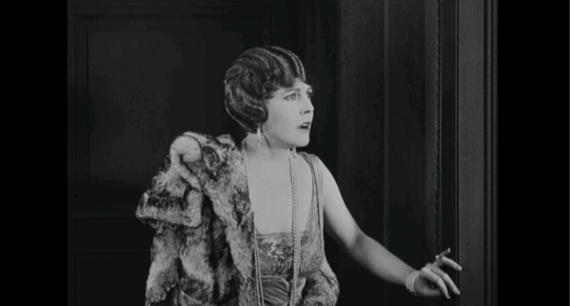
The film follows young Frenchwoman Marie St. Clair (played by Chaplin regular and Edna Purviance, who he was also romantically involved with for a period), who plans to elope from her home village with her boyfriend Jean (Carl Miller). However, she’s left alone at a train station for some unknown reason. Deciding to travel on her own to Paris, she meets and becomes the mistress of playboy Pierre (Adolphe Menjou). What then plays out is her being reunited with her old boyfriend and considering whether the big city, where she has become a “woman of Paris” is right for her or whether she wants to return to her countryside lifestyle, although it was one of unhappiness outside of her romance.
Firstly, the film, subtitled A Drama of Fate cements Chaplin’s status as an excellent director of the time. It’s a very good silent drama and proved that Chaplin could be as equally adept at writing and filming straight films as he was at creating comedic masterpieces. Chaplin sets his stall out immediately – an opening intertitle sees him state that the film is the first serious drama he has written and starred in, and makes it clear he doesn’t appear in the picture.
That latter statement isn’t entirely true. Chaplin does appear for a few brief seconds in an unbilled and unrecognisable walk on and off part as a railway porter, who drops some luggage. It’s very much a blink and you’ll miss it moment, but apparently it was originally a longer sequence which brought howls of laughter from test audiences – Chaplin didn’t want anything to draw away from the story itself, so cut his part. But this would be a rarity in his career – he would star in all of his subsequent films until 1967’s A Countess from Hong Kong, the final film he wrote and directed.
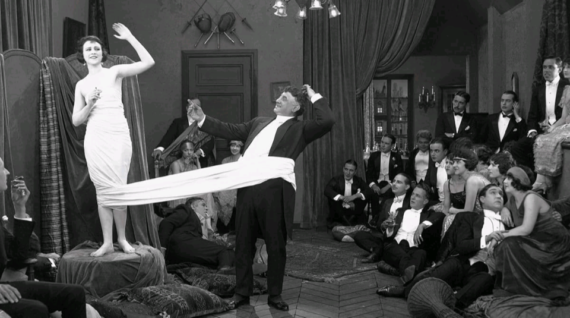
The star this time is Purviance, with the film a vehicle designed by Chaplin to make her more of a star in her own right. She’s fantastic throughout, conveying the complex nature of her character, moving from sadness to happiness. It’s very much her film.
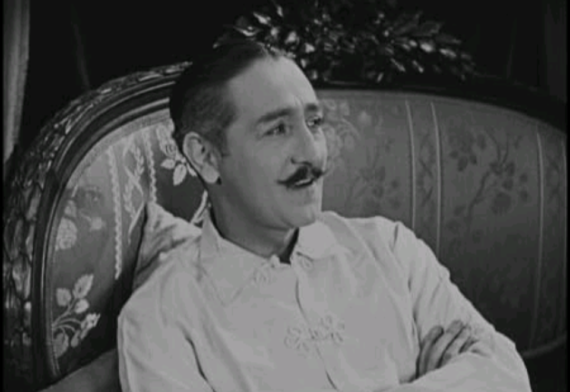
Yet the other actors also play their parts well, particularly Clarence Geldart as Marie Claire’s overbearing father, Carl Miller as her boyfriend Jean and Adolphe Menjou as her soon to be husband Pierre. There’s some great, not over the top, acting on show here, which all adds to the serious tone of the film. It all feels very natural, which likely explains why the great British filmmaker Michael Powell, who saw the film as a teenager, described it as the moment when cinema “grew up” – indeed, it feels hugely ahead of its time and a landmark in the way films were made.
The visuals, whilst not showcasing comedy, are no less interesting here, with some really striking shots that utilise light and darkness to great effect, and show the juxtaposition of the village – shown, unwelcoming, at night – and the city, with Paris looking bright, light, fun and intoxicating. It’s easy to see why Marie Claire would be drawn to the big city, but it’s also clear, as the story progresses, to see why she’d have a crisis of confidence in her choices and consider leaving Pierre and moving back to the countryside.
There are some really fantastic sequences and visuals, beautifully supported by Chaplin’s perfect score, including Marie Claire and Pierre’s meeting at a ball, food being prepared at said ball (which is a rare sequence in the film that is played for laughs), a number of exciting dance sequences, Marie Claire’s meetings with Jean, some last act dark drama, and, finally, a perfect conclusion. The ending features an open road favoured by Chaplin in his previous works but subverts expectations and leaves us with a final dose of irony.
A Woman of Paris is a fantastic, underrated, film by Charlie Chaplin, which was a huge departure from the norm; there’s very little comedy here with the film mostly played as a serious drama and only featuring the star in the briefest of unrecognisable cameos. Acting is a treat, the script sublime and it’s all brought to the screen with some beautifully shot sequences, a gorgeous score and some wonderful observations about the characters and their traits.
Film: 

A Woman of Paris is released on Blu-ray by the Criterion Collection on 7th April 2025. The new 4K digital restoration of the 1976 re-release version, which loses some scenes from the original 1923 release, is a revelation. I struggled to spot many blemishes in the transfer, which looks simply outstanding throughout – the black and white cinematography richly showcased. The audio is also great. It’s a silent film and we get Charlie Chaplin’s original score – it’s a marvellous suite of music.
Opening up the extras is a five-minute introduction to the film by Chaplin scholar David Robinson, which sets good context for the character of the film and its genesis, and how it was a huge departure from the norm expected of Chaplin. It may only run for five minutes but Robinson packs so much in, it feels much longer. It’s an excellent introduction.
A welcome inclusion is an alternate 2005 score by conductor Timothy Brock, which is based on a selection of director Charlie Chaplin’s unused composition sketches from 1951-1969, as well as musical themes found in Chaplin’s 1976 score, newly arranged by Brock and recorded by the Orchestra Città Aperta in 2010.
Up next is A Serious Drama, a new video essay by Chaplin biographer Jeffrey Vance, which explores how the director was able to focus on his artistic vision, without having to think about on acting (aside from his very brief unbilled part). The 23-minute piece is fascinating, particularly the way it highlights how Chaplin directed actors to mouth some of the familiar words in the script in an easy to lip read way for an increased effect on the audience, how only three minor sequences from the original script were unused for the film, the innovations of the action and direction, his approach to characterisation and much more. Essential viewing for fans of the film, its star and its director.
Chaplin Today: A Woman of Paris is an excellent 2003 documentary about the film, directed by Mathias Ledoux. The series of documentaries has previously appeared on UK releases of the film and others by Chaplin and are always a fine inclusion on disc. This one features an interview with actor Liv Ullmann and audio reflections from filmmaker Michael Powell. The 27-minute documentary gives a really good overview of the film and its production. Another very good extra.
Archive Commentary About A Woman of Paris, is a 2022 documentary produced by Arnold Lozano utilising unique photographs and ephemera from the Charlie Chaplin Archive. Running for nine minutes, narrated in French and subtitled, it talks through the creation of United Artists, some of Chaplin’s shorts, and a focus on A Woman of Paris, mostly supplemented by stills, with occasional screen test footage and other imagery. A neat addition.
A brief audio interview with Chaplin’s long-time cinematographer Roland “Rollie” Totheroh is included. Dating from 1964 the five minute piece sees Totheroh reflect on the film. It’s a brief but welcome inclusion.
A 14-minute collection of shots from the original 1923 version which Chaplin deleted when the film was re-released in 1976 are also included. Whilst it would have been nice to have had both versions included, the addition of the deleted scenes is a solid consolation.
Rare footage shot at Chaplin Studios the day after Hollywood veterans Chaplin, Douglas Fairbanks, D.W. Griffith and Mary Pickford, officially founded their distribution company United Artists Corporation, is also included. It was shot in February 1919 and sees the group restage the previous day’s contract signing, before being shown later at Griffith’s studio where they posed for the press. The three-minute footage is silent.
Concluding the on-disc extras are a three minute 1976 re-release trailer and the one-minute trailer for a re-release of the original version.
I wasn’t provided with the essay leaflet, but I imagine the main article by Pamela Hutchinson is this one found on the Criterion website, which is an outstanding overview of the film and a must read.
The Criterion Collection have put together a fabulous package for an underrated but essential slice of silent cinema from Charlie Chaplin. The picture and audio are first class, that restoration is a real treat for a film that is over 100 years old albeit the version included is a 1976 re-release, and it’s supplemented by some marvellous, insightful and rewarding extras. Highly recommended for fans of Chaplin and silent cinema in general.
Disc/Package: