



Between January and March 2022, I watched all Alfred Hitchcock’s films in chronological order and came up with a ranking of them from worst to best. In this five part article, I’m sharing the reviews I wrote as I went along and the final ranking on which I settled. In part 5, I’m looking at the top 10, 5 star classics all.
You can find the other parts of this article at the following links:
PART ONE
PART TWO
PART THREE
PART FOUR
All entries contain spoilers.
10. NOTORIOUS
I suspected Notorious was a classic based on the one viewing I had of it long ago and it did not disappoint, though it did momentarily make me question this presupposition with an unpleasant prologue in which American agent Cary Grant improbably allows an extremely drunk Ingrid Bergman to take him for a drive, gets her out of trouble with a traffic cop and then promptly punches her out. While it doesn’t play well at all today, one thing this prologue does establish is the moral grey area that Notorious’s characters inhabit, with a trio of excellent performances creating a memorably complex set of heroes and villains whose barely suppressed emotional responses betray their vulnerabilities in the face of their various deceptions.
That unfortunate opening sequence is Notorious’s only major flaw but its classic status is something that creeps up on the viewer. Ben Hecht’s masterfully constructed script is a real slow burn, taking its time to build its relationships and scenarios before unleashing the thrilling spy antics in full force. This is very much to Notorious’s credit and the switching viewpoint of the narrative helps us to care a great deal about what happens to the characters, even, crucially, the villain. Hitchcock’s dream cast are fairly evenly matched. Grant’s suavity is perfectly offset by his wounded romantic pride, while Bergman fully gets her teeth into the emotionally complicated role of a convicted Nazi spy’s daughter, the conflicted feelings she has suffered as a result of this relationship resurfacing in force when she is pressed by the US government into seducing and marrying one of her father’s former associates. The situation is further complicated by Grant and Bergman having fallen in love prior to the mission.
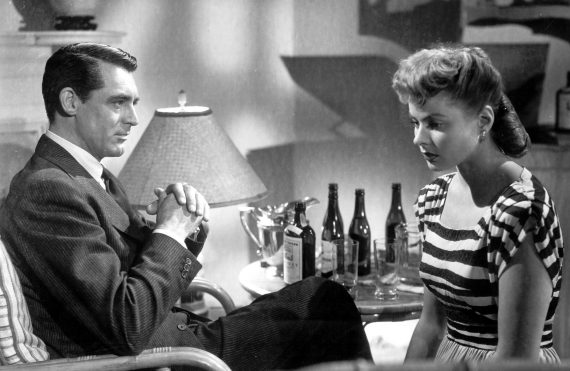
Romances in classic Hollywood films are often a little too speedily established, never more so than in the chemistry-free union of Bergman and Gregory Peck in the previous year’s Spellbound, which supposedly grows into full-blown love over the course of one pleasant walk. Notorious manages to establish its romance in just as short an amount of screen time but across a more convincing timeframe within the film. The passion between Bergman and Grant is iconically sealed in the famous scene in which Hitchcock got around the Production Code rules banning long kisses by having the pair break off from kissing every three seconds before immediately continuing. This allows the necessary heat to be generated early on so that audiences can fully appreciate the agony the pair experience when the mission comes between them.
This is where the third participant in this cinematic ménage a trois enters and the film’s classic status is immediately assured. Claude Rains has always been one of my favourite actors and the role of Sebastian is one of his greatest, netting him a well-deserved Oscar nomination. Sebastian is a Nazi undertaking devious deeds, which should be sufficient in making him irretrievably loathsome, but Hitchcock, Hecht and Rains mostly depict Sebastian through the lens of his very real love for Bergman’s character and his insecurities about losing her to a more desirable man. This had the unexpected effect of making the villain surprisingly sympathetic in some ways, giving the film an exquisite depth. Hitchcock had run into trouble by depicting a partially sympathetic German U-boat captain a couple of years earlier in Lifeboat. But he managed to slip another variant of that emotional complexity into Notorious without being accused of treason.
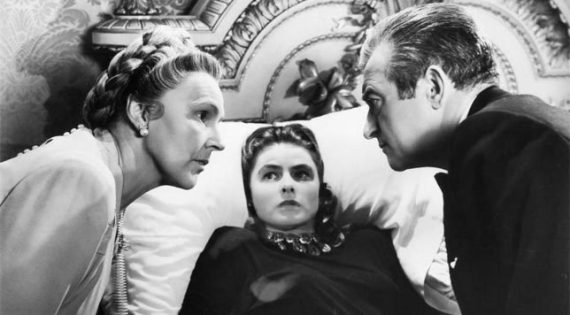
If all this makes Notorious sound rather heavy, there are plenty of lively, tense and gripping scenes of international espionage too. The film is largely lacking in the trademark Hitchcock humour, with Hecht wisely steering clear of his penchant for comedy which clashed so badly with Spellbound’s tone. But it is a lot of fun, with Hitchcock using clever shots and unusual camera angles to reveal key details (and details about keys!) without a lot of expository dialogue. Notorious also features one of my favourite endings, bringing together its three leads in a moment dripping with tension and ultimately desperation. The final shot is powerful as hell, leaving the viewer with a sense of inevitability about an imminent event without actually showing it coming to terrible fruition.
9. DIAL M FOR MURDER
Dial M for Murder was a project that Hitchcock took on after his short-lived production company Transatlantic Pictures was dissolved amongst unsuccessful plans to film David Duncan’s The Bramble Patch. Whether it was this troubled time that affected Hitchcock’s views on Dial M for Murder is unclear but he later spoke of the film as dramatically inert and his direction as being, if you’ll excuse the pun, phoned in. Neither claim is true, and while you could reasonably say that Hitchcock would know better than me about the latter point, there is plenty of evidence both onscreen and off to suggest he was more engaged (if you’ll excuse the pun) with the project than he later claimed. Would a director who was “coasting” have a four foot telephone built in order to get one close up shot that couldn’t be achieved with a normal sized prop?
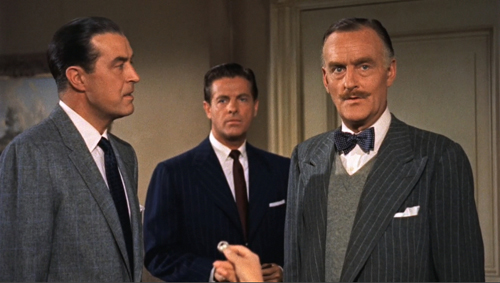
Dial M for Murder is the third of Hitchcock’s so-called “limited-setting” films but, unlike the previous Lifeboat and Rope, it does have several scenes outside its main set, in this case an apartment. While these short scenes do open the film out a bit from its stage origins, it mainly achieves its deeply cinematic appeal through good storytelling, a great cast, excellent direction and stunning colour. If Rope had been a technical triumph in which the experimental side was front and centre, Dial M for Murder makes pure entertainment value the main focus. Frederick Knott adapted his own fiendishly clever hit play for the screen, carrying over two of the original actors in Anthony Dawson and John Williams. Star power is provided by Ray Milland and, in her first of three films with Hitchcock, Grace Kelly. Robert Cummings, who previously starred in Saboteur, completes the main cast.
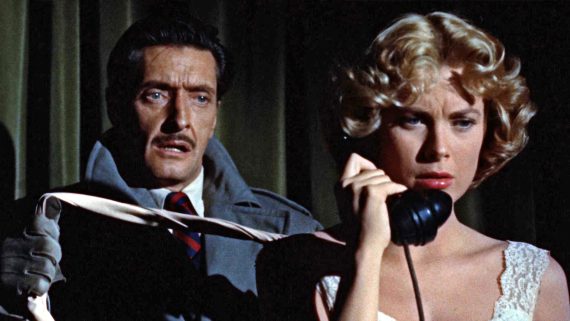
It’s hard to say much of anything about Dial M for Murder’s plot without ruining the experience for the viewer. In keeping with Hitchcock’s general dislike of Whodunnits, it has more in common with the Columbo style How-catch-‘em approach, in which the viewer immediately knows what role everyone will play in the drama but not how the events will unfold. It’d been a long time since I last watched Dial M for Murder so I had happily forgotten most of the details of the plot but even going in to a rewatch knowing all the details I’m sure it would still be massively enjoyable. Though there’s no replacing that edge-of-the-seat thrill of the first watch, the story is told so entertainingly that repeat viewings are sure to be almost as pleasurable, especially if shared with a viewing partner who doesn’t yet know all the secrets.
Almost every member of the cast is excellent, with only Cummings struggling to make much of a mark with an underwritten role. Ray Milland is perfectly smarmy and overconfident, Dawson memorably shifty and, in one key scene, terrifying, while Williams is scene-stealingly droll as the inspector on the case. But it is Kelly who emerges as the iconic one, bringing a subtlety to a role that could’ve easily been badly overplayed. Dial M for Murder was originally intended to be presented in 3D and was filmed and promoted with this in mind but its release coincided with a dwindling of interest in the medium. Hitchcock himself observed “It’s a nine-day wonder, and I came in on the ninth day.” Fortunately, the switch to 2D prints of the film saw business pick up, with the script and performances being more than enough to make the film leap off the screen.
I formerly had Dial M for Murder rated at 4 stars, perhaps due to having found it stagey as I originally had with Rope. As I also did with my recent rewatch of Rope, I fully revised this opinion of Dial M for Murder. Not only is it wonderfully cinematic, it is pretty close to perfect in all other departments too. To my own surprise, it’s landed at number 9 in my ranking and I could happily watch it again right now!
8. PSYCHO
I’ve never been one for thinking 5 star ratings should be saved for flawless films. On watching Psycho after many years, for instance, I never felt like I was watching anything less than an important, brilliant and thoroughly entertaining 5 star classic and yet I felt there were several flaws to take into consideration. Psycho is a funny one because it’s a film that very few people get to see in the way that original audiences for the film did. Aside from it not seeming as visceral for audiences used to far more brutal, graphic films made in its wake, Psycho is so famous that hardly anyone comes to it not knowing who the killer is in advance.
The extent of Psycho’s fame is such that I often forget, even while watching it sometimes, that it was ever seen as a film with a twist. The majority of people watching the film nowadays know Norman Bates is the one committing the murders and this completely changes the way the film is viewed. I don’t think knowing Psycho’s secret makes it a lesser viewing experience. On the contrary, I actually think it improves the film. I can never say this for certain as I’ve never seen the film without knowing the twist but I think if I had I would’ve found it a tad ludicrous. Having to retrospectively imagine Norman was doing that Mother voice all along would’ve felt like a real stretch. To be honest, it does still feel slightly silly and I’d have preferred it if the voice of Mother has been depicted as being inside Norman’s head rather than as being shrieked like Terry Jones by Norman himself, so loudly that people in the surrounding motel rooms can hear it from the house no less!
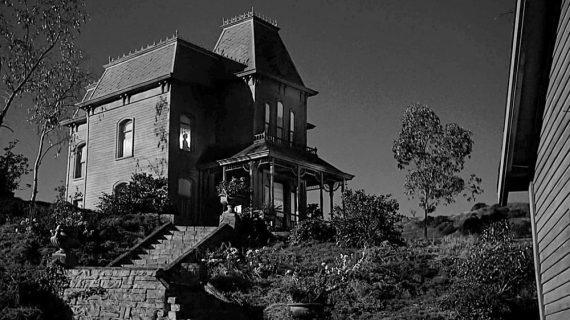
Before we get to what’s great about Psycho, I do have one other major problem with the film and that is the penultimate scene in which a psychiatrist tells us all about Norman’s mental illness. In my North by Northwest review I talk about some very lumpy exposition but this particular example is even worse as it serves as the film’s conclusion. Since we’ve never seen this psychiatrist character before, the effect is like an essay conclusion rather than a dramatically satisfying scene. It may as well have been Hitchcock stepping out from behind the camera to give us that big information dump. It seems to be aiming to emulate those scenes in whodunnits where the detective methodically reveals the killer but it just makes the film feel like it’s turned into a pop-psychology thesis.
These feel like some pretty big negatives for Psycho to have to shake off in order to achieve 5 star status but the rest of the film is so excellent that it does so with comparative ease. The structure of the film is fiendishly clever, setting up a storyline about stolen money which is then unceremoniously killed off with its protagonist. The narrative shift from Janet Leigh’s impulsive woman in love to Anthony Perkins’ repressed motelier is so smoothly achieved that it takes some time to notice the trick. This is achieved through some beautifully laid groundwork in a wonderful scene in the parlour in which Leigh and Perkins chat over a light meal. The maternal interest she takes in Norman subtly transfers to the audience through a mixture of good writing and two great performances, allowing us to take up with Norman as our protagonist with relative ease.
The casting of Psycho’s leads is key to its appeal. Despite being killed off halfway through the film, Leigh is undoubtedly the second lead here and she throws herself into the role with a dedication that fully justifies the Best Supporting Actress Oscar nomination she received. It still amazes me that Anthony Perkins didn’t also receive an Oscar nomination for his flawless portrayal of Norman, although given how controversial Psycho was, it did well to receive the four nominations it did. Perhaps nominating the killer himself made the Academy a little queasy. Perkins was just TOO good in the role! This remains one of my favourite screen performances, creating a thoroughly sympathetic and therefore doubly disturbing killer. With Leigh serving as the perfect foil, Psycho’s first half is utterly riveting and, while the script does take a step down in quality in the second half, the performance of Perkins and Hitchcock’s direction keep the quality high.
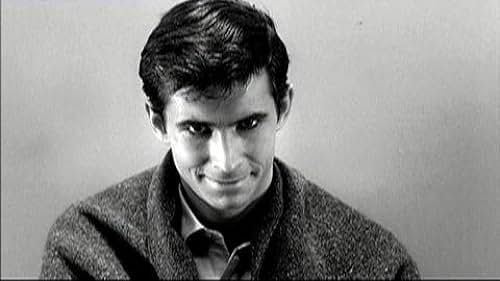
Speaking of Hitchcock’s direction, I just love it here. It bagged him his final Oscar nomination for Best Director (an award he never won), somewhat surprising given the restrictions he had to work with. Horrified by the material, the studio refused to give Hitchcock a decent budget and he ended up shooting with the TV crew of his series Alfred Hitchcock Presents. These limited resources ultimately made the film even better though. There’s the thrilling energy of an independent production here and the black and white cinematography is wonderfully rugged. Of course, the major set piece is that terrific shower scene, with the cut from the draining blood to Leigh’s lifeless eye being one of cinema’s most iconically chilling. This is probably a good time to mention Bernard Hermann’s indelible score too. Filled with shrieking strings, it’s an edgy, nerve-shredding creation that establishes the appropriate sense of unease from the opening credits onwards. Those violent, screaming flourishes of sound as Norman’s blade strikes repeatedly must be among the most famous moments of film music, up there with the ominous Jaws theme.
Psycho is perhaps Hitchcock’s most famous film and the one most casual fans would think of first if asked to name a Hitchcock film, though as a huge fan it feels somewhat anomalous. It tied Hitchcock’s name forever to the Horror genre even though he made comparatively few straight horror films, and it remains one of the most revered works of that oft underestimated genre. My handful of reservations about it mean it had entered my ranking at number 8, perhaps a surprisingly low showing but testament to its brilliance when you look at the films it appears above.
7. TORN CURTAIN
Torn Curtain is renowned primarily for being one of Hitchcock’s weakest films, a hurriedly shot, plodding Cold War thriller with miscast stars, meandering plot and little of the inspirational direction that made Hitchcock a household name. It’s also famous for being the film that ended the working relationship between Hitchcock and composer Bernard Hermann, whose score was rejected in favour of an unremarkable effort by John Addison. Studio control is the thing that is often blamed for many of Torn Curtain’s shortcomings, with Universal exercising power over Hitchcock after a couple of commercial flops and Hitchcock reluctantly but diligently complying with their wishes. What, then, is Torn Curtain doing in my Hitchcock top 10?!
I love Torn Curtain. I had no idea I did until I started watching it yesterday and found myself quickly absorbed, amused and gripped by what I was watching. Sometimes a wonderful potboiler is just what you’re after and Torn Curtain ticks those boxes but I also think it has moments of real invention that clearly betray the identity of its director. Some of Hitchcock’s less-celebrated tells are on display here too, including ropey back projection and dodgy fake sets, but if that bothers you to any great extent you might as well avoid the whole Hitchcock catalogue! At this stage in his career, Torn Curtain feels like an old-fashioned Hitchcock film to be sure but after a few more lurid experiments it feels great to be back in that comfortable world again. Perhaps my chronological watching schedule affected my rating a little, with Torn Curtain being a sigh of cosy relief after the awkward squirm of Marnie, but I’m pretty sure I’d love Torn Curtain under any circumstances.
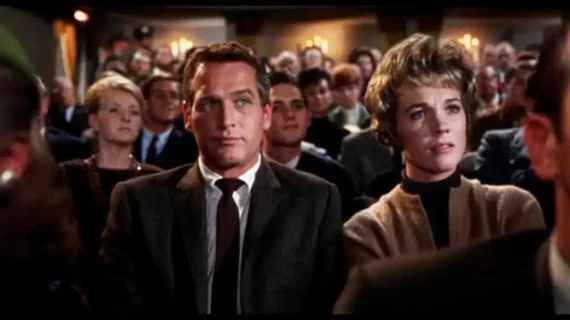
I may not agree that Torn Curtain is plodding, uninspired or bereft of memorable moments, but one criticism I can get on board with is that of its stars. Paul Newman and Julie Andrews, as the engaged couple who find themselves undercover behind the Iron Curtain, are less than suited to their roles, with Newman being just about adequate and Andrews barely given a chance to be anything but underwhelming. I love both these stars but the studio’s contention that shoving their top grossing actors into any film would be a formula for success is immediately exposed as a mistake in an opening love scene in which there is no chemistry whatsoever. However, Hitchcock turns this problem into a virtue by shifting the focus of the film from the stars to his international supporting cast. It’s clear that the story of the leads troubled relationship was intended to feature more heavily but Hitchcock wraps that up long before the end, allowing him to shine the spotlight on the oddball collection of supporting players who bring Torn Curtain to life. Standouts include Wolfgang Kieling as Gromek, a German security officer with a whimsical fascination with American colloquialisms; Ludwig Donath as the impatient, hedonistic genius Professor Lindt; and Lila Kedrova as an exiled Polish countess desperate to obtain a US Visa. This latter performance is particularly wonderful, equal parts tragic and comic, with Kedrova registering a whole lifetime of tragedy behind the eyes of a character who spends mere minutes on screen before the camply affecting downbeat ending to her story. Also good value for money are Günter Strack as the comically serious Karl and Tamara Toumanova, gamely playing on her own identity as a prima ballerina to create a star dancer with a potentially deadly self-obsession.
Torn Curtain came out at the height of Bond-fever and is often seen as a pale imitation of Bond. As someone who can’t stand Bond films, I only really saw superficial thematic links, with Torn Curtain emerging as a warmer, far less smarmy adventure. It reminded me more of a less overtly comic version of Hitchcock’s own North by Northwest, with its smooth transition from one set piece to another. The official line on Torn Curtain now seems to be that it contains only one worthwhile scene in the brutal fight to the death between Newman and Kieling, in which Hitchcock attempts to illustrate the difficulty of killing a person, something which Torn Curtain’s contemporaries often made look easy. It’s an excellent scene but there are plenty of other fantastic, overlooked moments that trump it. The museum chase, later homaged by Torn Curtain fan Wes Anderson in The Grand Budapest Hotel; the ingenious and suspenseful sequence with the two buses; Newman’s race against the clock to dupe Professor Lindt out of crucial information by questioning his intelligence; the ballet escape and tense cargo crane deception. The hits just keep coming.
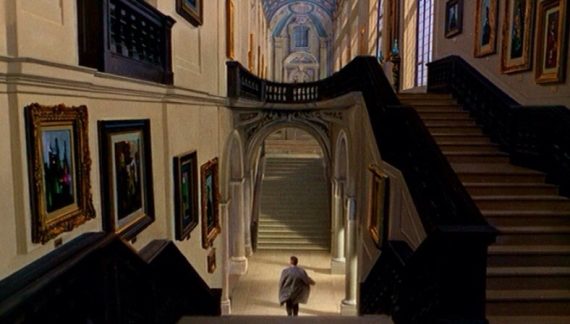
It’s completely taken me aback just how much I loved Torn Curtain. Part of the joy of this Hitchcock quest has been discovering underrated gems and I’ve amassed several of them, with the likes of Waltzes from Vienna, The Paradine Case, Champagne and Mr. and Mrs. Smith appealing to me much more than they do to most. But Torn Curtain takes the biscuit. I’ve placed it at number 7 in my ranking, one place above Psycho. Freaking Psycho, man! Am I crazy? Quite possibly. Am I delighted. Most definitely. Put that Bernard Hermann score back in and who knows what heights this film could’ve scaled!
6. THE LADY VANISHES
For the final film in his famous run of six British thrillers, Hitchcock switched from working with screenwriter Charles Bennett to instead collaborate with British cinema legends Sidney Gilliat and Frank Launder. Gilliat and Launder would go on to write, produce and/or direct some of the great underrated British films of the next three decades, including the likes of Green for Danger, London Belongs to Me, Only Two Can Play and the popular St. Trinians films. Their extraordinary script for The Lady Vanishes established Gilliat and Launder as forces to be reckoned with from an early stage. Its fiendishly clever construction is bolstered by a pervading wit that characterises The Lady Vanishes as the most consistently comedic of the British films. While the likes of The 39 Steps and Young and Innocent made plenty of room for humour, The Lady Vanishes blends comedy, mystery and adventure more successfully, thanks to a diverse set of vivid characters, cracking dialogue and a plot with the propulsive forward motion of the train on which it is set.
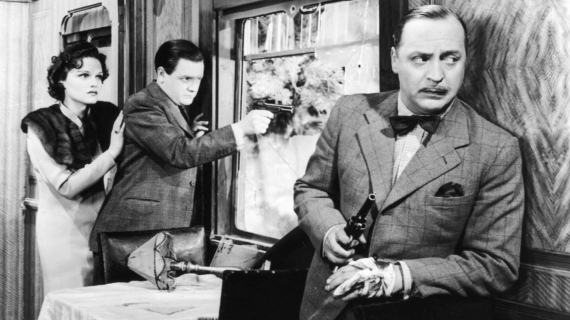
Such strong material could easily be scuppered by the wrong cast or bad direction but fortunately The Lady Vanishes is equally excellent on these fronts. The cast includes Hitchcock’s best leads yet in Margaret Lockwood and Michael Redgrave, both charmingly droll in their many dialogue scenes and physically adept on the occasions when they need to clonk someone over the head with a blunt instrument or tumble into a magician’s magic box. The rest of the cast is peppered with famous British faces, including a small role for Googie Withers, a nicely oily turn as an adulterous lawyer by Cecil Parker and a fabulously engaging performance by May Whitty as the titular disappearing woman. But the film is emphatically stolen by Basil Radford and Naunton Wayne as Charters and Caldicott, a pair of cricket-obsessed Brits desperate to make it home for the test match at any cost. No such characters appear in Ethel Lina White’s source novel The Wheel Spins but these two original creations were so popular with audiences that they went on to appear in several other film and radio productions, both as Charters and Caldicott and, after contractual issues emerged, as very similar characters. The pair came very close to being featured in Carol Reed’s The Third Man, before their characters were instead amalgamated into the character played by Wilfred Hyde White.
Hitchcock’s direction of his superlative cast is equally excellent. The film begins with a lengthy prologue in a crowded hotel filled with last minute guests trapped by an avalanche. Hitchcock introduces his characters through a delightful collection of comic vignettes, ensuring that we know all the key players before they board the train where the main action takes place. Once we’re aboard, the film immediately becomes as intriguing as it is amusing, its mystery laced with ambiguity and a sinister streak that blends beautifully with the comedy. The different motivations of each character help their individual stories naturally coalesce into a satisfying whole, building to a climax that throws all the key players together for an action-packed finale.
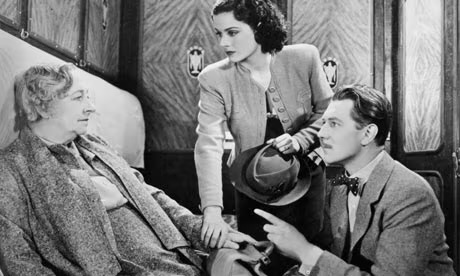
The Lady Vanishes was an immediate hit with audiences and critics, confirming David O. Selznick’s conviction that Hitchcock had what it took to make it in Hollywood. Soon he would be working with bigger budgets and bigger stars but The Lady Vanishes remains up there with his finest works. There are still endearing idiosyncrasies of the British era, such as obvious model shots here and there, but ultimately The Lady Vanishes is as smooth, thrilling and thoroughly classic as anything to come. Hitchcock had grown exponentially in just over a decade as director and it would be this film, rather than the divisive one that immediately followed, that would go down as the culmination of this particular era.
5. STRANGERS ON A TRAIN
As I work my way through the Hitchcock filmography, I’m aware that I have a very high number of his films rated as 5 stars from previous watches and as I get to each one I wonder if I will be downgrading them at all. There are certain films to come with which I’m so familiar that I’m positive that won’t be the case but with others, for which rewatches have been a longer time coming, I go in almost expecting to correct a past overreaction. Strangers on a Train was, for some reason, the latter. I say “for some reason” because it was absolutely terrific.
After a few more experimental films, Strangers on a Train puts Hitchcock firmly back in the fast-paced, suspenseful murder thriller mould with which he was now already widely, if reductively, associated. Despite getting my knickers in a twist whenever someone reviews a Hitchcock film by complaining that it doesn’t exactly fit into this constrictive box, it is admittedly satisfying to see Hitchcock fully invest himself in the genre with which he became synonymous and Strangers on a Train is a key film in cementing that reputation. Based on a novel by Patricia Highsmith, Strangers on a Train has a morbidly alluring premise which has not been dulled by its many imitators over the years. Rising amateur tennis player Guy Haines meets wealthy layabout Bruno Antony on a train and is unwillingly engaged in conversation for the duration of the journey. Amongst Bruno’s invasive questions about Guy’s impending divorce, talk turns to Bruno’s theory of how two strangers who wanted people out of the way could swap murders, thereby killing a complete stranger and avoiding the troublesome matter of motive. Bruno also happens to have a father he would like out of the way and suggests Guy kill him in exchange for Bruno offing Guy’s wife. Thinking he is dealing with an everyday crank rather than a genuine psychopath, Guy humours Bruno. But when Bruno actually goes through with his murder, he begins persistently harassing Guy to fulfil his end of the bargain.
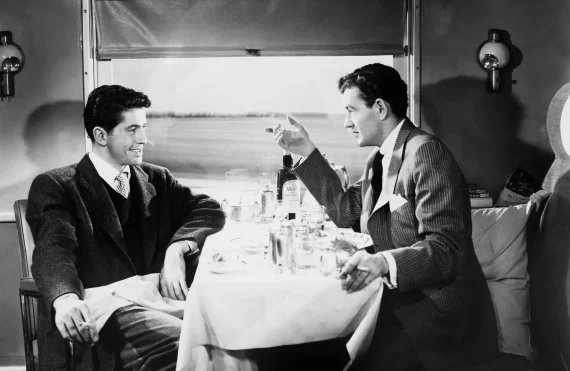
The scene is set for a tense, persistently suspenseful tale and Hitchcock tells it with great wit and imagination. After the humour associated with the director returned in force in the previous year’s Stage Fright, it is gratifying to see it remain prominently in Strangers on a Train. This is not a comedy, as Stage Fright had been, but its sense of fun prevents it becoming the bleak proposition its premise could’ve made it. The cast doesn’t have any huge stars but by using a set of reliable, lesser-known actors, Hitchcock keeps that crucial sense of the everyday front and centre, increasing the impression that anyone could find themselves in this unlikely scenario if they just met the wrong person at the wrong time. Robert Walker is excellent as that wrong person. His Bruno is often compared to John Dall’s similarly dandyish killer in Rope but Walker’s performance is more chillingly restrained. While Dall’s character could barely suppress his naïve glee, Walker is far more frightening in his assured psychopathy. The Rope comparisons were undoubtedly heightened by Farley Granger’s presence as the unfortunate Guy. A reliable leading man, Granger gets to spin out his descent into slowly encroaching terror this time round, in contrast with his rapid and irreversible unpicking in Rope. Perhaps surprisingly, the other standout performance comes from Patricia Hitchcock, Hitchcock’s daughter whom he had cast in a bit part in Stage Fright (perversely sticking her with the unflattering character name Chubby Bannister) but who here makes the most of a full-blown and rather crucial supporting role.
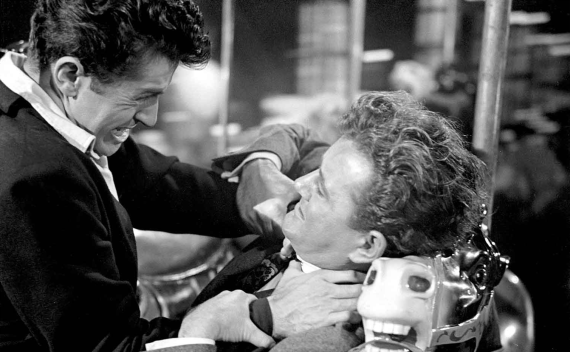
Strangers on a Train has many brilliantly suspenseful set pieces: Bruno’s stalking of Guy’s wife at the fairground; a tense, slow progression through a dark, unfamiliar house for Guy; a time-constrained tennis match intercut with a desperate attempt to retrieve a dropped artefact; a climactic return to the fairground for a fight on an out-of-control merry-go-round. It’s absolutely packed with incident. Hitchcock also drops some virtuoso shots into the mix. Most famous is the distorted reflection of a murder in a discarded pair of glasses, although I’ve always been equally fond of a simpler shot in which the ominous presence of Bruno is highlighted amongst a crowd of tennis fans, simply because he is the only one staring straight forward rather than turning his head from side to side to watch the ball.
Strangers on a Train is such a quintessential piece of Hitchcock brilliance that I’d go so far as to recommend it as the perfect starting point for newcomers to the director’s work. Though still a very famous film, it does tend to get lost amongst the more well-known films that followed, but it’s a brilliant piece of work and shoots straight up to number 5 in my ranking.
4. SHADOW OF A DOUBT
Shadow of a Doubt is perhaps most famous now for being Hitchcock’s favourite amongst his own films but it’s easy to forget that, prior to the latter day reappraisal of Hitchcock’s filmography, it was also his most critically revered work for several decades following its release. Though it is still regarded as a classic, Shadow of a Doubt is now far more rarely screened or discussed than the likes of Vertigo, Psycho or North by Northwest. This is a shame, since Shadow of a Doubt remains one of Hitchcock’s greatest films.
Shadow of a Doubt tells the story of “Uncle Charlie”, a brooding figure who abruptly arrives in the lives of his sister’s family for an indefinite stay in the picturesque Californian town of Santa Rosa. Uncle Charlie is hero-worshipped by his niece Charlie, who was named after him by his equally adoring sister. But Charlie’s impression of her Uncle begins to change in the face of his erratic mood swings, a strange gift and the arrival of two men with a suspicious interest in her family. It’s tempting to see Shadow of a Doubt as a forerunner for David Lynch’s Blue Velvet, with its combination of small town American wholesomeness and deeply sinister secrets (not to mention unsettling psychosexual implications). But Lynch’s film was an exposé of the seedy underbelly of suburbia, whereas Shadow of a Doubt instead shows a seemingly perfect small town corrupted only by the arrival of a presence from the city. The early scenes of run down city locations are deliberately juxtaposed with the idyllic prettiness of Santa Rosa. In Hitchcock’s film, the cancer isn’t always lurking beneath the surface, it’s an interloper from another world. Part of Shadow of a Doubt’s brilliance is in the way Hitchcock differentiates and then meshes these two worlds. The early scenes of the Newton family are almost Capraesque in their corny homespun charm but the arrival of Uncle Charlie brings looming shadows into the sunny California dream, culminating in a gloriously shot mid-film sequence in a library in which the two worlds irreversibly bleed into each other, robbing one character of their innocence forever.
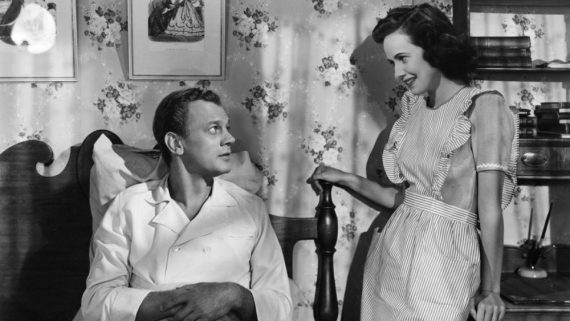
Shadow of a Doubt is one of Hitchcock’s handsomest films, enhanced greatly by excellent location work in Santa Rosa itself, the immersive real town replacing the artifice of some of Hitch’s more studio-bound efforts. This is crucial, as the audience must experience the beauty of the setting in order to appreciate the tragedy of its despoiling, a metaphor for the younger Charlie’s devastating emotional journey. Hitchcock never misses a beat in depicting the sun’s irretrievable disappearance behind a cloud, and yet he also allows us to enjoy the experience of small town simplicity, injecting much humour into the film. Chief asset in this regard is Hume Cronyn, a key Hitchcock collaborator in future projects (and a bona fide late-life star in 80s films like Cocoon and Batteries Not Included). Cronyn plays a socially awkward neighbour whose obsession with the perfect murder greatly amuses the Newton patriarch Henry Travers (Clarence the Angel himself, for those tracking the Capra connections).
The main cast of Shadow of a Doubt is largely excellent. Some may be irritated by the Newton poppets, the precocious Edna May Wonacott and Charles Bates, but Teresa Wright and Joseph Cotten are both terrific as the two Charlies and Patricia Collinge runs the gamut from hilariously dotty to heartbreakingly real as Charlie’s oblivious sister Emma, a routinely underrated performance. Another stand out with regards to the film’s humorous side is Janet Shaw, who’s one brief scene as Charlie’s former classmate Louise proves to be one of the most memorable in the film. Her beyond-deadpan turn reflects the terminal disappointment of a young woman stuck in an endless string of waitressing jobs, reflecting the unspoken downside of the small town existence.
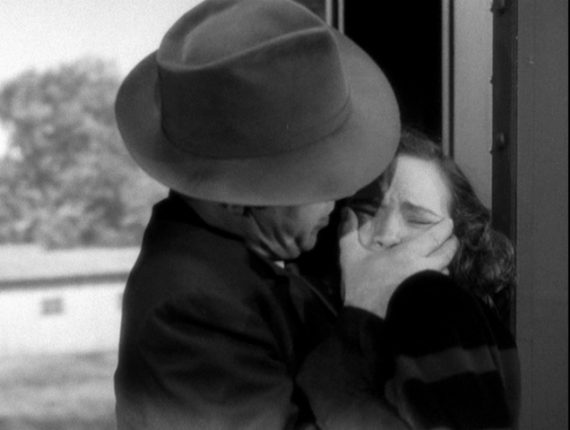
When I first watched Shadow of a Doubt as a teenager I mistook it for a desperately unsubtle film due to Joseph Cotten’s frequent, deeply suspicious outbursts, which I reasoned were not the behaviour of a criminal mastermind. But it’s clear watching it now that Uncle Charlie is not meant to be anything approaching a criminal mastermind. When we first meet him he is already being tailed by the police, lounging around smoking a cigar with money all over his floor. No, Uncle Charlie is something far more terrifying than a mastermind. He’s a sociopath. His hatred of women, with particular scorn for rich widows, cannot be suppressed no matter how suspicious his venomous diatribes make him seem. His other weakness seems to be his genuine affection for his namesake niece, a borderline incestuous relationship which leads him to make ridiculous errors like giving away a deeply incriminating piece of evidence as a gift. But even this seems to be conditional on her total worship of him and when that changes, the pendulum swings violently the other way.
Shadow of a Doubt is not, then, a detective story or an examination of a criminal always one step ahead of the law. We know Uncle Charlie is destined to be caught almost from the off. He’s just too conspicuous, too ruled by his emotions to keep getting away with his crimes. Instead, Shadow of a Doubt emerges as an examination of what effect an individual’s unforgivable acts can potentially have on those who love them and the community of which they are a part. There is plenty of suspense sprinkled throughout but there’s a greater emotional core here than in more superficial films of its kind. A classic.
3. NORTH BY NORTHWEST
Hitchcock ended an incredible 1950s by tying off two of his most famous collaborations: those with James Stewart and Cary Grant. Hitch made 4 films apiece with each actor, with the Stewart films being particularly enduring. Accordingly, their final collaboration Vertigo put a magnificent full stop on their working relationship. The Grant films, meanwhile, had been a bit more of an uneven collection, with the flawed Suspicion and the rather tedious To Catch a Thief failing to stand up to the excellent Notorious (though both films have their champions). But the final Hitchcock/Grant film, North by Northwest, was not only their greatest together but also one of the defining films of the Hitchcock canon. It distils all the best elements of Hitch’s much-loved wrong-man-on-the-run trope to create one of the finest adventure films ever made.
Suspicion aside, the Cary Grant Hitchcock films are all acknowledged as big influences on the James Bond films. Though I can appreciate their appeal, I’ve always found the Bond films to be repetitive bores, largely because I find Bond himself a flat non-character, a bland wish fulfilment fantasy for the sort of unimaginative person you’d least want to get stuck in a lift with. With its numerous thrilling action set pieces, risqué romance and undercover agents, North by Northwest is perhaps the clearest Bond-forerunner yet but it has something those films never had: an interesting lead character. Cary Grant is brilliant as Roger Thornhill, an advertising executive who ends up being mistaken for a non-existent government agent because of a small comic misunderstanding. This tiny coincidence ends up causing him to be pursued across country by villains and police officers when he is also framed for murder in another comically awkward misunderstanding. As you can probably tell from this synopsis, Thornhill is not a cool, laconic hero but a hapless victim who stumbles reluctantly into misadventure. His initial run-ins with the bad guys cause him nothing but humiliation, including a priceless extended sequence in which he is accompanied on his quest by his despairing mother, the scene-stealing Jessie Royce Landis. It is also made immediately clear that Thornhill is not a particularly pleasant man, which makes him a much more unconventional hero as he applies his cynical, biting wit to the numerous terrifying situations in which he finds himself.
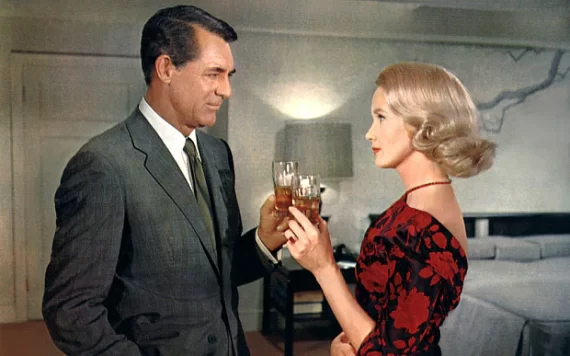
Entrusting screenwriting duties to the great Ernest Lehman was a masterstroke. Lehman, a writer for such classics as Sabrina, Sweet Smell of Success, Who’s Afraid of Virginia Woolf and West Side Story, wanted to write “the ultimate Hitchcock movie” and he pretty much succeeded. Lehman’s screenplay is rich in action, suspense, sex appeal and humour, all characteristics of Hitchcock’s best work. It may slightly lack the substance of, say, a Vertigo but North by Northwest very much places the emphasis on excitement and fun and while it might not go that deep with its characters, it does manage to make them all quite three-dimensional to a satisfying enough degree to grip the audience rather than just superficially thrill them.
I do have a couple of small issues with the script here and there. The scene where the truth is revealed about George Kaplan, the man Thornhill has been mistaken for, is one of the lumpiest pieces of exposition I’ve ever seen, with characters announcing long chunks of information to other characters who clearly already know all the details. The dialogue in the love scenes between Grant and Eva Marie Saint is also extremely ripe. There’s a self-awareness here that makes it more entertaining than the smarmy innuendo of To Catch a Thief but that doesn’t stop my stomach turning at lines like “… and good taste in women. I like your flavour!” And, throwaway gag though it is, I’ve never been fond of the moment where a woman thinks she’s about to be sexually assaulted when Grant cuts through her bedroom, shouts “STOP!” and then, upon seeing him, begs him to come back and finish the job! It’s really a joke about how hot Cary Grant is but it’s still a moment that momentarily places the film squarely in its problematic era.
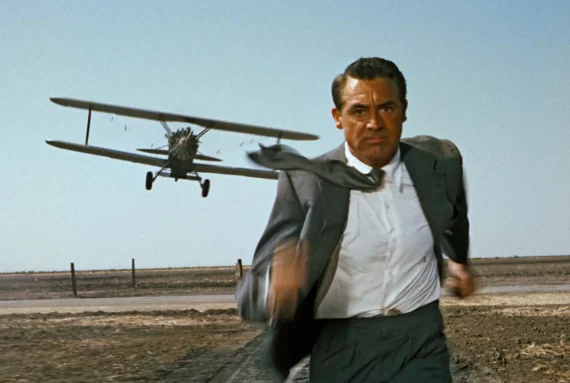
But to be honest I’m reaching for downsides to North by Northwest because overall it’s the sort of film I would call “a perfect night at the movies.” The sort of film you walk out of bursting to talk about with your viewing partners but unsure of which amazing scene to discuss first. Of course, there’s the iconic crop duster sequence which is as brilliant as you’ve probably heard. But there’s also the hilarious auction scene, the drunken car chase, the Mount Rushmore finale, and a million little bits of quotable dialogue to get stuck into. The performances are all top notch too, with Eva Marie Saint’s quintessential icy blonde and Martin Landau’s equally icy henchman Leonard standing out alongside Grant’s enthusiastic lead performance and Landis’s aforementioned cameo.
Placing North by Northwest in my Hitchcock ranking exposes the foolishness of rankings in general. It’s almost impossible to weigh it up against such a different film as Vertigo. I enjoy both films in completely different ways and would reach for them in completely different moods. I’m probably more likely to watch North by Northwest more frequently as its lighter tone is more inviting, yet Vertigo is perhaps a more fulfilling experience overall. Ultimately, North by Northwest’s tiny flaws have caused me to place it below Vertigo but its number 3 placing in a ranking of Hitchcock’s films still makes it clearly one of the great films in all of cinema.
2. VERTIGO
It should come as absolutely no surprise whatsoever to hear that I love Vertigo. I’ve seen it many, many times and it’s still every inch the 5 star classic I’ve always rated it as. Based on the French mystery novel D’entre les morts by Boileau-Narcejac, Vertigo has a fairly preposterous plot when held up to any amount of scrutiny. The trick Hitchcock so artfully pulls off is not only making this not matter but making us actively want to avoid applying such level-headed restrictions. And, preposterous or not, the whole tangled plot is fiendishly clever in its unlikely twists and turns.
Helping to sell this wonderful story, Hitchcock has another fantastic cast at his disposal. Jimmy Stewart is back for a fourth and final collaboration and once again he hits it out of the park. Stewart’s Hitchcock roles are an incredible collection of reluctant heroes and antiheroes and Vertigo’s Scottie is the best of the lot, one of the great antiheroes in cinema history. Beginning as a well-meaning detective who gets out of his depth, Scottie’s eventual shift into a disturbed, obsessed manipulator is an incredible transition and the latter half of the film still sends genuine shivers down my spine, so unexpectedly unpleasant but utterly compelling is it. It’s one of the great Stewart performances in a career chock full of masterful characterisations and it’s hard to imagine many other actors of the era who could’ve created such an indelibly haunting version of Scottie, or even been willing to try.
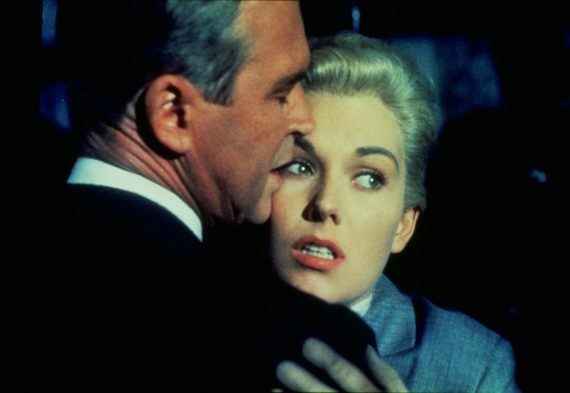
As both the woman with whom Scottie becomes obsessed and the woman who he tries to mould in her image, Kim Novak is every bit as beguilingly mysterious as Madeline needs to be and as appealingly down to earth as Judy needs to be, and is iconically beautiful as both. Completing the trio of knockout central turns is an underrated performance by Barbara Bel Geddes as Midge, Scottie’s trusted pal who longs to be more. Midge has her own issues and capacity for low-key creepiness but Bel Geddes makes her a welcome port in Vertigo’s psychosexual storm. Whenever Midge is onscreen, there’s a sense of a connection to reality that the rest of the film makes us feel we’re losing a grip on.
Hitchcock directs the hell out of Vertigo. The run of films that directly precede it in the Hitchcock catalogue had a comfortable quality, with the likes of The Man Who Knew Too Much and To Catch a Thief feeling solidly directed but comparatively unexciting. Perhaps rejuvenated by the successful experiment of The Wrong Man, Hitchcock turns Vertigo’s already out-there material into something truly otherworldly. The colour palette is both magical and nauseating, as befits the subject matter, and every beat of the twisty tale is hit in a way that ensures the audience never loses sight of the plot even as it takes more and more unexpected turns.
The final thing that cannot go unmentioned when discussing the masterpiece that is Vertigo is its phenomenal score by Bernard Hermann. Wheedling its way under our skins before the first shot has even appeared onscreen, this is justly one of the most revered film scores ever applied to celluloid. Tonally, it is absolutely perfect. Hermann has tapped into the unique feel of Vertigo’s strange story as intuitively as Hitchcock has and, in doing so, he has elevated that atmosphere still further. I must confess to often being guilty of overlooking the undeniable importance of film scores but that is simply impossible in Vertigo’s case.
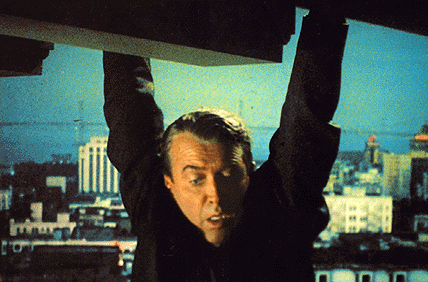
Despite a mixed reception on release, Vertigo is now roundly accepted as one of the greatest films ever made. It’s easy to see why that took a good few decades to register, given how ahead of the curve it feels in so many respects. It’s a film that can be watched again endlessly and still unpicked a little more each time. It’s ended up at number 2 in my current ranking as, masterpiece though it is, my love of Rear Window still puts that film just out of Vertigo’s reach.
1. REAR WINDOW
Part of the pleasure of doing this Chronological Hitchcock rewatch has been in discovering films I’ve never seen and revisiting ones that I’ve only seen once or have largely forgotten. But there’s always pleasure to be had in the familiar too and Rear Window is a film I already knew inside out. I’ve watched it again and again over the years and it’s probably my most viewed Hitchcock film. But that never stops me from loving it as much as I always did.
Although he’d made some fantastic films in the interim, after Spellbound’s multiple Oscar nominations Hitchcock seemed to have been reassessed by mainstream critical thinking of the time. He was no longer the Oscars mainstay he’d been in the 40s, with his films either being ignored completely or getting one nomination here and there, rarely in a major category. To some extent, Rear Window recaptured that Hollywood prestige for Hitch, netting four Oscar nominations including a Best Director nod. Crucially though, it missed out on Best Picture recognition, suggesting that Hitchcock was slowly and snobbishly becoming regarded as a maker of cheap, lurid entertainments for the masses. The Best Picture winner that year was the more-than-deserving On the Waterfront but it’s hard to imagine anyone stepping over Rear Window to get to nominees like Three Coins in a Fountain or The Country Girl. Interestingly, when critical reappraisal eventually did come, it would be this period from Rear Window onwards that became the most discussed and revered in Hitchcock’s filmography.
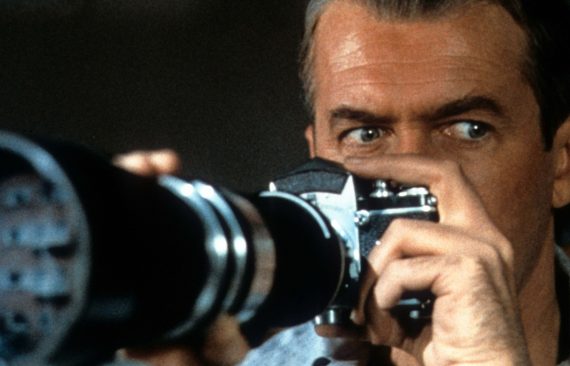
Rear Window is an absolute classic and a film that can easily withstand the endless pastiches and parodies that followed in its wake. There’s much working in Rear Window’s favour from the outset. John Michael Hayes, who would also work with Hitchcock on his next three films, wrote an extraordinary script which combines spine-tingling suspense and romantic drama with an incisive interrogation of contemporary gender roles and a good dollop of humour. Hitchcock has assembled another perfect cast, with James Stewart reliably great as the temporarily wheelchair-bound photographer L.B. Jefferies, a far more unpleasant character than I tend to remember from watch to watch. His slow drift into boredom-induced voyeurism aside, his patronising, tactless, even cruel treatment of his would-be-fiancé is sometimes heartbreaking to watch. This is a character trait rather than a script problem, although with the wrong actor it could’ve become the latter. Stewart’s innate likability is crucial in making Jefferies a flawed but enjoyable hero. Grace Kelly’s Lisa is also perfectly pitched, her wit and strength of character balancing her frustrating devotion to this man who takes her for granted. Kelly is excellent, as well as iconically beautiful, and her growing involvement in Jefferies’ obsession with his neighbours’ activity is convincing and crucial in driving the plot forward. But my favourite among Rear Window’s star turns is that of the inimitable Thelma Ritter, one of my favourite actors of Hollywood’s Golden Age. As Jeff’s nurse Stella, Ritter is deeply lovable and hilarious, providing the viewpoint of another generation with good-natured wit without ever drifting into hoaky, preachy wisdom. That the script involves her so closely in the action is a masterstroke. Ritter was nominated for six Oscars in her career and amazingly none of them were for this, perhaps her most famous role. As witty as the characters she portrayed, Ritter began hosting Come and Watch Me Lose Again Oscar parties after her first few losses. What a dame!
But what makes Rear Window really special is its unique and elaborate set design and Hitchcock’s direction of that set. Officially, Rear Window is the fourth and last of Hitchcock’s “limited-setting” films, in which the action is confined to one small space. In this case, that space is Jeff’s small apartment but from that limited space, Jeff and the audience can see a whole plethora of other small spaces through the windows of the adjacent apartment building. These multiple limited spaces build up into a microcosmic world, with numerous characters and stories, both humorous and sad, coexisting, supplementing and overlapping with the main narrative of the possibly murderous salesman living among them. Hitchcock’s camera roams this incredible set with the idle interest characteristic of owners of the recently invented TV remote, switching channels until one captures their interest. There are long silent passages of Rear Window in which the viewer is implicated in Jeff’s voyeurism, only cutting away from his viewpoint to remind us of his presence and allow us to compare our reactions with his. It’s a monumentally effective technique which draws the viewer in completely as they get lost in the act of looking.
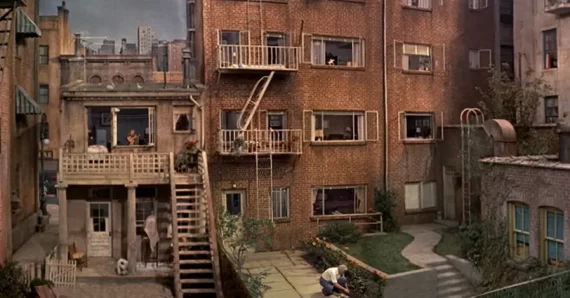
Ironically for a film in which the hero has a broken leg, Rear Window barely puts a foot wrong. From its innovative design to its wonderful script, its glorious cast to its brilliant direction, its exquisite cinematography to its clever use of diegetic sound, it’s an almost perfect creation.