


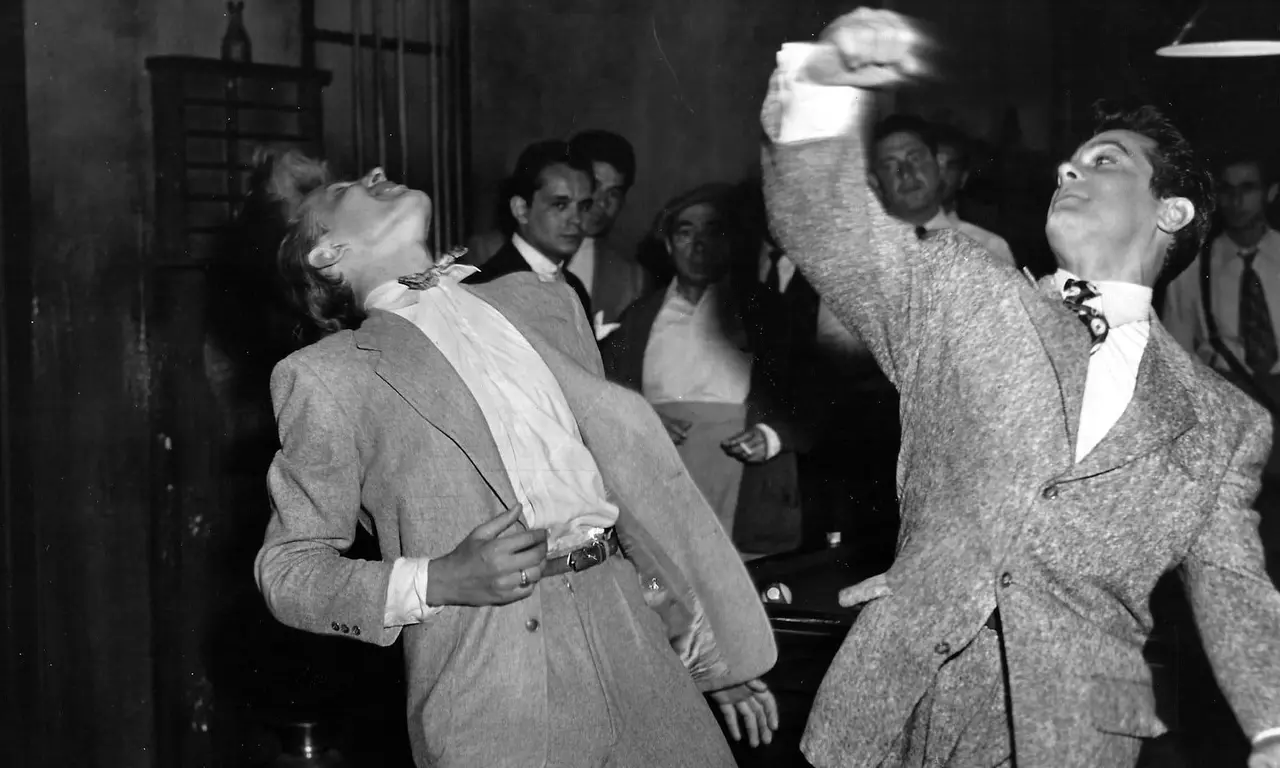
 Film Noir is one of the most exciting genres for the cineaste who thinks they’ve seen it all. There seems to be an endless supply of these fascinating films and the hit rate is surprisingly high. A low budget and rough edges frequently only enhance their appeal, which means the dark, forgotten corners that often house below-par efforts in other genres are frequently home to hidden gems in the world of Noir. Whenever a new set of Noir films is released, I always go in confident that I’ll find at least one great example of the genre and this new Arrow boxset does not disappoint in that respect, with two very fine films nestling amongst two efforts that, if hardly exemplary, should still please the average Noir lover across their refreshingly brief runtimes.
The Suspect
 Director: Richard Siodmak
Screenplay: Bertram Milhauser, Arthur T. Horman
Based on the novel by: James Ronald
Producers: Islin Auster
Starring: Charles Laughton, Ella Raines, Dean Harens
Year: 1944
Country: USA
BBFC Certification: PG
Duration: 85 mins
Robert Siodmak might not be a household name but to Noir fans his credit in the opening titles is a cause for celebration. Other Noirs directed by Siodmak include The Killers, Criss Cross and Cry of the City, a list of stellar efforts to which I can now add The Suspect. Although it is set in Edwardian London amongst a stuffier set of characters than the phrase “Noir” typically conjures in the mind, there is plenty to distinguish The Suspect as a fine example of the genre. Noir is one of the most hotly debated genres when it comes to what films should and shouldn’t be classed as such, but from its fatalistic tone and chilling sense of inevitability to Siodmak’s sparing, effective use of shadows and a looming sense of ambiguous morality, this felt unquestionably like classic Noir to me. That said, there’s a slightly more reserved quality to The Suspect that differentiates it from its contemporaries. At first this feels like a flaw but as the pacing reveals itself as a deliberate stylistic choice rather than an error of judgment, The Suspect weaves its unique spell, with Siodmak’s cerebral approach and Charles Laughton’s restrained but edgy lead performance overcoming some instances of clunky dialogue (I’m pretty sure “I know you like a book” is a clumsy combination of two different phrases).
Laughton was frequently identified with performances of outsize proportions such as Captain Bligh in Mutiny on the Bounty, Sir Humphrey Pengallan in Jamaica Inn or his Oscar-winning take on the titular king in The Private Life of Henry VIII. But in The Suspect, Laughton is notably subdued and fiendishly subtle as Philip Marshall, a kind-hearted shop manager who’s bullying wife and burgeoning love for a young stenographer push him to consider desperate deeds. The love story between Philip and Mary Gray, played by Ella Raines who was 21 years Laughton’s junior, is often cited as lacking credibility but that is only the case if you subscribe to the most shallow notions of intimacy and attraction. The film even includes a convincing scene in which the vulnerable Mary explains her attraction to Philip, in a way that likely once played as sweet but now seems like an astute examination of questionable power dynamics. It’s rare to find films so seamlessly accommodating shifting ideologies across decades, but the sly way in which Laughton’s early scenes with Raines combine sincerity and a lascivious undercurrent betrays the fact that this accommodation was not a complete accident.

The Suspect isn’t always as subtle as its central performance. It could’ve been even more fascinating with a little more grey area in the relationship between Philip and his wife Cora, played with shrieking stabs of hysteria by Rosalind Ivan. Ivan had played a similar nagging wife character in the more famous Scarlet Street, knowledge of which diminishes the impact of this performance while simultaneously highlighting certain misogynistic tendencies of the genre. But such cinematic shorthand does allow The Suspect to easily maintain its concise runtime, which compliments its deliberate pacing beautifully. The ending sees a simple but clever twist complimented by an understated moment of quiet dignity that closes the film with the merest smattering of ambiguity befitting of the moral complexity for which The Suspect aims. With just a little more nuance and ambition, the film could’ve been a classic but I kind of like it the way it is, combining its rough edges with a polished gentility that makes it a very British kind of Noir and another hidden gem in a genre that seems to be overflowing with them.


The Sleeping City
 Director: George Sherman
Screenplay: Jo Eisinger
Producers: Leonard Goldstein
Starring: Richard Conte, Coleen Gray
Year: 1950
Country: USA
BBFC Certification: PG
Duration: 86 mins
Amongst the numerous “city” Noirs – Night and the City, Cry of the City, The Naked City – The Sleeping City feels like a minor entry in the unofficial series. This is partly because those other films justified their titles by creating a sense of an imposing metropolis so strong that it was practically the main character. The Sleeping City looks set to follow suit initially but then quickly confines itself within the walls of Bellevue Hospital instead. One of the film’s most notable achievements is its location shooting, which took place in the real New York hospital and gives the film an impressive look that many low-budget Noirs struggle to match. Unfortunately, it also necessitated the addition of an odd prologue in which actor Richard Conte breaks character and the fourth wall to inform us that the story is fictional and that the real Bellevue is a virtuous and wonderful place. You can understand why New York Mayor William O’Dwyer was so insistent that the sleazy goings on in the fictional Bellevue were differentiated from the real hospital but the overly-reverential tone of this introduction does rather knock the film off its axis from the outset. It’s hard to reconcile the two tones and there’s an awkwardness to the early scenes that is magnified by the false start.
The Sleeping City actually has a very good script by Jo Eisinger, the writer of previous Noir staples Gilda and Night and the City. The story is grim and uncompromising, with some strong narrative twists, interesting characters and lots of authentic, hardbitten dialogue. Where the film falls down is in its casting and direction. Conte is good as the undercover detective posing as an intern and Coleen Gray is also convincing as the nurse who catches his eye in both a professional and personal sense. But the supporting actors around the two leads really let the side down. The early scenes with John Alexander as the chief investigator on the case feel desperately forced, with everyone struggling to make the slang terms they clearly don’t understand sound like they’re coming out of their mouths naturally. The effect is a good screenplay that sounds like it’s being recited at a first-time table read. At the other end of the scale, we have Richard Taber as Pop Ware, a hospital maintenance man who (mild spoiler) is clearly the villain of the piece from the moment he arrives. He does not have a moustache, but if he did you can bet it would be twirled relentlessly. Taber seems to be trying to make the most of this opportunity to play a major role but he drifts too far into pantomime. He is quite entertaining to watch but I felt myself yearning harder for someone to nail the role, instead of nailing it to our faces.

Director George Sherman turned out scores of B-pictures across his career, few of which are discussed much anymore. Though I have seen very little of his work, The Sleeping City feels like an example of a decent B-movie director attempting something slightly more ambitious but being unable to break free of his well-rehearsed mediocrity. Though it is entertaining enough and will likely keep the average Noir fan happy for just shy of 90 minutes, The Sleeping City is also frustrating because you keep wondering what a better director and cast could’ve done with its strong screenplay and unusually high level of access to an interesting location.
Thunder on the Hill
 Director: Douglas Sirk
Screenplay: Oscar Saul, Andrew Solt
Based on the play by: Charlotte Hastings
Producers: Michael Kraike
Starring: Claudette Colbert, Ann Blyth
Year: 1951
Country: USA
BBFC Certification: PG
Duration: 84 mins
While Douglas Sirk is a director who would later become synonymous with lushly mounted Melodrama, his career is more varied than the critical focus on those final seven years or so would suggest. Sirk had made a few Noirs before this one but Thunder on the Hill arrived during a period when he was mainly making light comedies and musicals. With its stormy backdrop and ominous themes of murder and imminent execution, Thunder on the Hill has links to Noir but it feels more like a Mystery with hints of the Melodramas that would soon ensure Sirk’s place in the history books. With its religious leanings, which include a heroine who is a crime-solving nun, the sense of hope is stronger than in most classic Noir, although the inevitability of someone being carted off to the gallows does bring a certain Noirish fatalism to proceedings.

Whether Noir or not, Thunder on the Hill is at the very least a great little film. It has strong credentials, with Sirk’s name on the credits being joined by screenwriters Oscar Saul, fresh from his work on the screen adaptation of A Streetcar Named Desire, and Andrew Solt, who had just written Nicholas Ray’s exceptional Noir In a Lonely Place. Cinematographer William H. Daniels had also recently cemented his place in Noir history with an Oscar win for his seminal work on The Naked City. With star names Claudette Colbert and Ann Blyth heading up the cast list, Thunder on the Hill has the air of a small A-picture rather than the grubbier B-movie vibe of much Noir. This is to both its credit and its detriment, as Noir fans like myself often thrive on that down-and-dirty energy. But if Thunder on the Hill lacks a bit of edge, it makes up for it in charm.
Thunder on the Hill tells the story of a Norfolk convent which finds itself host to convicted murderer Valerie Carns and her escorts when severe flooding forces them off course on the way to her execution. Sister Mary, the nurse in charge of the convent’s hospital ward, begins to suspect Valerie may be innocent and, against the wishes of the police sergeant and her own Mother Superior, launches an amateur investigation into the case. There’s an endearing Nancy Drew-like quality to Sister Mary’s escapades and a nice vein of humour as she enlists the help of a fellow nun in her sleuthing. But Sirk never lets us forget that the stakes are extremely high and the raging storm acts as an effective ticking clock, since once the rain stops we know time will be short. The storm and the flooding it has caused also act as an obstacle, largely confining everyone to the convent and forcing Sister Mary to use the resources at her disposal.

Though they could’ve gone down a Whodunnit path, the makers of Thunder on the Hill recognise that the thrills aren’t in hiding the killer’s identity but in ramping up the tension as time drizzles away like the rain on the windows. Claudette Colbert is very good in a meaty, unglamorous role, and her ability to convincingly convey intense emotions on cue makes her the perfect lead for Sirk’s brand of sincerity. For all the latter day claims about Sirk being a satirist of saccharine celluloid, I’ve always thought his films seemed genuine, if not necessarily unaware of their blatant manipulations, and this makes them work all the better for me. Thunder on the Hill demands a level of emotional investment and between them Colbert and Sirk ensure it. Consequently, a potentially hokey little tale of mystery and morality becomes compelling and delightful. You won’t find the grimmest jettisons from Noir’s cigarette butt here but as a Noir-adjacent mini-adventure, Thunder on the Hill provides the perfect palate cleanser at this point in the boxset.
Six Bridges to Cross
 Director: Joseph Pevney
Screenplay: Sydney Boehm
Based on the story by: Joseph F. Dineen
Producers: Aaron Rosenberg
Starring: Tony Curtis, George Nader, Julie Adams
Year: 1955
Country: USA
BBFC Certification: PG
Duration: 96 mins
Opening with an out-of-place title song by Sammy Davis Jr., Six Bridges to Cross is, for my money, the least Noirish film in this set. Though it follows the sometimes violent life of a criminal, the tone here is that of a sentimental morality play, with the focus on the troubled friendship between Tony Curtis’s charismatic habitual crook Jerry Florea and George Nader’s cop Edward Gallagher. The tug of war for Jerry’s soul is reminiscent of the much better Angels with Dirty Faces, but the glorification of law enforcement is at the expense of the light and shade that characterises the best Noirs and Curtis and Nader are no James Cagney and Pat O’Brien. The fact that their chemistry as supposed lifelong friends never quite ignites is as detrimental to the film as a mismatched romance is to a Rom-Com.

Despite, or sometimes because of, its predictability, Six Bridges to Cross manages to entertain through the efficient way it hits all the expected beats. It’s not at all that Six Bridges to Cross is a bad film. Writer Sydney Boehm, who also wrote one of the greatest Noirs in The Big Heat, has turned in a pretty decent screenplay but it hasn’t connected with a director or actors who can get the most out of it. I’ve never been much of a Tony Curtis fan (his astonishingly good performance in Sweet Smell of Success aside) but he sinks his teeth into this part with an enthusiasm which is always entertaining, if sometimes too overwhelming. By contrast, Nader is a little too stiff in a pivotal role that demands a more emotional performance. The differences between the two men are key but the performance styles are so polarised that there is no locating that common ground that keeps them together. Ultimately, this makes an already unlikely, though somewhat inevitable, conclusion even harder to swallow.
Four Film Noir Classics Vol 2 is released on limited edition Blu-ray by Arrow Video on 20 March 2023.
LIMITED EDITION CONTENTS
-High Definition (1080p) Blu-ray presentations of all four films
-Original lossless mono audio on all films
-Optional English subtitles for the deaf and hard of hearing on all films
-Audio commentaries by leading scholars and critics Farran Smith-Nehme (The Suspect), Imogen Sara Smith (The Sleeping City), Josh Nelson (Thunder on the Hill) and Samm Deighan (Six Bridges to Cross)
-It Had to be Done, author and scholar Alan K. Rode takes a detailed look at the life and work of Robert Siodmak director of The Suspect and other classic noirs
-The Real Deal, a visual essay by author and critic Alexandra Heller-Nicholas looking at realism and reality in The Sleeping City
-José Arroyo on Thunder on the Hill, a new appreciation by the esteemed film scholar and critic
-Style and Place, a new visual essay by film critic Jon Towlson examining the work of celebrated cinematographer William H. Daniels
-Vintage radio play versions of The Suspect and Thunder on the Hill starring Charles Laughton, Ella Raines, Claudette Colbert and Barbara Rush
-Theatrical Trailers
-Poster and stills galleries
-Reversible sleeves featuring original and newly commissioned artwork by Scott Saslow
-Double-sided fold-out posters for each film featuring original and newly commissioned artwork by Scott Saslow
-Hardback collector’s book featuring new writing on the films by film critics Kat Ellinger, Philip Kemp and Jon Towlson [Limited Edition Exclusive]