



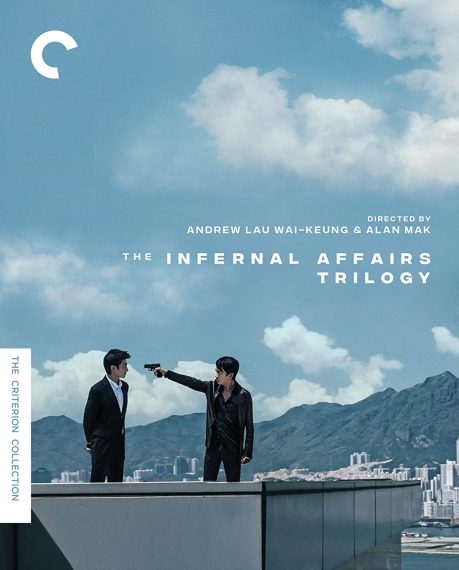
 Director: Andrew Lau, Alan Mak
Screenplay: Felix Chong, Alan Mak
Starring: Andy Lau, Tony Leung, Anthony Wong, Eric Tsang, Leon Lai, Francis Ng, Chen Daoming, Edison Chen, Shawn Yue, Chapman To, Kelly Chen, Sammi Cheng, Carina Lau, Hu Jun, Gordon Lam, Liu Kaichi, Berg Ng, Wan Chikeung
Country: Hong Kong
Running Time: 338 minutes (101m/119m/118m)
Year: 2002-2003
Infernal Affairs is a perfect miracle of a film. The finest post-Heat thriller to date and if anything, a more human and emotional film than Michael Mann’s. In any case, the first police operation where the moles (Andy Lau and Tony Leung) learn that they have an opposite, is as tense as anything in the genre.
Martin Scorcese re-made the story as The Departed. Had he seen the original? Doesn’t matter, it’s a fine film and quite different, dripping with Catholic angst and leaning into gangster trappings more than police procedural. Infernal Affairs is the tighter production, full of character and sparky dialogue.
Andrew Lau and Alan Mak’s direction is extraordinary and they continue to sell the story even when some plot points stretch credibility. The key is in the phenomenal cast, small moments of indulgence (an early scene in a music story is wonderful and will echo throughout the trilogy) and an undercurrent of morality, as each man wrestles with his fate.

The ambitious Infernal Affairs II continues the vein of confidence from the first film and, importantly, the tone has shifted. It has an air of Godfather II. The nature of time becomes an element; rather than a gimmick, dialling backwards to unpick the history of the characters against the backdrop of the Hong Kong handover is integral to the story and informs what we already know. Plus, it’s an excuse for more Eric Tsang (Sam) and Anthony Wong (SP Wong), who are fabulous in every scene, especially those they share. Again, the cast, direction and writing keep the story grounded and emotional even as it continues to push plausibility into affairs truly of the infernal kind. If it lacks the ice cool aesthetic of the first film, it is still never less than enthralling.
Part III is the most challenging Infernal Affairs, choosing to narrow the scope. If the first film was concerned with morals, the second with time, this is focusing on the perception of reality, especially that of Inspector Lau’s. The story has always been happy to play with weighty themes, like a Buddhist Dante, but it was always fun too. Part III can be more intense, though flashbacks and dream sequences open up the relationships of characters from the earlier films too. In the end, Part III adopts a slight story, nevertheless one that adds value and closure.
The Infernal Affairs trilogy is an incredible achievement that simply underlined how versatile, important and downright fun Hong Kong films can be.

VIDEO
On one hand, UHD would seem like an obvious choice for Infernal Affairs, it’s such a crisp and bright film. Nevertheless, this is an excellent transfer and we shoukdn’t be complacent about Blu-ray. The photography is great; fast but not frenetic, close and tight with a lovely depth of field that the DVD masked. Quality shifts occasionally across the three films, but it always feels tangible, even in the most innocuous scenes.
AUDIO
The audio has character, much like the video. Some dialogue can seem to shift, almost to be indistinct. It could be an aesthetic choice but in any case, subtitles do help. Again, across all three films, it’s an improvement on the DVD.
EXTRA FEATURES
Infernal Affairs has the best set of extra features, though the alternate ending, while a curiosity, is very long. The new conversation with the directors is great and while the Behind The Scenes b-roll is fascinating, the lack of context or editorial can make it drag. Still, only in Hong Kong can you see film crews so positive (they even bless the film before they start), so much so there is even footage of Andy Lau and Tony Leung singing the theme.
Parts 2 and 3 continue the theme, though the deleted scenes and bloopers are fun. Throughout, the commentary is worth listening too, though if you need the subtitles, it can get confusing.
This is overall a fine release from Criterion and a fantastic opportunity to revisit one the best modern trilogies.